Starting July 1, 2026, Medicare will cover Wegovy, Zepbound and Foundayo for obesity at a $50 monthly copay. The program is real, it’s called the Medicare GLP-1 Bridge, and it runs through December 31, 2027.
I’m lucky — my employer’s insurance covers Zepbound, and I’ve been on it long enough to learn the system the hard way. Prior authorizations, comorbidity documentation, baseline bloodwork, the paperwork dance between the pharmacy and the insurer — none of it was obvious going in. Coverage rules vary wildly from one private plan to the next. What works for me through my employer’s plan isn’t going to be the same as what your wife has through her job or what a friend pulled together through the marketplace.
Medicare is different. As of February 2026, 56 million Americans are enrolled in Medicare Part D or a Medicare Advantage plan with drug coverage — roughly 8 in 10 Medicare beneficiaries. Of those, an estimated 10 million-plus have obesity that could qualify under the new rules. This is the biggest single expansion of GLP-1 access we’ve seen, running on one national framework instead of a thousand different formularies.
If you, your spouse, or your parents are on Medicare and want in, the next eight weeks matter. Most denials at launch are going to come down to documentation that wasn’t in the chart on time. Here’s how the Medicare GLP-1 Bridge works, who qualifies, and what to get done before the window opens.
What Is the Medicare GLP-1 Bridge?
The Medicare GLP-1 Bridge is a temporary CMS demonstration program that lets eligible Medicare beneficiaries get certain GLP-1 medications for obesity at a flat $50 monthly copay. It runs from July 1, 2026 through December 31, 2027.
The Bridge exists because federal law has historically prohibited Medicare from covering drugs used solely for weight loss. CMS used its demonstration authority to create a workaround. In November 2025, the administration cut a deal with Eli Lilly and Novo Nordisk to drop the price Medicare pays to $245 a month. The government covers the gap between that and your $50 copay.
Worth saying clearly: the drugs aren’t $50. Your copay is.
Which Drugs Are Covered Under the Medicare GLP-1 Bridge
The Bridge covers three FDA-approved GLP-1 medications for obesity, but the formulation details matter:
- Wegovy (semaglutide) — both the injectable and the oral tablet are covered
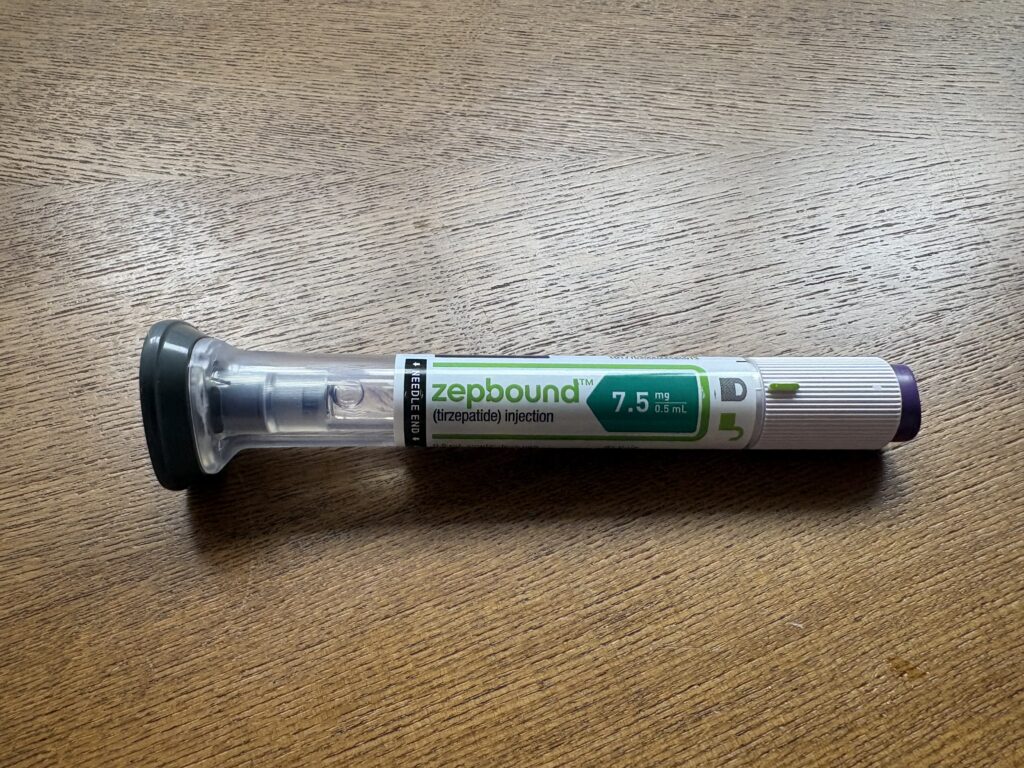
- Zepbound (tirzepatide) — only the KwikPenformulation. The single-dose vials and single-dose pens, including the cheaper vials available through LillyDirect, are not covered under the Bridge
- Foundayo (orforglipron) — Eli Lilly’s daily oral GLP-1 pill, FDA-approved in April 2026. All formulations are covered
If you’re currently on Zepbound vials through LillyDirect or any other direct-pay channel, you’ll need to talk to your prescriber about switching to the KwikPen formulation before July 1 to get the $50 copay through Medicare. Same drug, same dose, same active ingredient — the Bridge just only reimburses for the KwikPen device.
Compounded semaglutide and tirzepatide are not covered.
Who Qualifies for the Medicare GLP-1 Bridge
You qualify if you meet one of these three clinical pathways:
- BMI of 35 or higher, no other conditions required
- BMI of 30 or higher, plus one of: heart failure with preserved ejection fraction, uncontrolled hypertension (>140/90 despite concurrent treatment with two antihypertensive medications), or chronic kidney disease stage 3a or above
- BMI of 27 or higher, plus one of: pre-diabetes (per ADA guidelines), prior heart attack, prior stroke, or symptomatic peripheral artery disease
You also need to be enrolled in a Medicare Part D plan or a Medicare Advantage plan with drug coverage (MA-PD). Original Medicare alone — Parts A and B without a drug plan — doesn’t qualify.
One requirement most coverage skips: the prescription has to be paired with structured nutrition and physical activity — lifestyle modification consistent with the FDA label. That’s part of the prior authorization attestation, not a separate hoop, but your provider has to document it in the chart.
If you’re already getting a GLP-1 through Part D for diabetes, sleep apnea, or cardiovascular risk reduction, that coverage continues unchanged. The Bridge is specifically for the obesity indication.
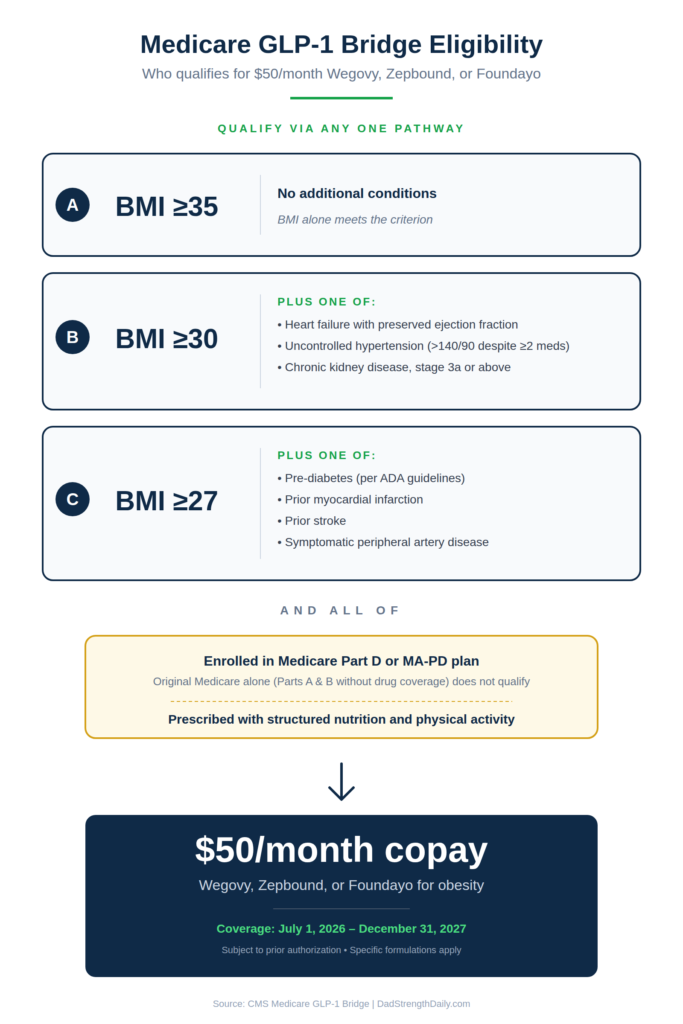
Source: CMS Medicare GLP-1 Bridge official eligibility criteria.
Prior Authorization Checklist: What to Document Before July 1
Prior authorization is the gatekeeper. Get this done in May or early June so the PA goes through cleanly the first week of July.
Ask your prescriber to put the following in the chart:
- BMI measurement at the time of GLP-1 initiation — height and weight measured in clinic, not self-reported
- The qualifying diagnosis for your pathway:
- BMI ≥35: no additional diagnosis needed
- BMI ≥30: HFpEF, uncontrolled hypertension (with documentation of >140/90 despite two antihypertensives), or CKD stage 3a or higher
- BMI ≥27: pre-diabetes per ADA guidelines, prior MI, prior stroke, or symptomatic peripheral artery disease
- The right ICD-10 codes — E66.01 (morbid obesity due to excess calories) for the obesity diagnosis, plus the comorbidity coded separately (e.g., I50.30 for HFpEF, N18.31 for CKD 3a, R73.03 for prediabetes)
- A structured nutrition and physical activity plan — CMS requires the prescription be paired with lifestyle modification consistent with the FDA label. A note from your provider documenting dietary counseling and an exercise plan satisfies this.
- A medical necessity statement from the prescriber tying the medication to obesity treatment
If you don’t have a primary care doc who’s familiar with GLP-1 prior auths, this is the time to find one. Obesity medicine specialists know exactly what CMS will want in the chart.
The Fine Print on the Medicare GLP-1 Bridge
A few things to know before you plan around this:
The $50 doesn’t count toward your Part D out-of-pocket max. The Bridge operates outside the standard Part D benefit. If you’re trying to hit your annual cap on other prescriptions, this won’t help you get there.
Low-Income Subsidy cost-sharing doesn’t apply. If you’d normally qualify for $0 or reduced copays through Extra Help, you’re still paying $50 here. That’s a quiet gotcha for fixed-income beneficiaries.
It’s temporary. The Bridge runs through December 2027. CMS originally planned to fold this into permanent Part D coverage through the BALANCE model in 2027, but that was delayed in April. So the long-term picture past 2027 is unsettled.
The “$1,300 down to $50” framing skips a step. Manufacturers dropped the Medicare price to $245 a month, and the government covers the gap.
What to Do Before July 1
If you’re already at a clinic that prescribes GLP-1s, message them and ask what they need for a Bridge prior auth. If you’re not, book a visit with your PCP or an obesity medicine doc for late May.
Get the bloodwork done. Get the BMI in the chart. Get the comorbidities documented. Get the lifestyle modification plan on paper. If you’re currently on Zepbound vials through LillyDirect or any direct-pay channel, talk to your prescriber about switching to the KwikPen formulation now — only KwikPen qualifies for the Bridge.
Frequently Asked Questions
Does Ozempic qualify under the Medicare GLP-1 Bridge?
No. The Bridge covers Wegovy (injection and tablets), Zepbound (KwikPen formulation only), and Foundayo — the GLP-1s with FDA approval for obesity. Ozempic remains under standard Part D coverage for type 2 diabetes, as it has been.
Are all formulations of Zepbound covered?
No. Only the KwikPen formulation of Zepbound qualifies for the Bridge. The single-dose vials and single-dose pens — including the cheaper vials many patients have been buying through LillyDirect — are explicitly excluded. If you want the $50 Medicare copay, your prescription needs to be written for the KwikPen.
What is Foundayo?
Foundayo (orforglipron) is Eli Lilly’s once-daily oral GLP-1 pill for obesity, FDA-approved in April 2026. It’s the first oral GLP-1 that can be taken any time of day without food or water restrictions (unlike the oral version of Wegovy, which has to be taken first thing in the morning on an empty stomach). Phase 3 trials showed about 12% body weight reduction at the highest dose — less than the injectables but a meaningful option for people who don’t want to inject.
Can I qualify if I’m under 65?
Only if you already qualify for Medicare on disability or another basis, and you’re at least 18. The Bridge follows standard Medicare eligibility — it doesn’t expand who’s on Medicare.
What happens after December 2027?
CMS plans to transition Bridge enrollees to the BALANCE model in Part D, which would make GLP-1 obesity coverage a permanent benefit. That transition was originally set for 2027 but got delayed. Long-term coverage past 2027 is still being worked out.
Does the Bridge cover compounded semaglutide or tirzepatide?
No. Only the FDA-approved branded formulations listed above are covered.
Can I get coverage through the Bridge if Wegovy or Zepbound is already on my Part D formulary for another condition?
If you’re prescribed it for a use covered under standard Part D (like cardiovascular risk reduction with Wegovy or sleep apnea with Zepbound), that goes through your Part D plan, not the Bridge. The Bridge only covers prescriptions written for the obesity indication.