
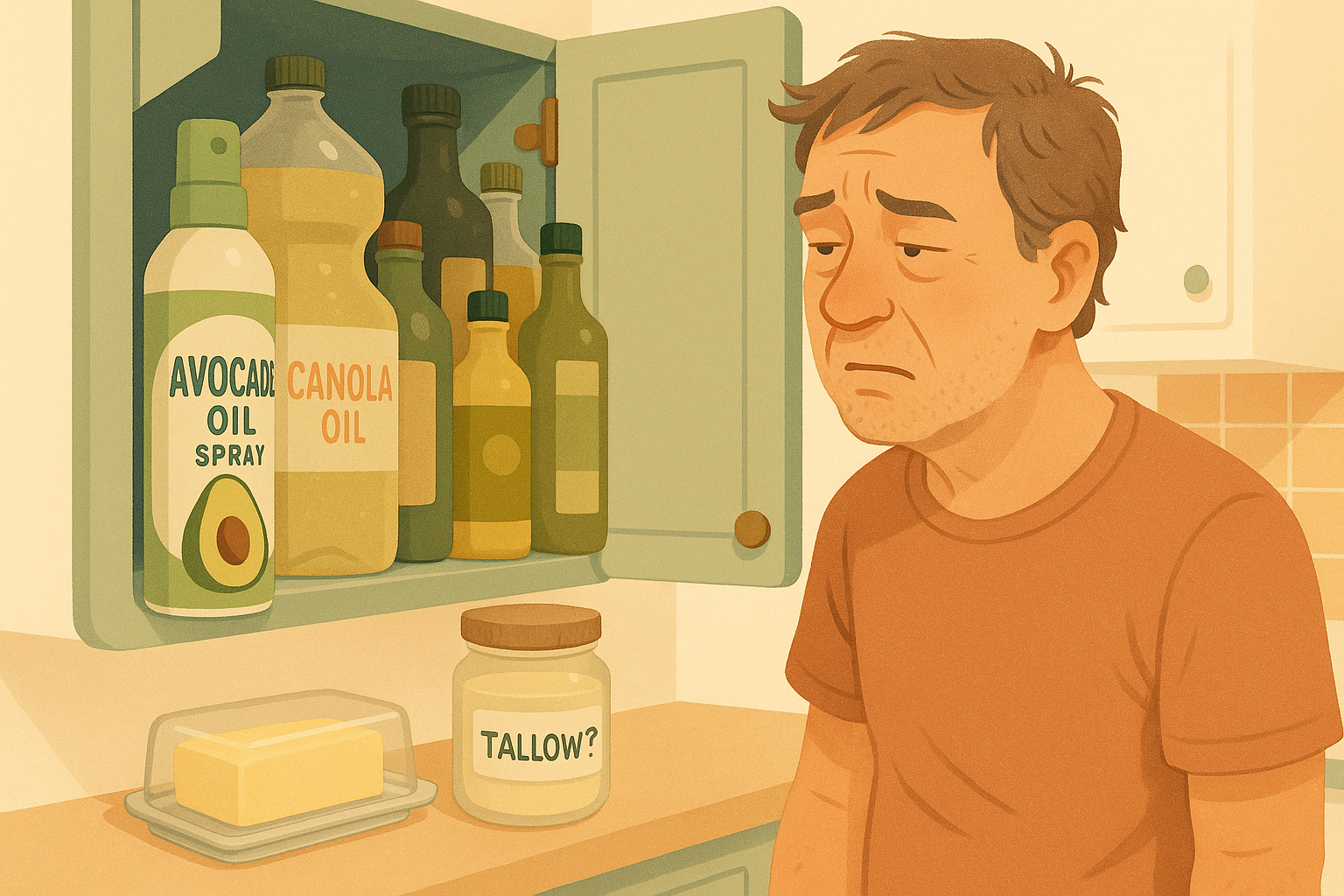
My kitchen, briefly
Get the next one in your inbox
I write about longevity, training, and preventive health weekly — without the guru worship. Free, no spam, unsubscribe whenever.
I have an avocado oil spray bottle. I have a wife who likes real butter on hot bagels. I have a vague mental model that olive oil is good and seed oils are bad, but I do not really like the taste of olive oil. I haven’t touched my canola oil in three months and I am not sure whether to use it up or pour it down the drain in penance.
I have heard the word “tallow” more times in the past six months than in the previous forty-nine years combined. I do not know what tallow is, exactly. I’m pretty sure it comes from a cow.
This is the position of a lot of fifty-year-old American men with a kitchen, and it has been quietly tolerated by their doctor’s office for at least a decade. We have been here before. There was a brief period in the late 1990s where we all agreed margarine was the answer, until we discovered it was full of trans fats and possibly worse than what it replaced. There was a longer period in the 2010s where coconut oil was a superfood, until it turned out to be just saturated fat with better marketing. Now Robert F. Kennedy Jr. is rebranding beef fat as the cure for cardiovascular disease and Lay’s is changing what oil they fry potato chips in. I am genuinely losing track.
If you grew up in the 1970s or 1980s, the dietary advice was: eat less fat. By the 1990s, we were supposed to replace butter with margarine. In the 2000s, that flipped. Trans fats were the new poison. Switch back to butter. Maybe try the Mediterranean diet. If you spent any time on a wellness podcast in the 2010s, you got keto, bulletproof coffee, MCT oil. Now we are supposed to fry our food in beef fat like our great-great-grandfathers.
I have been keeping score. The score is: I am supposed to be eating a fat that is not seed oils, not animal fat, not margarine, not coconut oil, not extra virgin olive oil if it tastes too peppery, but probably olive oil except when it isn’t. Avocado oil is fine. Tallow apparently. Butter sometimes. We should also worry about the omega-6 to omega-3 ratio. The score is that I have no idea what is going on.
So I did what any reasonable person who is also a science blogger does. I went and read the actual research.
The piece that finally pulled me in was a STAT News opinion by a clinical dietitian in Minneapolis named Cole Hanson, who works on a cardiac inpatient floor and watches his patients optimize their diets based on what RFK Jr. said on a podcast. His piece is the cleanest summary of the actual evidence on dietary fat I have seen anywhere. So I read it. Then I read the studies he cites. Then I read the studies those studies cite. I know what tallow is now. I’ve revised my position on the avocado oil spray. And my wife can keep her butter.
The boring answer is somehow harder to find than it should be
One number keeps smacking me in the face, and I almost never hear it on podcasts.
In 2020, the Cochrane Collaboration published a systematic review by Lee Hooper and colleagues. They combined fifteen randomized trials with about 59,000 people, asking what happens when people replace saturated fat in their diet with polyunsaturated fat (the stuff in seed oils and fatty fish).
Heart attacks and strokes dropped about 21%. That’s roughly the statin ballpark.
The fats currently being demonized as the source of American chronic disease are the same fats that, in pooled randomized trials totaling nearly 60,000 people, reduced cardiovascular events by an amount that would impress a cardiologist. We do not tell statin patients to stop their medication because of something they heard on a podcast. We are telling them to stop using canola oil for exactly that reason.
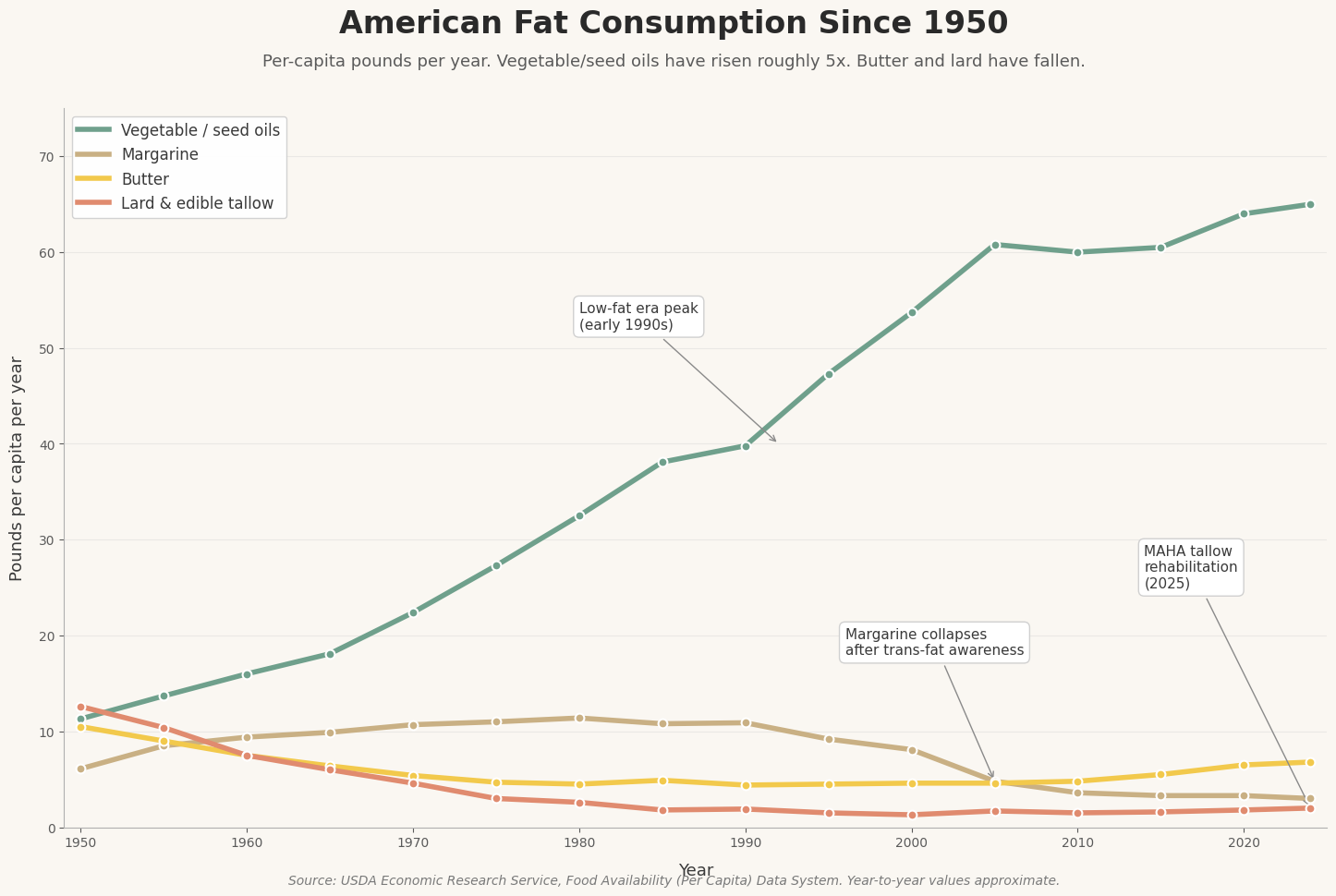
There is a harder thing to reconcile, and the chart above is where the argument gets interesting. Per-capita vegetable oil consumption in the United States has risen roughly fivefold since 1950. Butter and lard have fallen sharply. If you squint at this chart, you can see the anti-seed-oil movement’s argument. We did not eat this stuff like this for most of human history. Then we started. And now everyone is sick.
Two things are true at once here. Seed oil consumption did rise dramatically. Also, age-adjusted cardiovascular mortality has fallen by more than 60% over the same period. The story “seed oils caused the chronic disease epidemic” has to explain why the disease curve went the wrong direction.
So what happened? Why are we sicker than we were if cardiovascular death is down? The answer is mostly: we eat differently than the chart suggests.
Kevin Hall at the NIH actually tested this in 2019. His team ran the first proper randomized trial on ultra-processed food versus minimally processed food. Twenty inpatient volunteers spent two weeks eating an ultra-processed diet, then two weeks eating a minimally processed diet. The two diets were matched for calories presented, macronutrients, sugar, sodium, and fiber. Participants ate as much or as little as they wanted.
On paper the diets matched. In practice, the ultra-processed group ate about 500 more calories per day and gained weight. The minimally processed group lost weight.
That is not an influencer’s claim. That is a randomized trial.
The thing this study actually showed is that ultra-processed food is engineered to override your satiety signals. Whatever is in the package, however much fat or sugar or fiber it contains, the engineering makes you eat past full. Hall’s team did not isolate the mechanism. They proved the effect.
So what actually drives the overeating in those foods? Is it the seed oils?
I don’t think so. The minimally processed menu in Hall’s study also contained oils. Both diets had similar fat content. Participants on the comparison arm were not told to avoid seed oils. They had eggs cooked in butter or olive oil, chicken roasted with vegetable fats, salads with dressings made from oils. The real difference between the two arms was not “seed oil vs no seed oil.” It was how processed the food was.
Other evidence points the same direction. Randomized trials of higher linoleic acid intake (the omega-6 fatty acid in seed oils) have not produced the inflammation increase the anti-seed-oil narrative predicts. Meta-analyses of these trials show no measurable change in C-reactive protein, IL-6, or TNF-alpha at typical dietary doses. The scary inflammation story does not show up in humans.
The Mediterranean diet is built around olive oil and other unsaturated fats. It is also the most extensively studied diet in cardiovascular outcomes research. PREDIMED randomized about 7,500 high-risk adults to a Mediterranean diet versus a low-fat control. After five years, the Mediterranean arm had about 30% fewer heart attacks and strokes. If unsaturated fats were the driver of disease, this pattern would not produce these results.
My read: ultra-processed food is built to make you keep eating. Texture, eating speed, and a fat-sugar-salt formula override your satiety signals before your gut catches up. The oil is one ingredient that goes into making that work, but replacing seed oils with tallow does not address the engineering. It just changes which fat is in the package, while the calories and the formulation stay exactly where they were.
If there is a lever here, it is processing. Not the oil.
What “seed oils” actually means
“Seed oils” is not a nutritional category. It is a marketing term.
In the way the term is currently used in wellness discourse, it covers canola, corn, soybean, sunflower, cottonseed, grapeseed, and sometimes safflower oils. Not all of these are actually pressed from seeds. Corn oil comes from the germ of corn kernels. “Vegetable oil” at the grocery store is usually a blend of soybean and other oils. The category exists because someone needed a word for “the oils that show up in industrially processed foods,” and “seed oils” is what we got.
When I’m in the kitchen, I mostly care about three things: what’s in the fat, how hot I can take it, and how it was made.
Fatty acid profile matters most for your lipid panel. Saturated, monounsaturated, or polyunsaturated. Within polyunsaturated, whether it leans omega-6 or omega-3. This is what drives the substitution argument and the trial outcomes.
Smoke point matters most for actual cooking. It is the temperature at which the oil starts to break down and produce harsh flavors and free radicals. Different oils have different ceilings.
Processing is the most underreported of the three. Whether the oil was cold-pressed, refined, deodorized, blended, or adulterated. This is the part most often misrepresented on labels and least understood by consumers.
The behavior of different fats in your body is the part everyone wants to wave away with the word “inflammation.” The honest behavioral summary is much simpler than the discourse makes it sound.
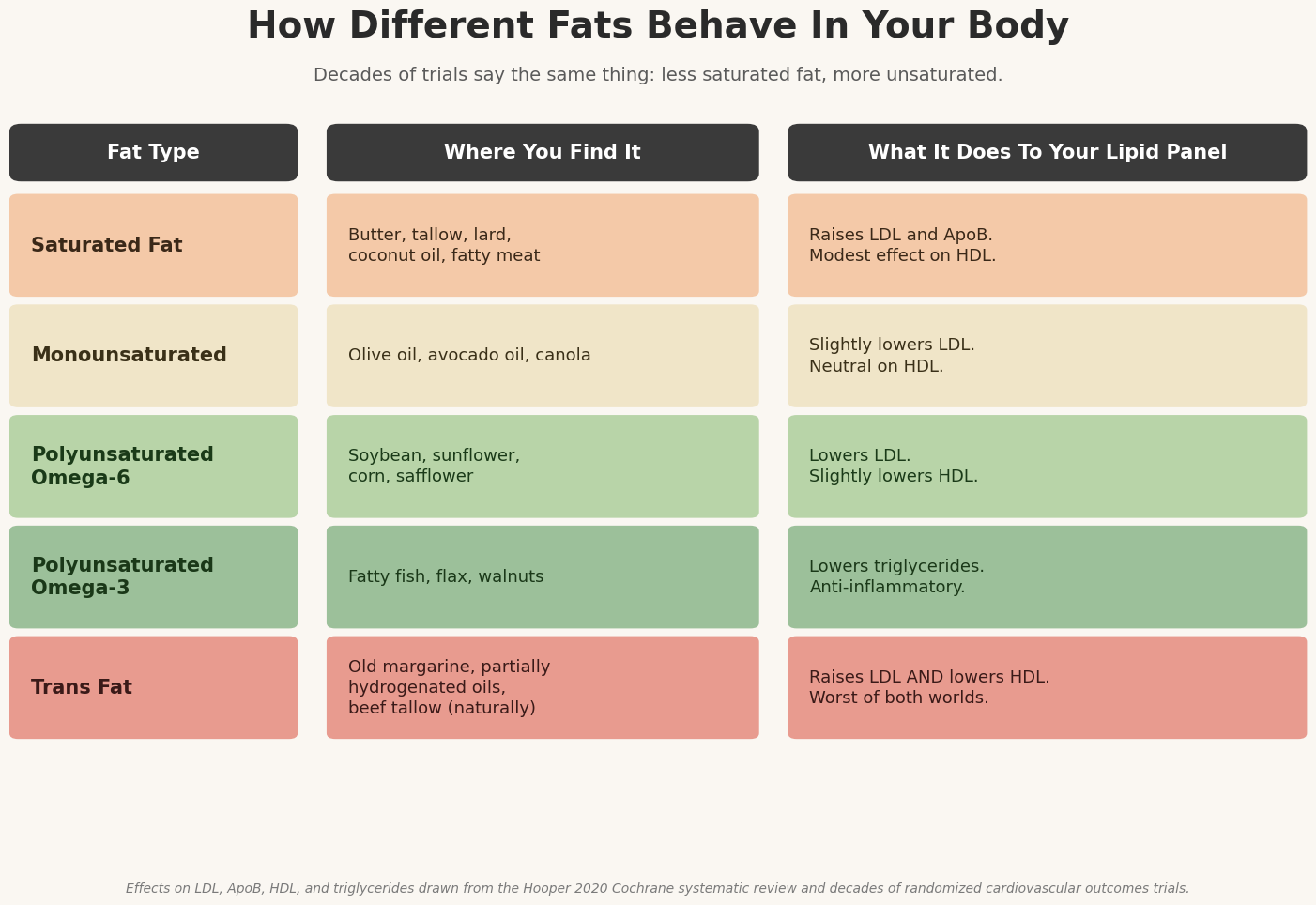
Decades of trials back this order. You don’t need the biochem notes to get the point. Saturated fat raises your LDL and ApoB. Monounsaturated fat is roughly neutral. Polyunsaturated omega-6 lowers your LDL, which is the actual mechanism behind the 21% cardiovascular event reduction in the 2020 Cochrane review. Polyunsaturated omega-3 lowers triglycerides. Trans fat does both bad things at once, which is why it was banned from industrial use in 2018 and is now sneaking back in through beef tallow.
You do not need to understand the chemistry. You need to know that “less saturated fat, more unsaturated fat” is the substitution that consistently shows benefit in trials.
Smoke points are a different conversation, and the one most directly relevant to your kitchen.
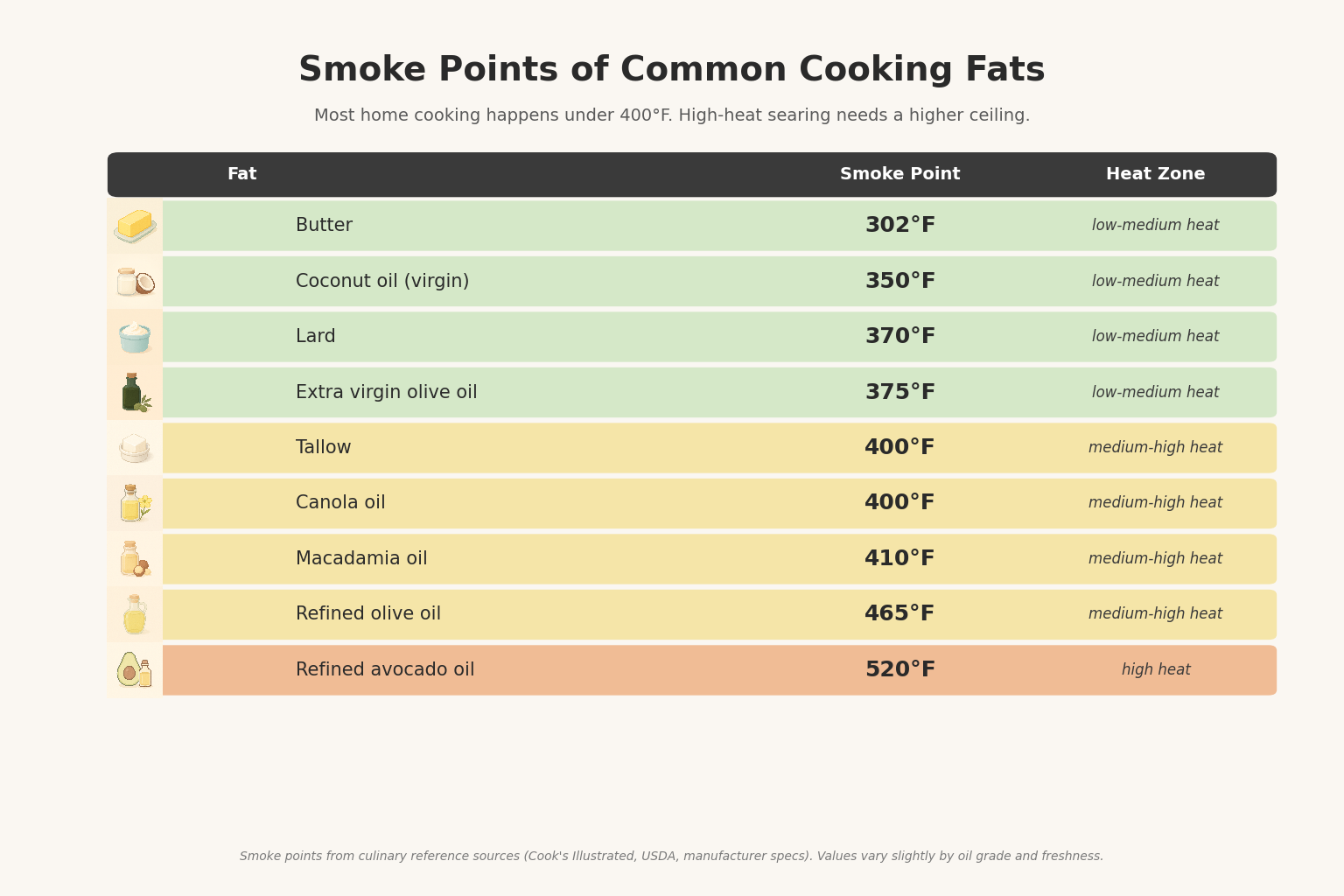
Most of what happens in your kitchen is under 400°F. Sauteeing onions for pasta, scrambling eggs, basting a piece of chicken in the oven, dressing a salad. The high-heat exception is searing a steak in a cast-iron pan, which can hit 500°F or higher. That is where avocado oil and refined olive oil earn their place.
The seed-oil panic includes a chemistry claim that vegetable oils oxidize at high heat and produce harmful aldehydes. This is technically true. It is also true at home-cooking levels, but at concentrations small enough that no human trial has been able to demonstrate measurable harm. Don’t reuse the same frying oil dozens of times. Don’t deep-fry the same batch of canola at 400°F all week. You have solved 90% of the oxidation concern. Restaurant fryers are a real exception. Your kitchen is not.
The processing variable is the one most underreported. Refined olive oil is olive oil that has been heated and chemically processed to neutralize flavor and raise the smoke point. It is not “fake” olive oil, but it is also not the cold-pressed extra-virgin product the Mediterranean diet research is built on. Avocado oil has a separate problem. In 2023, UC Davis researchers tested 36 private-label avocado oils sold in the United States and Canada. Only 31% were pure avocado oil. Roughly 70% were rancid, mixed with cheaper oils, or both. The category is poorly regulated and your $9 bottle of “100% avocado oil” may not be what the label says.
If you bought that bottle at Whole Foods and it has been on the shelf for a year, you may be using exactly the seed oil you were trying to avoid, plus oxidation damage you cannot taste.
The marketing term “seed oils” obscures more than it explains. The fats that consistently reduce cardiovascular risk in trials happen to include several oils that the panic is telling you to avoid. The fats currently being promoted as alternatives include some that perform worse on the same trials. And the processing question, which actually matters more than the seed-vs-not-seed distinction, is the one the wellness discourse never gets to.
What tallow and lard actually are
Time to answer the question I mentioned at the top.
Tallow is rendered beef fat. Lard is rendered pork fat. To render fat means to slowly heat fat tissue until the fat melts away from the connective tissue. You strain off the solids. What is left is a white-to-cream colored fat that is solid at room temperature and stable for cooking. Your great-grandmother probably had a container of it under her kitchen sink, next to the Crisco.
McDonald’s fried their fries in beef tallow until 1990, when they switched to vegetable oil for cardiovascular health reasons. The switch was driven by the same kind of trial evidence we covered in the previous section: replacing saturated fat with polyunsaturated fat reduces cardiovascular events. The 1990 McDonald’s change was a population-scale dietary intervention. It probably prevented a measurable number of heart attacks.
That is the cooking fat the new dietary guidelines are pushing us back toward.
What you will not see on the glossy “return of traditional fats” packaging: beef tallow contains ruminant trans fats. Ruminants are the mammals with multi-chambered stomachs that ferment plant matter before digesting it. Cows, sheep, goats, deer. The fermentation in the first stomach (the rumen, hence the name) produces small amounts of trans fats that end up in the animal’s body fat and milk. These naturally-produced trans fats are not the industrially-hydrogenated trans fats that got banned from US food in 2018. But chemically, they behave in your body the same way. They raise LDL and lower HDL. The cardiology consensus that they should be limited goes back at least to the early 2000s.
A 7×7 Steakburger from Steak ‘n Shake (the chain that recently “RFK’d” its fries) plus a large order of beef-tallow fries delivers roughly 90 grams of saturated fat and 10 grams of trans fats in a single meal.
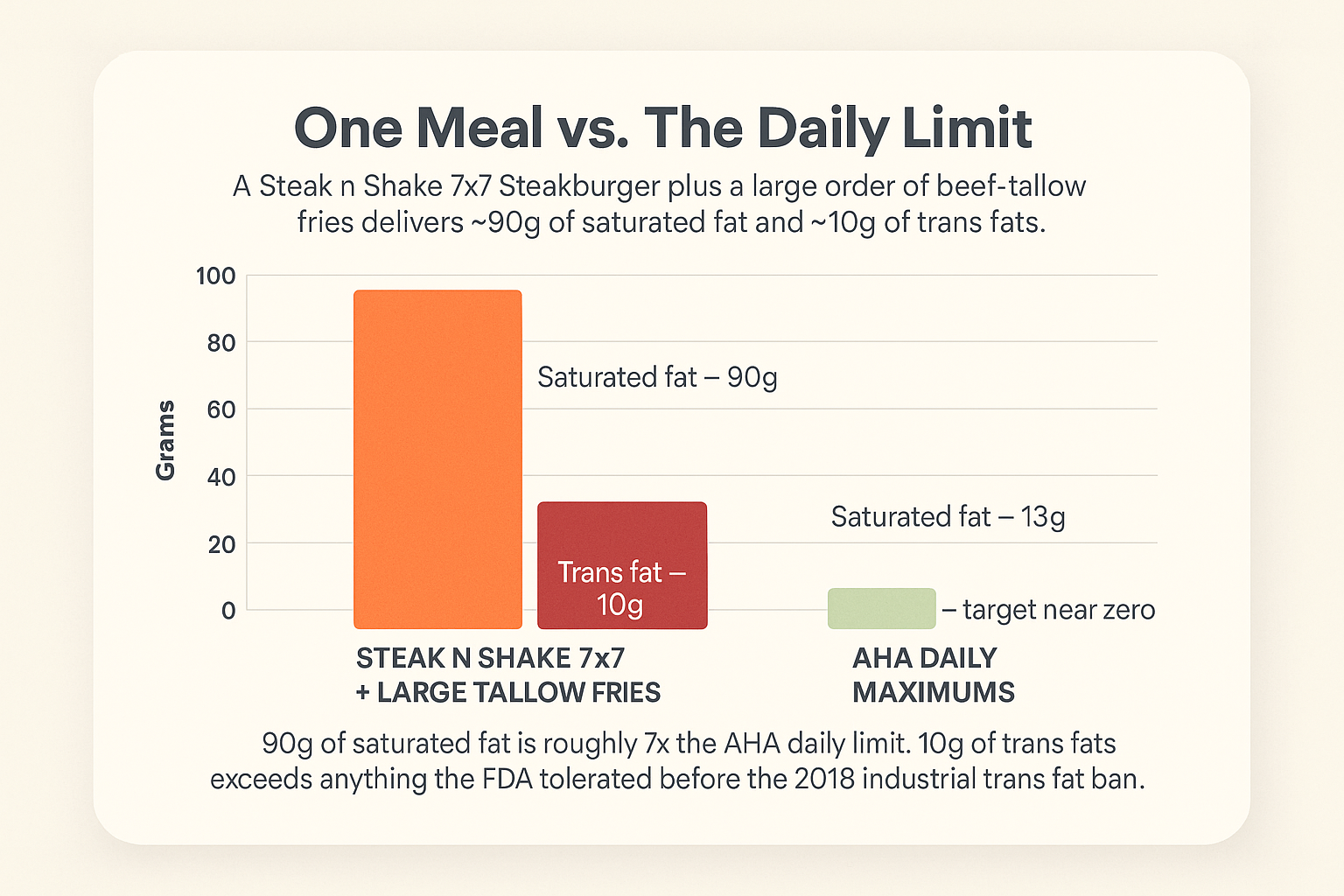
A single meal at that chain contains roughly seven times the AHA’s recommended daily limit for saturated fat. The trans fat content alone exceeds anything the FDA tolerated under the pre-2018 partial-hydrogenation rules. The administration that declared it is “ending the war on saturated fat” has settled on a cooking medium that delivers more of the exact compounds most associated with cardiovascular mortality.
Lard is a slightly different story. Pork fat has less of the ruminant trans fat problem because pigs are not ruminants. Lard is still mostly saturated and monounsaturated fat, with very little polyunsaturated content. Compared to tallow, lard is the less-bad rendered-animal-fat option. Compared to canola or olive oil, it is worse. Lard does have a legitimate culinary niche: home bakers have used it for generations to make pie crusts because the fat crystals produce a flakier, more tender result than butter or vegetable shortening. That niche is real and worth respecting. It is also not what the dietary guidelines are talking about when they recommend tallow and lard alongside olive oil as everyday cooking fats.
The deeper irony of the 2026 guidelines themselves is worth knowing. The document retained a phrase from earlier versions: prioritize oils that are sources of essential fatty acids. In nutrition science, “essential” means fatty acids your body cannot manufacture and must obtain from food. There are two: linoleic acid (omega-6) and alpha-linolenic acid (omega-3). The oils richest in essential fatty acids are canola, soybean, and sunflower. The fats the guidelines suggest as examples (olive oil, butter, tallow) are not primary sources of essential fatty acids. The guidelines used the right scientific language and then pointed it at the wrong foods.
I am not the first person to notice this. Cole Hanson, whose STAT piece pulled me into this whole investigation, made the same observation in his own words.
When the policy framework contradicts itself in language this obvious, the policy is being driven by something other than the evidence. That “something other” is not hard to identify. The beef and dairy industries have spent decades trying to rehabilitate saturated fat in the dietary guidelines. The current version is the best marketing cycle they have had in two generations. The Meat Institute publicly celebrated the new guidelines. The Soybean growers sounded the alarm. None of this is hidden. It is just below the level of attention the average reader gives to what they put in a frying pan.
Quick aside: what about my wife’s bagel butter?
While I was figuring out what to do about my avocado oil spray bottle, I realized I had a parallel question about dairy. My wife likes real butter on hot bagels. We use whole milk. We eat cheese. I had a vague sense that this might also be a problem.
It turns out the dairy answer is more interesting than the seed oil answer.
Over the past decade, the evidence on whole-fat dairy and cardiovascular risk has been gradually rehabilitated. The shift is not driven by industry lobbying the way the tallow rehabilitation is. It is driven by actual data. Multiple large prospective cohort studies and several meta-analyses have found that full-fat dairy intake is either neutral or slightly protective for cardiovascular outcomes. The 2018 PURE study, which followed about 136,000 adults across 21 countries for roughly nine years, found that higher dairy intake (including whole-fat dairy) was associated with lower cardiovascular events and lower total mortality.
This was surprising to nutrition researchers in roughly the same way the omega-3 supplement findings were surprising in reverse. The simple “saturated fat is bad, dairy fat is saturated fat, dairy fat must therefore be bad” syllogism turned out to be wrong about dairy specifically. The explanation researchers settled on is sometimes called the “dairy fat paradox.” The saturated fat in dairy comes embedded in a complex matrix of proteins, calcium, phospholipids, and bioactive compounds. The matrix appears to change how the body handles the fat. The mechanism is not fully understood, but the outcome data is clear: dairy fat in its natural matrix does not behave like the saturated fat in tallow.
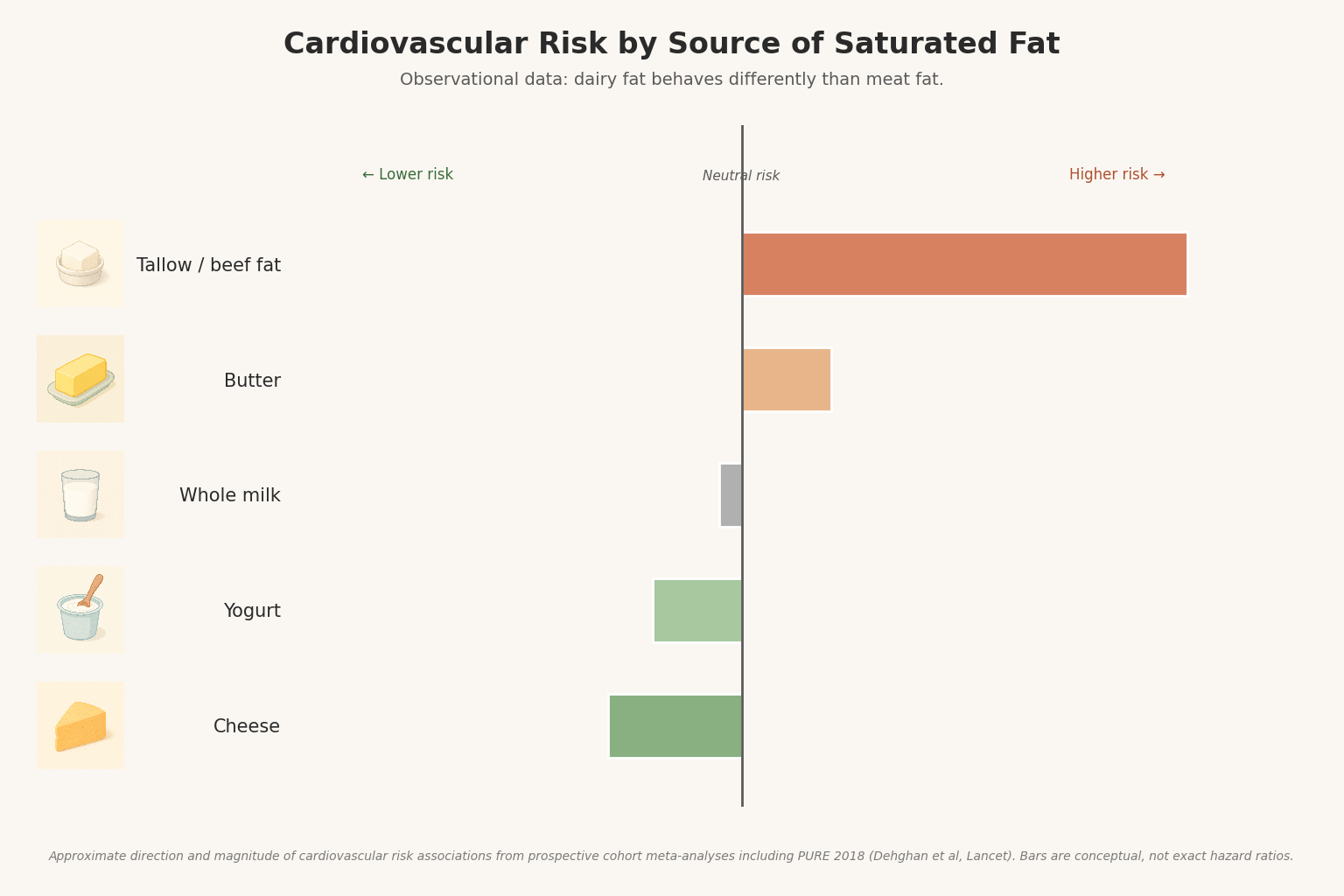
Fermented dairy looks particularly good in this evidence base. Cheese and yogurt consistently outperform non-fermented dairy in observational studies. The explanations are multiple and not mutually exclusive: live cultures, the calcium-protein-fat matrix, vitamin K2 in aged cheese, the effects of fermentation on bioavailability. Researchers have not nailed down which of these mechanisms matters most. What is clear is that hard cheese is not the cardiovascular villain my generation was told it was.
Butter sits in between. It is dairy fat without the protein matrix. So it gets less of the “dairy fat paradox” benefit. The modern evidence does not support the 1990s “butter will kill you” framing, but it also does not put butter in the same category as cheese. The cleanest read is that butter in moderate household amounts is not a clinical concern.
Which brings me back to my wife’s bagel.
A tablespoon of butter on a hot bagel a few mornings a week is not the lever that moves anyone’s cardiovascular risk. The amount of saturated fat from butter in normal household consumption is dramatically less than the amount of saturated fat in a single fast-food meal with tallow fries. The math does not even start to bend until you are loading butter into bulletproof coffee and pouring heavy cream over keto pancakes and putting a stick of butter in a daily smoothie. At that level of consumption, the saturated fat actually does start to matter.
Your normal household amount is not that.
What I’m doing about my avocado oil spray bottle
So I have a kitchen. Let me walk back through it.
The avocado oil spray bottle stays. The fat is mostly monounsaturated, the smoke point handles a cast-iron sear, the spray bottle holds my total fat intake down. There is a small chance the bottle was diluted or rancid before I bought it. I’m going to switch to a national brand that publishes third-party purity testing rather than the cheapest house-label option, and I will go through bottles fast enough that the rancidity window stays manageable. That is about all the variance management this question deserves.
The canola oil that has been sitting unused for three months is fine to use up. I am not pouring it down the drain in penance. The trial evidence says canola is among the better oils for replacing saturated fat. The seed-oil panic does not appear in any randomized human trial. Throwing out a bottle of perfectly good polyunsaturated oil because of a podcast cycle would be the opposite of what the science suggests.
I am going to try a milder olive oil before I conclude I dislike all of them. The bottle that lives in most American kitchens is a strong-pepper Italian extra-virgin that is not actually well suited for someone who does not already love olive oil. Refined olive oil and California-grown extra-virgins are both gentler. If I find one I like, I will keep it for salad dressings, low-and-medium-heat sauteeing, and drizzling on bread. If I still hate all of them, I will use my avocado oil spray for those jobs too, which is a fine outcome.
I am not buying tallow. I am not buying lard except possibly for a homemade pie crust at Thanksgiving, which is the kind of context where the calorie load and the cooking method are appropriate to the fat. I am not buying macadamia oil because the marketing has outrun the science by a wide margin and the price is unjustified.
My wife is keeping her bagel butter. We are keeping the whole milk and the cheese. The amount of dairy fat in a normal week’s worth of household consumption is rounding error compared to the things that actually move cardiovascular risk in the average American diet.
The things that actually move cardiovascular risk in the average American diet are how much ultra-processed food you eat, whether vegetables and legumes show up on the plate most days, how much you move your body, what your weight is doing, where your LDL and ApoB sit, and how you sleep. The cooking oil in your sautee pan does not crack that list.
This is the boring part. It is also the part the policy environment and the dietary guidelines and the podcast cycle are all set up to obscure. Spending a Sunday afternoon angry at canola oil instead of buying more vegetables is a strategy that benefits beef ranchers and influencer brand deals and almost nobody else.
I started writing this because I wanted to know what to do with my avocado oil spray bottle. The actual answer turned out to be: it’s fine, the question wasn’t important, and the conversation around it has been hijacked. I will keep cooking with oils that meta-analyses describe as cardioprotective. I will keep eating the vegetables I was already eating. And I will try, when I can, to stop having opinions about what’s in other people’s frying pans.
If the next dietary advice cycle tells me to fry my eggs in goose fat, I am not turning the bottle around immediately. The data takes longer than that to change.
About Gunnar
Gunnar is 53. He lost about 170 pounds, trains in a garage gym, and writes DadStrengthDaily from personal experience, citing primary sources where he can. He also moderates r/ProactiveHealth. He is not a doctor, and nothing here is medical advice. Talk to your own doctor before acting on anything, especially GLP-1s, TRT, blood pressure, sleep apnea, and cancer screening.