
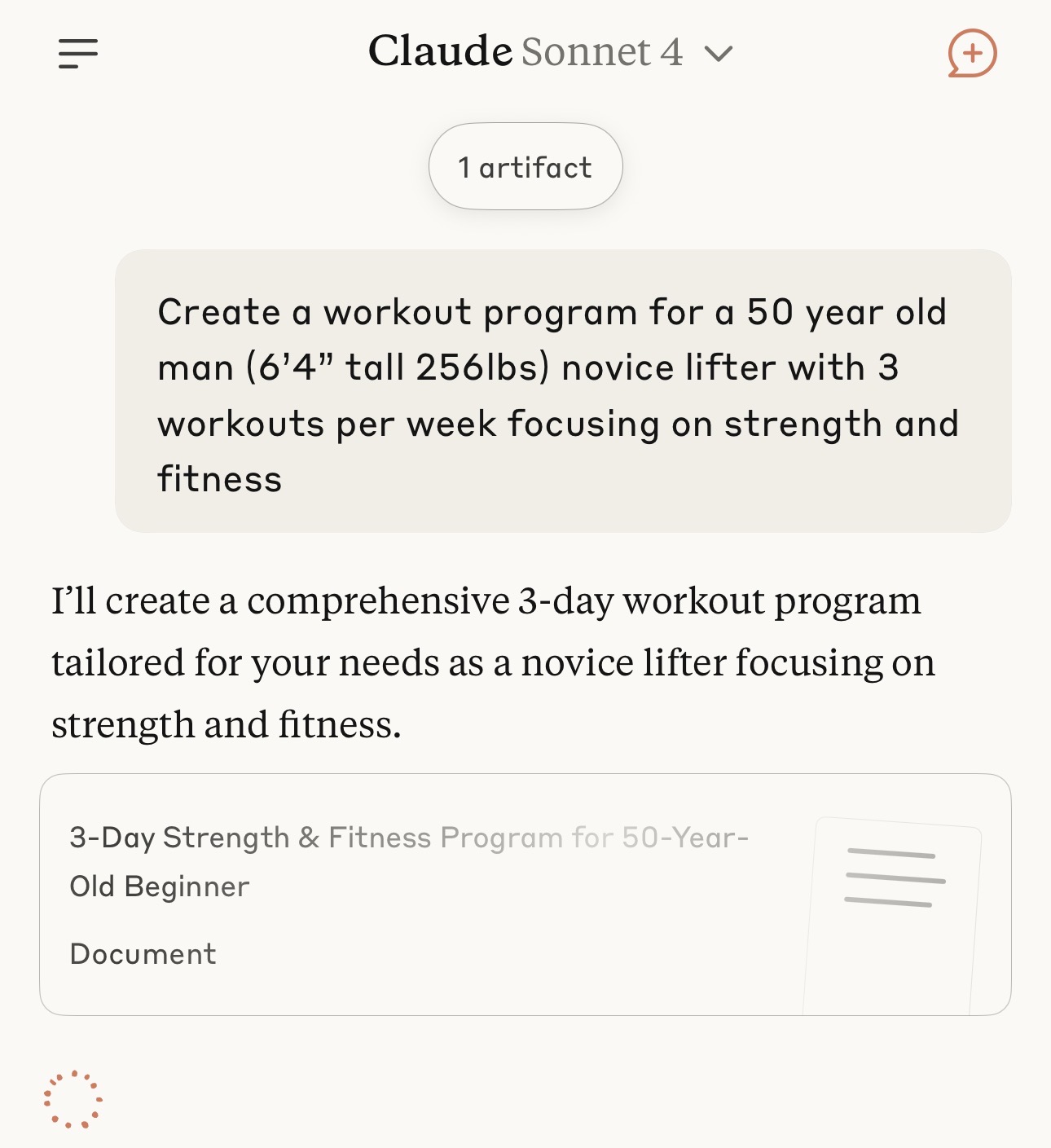
I tried building myself a workout program with AI. It took about five minutes in Claude, and what came back was a genuinely reasonable three-day strength program scaled to a 50-year-old beginner.
That’s not really in question anymore. A 2026 study in the Journal of Sports Science and Medicine had nine certified personal trainers and ChatGPT separately answer the same nine common exercise questions, then had experts score the answers without knowing which was which. ChatGPT won the overall score on six of the nine questions and beat the trainers on scientific correctness more often than not. If the question is whether software can write a good program, mostly, yes.
My own problem showed up somewhere else. After I decided to get healthy, I bought the equipment (an indoor bike, dumbbells, the Concept2 rower I’d hauled around since college) and tried apps like Calibre and Hevy. Both gave me real structure and real tracking. Neither one turned into a habit.
That’s not just me. A 2026 study followed close to 390,000 users of the workout app Fitbod by experience level. Among beginners, only about 10% were still following their program a year later. Experience helped: lifters with four or more years of history stuck at closer to 26%. For a beginner, a program on its own is closer to a coin flip that lands on quitting nine times out of ten.
What actually changed for me was hiring a human coach through the Future app. I went from not training at all to working out four times a week, then five, one of them at my office gym.
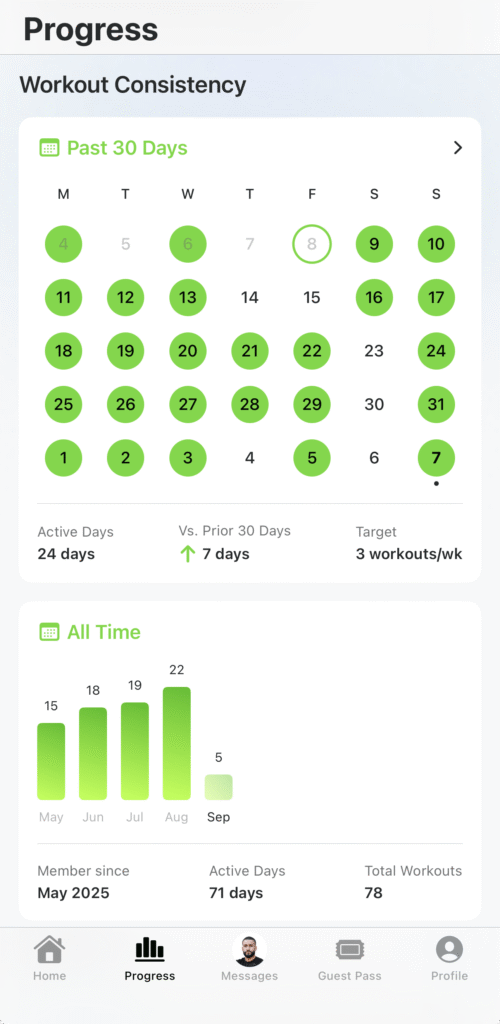
My trainer isn’t scary. He’s just a person, and disappointing a person costs something that disappointing an app doesn’t.
Future didn’t just take my word for it. In February 2026 the company split itself into two products: Future Pro, the human-coached version I use, and a free AI-only beta built to compete on price. By June, they killed the AI version. Their own statement pointed to member feedback, not a cost or engineering problem: “we’ve decided not to move forward with launching that product and instead, double down on what we do best: helping people make real progress with the support of world-class coaches.” A company selling both versions chose to stop selling the cheaper one.
There’s research behind that choice too, and it isn’t really about the quality of the programming. A 2025 trial randomized 120 inactive women with obesity to different amounts of coaching contact, from weekly in-person sessions down to a single monthly check-in blended with web contact. At 20 weeks, everyone getting some form of coaching, weekly, biweekly, or monthly, was exercising 2.0 to 2.4 days a week on average, versus 0.9 for the group that got none. The three coached groups didn’t differ from each other in any reliable way. The jump that mattered was from zero human contact to some. How much of it barely mattered.
A gym field experiment makes the same point more bluntly. Researchers paid nearly 800 people to visit the gym, structuring the reward two different ways: some earned it for their own visits, others only earned it when their assigned partner also showed up that week. The tandem-reward group visited the gym about 35% more often than the group rewarded individually. Nobody changed the workout. They just made someone else’s attendance depend on it too.
There’s also a practical reason this matters more the older you get. A bad rep on a joint that’s already worn out is worse than a missed workout. A person standing three feet away catches the bad rep before it becomes an injury. An app can’t.
None of this is a knock on AI programming. Software can write a plan as good as plenty of human trainers can. It just doesn’t notice when you skip it. A JMIR review covering that same ChatGPT-versus-trainers study describes someone who stopped following a ChatGPT-built program, citing a “lack of ongoing engagement.” In the person’s own words, “no one was watching.”
If you already train consistently, the program really is close to a solved problem, and Future’s coaching, which runs $149 to $199 a month depending on how long you commit (I’m on the annual plan, at $149), isn’t buying you a smarter plan than Fitbod’s $16-a-month one. What it’s buying is somebody who notices when you don’t show up. If you’ve tried the cheap version and it never stuck, like I did, twice, that’s what the other $133 a month is actually for.
Get the next one in your inbox
I write about longevity, training, and preventive health weekly — without the guru worship. Free, no spam, unsubscribe whenever.
About Gunnar
Gunnar is 53. He lost about 170 pounds, trains in a garage gym, and writes DadStrengthDaily from personal experience, citing primary sources where he can. He also moderates r/ProactiveHealth. He is not a doctor, and nothing here is medical advice. Talk to your own doctor before acting on anything, especially GLP-1s, TRT, blood pressure, sleep apnea, and cancer screening.