
Update (July 18, 2026): I knew it was the lettuce!
When this went up I would not blame the parasite outbreak on lettuce, because the CDC still listed the source as unknown. That has changed. The FDA has now published an outbreak advisory telling people in five states (Indiana, Kentucky, Michigan, Ohio, and West Virginia) not to eat the shredded iceberg lettuce served at Taco Bell, and it names the supplier: Taylor Farms de Mexico. On July 17 Taylor Farms said it was voluntarily pulling all iceberg lettuce grown in central Mexico from the U.S. market and starting a recall. It was iceberg this time, not romaine, but the lesson is the same one I started with. A leafy green I already will not eat raw turned out to be the vehicle, and the wider cyclospora season is still ugly at more than 1,600 cases across 34 states.
A parasite outbreak has now sickened more than 1,600 people across 34 states, and the produce aisle is under suspicion again. For a vegetable that is mostly water, lettuce carries a surprisingly long rap sheet.
I stopped buying romaine a while ago, and every few months the news reminds me why. This month it is a parasite. As of the CDC’s July 14 health advisory, 1,645 people across 34 states have come down with cyclosporiasis, an intestinal illness caused by the microscopic parasite Cyclospora, with 141 hospitalized and more than 5,100 additional cases still being sorted out.
I want to be careful here, because the news is jumping to conclusions. The CDC has not named a food. Its own outbreak page is titled “Unknown Source,” and the agency says plainly that no specific food has been confirmed. The lettuce talk is coming from elsewhere. Michigan health officials have floated leafy lettuce as a leading suspect, and the Washington Post reported, citing anonymous sources, that investigators are also looking at Taco Bell. Taco Bell says no link has been confirmed, and neither the CDC nor the FDA will say either way. So treat the lettuce angle as a hunch, not a verdict.
The hunch is reasonable anyway, because lettuce has earned the side-eye.
Romaine is a repeat offender
The track record is not subtle. In spring 2018, romaine grown around Yuma, Arizona sickened 210 people in 36 states. Ninety-six of them landed in the hospital, twenty-seven developed a type of kidney failure, and five died. That fall, romaine did it again with another 62 cases. The next fall, romaine from the Salinas Valley in California sickened 167 people and hospitalized 85. If it feels like romaine is always in the news, that is because it more or less is.
This is not bad luck. It is how the lettuce is grown. Most of America’s lettuce comes from a few valleys in Arizona and California that happen to sit next to enormous cattle operations. E. coli lives in cattle. It rides on dust and irrigation water and lands on open fields of lettuce that we then eat raw, with no cooking step to kill it. A lot of that lettuce is chopped, washed, and bagged in central facilities, where one contaminated head can seed a whole production run. The FDA spent years studying the Yuma growing region and kept circling back to one conclusion: the pathogens are in the environment, and the leaves are downwind. The industry has tightened up since then, with better traceability and stricter growing rules, but the recalls keep coming.
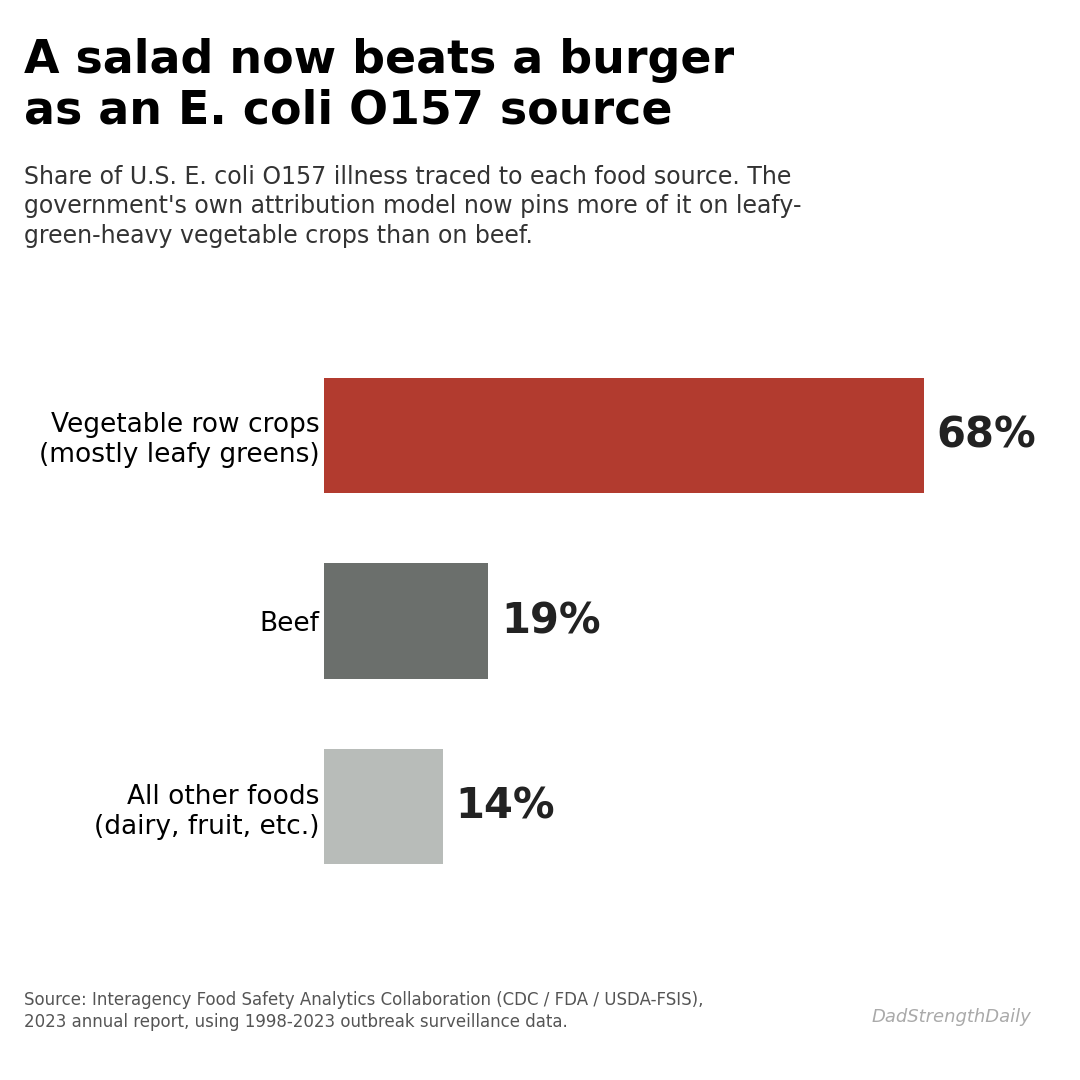
The national data match the pattern. Leafy greens cause about 9 percent of all U.S. foodborne illnesses with a known cause, and within that group, lettuce alone drives 60.8 percent of the outbreaks and 75.7 percent of the illnesses. When federal agencies trace where E. coli O157 comes from, their latest attribution report assigns more of it to vegetable row crops, the open-field category that includes leafy greens, than to beef. A salad is a more likely source of that particular bug than a hamburger.
None of this means your next bag will hurt you. Millions of servings get eaten every week without incident, the per-serving odds are genuinely low, and public health agencies still tell everyone to eat more vegetables, which is the right call. What gets me is narrower. This particular vegetable keeps causing the same outbreak, and unlike beef, it gives you no cooking step to fall back on.
Get the next one in your inbox
I write about longevity, training, and preventive health weekly — without the guru worship. Free, no spam, unsubscribe whenever.
What you are actually eating
So why do we keep buying it? Habit, mostly, plus a quiet belief that salad is automatically virtuous. Look at what you actually get. Iceberg lettuce is about 96 percent water, which is why a full cup barely reaches ten calories and carries almost nothing else. Romaine and the darker leaves are better, with real vitamin A, vitamin K, and folate. But I keep running into the same problem. Whatever is in lettuce, I can get more of it somewhere safer, and usually from something I can cook.
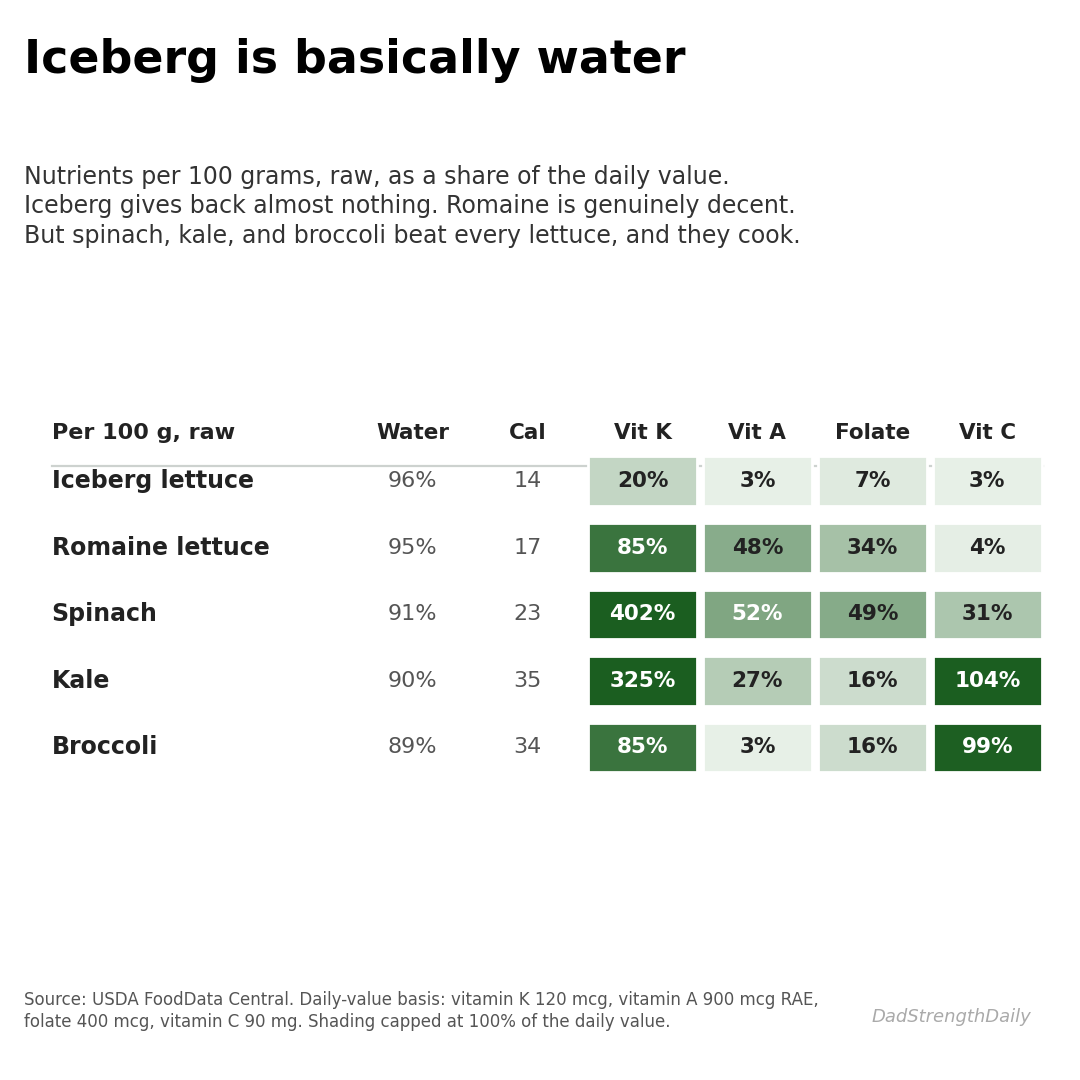
Iceberg is the one that earns the crunchy-glass-of-water reputation, ninety-six percent water and giving back almost nothing. Romaine is a different animal. It carries real vitamin A, vitamin K, and folate, and if lettuce is going in my bowl, it is romaine. My problem is not that romaine is worthless. It is that spinach, kale, and broccoli deliver all of it and more, and most of them can go in a hot pan, which kills the very pathogens that keep making headlines.
The fiber argument is weaker than it sounds. A generous two-cup bowl of romaine carries maybe two grams, against the twenty-eight or so you want in a day. A single apple, or half a cup of beans, does more.
Then there is the part nobody says out loud. Lettuce is boring. It tastes like crunchy water, so we drown it in ranch or Caesar to make it worth chewing, and suddenly the “healthy” choice is carrying a few hundred calories of oil and buttermilk. And the fat is not entirely optional. In a 2004 clinical trial, people who ate their salad with fat-free dressing absorbed almost none of its carotenoids, the plant pigments the body converts into vitamin A. You need a little fat on the plate to take them up at all. So an undressed salad gives back less than it looks like, and once I add enough dressing to make it taste like something, the calorie math stops looking so smart. I would rather eat a vegetable I actually like.
The one thing lettuce is genuinely good for is bulk, a big volume of food for almost no calories. But cabbage, cucumber, and peppers fill a plate just as well, with nothing like lettuce’s outbreak record, and no raw vegetable is entirely risk-free anyway.
What I am not saying
Now, I am not anti-vegetable. Greens really are good for you. The nitrates in leafy vegetables help your body make nitric oxide, which relaxes blood vessels and nudges blood pressure down. And in a well-known 2018 study in Neurology, older adults who ate the most leafy greens declined mentally at a rate that looked eleven years younger than those who ate the least. But I think this is where lettuce gets credit for evidence that is really about leafy vegetables as a whole. Neither result gives me a reason to pick raw romaine over cooked spinach. And the brain study shows a link, not proof, since people who eat a salad every day tend to do a lot of other healthy things too.
I still eat plenty of greens. I just stopped buying raw commercial lettuce, especially iceberg and the chopped stuff in bags, which mixes leaves from a lot of farms and can spread one bad batch across a whole shelf. Most nights I cook my greens, because heat is a kill step and rinsing is not. The FDA and CDC both say that washing a bag of salad does not reliably remove pathogens once they have worked onto or into the leaf. When I want raw crunch, I reach for cabbage or peppers.
If romaine is your favorite vegetable, keep eating it. I am not here to talk anyone out of a salad. If you do keep buying it, at least stack the deck. Buy whole heads instead of bags, throw out the outer leaves, and use a real tablespoon of olive oil so the nutrients you paid for actually get absorbed. Which oil that should be is its own argument, and I went through what I found in the cooking-oil evidence. I just don’t think lettuce is irreplaceable, and once I saw how little I gave up by dropping it, the recalls stopped being a headline I had any reason to sweat.