
We spend decades saving enough money to leave work and almost no time deciding what will replace its structure, challenge, and sense of progress. Most men don’t need another job after retirement. I think most of us still need a project.
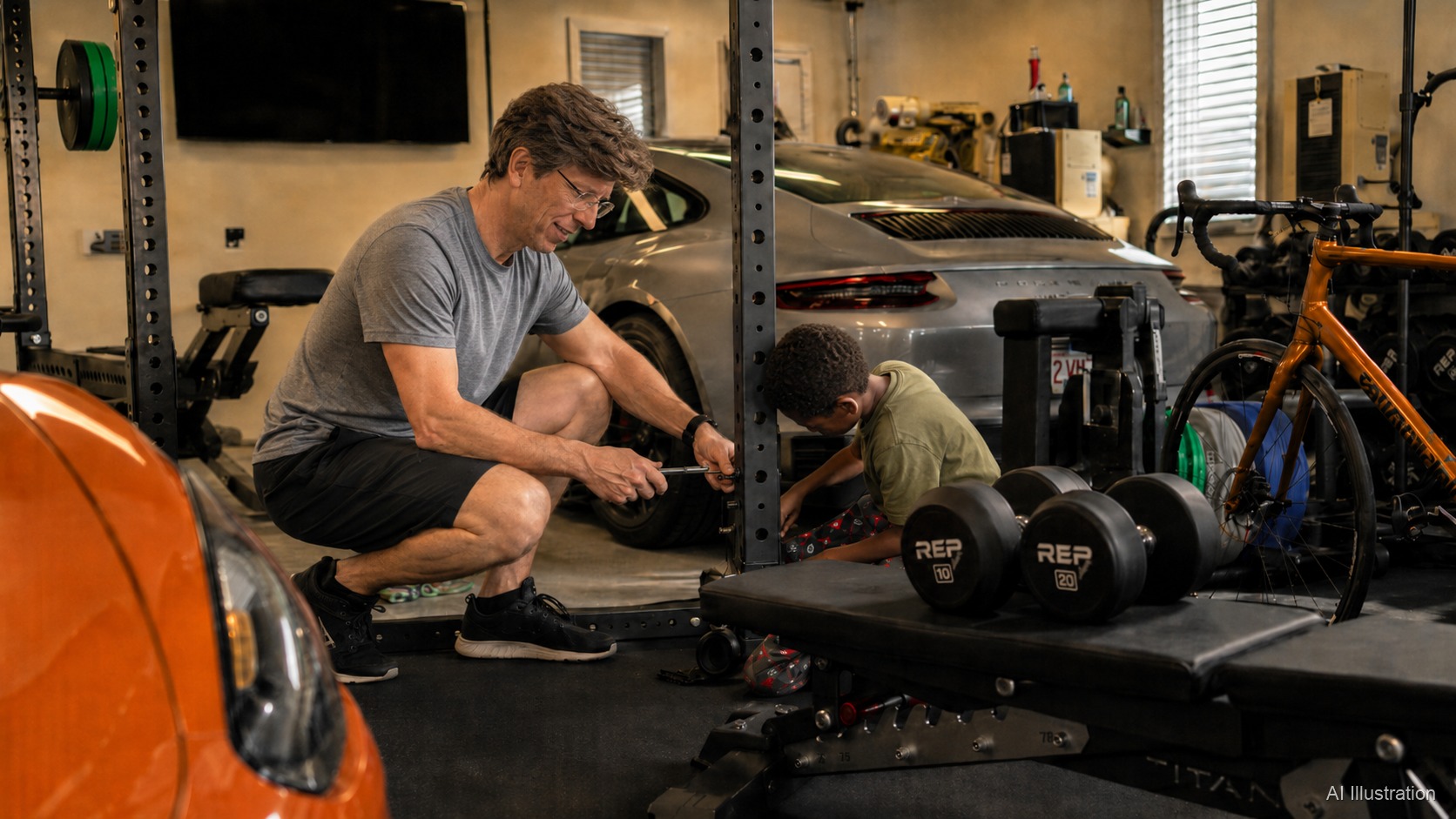
I am 53, still working, and not planning a retirement party for next Friday. But I am close enough now that the subject has stopped feeling theoretical.
I have also never really had hobbies, and that is the part that makes this personal. My job and my kids fill the days so completely right now that I never notice the absence of anything else. But the job will not last forever, and my kids will not always need me the way they do today. When I try to picture myself ten years from now, with the calendar suddenly wide open, I do not have a good answer for what goes in it. That empty space is the part I actually worry about.
The standard retirement plan is mostly a list of things that stop. No alarm clock. No commute. No meetings. No boss. No email on Sunday night. No performance review written by someone who has spoken to you twice all year.
I understand the appeal. I have worked enough of my adult life to appreciate the fantasy of a Tuesday morning that belongs entirely to me. What I find strange is how often the plan ends there.
We spend thirty or forty years building the account that will fund retirement, then give almost no thought to the life the account is supposed to fund. The money gets spreadsheets, projections, Monte Carlo simulations, and meetings with professionals. The rest gets “travel more,” “play some golf,” and a vague picture of sitting somewhere warm. That might be enough for a long vacation. I am not convinced it is enough for a life.
The question I have started asking is not what I want to retire from. It is what I want to build toward.
The job was doing more than paying you
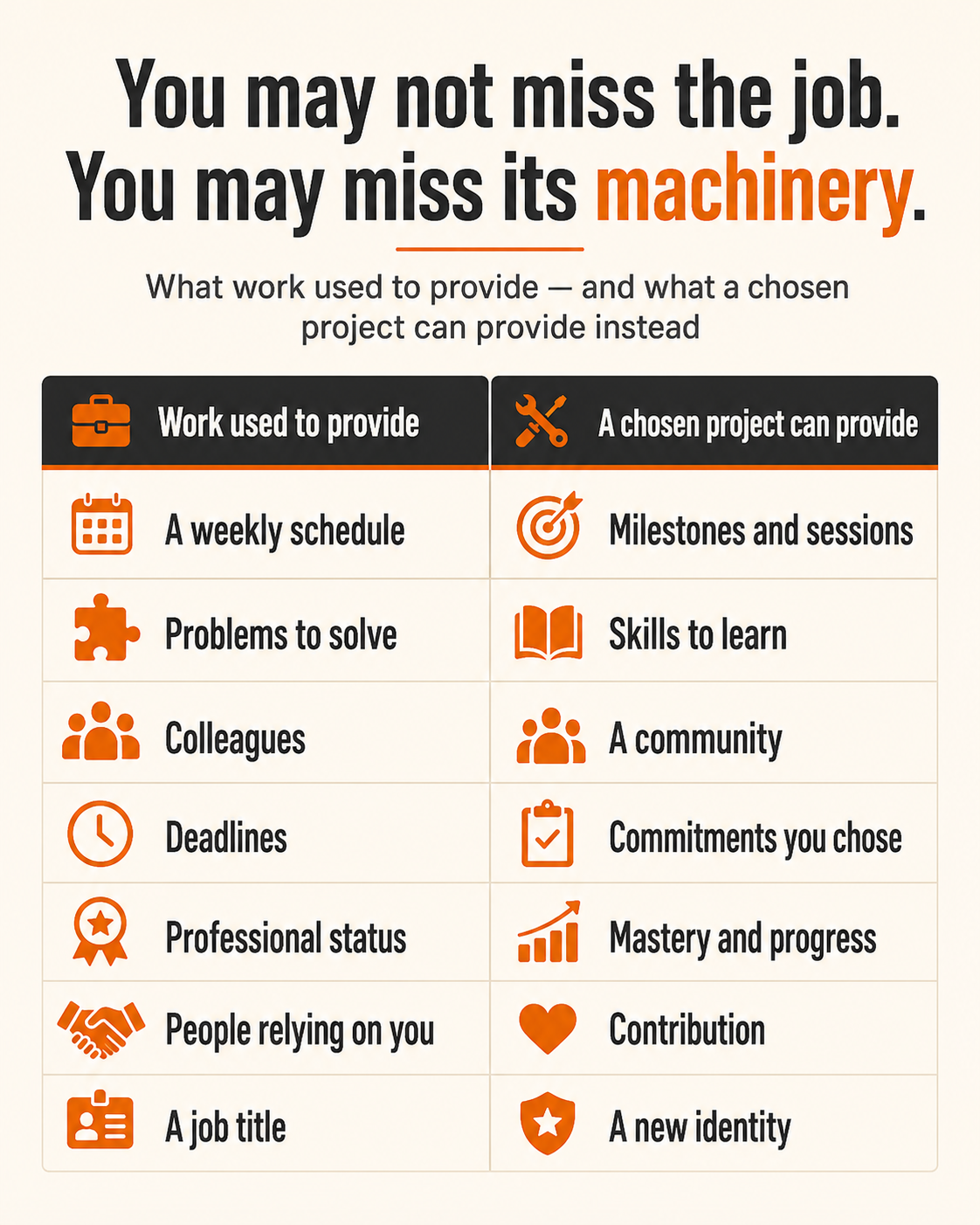
Even a job you are ready to leave quietly runs a lot of machinery for you. It shapes the week and hands you problems that someone is waiting on. Deadlines, progress, the occasional stretch of real competence, a bit of status, the small satisfaction when something hard finally works. And underneath all of it, a job answers a question most of us never say out loud: where am I needed today?
I don’t romanticize work. Plenty of jobs are draining, pointless, badly managed, or physically punishing, and retirement can be a genuine release from them. A study of 8,113 American adults found that retiring actually raised people’s sense of purpose overall, with the biggest gains among lower-income people leaving jobs they disliked. Retirement was not an existential collapse. For a lot of people it was an opportunity.
That finding matters to me, because I don’t want to write another article telling men retirement is dangerous and they had better stay at their desks forever. The office is not a vitamin. Your employer is not doing you a favor by keeping you on payroll until you die. Freedom can be good.
But freedom and direction are different things. A blank calendar feels luxurious when you have been overbooked for thirty years. After a while, it is still a blank calendar. The better version of retirement, at least in my head, has room to do nothing without turning nothing into the organizing principle of the next twenty years.
Men need projects, not ways to stay busy
“Keep busy” may be the most depressing retirement advice ever given. Keeping busy sounds like inventing errands so the day passes faster, or reorganizing the garage for the fourth time because dinner is still five hours away.
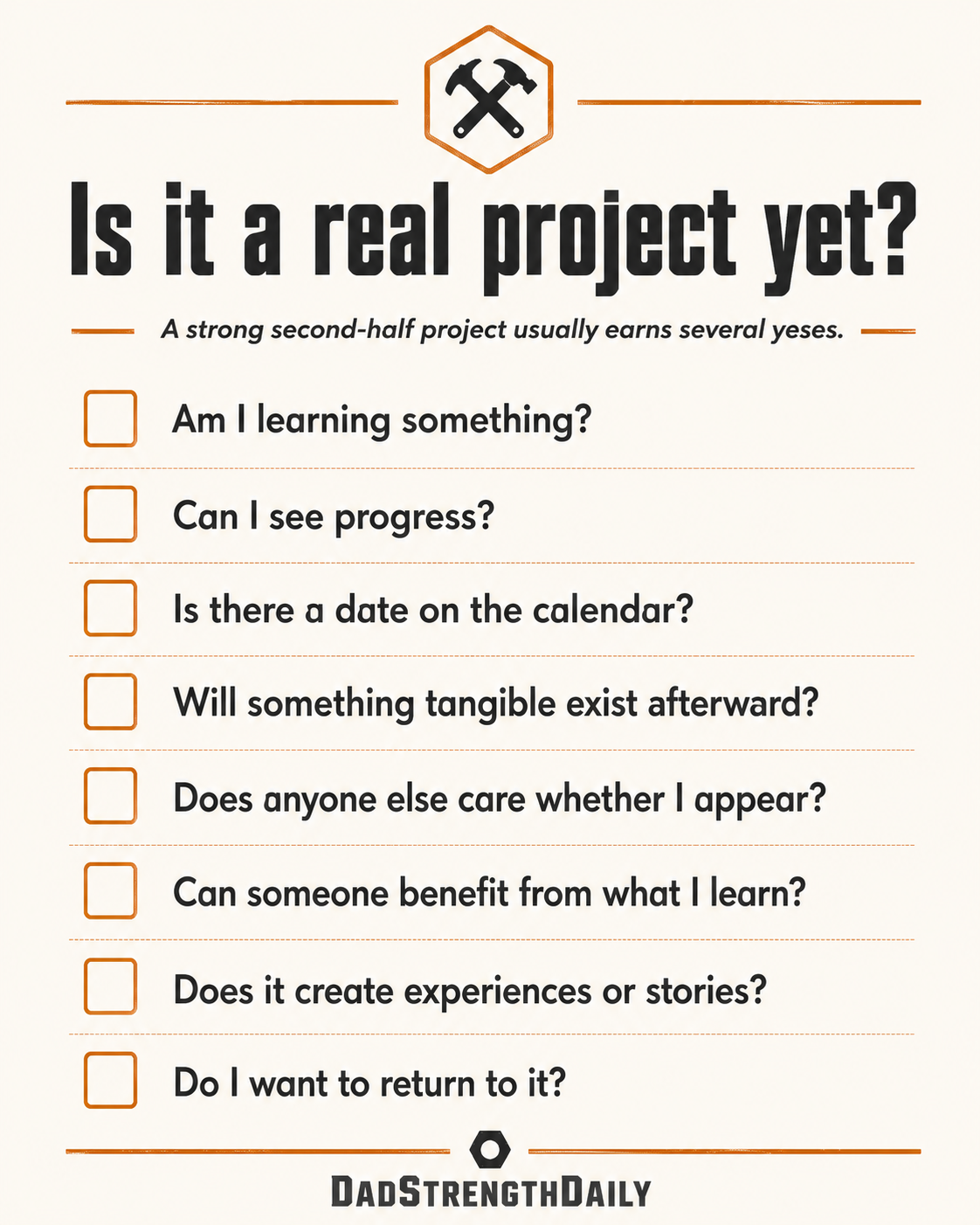
A project is different. It goes somewhere. Watching car-restoration videos is entertainment; bringing a dead one back to life is a project. The difference is direction. A project has an outcome, even when the outcome changes on you, and getting there makes you learn something and shows you when you are improving. It tends to put a date on the calendar, and the good ones eventually pull other people in. Knowing a lot about strength training is just an interest until you use it to help three younger guys build their first sensible program.
That doesn’t mean every retired man needs to open a business, flip a house, or turn woodworking into an Etsy shop. This is not hustle culture with reading glasses. A project does not have to make money, impress anyone, or become content. It only has to matter enough that you want to come back to it.
DadStrengthDaily is a project for me. So was building a real garage gym after spending most of my adult life doing no exercise at all. Both started messier than they look now. I did not have a grand plan. I had an interest, then a problem to solve, then the next small thing that needed doing. Most meaningful projects are not discovered fully assembled. They get built by staying with something long enough for it to develop weight.
There is no randomized trial proving that every man gets happier the moment he is issued a project at retirement, and I am not going to pretend otherwise. A 2025 scoping review in The Gerontologist looked at 30 studies on meaning during the retirement transition, and they kept returning to the same ingredients: meaningful activity, hobbies, volunteering, mentoring, valued social roles, identity, and some structure after work. The authors were also blunt that only six of the 30 studies were longitudinal and the field needs stronger designs. So this is a pattern, not a prescription.
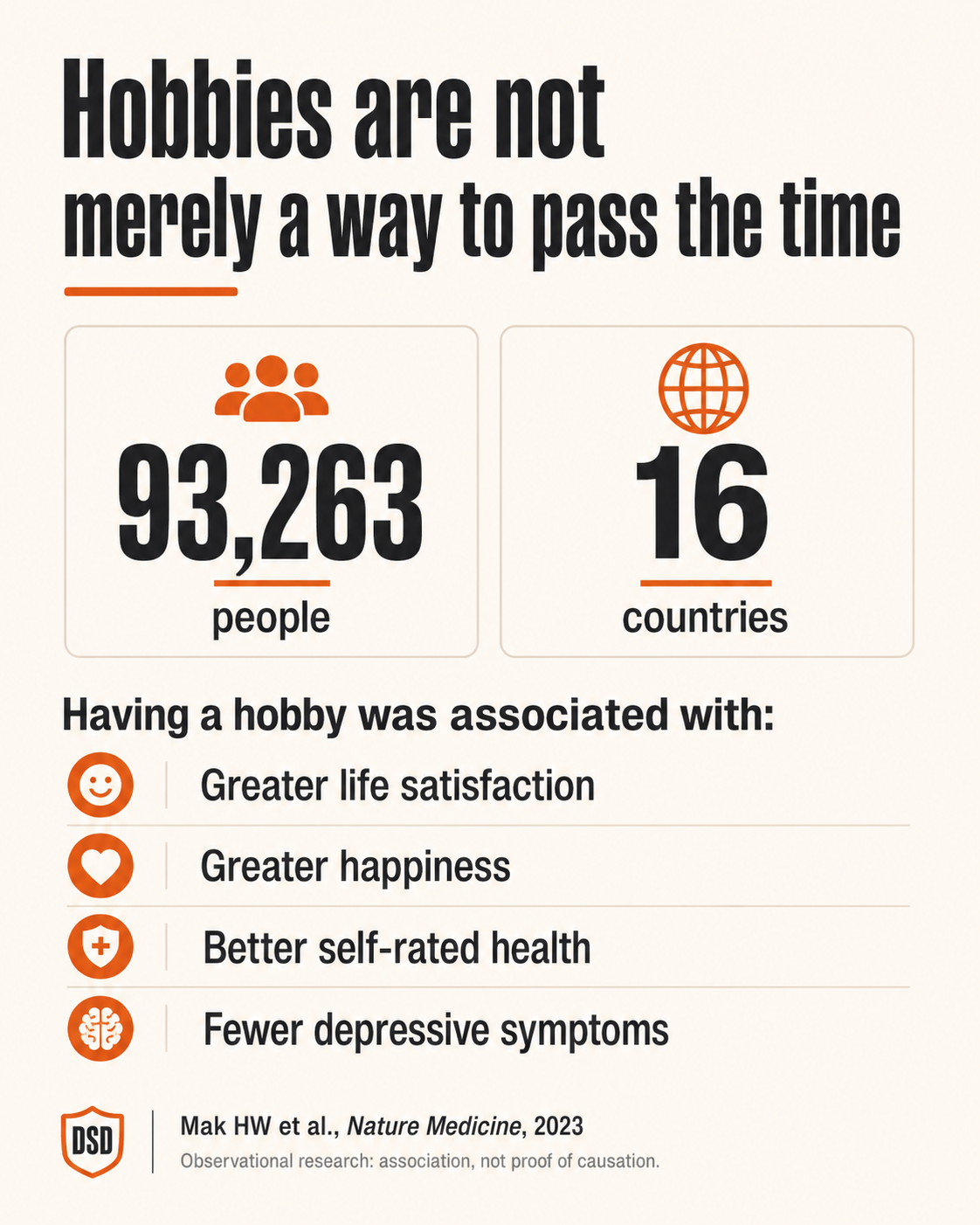
One much larger study makes me take the pattern seriously. Researchers pooled longitudinal data from 93,263 people aged 65 and older across 16 countries and found that having a hobby was associated with fewer depressive symptoms and higher happiness, life satisfaction, and self-rated health. The link showed up in men and women, in retirees, and fairly consistently from one country to the next. They still could not prove hobbies caused the improvement; well-being and participation probably feed each other. I would not stretch that into “model trains prevent depression.” What I take from it is that regular engagement in something you care about is not a trivial extra once work ends, and a project is simply that engagement with somewhere to go.
The best example is a shed
The Men’s Shed movement began in Australia and spread to the United Kingdom, Ireland, Canada, New Zealand, and beyond. The idea is almost suspiciously simple: give men a shared space, some tools, and things worth doing together. The social part happens around the work instead of being advertised as the work.
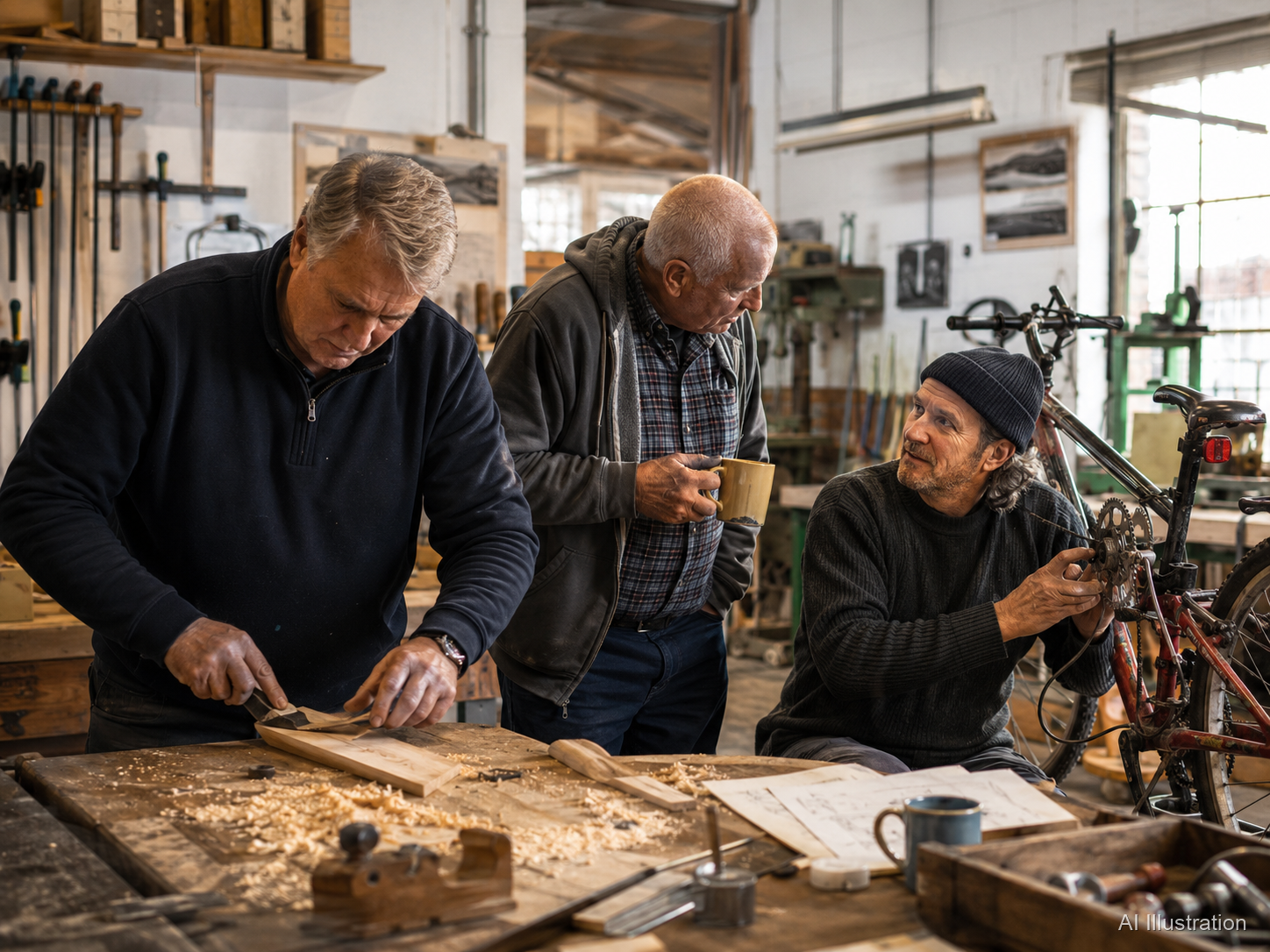
That distinction makes sense to me. A lot of men would rather stand next to someone fixing a mower than sit across from him at an event designed to make them discuss their feelings. Conversation comes easier when your hands are busy and silence is allowed.
It reached the United States late, but it is here. The first American shed opened in 2017 in Hopkins, Minnesota, and by 2019 there were more than a dozen across eight states. What the men build tells you what the sheds are for. They fix donated bicycles for kids who need them, put together picnic tables and benches, and in Honolulu a group has restored century-old outrigger canoes. Phil Johnson, who started the Hopkins shed at 67, described it to AARP as “like Boy Scouts for men, except you don’t have to earn merit badges.”
A 2022 mixed-methods systematic review pulled together 52 Men’s Shed studies and found evidence of benefits for well-being, social isolation, and self-rated health, with the strongest signal on mental health. It also found the evidence limited by small studies and a shortage of longitudinal designs. One of its more useful observations was that activity-based programs can supply purpose and structure without pressuring men to talk.
Nobody built a support group and bolted a workbench onto it to make it feel more masculine. They built the workbench, and the support grew up around it. It is the most workable answer I have found to the friendship problem men run into after 50.
A project should make you matter to someone
The garage can be a sanctuary. It can also become a very comfortable place to disappear.
The strongest projects do more than occupy one person. Someone else notices the result, learns from it, or expects you to show up. Researchers call part of this mattering, the sense that your contribution has value to other people, and in a one-year study of 186 retirees that feeling was what linked social support to positive emotion. The need is not for praise. It is for evidence that your effort lands somewhere outside your own head. The Baltimore Experience Corps trial randomized older adults into elementary schools to help kids read, and the ones who did came away with a stronger sense of generativity, the feeling of giving something to the next generation. There is real power in turning thirty years of experience into somebody else’s head start.
Work also hands you a social network by default, and retirement removes it fast. A small English study followed 424 people through retirement found that keeping up group memberships tracked with better quality of life six years later, while every membership lost in the first year tracked with roughly a 10% drop. So the part I would act on is simple: do not wait until the retirement party to build a life outside the company directory. Join the cycling club before you have unlimited time to ride. Help with the youth team while you still have to guard Thursday evenings. A community is hard to order on Monday for delivery by Friday. It grows through repeated presence, which means the best time to start may be while work is still in the way.
Don’t wait to find the perfect project
“Find your purpose” creates its own kind of paralysis. It makes purpose sound like one correct answer hidden somewhere inside you, and a wrong guess might waste the last third of your life. That is far too much pressure to hang on a hobby, a volunteer shift, or a half-restored motorcycle.
There is a better frame, borrowed from design: prototype. Instead of waiting for a revelation, run small experiments. Take the class before you commit to the whole craft. Shadow someone who already does the work, or just help at a couple of events and see what sticks. Build one table before you buy a garage full of woodworking equipment. Purpose is not only found. It can be developed, and testing a few cheap versions of it beats holding out for the one true calling to announce itself.
I don’t want retirement to become another performance contest. There should be unproductive mornings, travel with no lesson attached, books read for no reason, and afternoons where the only accomplishment is grilling something and not checking email. The point is not to replace one packed calendar with another, or to prove you are still economically useful after a company stops paying you. The point is to keep a live wire running into the future.
Maybe yours is a car, a garden, a workshop, a book, a coaching role, or a skill you have been postponing since your thirties. The exact project matters less than whether it pulls you forward. We are taught to plan retirement as an escape: enough money, one last day, then freedom. I think the stronger plan runs the other way. Build a life with enough in it that leaving work does not open a hole.
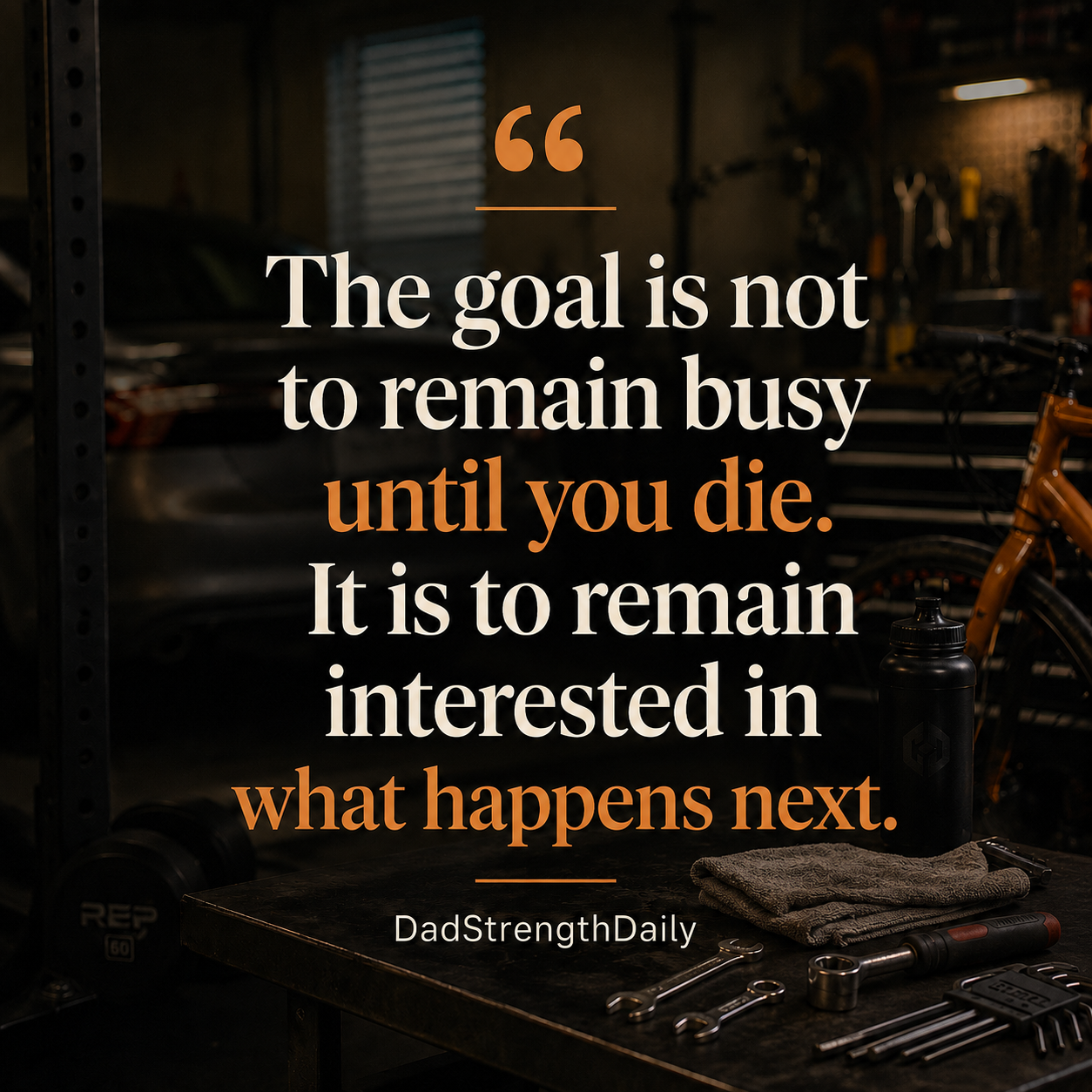
Do not retire from something. Build toward something. The point was never to stay busy until you die. It is to stay interested in what happens next.
Further reading and listening
- Bill Burnett and Dave Evans, How to Live a Meaningful Life (2026). The prototype-your-life argument, applied to meaning.
- Arthur C. Brooks, From Strength to Strength. Why the second half leans toward wisdom, teaching, and service.
- Rich Roll Podcast #974, Burnett and Evans on designing a meaningful life.
- Hidden Brain, “Cultivating Your Purpose” with Anthony Burrow. Purpose is developed, not just found.
Get the next one in your inbox
I write about longevity, training, and preventive health weekly — without the guru worship. Free, no spam, unsubscribe whenever.