
A man who grew up in 1980s Germany reads the alcohol research nobody wanted published, and finds the “safe amount” he was raised on was never measured to be safe.
Correction (June 11, 2026): A reader on r/ProactiveHealth flagged that the study’s risk estimates at low intake aren’t statistically significant. I’ve softened two lines below to reflect that.
I stopped drinking somewhere in my forties and I haven’t thought much about it since. No rock bottom, no intervention. A single beer had started leaving me with a headache that ran into the next morning, I noticed I didn’t actually miss anything about it, and at some point I just stopped buying the stuff. I’m not in recovery and I don’t go to meetings. I quit, and as far as I can tell I lost nothing.
Like most men my age, I’d grown up with an assumption I never examined: too much drinking was clearly bad, but a moderate amount sat in some harmless middle, and maybe a glass of red wine even did your heart a favor. That was the story.
So I read the news this month with the particular interest of a man who’d already made his decision and wanted to know whether he got lucky or got it right. On June 8, federal researchers finally published the alcohol study that had been quietly set aside. It’s called the Alcohol Intake and Health Study. It was commissioned back in 2023 to help write the new Dietary Guidelines, and then it was sidelined. A House Oversight report in January called it “irretrievably flawed.” The scientists who did the work didn’t agree, so they published it themselves in the Journal of Studies on Alcohol and Drugs, which is where I read it.
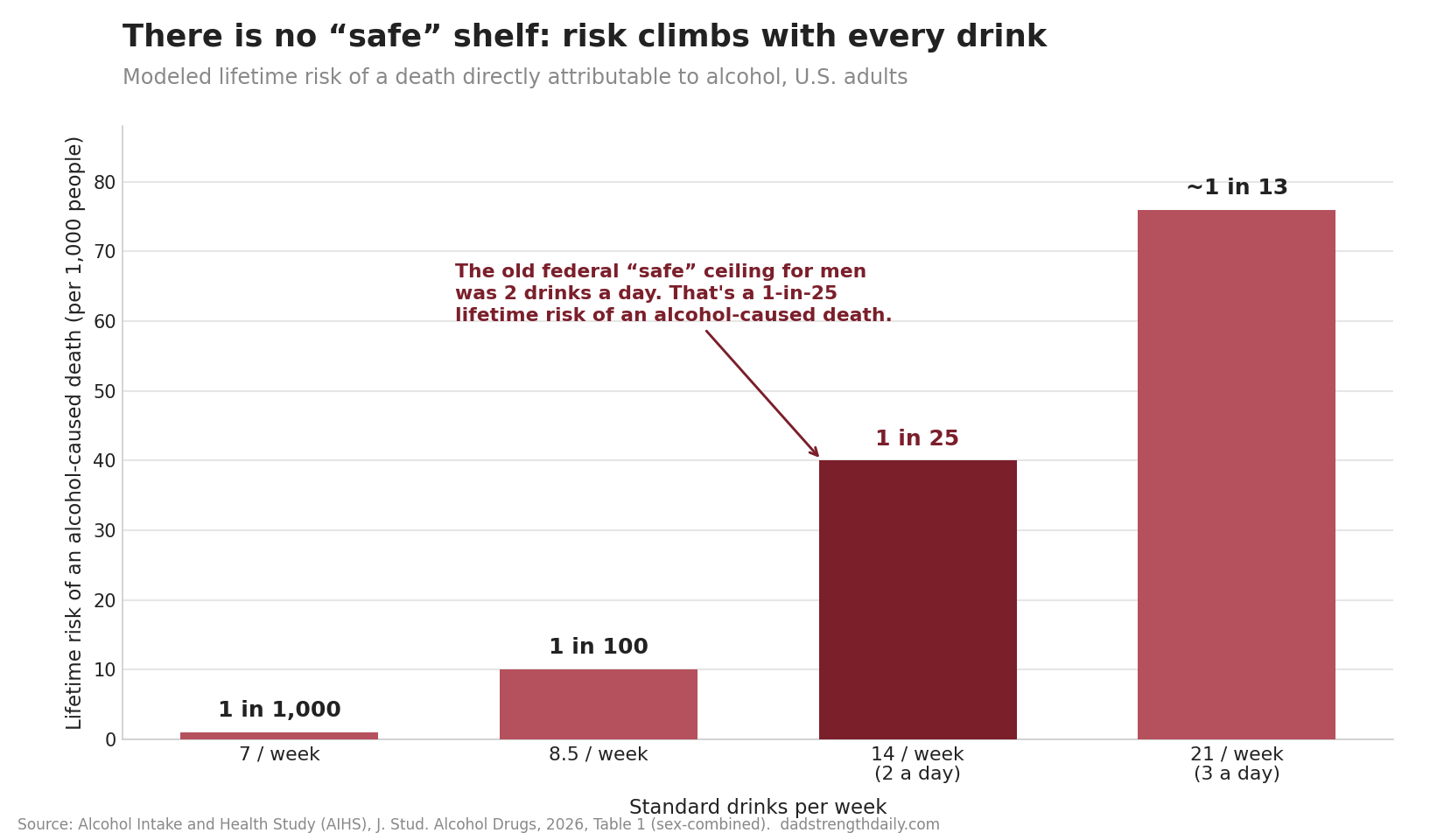
The finding isn’t complicated: in this model, no level of drinking comes out protective, and the risk climbs as you drink more. These are population-level estimates of alcohol-attributable death, not a prediction about your specific nightly beer, but the shape of the curve is the whole point. A drink here means the official one, 14 grams of alcohol, which is a 12-ounce beer, a 5-ounce glass of wine, or a shot of spirits, not the oversized pour most of us actually count as one. At seven drinks a week, your lifetime risk of dying from something the drinking caused is roughly one in a thousand, though the estimate at that low level is too imprecise to lean on. Above eight or nine a week it crosses one in a hundred. At fourteen a week, which is two a day, the number the old guidelines called the safe ceiling for men, it’s about one in twenty-five, and the higher up the curve you go, the more I’d trust the number. The authors concluded the guidelines should tell people to drink no more than one a day, and ideally less.
Then the new guidelines came out in January and ducked the whole question. The 2025 to 2030 Dietary Guidelines dropped the numbers entirely. No two-drinks-for-men, no one-for-women, no definition of a standard drink. They just say “drink less” and leave it there. A study that produced an uncomfortably specific number got replaced with a vague instruction nobody can act on.
I find the politics less interesting than the thing underneath it. The “safe amount” I grew up believing in was never measured to be safe. It was an accident of a good story, and the story fell apart years ago. I just didn’t notice, and neither did most people my age.
The red wine story I grew up believing
If you’re around fifty, you absorbed a particular piece of folk wisdom sometime in the 1990s or early 2000s: a glass of red wine is good for your heart. I sort of believed it. It came with a name that made it sound like settled science, the French Paradox, and a mechanism that sounded properly biochemical, resveratrol, the compound in red wine that supposedly explained why the French ate all that cheese and butter and didn’t drop dead of heart attacks.
Both halves of that story are gone now, and how they fell apart is worth knowing, because it explains why so many smart people believed something that was never true.
The French Paradox was coined in 1992 by a French researcher named Serge Renaud, and it was always an observation, not an experiment. It noticed that French heart-disease deaths looked low relative to French diets and pointed at the wine. But the low French numbers were partly an artifact of how France recorded causes of death, and whatever was actually protecting French hearts had far more to do with the rest of the Mediterranean diet, and the life around it, than with the alcohol. The wine got the credit because the wine made the better story. The Blue Zones ran on the same kind of story, and their own researchers have been arguing about it in the journals for fifteen years.
Resveratrol was supposed to be the proof, the molecule that turned a coincidence into a mechanism. The leading researcher on its heart benefits was Dipak Das at the University of Connecticut, and in 2012 a university investigation found him guilty of 145 counts of data fabrication and falsification. His work was retracted. Even setting the fraud aside, the dose was always the giveaway: to get anywhere near the amount of resveratrol that did something in a lab dish, you’d have to drink hundreds of glasses of wine a day. The compound is real. You were just never going to get a meaningful dose of it from a glass of Cabernet.
What really kept the idea alive was that the epidemiology fooled the experts too, not just the wine drinkers. For decades, study after study found that moderate drinkers were healthier than people who didn’t drink at all, and that looked like evidence for moderate drinking. It was mostly an illusion, the sick-quitter problem. The group labeled “non-drinkers” in those studies was full of people who’d quit because they were already sick, or who never drank because they were too ill to, and that dragged the health of the abstainer group down and made the drinkers look good by comparison. Once researchers started separating lifelong abstainers from people who quit for health reasons, most of moderate drinking’s apparent benefit evaporated.
So by the time Andrew Huberman told millions of listeners in 2022 that “the best amount of alcohol to drink is probably zero,” he wasn’t being provocative. He was saying out loud what the evidence had been quietly turning into for a decade, in the exact wellness-and-optimization world a lot of us now live in. The culture was finally catching up to data that had moved years earlier.
Get the next one in your inbox
I write about longevity, training, and preventive health weekly — without the guru worship. Free, no spam, unsubscribe whenever.
What one drink a day does to a body like mine
I want to be careful here, because the fastest way to lose a reader my age is to tell him his nightly beer is going to kill him. It probably isn’t, not on its own, not this year. But the risk is real, and it climbs on a slow grade with no safe shelf where it drops back to zero.
The cancer link is the part most people my age never heard, and it’s the one that got to me. In January 2025 the Surgeon General issued an advisory calling alcohol the third-leading preventable cause of cancer in the country, behind tobacco and obesity. It’s causally tied to at least seven cancers, including breast, colon, esophagus, liver, and mouth and throat, and it accounts for roughly 100,000 cancer cases and about 20,000 cancer deaths a year in the US. In a survey around the same time, only about 56 percent of American adults knew that alcohol causes cancer at all. I was in the other 44 percent for most of my life. Nobody told me, because the warning label on the bottle is about pregnancy and operating machinery, not about my colon. A newer breakdown of the death toll found that almost all of the recent rise in alcohol-related cancer deaths has landed on men over 55.
The fastest-rising harm is to the liver. Deaths from alcohol-associated liver disease roughly doubled between 1999 and 2022, and the steepest increase by far is in adults 25 to 44, not the lifelong heavy drinkers in their sixties most people picture.
Then there’s the part nobody writes for a man like me: what one ordinary night of drinking does to the things I actually track. I lift in my garage, I pay attention to my sleep, and I care about recovery. On all three, alcohol turned out to be more harmful than I understood when I drank.
It suppresses testosterone. The mechanism is well documented: alcohol interferes with the signaling that tells the testes to make testosterone, and heavy chronic use damages the Leydig cells that produce it directly. I’m on testosterone replacement, so my own number doesn’t ride on what I drank last night, and honestly that takes some of the personal sting out of this for me. But for most men my age still running on their own production, a regular drinking habit is quietly taxing the exact system they’re worried about losing.
It wrecks sleep in a way that’s easy to miss, because alcohol does help you fall asleep, and that feels like proof it’s helping. What it does after that is suppress REM and fragment the second half of the night, so you get less of the sleep that actually restores you and wake up feeling like you didn’t rest. If you track sleep on a watch, a couple of drinks shows up as a bad night even when you were unconscious for eight hours.
And it blunts recovery from training. A 2014 study in PLOS ONE had trained men do a hard workout and then drink, and the alcohol cut the muscle-building response to the session by about a quarter, even when they ate protein alongside it. That was a heavy night in the lab, around twelve drinks, not a single beer, so I’m not going to pretend one Friday lager erases a workout. But the mechanism is real: the body trying to rebuild after a hard session is the same body now busy processing the alcohol, and the two compete. For a reader in the garage trying to hold onto muscle in his fifties, that’s this week’s problem, not a thirty-year risk curve.
The last one I take personally. Alcohol raises blood pressure, and I have an aortic aneurysm, so blood pressure isn’t an abstraction in my house. I won’t dramatize it. I’ll just say that when you already have a reason to keep your numbers low, a habit that pushes them the other way stops looking like a treat.
How the science kept getting bent
I’m an engineer by training, which means when a question has a clean answer and the official guidance is mush, I want to know what happened in between. With alcohol, the incentives kept bending the conversation toward the answer the industry could live with. The study buried this month isn’t the first time. It’s at least the second I can point to.
Strip away the politics and the real scientific fight is that same sick-quitter problem, now with two big federal reports landing on opposite sides of it. The buried study counted deaths that alcohol specifically caused, comparing drinkers against people who never drank. A competing report from the National Academies, released in December 2024, instead looked at how long moderate drinkers lived overall, and found they lasted a little longer while getting more breast cancer. That sounds like a contradiction, but the two were measuring different things, and the all-cause approach is the one still carrying the old confound. The cleanest way around that confound, a genetic method that uses people who can’t easily tolerate alcohol as a natural control group, keeps finding no protective effect at all, including in a study of more than 500,000 adults. The report using the cleaner comparison got sidelined. The one with the friendlier headline was the one the guideline process could live with.
The part that turned me from skeptical to genuinely annoyed is older than this month’s study. In 2018 the NIH killed a $100 million trial called MACH15 that was supposed to settle the moderate-drinking question for good by randomizing adults over 50, the exact age group reading this, to a daily drink or not. It collapsed when the New York Times reported that NIH officials had quietly courted the alcohol industry, Anheuser-Busch InBev and Heineken among them, to pay for most of it, and that the trial had been designed to all but guarantee a flattering result, leaving alcohol-related cancer and heart failure out of the outcomes it would even measure. An internal NIH review concluded it was, in their words, exceedingly unlikely to find that alcohol was harmful, and the agency shut it down. The pattern isn’t subtle once you’ve seen it twice: when a study might make alcohol look bad it gets sidelined, and when one is built to make alcohol look fine, the industry money shows up to pay for it.
To be fair, the other side isn’t all industry shills. Ned Calonge, who led the National Academies report that found a small survival benefit, stands by his work, and he’s no shill. But even he says, plainly, that he doesn’t believe anyone should start drinking for health reasons. What gets me is that even the most credible defense of moderate drinking, from the man who led the friendlier report, still ends at “but don’t start.” Nobody making the honest case is telling you to pick it up.
We’re finally drinking less, and the young are leading it
It would be easy to read all of that as pure doom, and that would miss the most hopeful trend in American health right now: we are drinking less, and the change is real and speeding up.
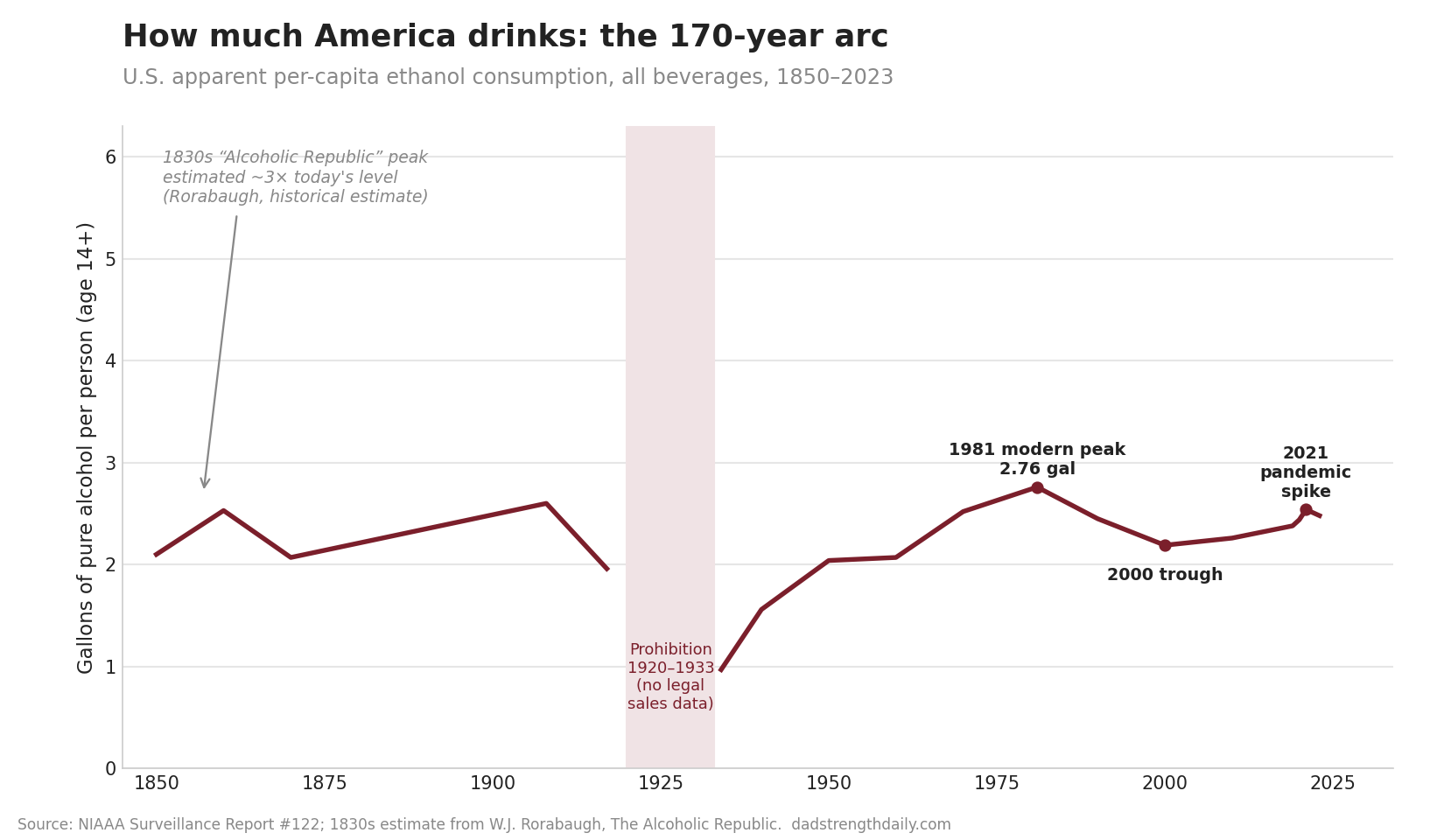
The decline isn’t new, exactly. Americans drank far more in the 1800s than we do today, the modern peak was back in 1981, and consumption has trended down since, with a pandemic spike that’s now reversing.
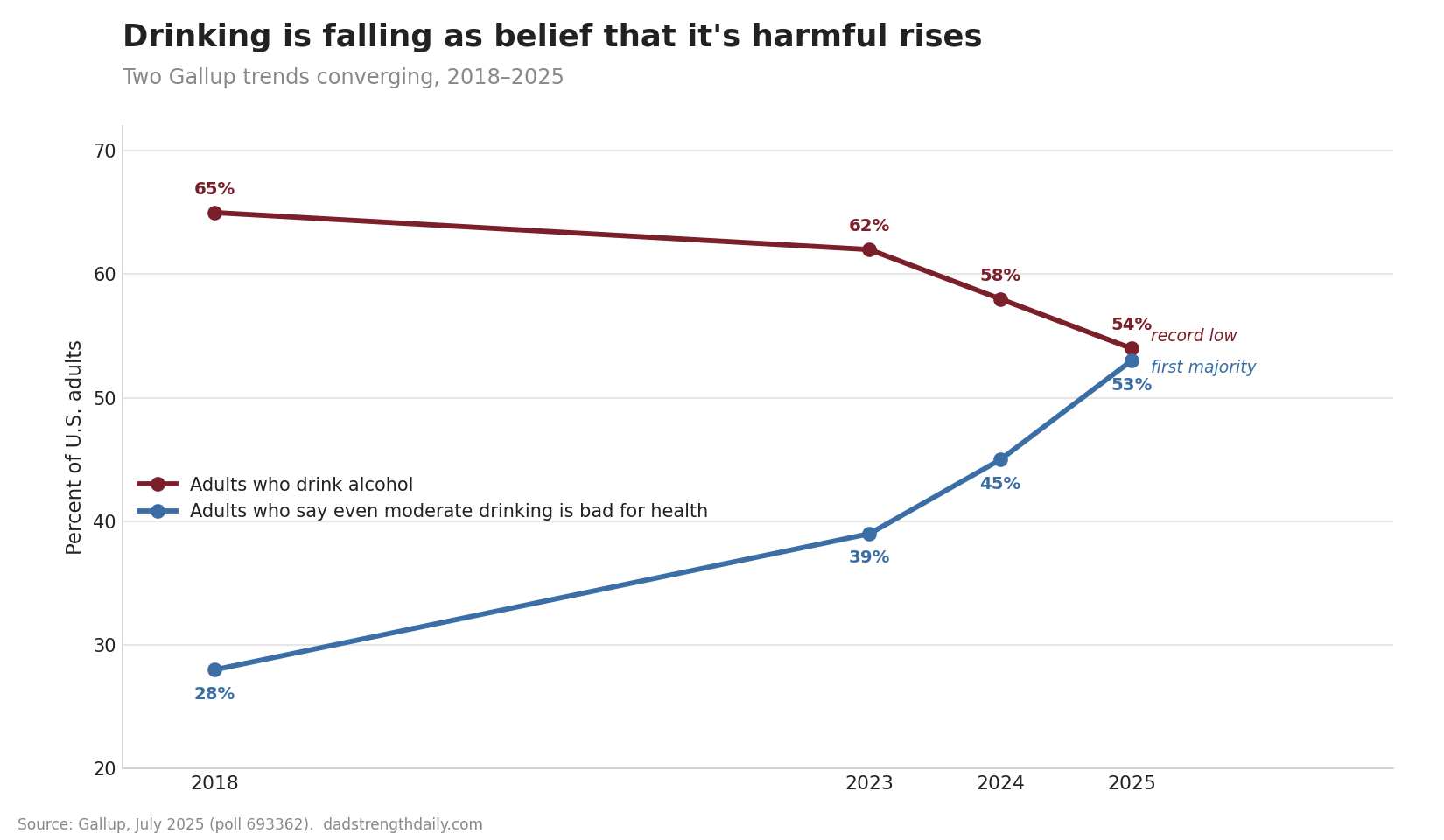
The speed is what I didn’t expect. In Gallup’s 2025 polling, the share of US adults who drink at all fell to 54 percent, a record low, and for the first time a majority, 53 percent, said even moderate drinking is bad for your health. The average is down to 2.8 drinks a week, the lowest since the 1990s and roughly half what it was in 2003. Drinking went down at the same time the belief that drinking is fine went down, and the two are obviously feeding each other.
The clearest signal is the kids. Past-year drinking among high school seniors has fallen from around three-quarters in the late 1990s to roughly 40 percent now, and most eighth graders say they’ve never tried alcohol at all. Whatever you think this generation is doing wrong, they aren’t drinking.
Some of that drop went somewhere new, and I’m on the somewhere-new myself, in a roundabout way. There’s early evidence that the GLP-1 drugs, the same class as the weekly shot I take for metabolic reasons, turn down alcohol craving as a side effect. The strongest piece so far is a single randomized trial in JAMA Psychiatry in early 2025 that gave low-dose semaglutide to people with alcohol use disorder and watched their drinking and cravings drop, backed by some earlier observational signals pointing the same way. That’s one small trial, not a settled result. It isn’t approved for drinking, it isn’t an alcohol-use-disorder treatment yet, and it’s no reason to start the drug, so I won’t oversell it. But it’s a strange thing to take a drug for your weight and read that it’s also quietly making people want to drink less.
There’s a smart counterargument worth taking seriously: that Americans aren’t just drinking less, they’re socializing less, and that the bar and the round and the shared bottle did real work holding people together. Writers like Ellen Cushing and Derek Thompson are right that the time Americans spend at social events has roughly halved in twenty years, and right that loneliness is a real cost. Where I land is that you can keep the ritual and drop the ethanol. The part of the round that mattered was the people, which is the whole reason non-alcoholic beer stopped being a punchline. People are showing up, ordering the thing without the alcohol, and as far as I can tell not losing anything either.
Even Germany is pulling back
I learned to drink in 1980s Germany, where the legal age was 16 for beer and wine and nobody thought twice about a teenager with a glass at a family dinner. Germany is one of the heaviest-drinking wealthy countries on earth, well above the US per person. So when I tell you that even there per-capita consumption is down by nearly a third since 1980, and the young people are going alkoholfrei anyway, take it as the strongest evidence I have that this isn’t just an American mood. If it can happen in the country that taught me to drink, the decline isn’t a fad.
I started this by saying I quit and lost nothing, and I meant it. I’m not a Prohibitionist, and I think Prohibition was a failure, both as policy and as a way of thinking about people. I don’t have a religious objection, and I won’t pretend the social pull of a drink isn’t real, because I grew up inside it. What I have is more boring than a moral position. I’m an engineer, so I treated my own drinking like any other variable and pulled it out to see what would happen. My sleep got better, my recovery got faster, and the only thing I actually gave up was a headache.
What I tell my two sons, who are still young enough that this is a future conversation and not a current one, won’t be a lecture about cancer statistics and risk curves. It’ll be closer to the truth as I’ve actually lived it: the thing was sold to all of us as a benefit, the benefit was never really there, and you can find that out before you spend thirty years on it instead of after. I found out late, and the only regret I have about quitting is that I didn’t do it a decade sooner. They can skip that part.
About Gunnar
Gunnar is 53. He lost about 170 pounds, trains in a garage gym, and writes DadStrengthDaily from personal experience, citing primary sources where he can. He also moderates r/ProactiveHealth. He is not a doctor, and nothing here is medical advice. Talk to your own doctor before acting on anything, especially GLP-1s, TRT, blood pressure, sleep apnea, and cancer screening.