
The most-studied legal drug in sports, sold backwards.
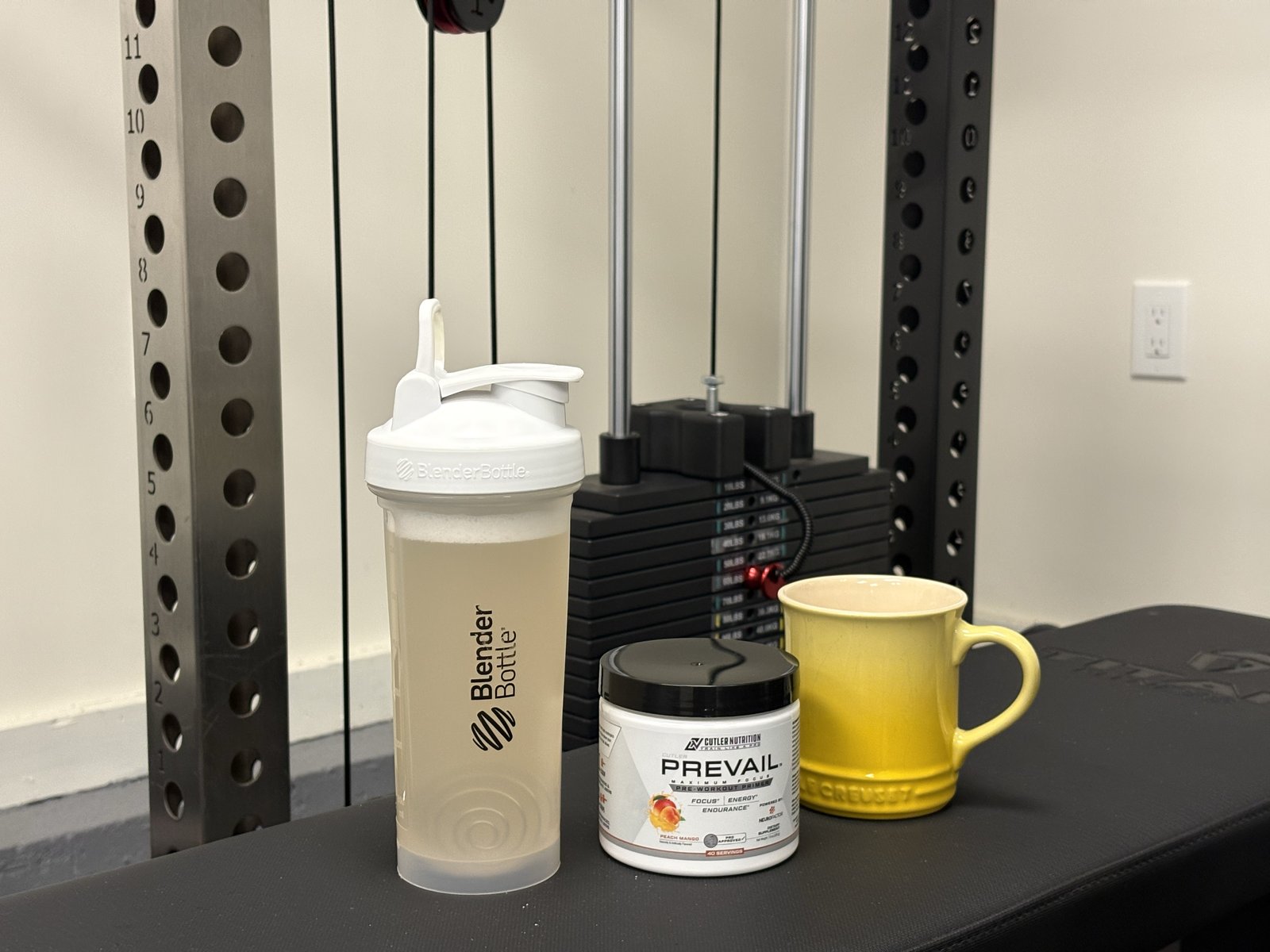
I order my coffee decaf. Then, on training days, I tip a scoop of pre-workout into a shaker bottle, about 180 milligrams of caffeine, and carry it out to the garage. The guy who won’t touch caffeine in a mug, drinking it on purpose from a plastic bottle before he lifts.
I treated that like a contradiction for a long time, a little guiltily, the way you treat any habit you can’t quite defend. Then I went and read the actual research on caffeine and training, and the more I read the more the decaf-plus-pre-workout routine started to look like the one part of my caffeine life I had accidentally gotten right. Caffeine is not good for you or bad for you. It is a dose, taken at a time, and almost everyone I know gets both the dose and the time wrong. The market that sells it to us is built to keep getting them wrong, because that is where the money is. And the mistakes cost more at fifty than they did at twenty-five, because the same dose now taxes your sleep harder and leans on a heart you may never have had checked.
What a scoop of pre-workout actually buys you
Get the next one in your inbox
I write about longevity, training, and preventive health weekly — without the guru worship. Free, no spam, unsubscribe whenever.
Caffeine is about as well-studied as a performance drug gets. When researchers pulled together 21 separate meta-analyses covering thousands of people, they found caffeine reliably improved endurance, muscular endurance, strength, and power. So it works. The honest part, the part the pre-workout ads leave out, is how much.
The effect is small, and it is biggest for exactly the kind of training most of us middle-aged guys do least. In that umbrella review the effect sizes ran from about 0.2 to 0.6, small to moderate in plain terms, with the larger numbers on the aerobic end and the smaller ones on raw strength. The International Society of Sports Nutrition’s position stand puts the endurance benefit at roughly 2 to 4 percent. For lifting, the numbers shrink. A meta-analysis of caffeine and strength found a real but modest bump, a standardized effect of about 0.20 for strength and 0.17 for power, with the upper body responding a bit more than the legs.
Two to four percent is not nothing if you race. If you are trying to add ten pounds to a squat in your garage, an effect size of 0.20 is the kind of thing you feel on a good day and can’t find on a bad one. Caffeine is a small, real edge, not an engine. Almost every one of those studies was run on young men. The research on people my age, and on women of any age, is thin, which the reviewers themselves keep pointing out. I take the edge. I just don’t pretend it is doing more than it is.
The doses that produced those effects run from 3 to 6 milligrams per kilogram of body weight, and the position stand notes the floor where you start to see anything is around 2 milligrams per kilogram. I weigh a little over 200 pounds, which makes my floor about 185 milligrams and the full lab range 270 and up. My single scoop, at about 180, sits right on the floor, the low end of where studies start to see anything, not some evidence-backed sweet spot. I did not plan that. I had to look up my own pre-workout’s label to find out, which tells you something about how most of us choose these things. Past 6 milligrams per kilogram you don’t get more performance, you just get more side effects. The mega-dosed pre-workouts that brag about 350 or 400 milligrams a scoop are not buying you a better workout. They are buying you a faster heart rate and a worse night’s sleep, and charging a premium for it.
The dose that helps, and the one that wrecks your sleep
The FDA puts the ceiling at 400 milligrams a day for a healthy adult, which is two to three cups of coffee, and calls that an amount not generally tied to dangerous effects. A 2017 review the agency leans on backed up the same number. It is guidance for healthy adults, not a personal clearance number, and high blood pressure, anxiety, or sleep that is already bad all argue for staying well under it. Go far above it fast and the picture changes quickly. The FDA estimates you can start seeing toxic effects, including seizures, with rapid consumption of around 1,200 milligrams.
Now actually run yesterday’s tally. The mug at home is about 95 milligrams. The refill is another 95. The energy drink somebody handed you at the kids’ tournament is 200. A scoop of the louder pre-workouts is 350 or 400 on its own. Most guys I know blow through the ceiling on an ordinary Tuesday without ever once deciding to take caffeine, which is the strange part of this whole drug. It is the only stimulant we dose by vibe.
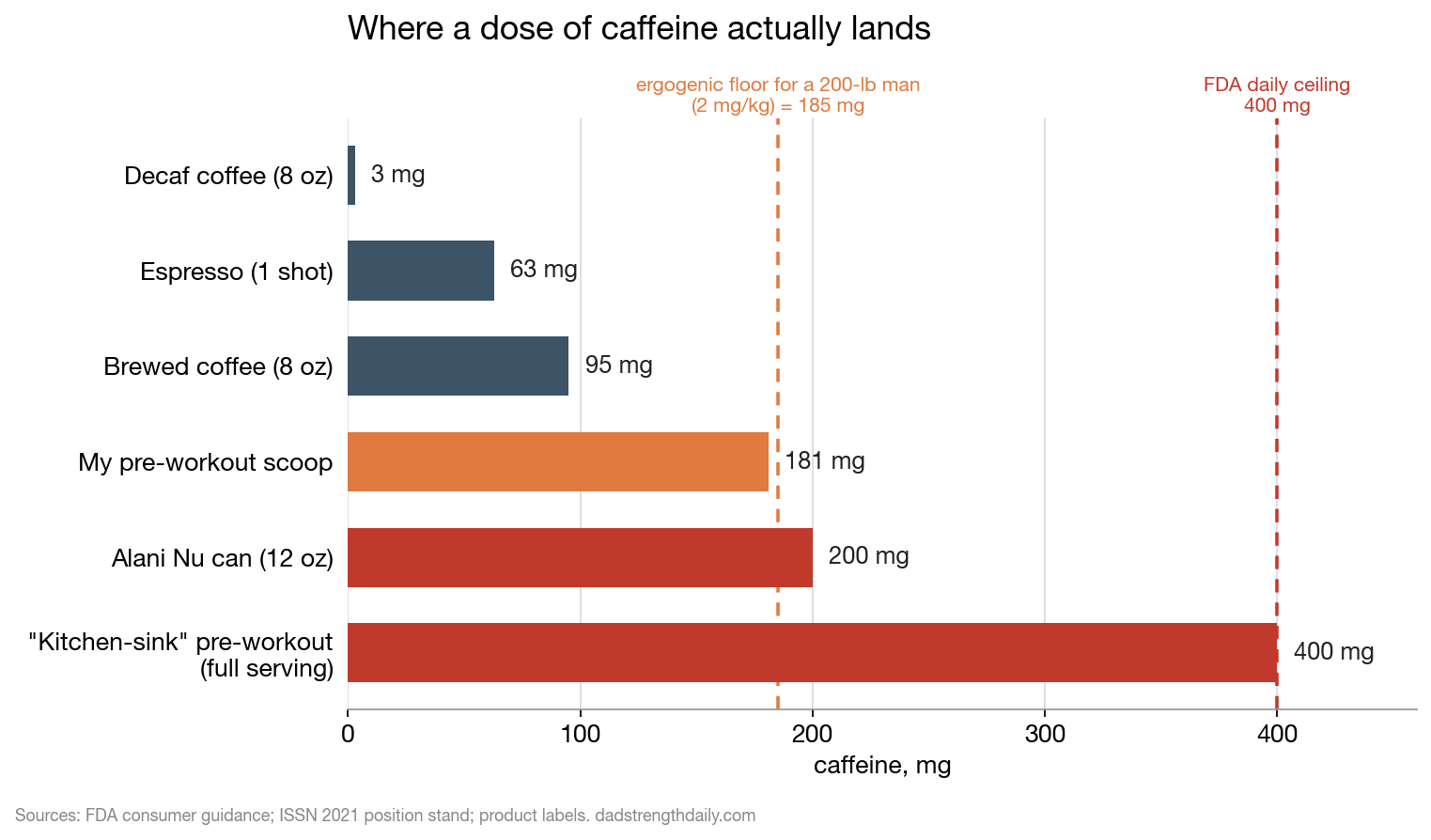
Hold the ceiling next to a single 12-ounce can of one of the popular energy drinks, which carries 200 milligrams. Half your day’s budget, in something you can drink in four minutes without noticing.
The number that changed how I actually live is not the ceiling, though. It is the half-life. Caffeine hangs around in your body for roughly five hours on average, and a lot longer in some people depending on genetics, your liver, whether you smoke. Five hours is the average, not the finish line. That means the coffee you drink at 3 in the afternoon is still half-present in your bloodstream at 8, and a quarter present at 1 in the morning.
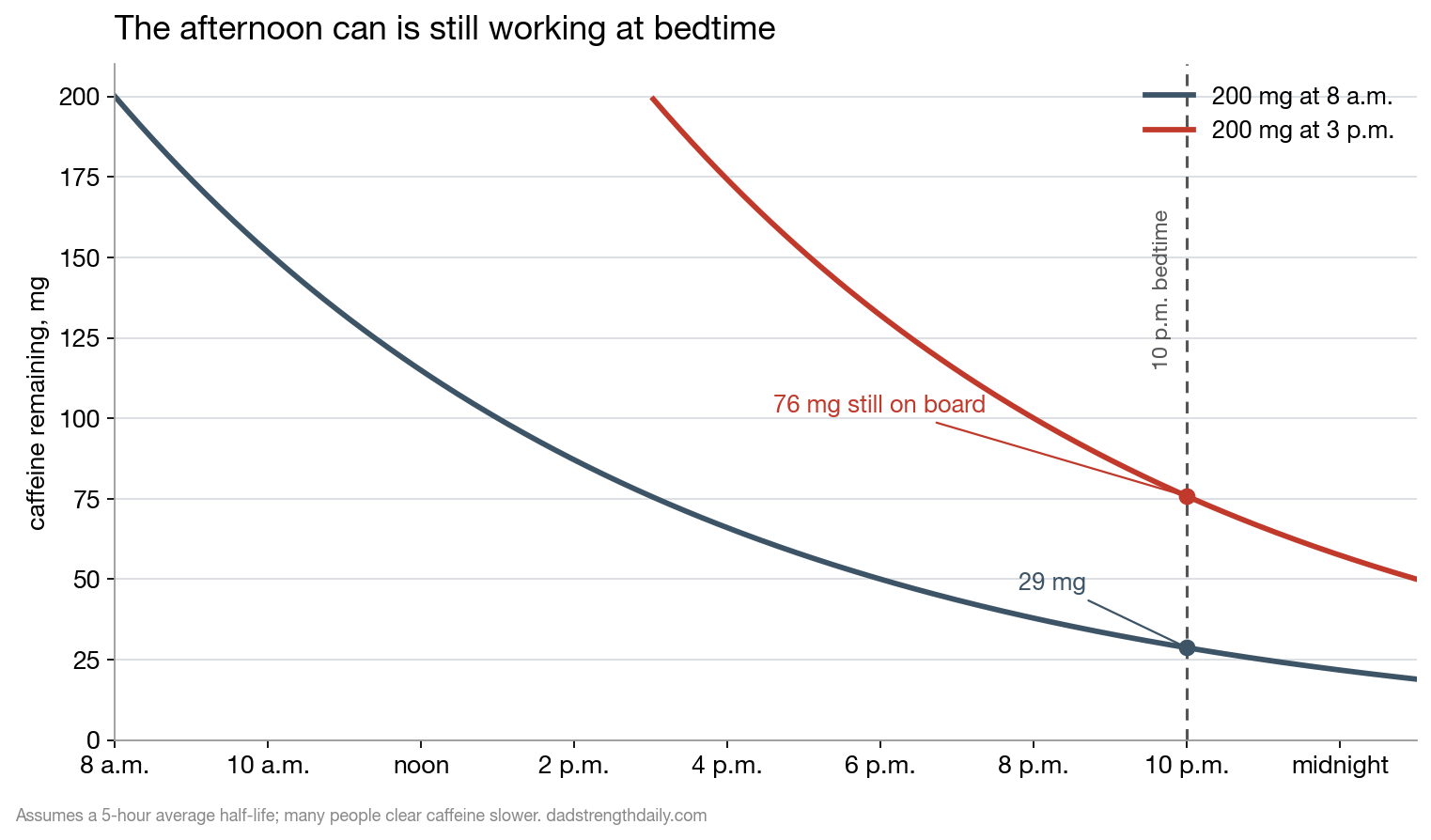
One study settled this for me. Researchers gave people 400 milligrams of caffeine at bedtime, three hours before bed, and six hours before bed, and measured their sleep with a monitor. The dose taken a full six hours before bed still cut measurable sleep. Six hours. The caffeine you can’t even feel anymore is quietly shaving time and quality off the night.
This is the whole reason my coffee is decaf. I wrote a long piece about what a year of my own sleep data did and didn’t show, and the least glamorous finding in it was that the boring stuff wins, and nothing is more boring or more reliable than not drinking a stimulant in the back half of your day. I get my caffeine in one deliberate hit before I train, and then I am done for the day. Decaf still has a trace, maybe 2 to 5 milligrams a cup, which is close enough to nothing that I can drink it at night and sleep. If you are a person who swears caffeine doesn’t affect your sleep, you might be right, because the genetics here are real and some people clear it fast. You might also just be someone who sleeps badly and has stopped noticing. The only way to know is to move your last dose earlier for two weeks and watch.
The 200-milligram can at the register
In June of 2026 the Texas attorney general opened an investigation into Alani Nu, the energy-drink brand owned by Celsius, over marketing a 200-milligram caffeine product to kids with bright cans and playful branding, after a family lawsuit tied to the death of a 17-year-old.
The kids-marketing angle is what makes the news. What bothers me is duller than the lawsuit. That same 200-milligram can sits in the cooler by the checkout at my grocery store, between the seltzer and the iced tea, with no more dosing context than a pack of gum. And the person reaching for it is at least as likely to be a fifty-something guy with a heart he has never had checked as a teenager. A 200-milligram stimulant is sold like it is a soda, to everyone, and if you don’t already know what that number means, the front of the can is not going to tell you.
The drinks are not just caffeine, and that turns out to matter. In a controlled trial, 32 ounces of an energy drink lengthened the heart’s QT interval, the electrical reset between beats, more than the same amount of caffeine in plain water did. That was a much bigger pour than one can, but it means something in the rest of the formula is acting on the heart’s electrical timing on top of the stimulant. A review of energy-drink cardiovascular effects catalogs raised blood pressure, palpitations, and a thin but real string of case reports linking the drinks to arrhythmias, heart attacks, and sudden death, usually in people who turned out to have an underlying problem they didn’t know about.
That last part is what I would watch if you are over 50. Plenty of people don’t know they have a rhythm problem until something leans on it. Atrial fibrillation gets more common with every decade past 50, and a lot of it is silent until something sets it off. A long-QT pattern can ride in your DNA for decades without a symptom. A 200-milligram can slammed before a hard session is one way to find out you had one of those, and that is not a test I am interested in running at fifty. I am not telling you a can of energy drink will stop your heart. I am telling you that “probably fine for most people” is doing a lot of quiet work in that sentence, and at our age the tail of that distribution is not somebody else.
The blend that won’t tell you the dose
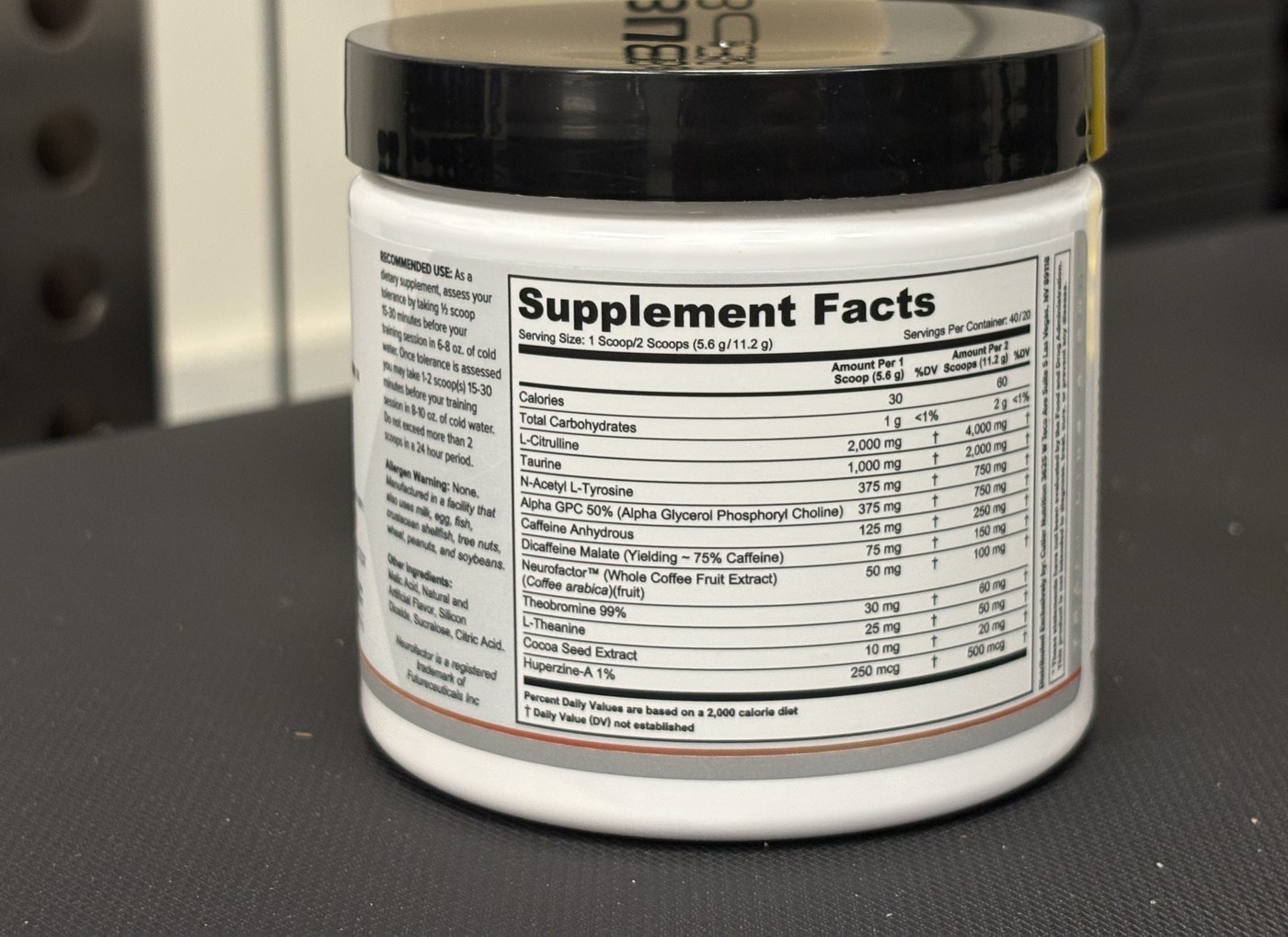
Here is the difference between my scoop of pre-workout and the tub next to it on the shelf, and it is the whole reason I will defend the one I use. My pre-workout prints its caffeine on the label, one column for a single scoop and another for the full two-scoop serving. A scoop is 125 milligrams of plain caffeine plus 75 milligrams of dicaffeine malate, a second form that the label itself notes works out to about 75 percent caffeine. So one scoop puts me around 180. The full serving would put me at about 360, most of a day’s budget in one shaker, which is why the second scoop stays in the tub. I can make a decision.
A lot of the category will not let you do that math. When researchers actually analyzed the labels of popular pre-workout supplements, they found the average product carried more than 18 ingredients, and that 44 percent of those ingredients were tucked inside “proprietary blends” that list a combined weight but never tell you how much of each thing is in there. Caffeine showed up in 86 percent of them, averaging 254 milligrams, but inside a blend you have no way to know whether your scoop holds 150 milligrams or 400. You are dosing a stimulant blind.
The blend is not just hiding the caffeine. It is the legal mechanism that lets a company bury an ingredient you would not knowingly take. The textbook case is DMAA, the amphetamine-adjacent stimulant inside Jack3d, which anyone who lifted in the early 2010s will remember as the most famous pre-workout ever sold. It took the deaths of two soldiers during physical training in 2011, a Defense Department ban from every base, and a 2013 FDA crackdown before that ingredient left the market. The part that should bother you is what happened next: DMAA’s chemical near-twin DMHA started showing up in new products, and a proprietary blend is the perfect place to keep a stimulant like that until the agency gets around to it. When a label won’t give you a real number, what you are paying for is not the supplement. It is the not knowing.
And caffeine, the boring legal one, can kill you if you concentrate it enough. The FDA has warned for years about pure powdered caffeine, the kind sold in bags online, where a single teaspoon carries roughly as much caffeine as 28 cups of coffee and the margin between a “scoop” and a fatal dose is a kitchen measuring error. At least two healthy young people died from it in 2014, which is what finally pushed the agency to move the bulk powder off the consumer market. None of that makes caffeine some hidden menace. It makes the dose the whole game, and anything that hides the dose has quietly taken the one number you needed to be safe.
How I actually use caffeine now
So here is the routine, which is duller than any supplement ad and has held up better than most of them. I keep caffeine to one deliberate dose, before training, where the evidence says it does something. The dose stays modest, one scoop and around 180 milligrams, near the bottom of the range that has any effect, because past a point you trade performance for jitters and a wrecked night. Nothing after midday, which is the whole reason the coffee at dinner is decaf. And I get it from something that prints the number on the label, so I am making a decision instead of taking a guess.
What I skip is the rest of it. The energy drink, because in big servings the formula has shown effects on the heart’s electrical timing that plain caffeine doesn’t, and it is sold like a soda anyway, and I am at the age where the underlying-condition asterisk is mine to worry about. The kitchen-sink pre-workout, because a proprietary blend is a polite way of refusing to tell me what I am putting in my body. And afternoon coffee, just because I would rather sleep.
None of that requires you to quit caffeine, and I haven’t. A real cup of coffee in the morning is fine, and if you train, a sane pre-workout dose will give you a small honest edge. At this point I just want the number, and I want it on the label. I want to know what time I took it. And when a company makes that part weirdly hard, I put the tub back on the shelf.
About Gunnar
Gunnar is 53. He lost about 170 pounds, trains in a garage gym, and writes DadStrengthDaily from personal experience, citing primary sources where he can. He also moderates r/ProactiveHealth. He is not a doctor, and nothing here is medical advice. Talk to your own doctor before acting on anything, especially GLP-1s, TRT, blood pressure, sleep apnea, and cancer screening.