
Your annual physical hands you a cardio number, and brisk walking covers most of it. A 147,000-person study over 30 years gives a rough number for the half of the guideline almost nobody counts.
I have heard the same sentence at the end of almost every annual physical: get about 150 minutes of exercise a week. It is good advice, and it is also the easiest advice in medicine to satisfy without really trying, because the official version literally uses walking as the example. The CDC writes it as 150 minutes of moderate aerobic activity “such as brisk walking,” roughly 30 minutes a day, five days a week. So most of us hear “150 minutes,” picture a few walks with the dog, and check the box.
What the doctor rarely says with the same precision is the second half of that same guideline. The CDC also recommends muscle-strengthening on two or more days a week, working all the major muscle groups. Notice what is missing. The cardio half comes with a number you can count. The strength half comes with “two days” and no sense of how much, which is probably why it is the first part people drop.
A new study in the British Journal of Sports Medicine gives the strength half a usable minutes estimate. It is one big observational study rather than a trial, so do not lean on it too hard. I still wanted the number, because a vague “two days a week” has never told me whether I am doing enough.
Where the curve looked best: 90 to 120 minutes
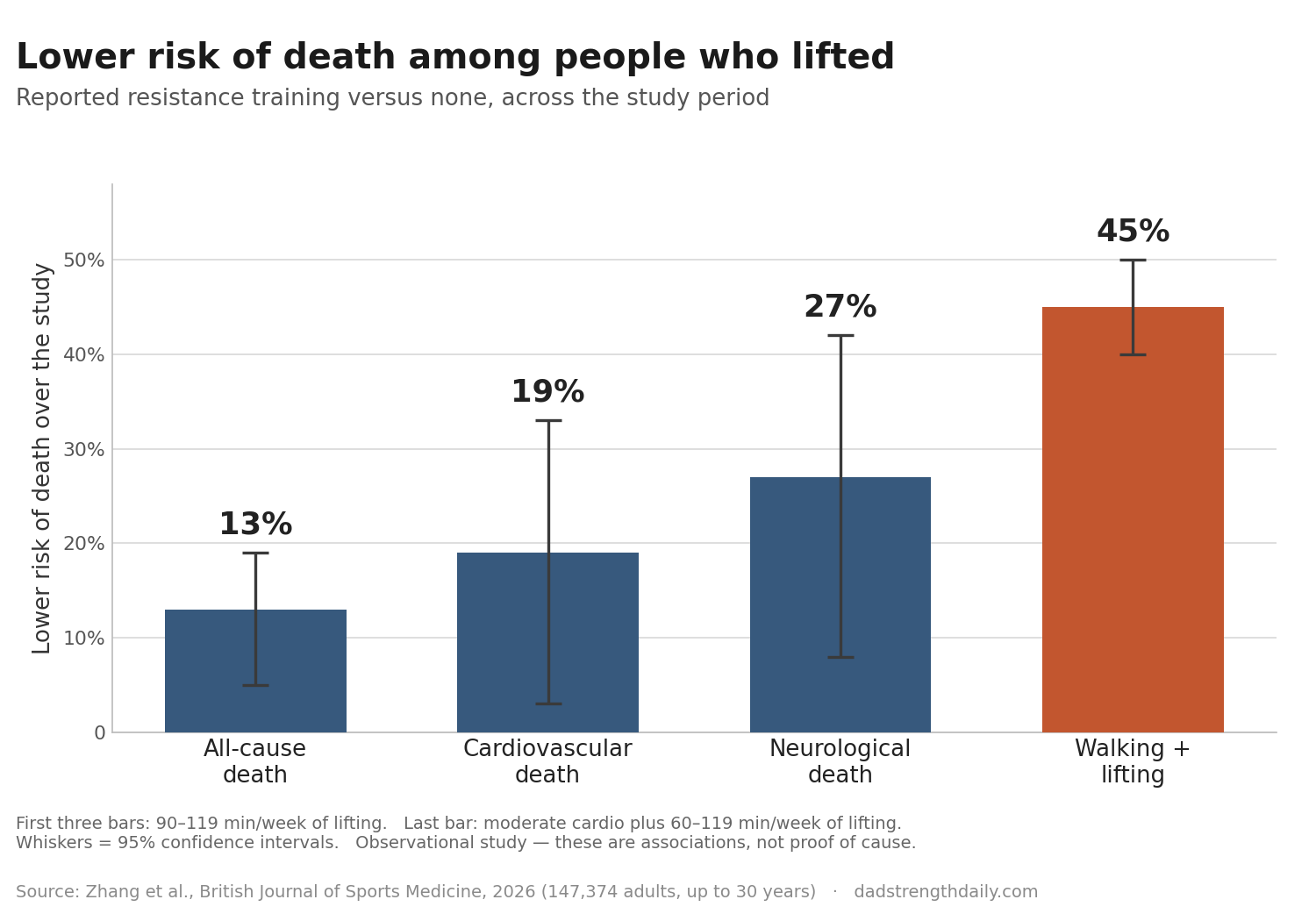
Researchers tracked 147,374 people across three long-running Harvard cohorts for up to 30 years, logged how much resistance training each one reported doing, and recorded 35,798 deaths. People who reported 90 to 119 minutes a week had a 13% lower risk of dying from any cause over that span, a 19% lower risk of cardiovascular death, and a 27% lower risk of dying from a neurological disease. Those are comparisons between groups, not a promise that any single man drops his own odds by 13%. In practical terms that is two or three focused sessions in the garage or at the gym, counting the working sets and not the scrolling between them, not a daily grind.
Then the benefit flattens. Past about 120 minutes a week the curve stops dropping. More time under the bar did not buy more years in this data, which is a useful thing to know if you have ever felt behind for not living in the gym. That one relieved me a little.
Get the next one in your inbox
I write about longevity, training, and preventive health weekly — without the guru worship. Free, no spam, unsubscribe whenever.
Walking and lifting, added together
What caught my eye was not the lifting number on its own. The lowest death rate in the whole study did not belong to the heaviest lifters or the most dedicated walkers. It belonged to people who did both, pairing a moderate amount of aerobic activity with 60 to 119 minutes of lifting a week. That group had a 45% lower risk of dying over the study period, lower than the walkers or the lifters alone. Read that carefully, though. These were people who already lived this way, not volunteers assigned to walk and lift, so the 45% is the distance between two kinds of people, not a result you can bank by bolting a habit onto your week. The walking your doctor already counts still helps. It just looked best with lifting next to it.
I would not read this as a reason to stop walking. Walking was already the easy, obvious half. Lifting is the half that finally has a rough target, and it is not a big one.
The catches
This is observational, and the space between a headline and the actual paper is where people get talked into things. It can show that lifters lived longer; it cannot prove the lifting is the reason. People who strength-train two or three times a week differ from people who do not in a lot of ways the researchers can adjust for only so far.
Two more things before you quote this across the dinner table. The three cohorts each enrolled one sex by design: the two Nurses’ Health Studies took only women, the Health Professionals study only men. That left the pooled sample about 79% women, so the male evidence here comes down to one cohort of roughly 31,500 men. Still a lot of men, but worth knowing when a single headline number blends everyone together.
Different outcomes had different curves, which is easy to miss when a study gets flattened into one number. The cancer finding runs opposite to the heart one. The small drop in cancer death showed up only at low doses, under an hour a week, and not in the 90 to 120 minute range. “Lift more, get less cancer” is not what this paper says. The all-cause and cardiovascular numbers are the ones I would lean on. The neurological figure is the eye-catching one, but its confidence interval was wide, so I hold it more loosely.
What I actually do
My own week looks nothing like that minimum. I follow a five-day plan, programmed by my coach, around an hour a session, and only part of each hour is the barbell work this study would count. The rest is a warm-up, some mobility, a core block, and on a couple of days enough cardio to get my heart rate up. I also ride an indoor bike for the easy aerobic miles. Add up only the lifting and I am well past the 90 to 120 minutes the paper calls the sweet spot.
I am not going to pretend that is the evidence-based optimum, because by this study it is not. I train five days because I like it and because a program I have to show up for keeps me consistent, not because the last hour of weekly squats is buying me extra years. The honest read points the other way from my own schedule. In this paper at least, the lower risk seems to land at a dose most people could hit in two or three sessions, and the days I pile on past that are for me, not for the odds.
If the only exercise instruction you have ever been handed is “about 150 minutes a week,” you were handed the easy half, the one brisk walking can absorb on its own. The other half finally has a rough target to aim at. I am not going to treat 90 to 120 minutes as a magic line, because one observational study does not earn that. But it is enough to keep me lifting on the days I would otherwise talk myself out of, and that is the part I would actually act on.
The full dose-response from this study is charted band by band, including what happens above two hours a week and how far the confidence intervals overlap.
About Gunnar
Gunnar is 53. He lost about 170 pounds, trains in a garage gym, and writes DadStrengthDaily from personal experience, citing primary sources where he can. He also moderates r/ProactiveHealth. He is not a doctor, and nothing here is medical advice. Talk to your own doctor before acting on anything, especially GLP-1s, TRT, blood pressure, sleep apnea, and cancer screening.