
Two dozen outlets ran the same scary headline in four days. Underneath is a strong mouse study with a weak human footnote, and the footnote is the part that went viral.
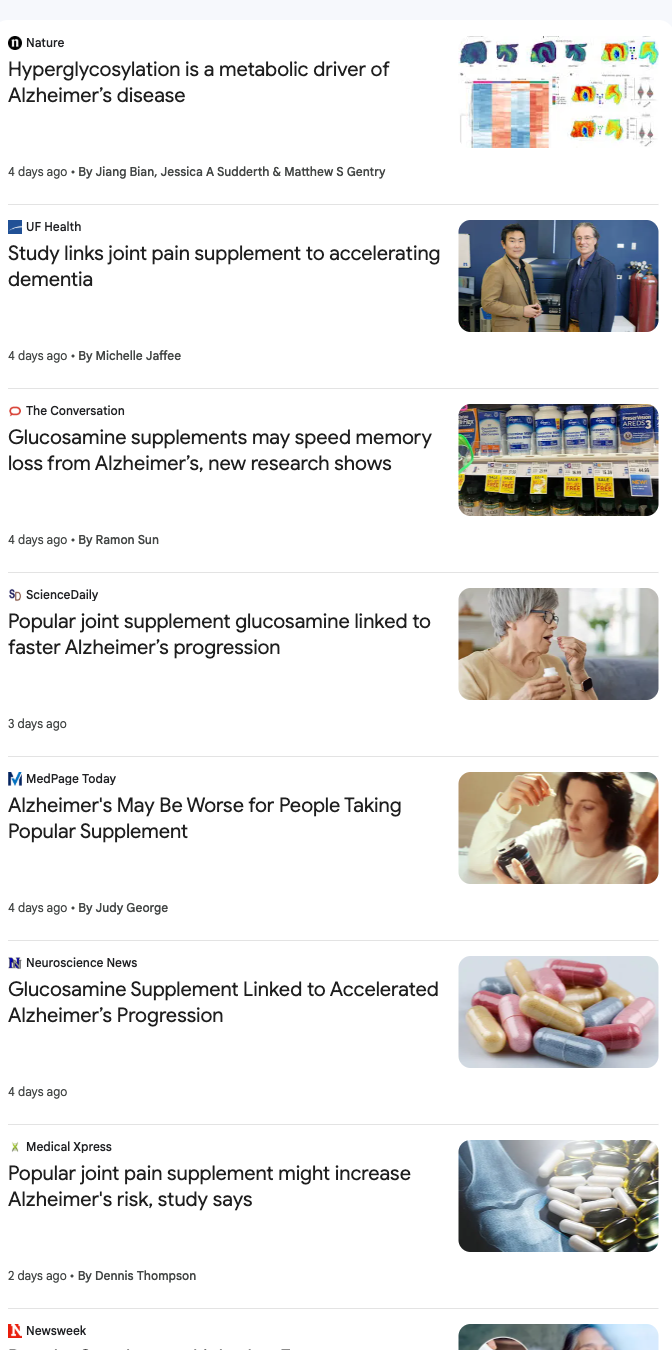
I almost shared the glucosamine headline before I read the paper. It came across my feed three different ways in one morning, all some version of “popular joint supplement linked to faster Alzheimer’s.” The screenshot above is what happens when you search the story now: roughly two dozen outlets, the same alarm, all inside four days. The audience this lands on is exactly mine, men around 50 with a bottle of glucosamine in the cabinet for cranky knees. Then I read the actual study, and the real story turned out to be more interesting than the scare, though not in the direction the headline wanted. It also helps to keep the actual question straight, because the headlines blurred it: not whether glucosamine gives a healthy person Alzheimer’s, but whether it might push along a brain that is already slipping.
If your memory and thinking are fine, this paper is not a reason to panic over glucosamine. If you already have memory trouble, that is a question for your doctor, not a headline.
What the study actually did
Much of the coverage I saw skipped what the paper actually is. It is a Nature Metabolism paper from Ramon Sun’s lab at the University of Florida, and at its core it is a basic-science paper about a process called glycosylation. That is just a normal bit of cell housekeeping where the body tacks sugar molecules onto proteins, not the sugar in your coffee finding its way to your brain. The researchers used mouse models and human post-mortem brain tissue to show that Alzheimer’s brains are stuck in overdrive on that sugar-coating pathway. They traced the chemistry, they knocked the pathway down genetically in mice and the mice did better, and then they fed mice glucosamine, which feeds that same pathway, and the mice did worse. That part is genuine, experimental, and the most defensible thing in the whole package, though the paper does not make it easy to say whether those mouse doses match the capsule a person takes for their knees. If the paper had stopped there, it would have been a solid mechanism paper, and much harder to turn into a viral health scare.
The scary number came from the weakest part
The headline came from the last step. To give the mouse work a human hook, the team ran a records analysis of patients at their own hospital system, about 24,000 with dementia and 41,000 with mild cognitive impairment. Among the ones with mild impairment, the early memory and thinking slips that are not yet dementia, glucosamine use went with a 25 percent higher chance of progressing to Alzheimer’s, and among those already diagnosed, a 25 percent higher chance of dying within five years. Both are relative figures, the bump compared with non-users, and the paper does not hand you the plain out-of-100 version that would tell you how big a jump that really is. A 25 percent increase could mean four people in a hundred becoming five, or twenty in a hundred becoming twenty-five, and those are very different worlds. Without the baseline, you cannot tell which one you are looking at. That is where the viral headlines came from, and it is the weakest part of the paper.
Here is why a records analysis like that earns a raised eyebrow rather than a fright. Glucosamine is not a prescription, so a hospital only knows you take it if a doctor happened to write it down, and the people who get that written down are not a random sample. The people who take glucosamine are the people with bad joints, who also tend to move less, weigh more, and are more likely to have diabetes. Several of those, diabetes and inactivity especially, affect brain health on their own, so a records comparison cannot tell you whether glucosamine did anything or whether it was just riding along with the rest. The study leaned on age-matched controls, which is thinner than it sounds, since matching two 74-year-olds does not make them the same person if one also has diabetes, carries more weight, and sees a doctor twice as often. There is no sign in the writeup that they adjusted for APOE status, the big inherited Alzheimer’s risk marker, for diabetes, or for the other usual suspects.
The authors themselves say plainly that they cannot show glucosamine causes anything, and that they had no data on dose or duration or brand. By their own logic, the clean trial that would settle it would be hard to justify, since you would be randomly assigning people already showing cognitive decline to a supplement you suspect makes things worse.
The larger human evidence points the other way
When you step back to the larger and better human evidence, it should keep you from panicking, because it runs opposite to the scare. One UK Biobank study of close to half a million people found regular glucosamine use linked to lower overall dementia risk, not higher, and it leaned on Mendelian randomization, a method that uses the gene variants people are born with as a kind of natural randomizer, which makes it less vulnerable to the confounding that muddies a plain records comparison. A separate Biobank study in older adults found glucosamine tied to less vascular dementia, and for Alzheimer’s specifically it found nothing, the result landing essentially dead on no effect. I could not find a large human dataset showing glucosamine drives Alzheimer’s. I want to be careful not to do the thing I am criticizing here, though. Those Biobank studies are observational too, and the honest read is that they are reassuring, not proof that glucosamine guards your brain. The Florida group explains the clash by guessing that glucosamine might protect a healthy brain while harming one that is already slipping, which is fair enough given their mechanism, but it is a guess resting on that one hospital’s records, not a finding anyone has reproduced.
Get the next one in your inbox
I write about longevity, training, and preventive health weekly — without the guru worship. Free, no spam, unsubscribe whenever.
Where the scare got manufactured
So who deserves the criticism here? Not really the scientists, who hedged their language in the paper and did some genuinely good bench work. The problem lives downstream, and you can watch it happen in that screenshot at the top. The University of Florida press office turned “associated with, in a retrospective sub-analysis” into “study links joint pain supplement to accelerating dementia.” The study’s own senior author wrote a plain-language version for The Conversation under a headline about glucosamine speeding memory loss. Then the science-news machine did what it does, which is reprint the press release. ScienceDaily, one of the most widely shared health-news sites, ran a near-verbatim copy of the university’s own announcement. By the time it reached my feed, every qualifier the authors wrote had been sanded off. The science had not suddenly become urgent either. The whole thing, the hospital-records analysis and its 25 percent numbers included, had been sitting on a preprint server since the spring of 2025. Nothing about the human claim was new this week. The peer-reviewed stamp and the press release were.
It would be easy to blame the journal here, and I started to. But the human analysis was not something Nature bolted on in peer review. It sat in the authors’ own preprint a year earlier, before a journal was involved. That is the part that actually bothers me. Nobody had to ask for a human hook. The pull to attach one to a strong piece of bench science, because a human angle is what earns a high-profile slot and a press release, is built in deeply enough that careful scientists add the shaky version themselves. The mouse work did not need the records analysis to be worth publishing. The records analysis is what let the whole thing get sold as a human finding it was never strong enough to be.
What I would actually do
If I were taking glucosamine, I would not toss it over this paper. I would judge it the way I judge any joint supplement, by whether my knees actually feel better after a couple of months, and quietly drop it if they do not. For a healthy brain, there is nothing here that says throw the bottle out, and the larger body of evidence does not point in the same alarming direction. If you or someone you love already has mild cognitive impairment or an Alzheimer’s diagnosis, the honest answer is that nobody knows. That uncertainty is worth two minutes with your doctor, not a decision made off a headline. Either way, the supplement is not the thing that should scare you this week. The speed at which a hedged paper became a frightening certainty is.
About Gunnar
Gunnar is 53. He lost about 170 pounds, trains in a garage gym, and writes DadStrengthDaily from personal experience, citing primary sources where he can. He also moderates r/ProactiveHealth. He is not a doctor, and nothing here is medical advice. Talk to your own doctor before acting on anything, especially GLP-1s, TRT, blood pressure, sleep apnea, and cancer screening.