
I grew up around cigarettes in Germany and watched them disappear. Here is what that turnaround can and cannot tell us about the war on soda.
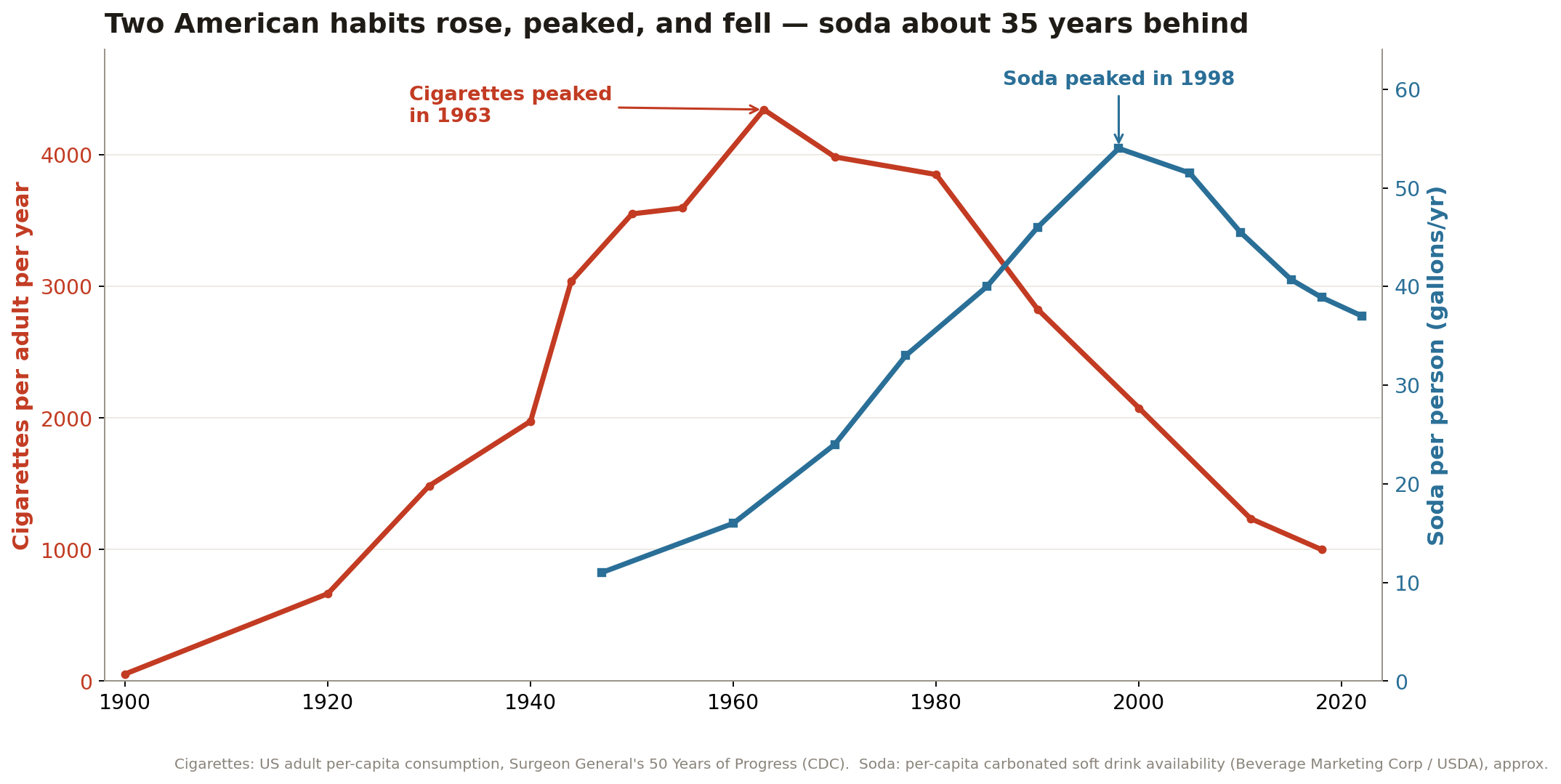
When I was a kid in Germany in the 1980s, cigarettes were simply part of the air. There were vending machines bolted to the wall outside the corner shop, at kid height, taking coins from anyone who walked up. People smoked on the train, in the restaurant, in the office, in the doctor’s waiting room. My memory of adult life back then is partly a memory of smoke, on coats and in curtains and hanging under every ceiling.
Germany was not some outlier that cleaned up early either. It was one of the last holdouts in Europe. As recently as 2007 it ranked near the bottom of the continent on tobacco control, and the indoor smoking bans most countries take for granted only arrived here in 2007 and 2008, decades after the science was settled. I bring that up because it makes what happened even stranger to me. Smoking still collapsed. In the United States, adult smoking has gone from roughly 42 percent in 1965 to around 11 percent today, and the picture across the rich world looks similar. Something turned a universal habit into a minority one inside a single lifetime, mine, and it did it even in the country that dragged its feet.
So now I keep reading about the same energy being aimed at sugary drinks. Berkeley and Philadelphia taxed them. Mayor Bloomberg in New York tried to cap the size of a fountain soda. Chile slapped big black warning labels on the front of the bottle. Friends ask me whether any of it does anything, and for a long time my honest answer was that I had no idea. In our house we mostly drink Coke Zero. My wife and kids reach for the occasional Mexican Coke, the kind made with cane sugar, as a treat. I had no idea whether the policies in the news were serious public health or just theater.
So I looked for the research. The short version surprised me, and it changed how I think about the whole fight. Bans, taxes, and labels are not interchangeable tools that happen to point at the same problem. They work in completely different ways, and the thing that separates them is not really how much they reduce soda overall. It is who they reach.
I want to put one thing on the table now rather than spring it later. Both habits, smoking and drinking a lot of sugar, have ended up concentrated among people with less money and less education. It did not start that way. It became that way, and how it became that way is what the soda fight is now repeating. So the honest question about any soda policy is not whether it looks tough. It is whether it reaches the families most exposed, or only the people who were already going to be fine.
What actually turned cigarettes around, and who quit first
There was never one magic intervention with cigarettes. The 1964 Surgeon General’s report told Americans smoking caused cancer. Warning labels went on packs in 1965. Television and radio ads were banned in 1971. Taxes climbed for decades. Workplaces and restaurants and then bars went smoke free, late in Germany as I said, but eventually everywhere. Each piece did some work, and untangling exactly how much credit the little warning label deserves versus the tax or the ad ban is genuinely hard. They all worked together.
But there is an uncomfortable part of that story that almost nobody mentions, and it is the part that matters most for soda. The decline did not happen evenly. Before 1964, smoking was spread fairly evenly across rich and poor, and if anything it skewed a little toward the affluent, because it had been sold as glamorous and aspirational. After the health information started flowing, the people who quit first and fastest were the educated and the well off. The gap kept widening from there. Today smoking is heavily concentrated among lower income and less educated Americans. The steep class gradient in smoking that we now treat as a natural fact of life did not exist before the warnings. It was created by who responded to the information first.
The pattern underneath is simple once you see it. Some policies ask you to act, and some just change the world around you. The first kind hands you information and waits for you to do something with it, using your own knowledge, money, and time. A warning label is the purest example, a health campaign another. The trouble is that the people best equipped to act on information, the ones with stable schedules and disposable income and a doctor they trust, act on it first. So the tools that lean on you to act tend to help the comfortable before anyone else, and they can widen the health gap instead of closing it. The other kind, the structural kind, does not ask. A tax, a ban, or a change to the product itself does not care whether you read the pamphlet. It moves the price, the shelf, or the recipe for everyone at once. The tobacco research bears this out. Cigarette taxes consistently narrowed the gap between rich and poor smokers, because people with less money are more sensitive to price. Information campaigns, and even some workplace bans, sometimes widened it.
I find that genuinely clarifying, because it means the right question about any soda policy is not just “does it reduce soda.” It is “who does it reach, and does it reach the people carrying the most disease.” Once I started sorting the soda fight that way, the three tools stopped looking alike.
Get the next one in your inbox
I write about longevity, training, and preventive health weekly — without the guru worship. Free, no spam, unsubscribe whenever.
What a warning label can and cannot do
Chile ran one of the cleanest real-world tests we have of a label-heavy policy package. In 2016 it rolled out one of the most aggressive food policies in the world, anchored by those black octagon warnings on anything high in sugar, salt, calories, or saturated fat, paired with bans on selling those products in schools and limits on marketing them to kids. A 2026 study in The Lancet followed more than 300,000 Chilean schoolchildren and found something real. Kids exposed to the policy through kindergarten and first grade were measurably less likely to be overweight, with girls about 2.85 percent less likely and boys about 2.4 percent. Against a baseline where more than half of Chilean kids carry excess weight, that is roughly a 5 to 6 percent relative drop, modest but real, and the researchers were careful to call it a plausible cause rather than a proven one.
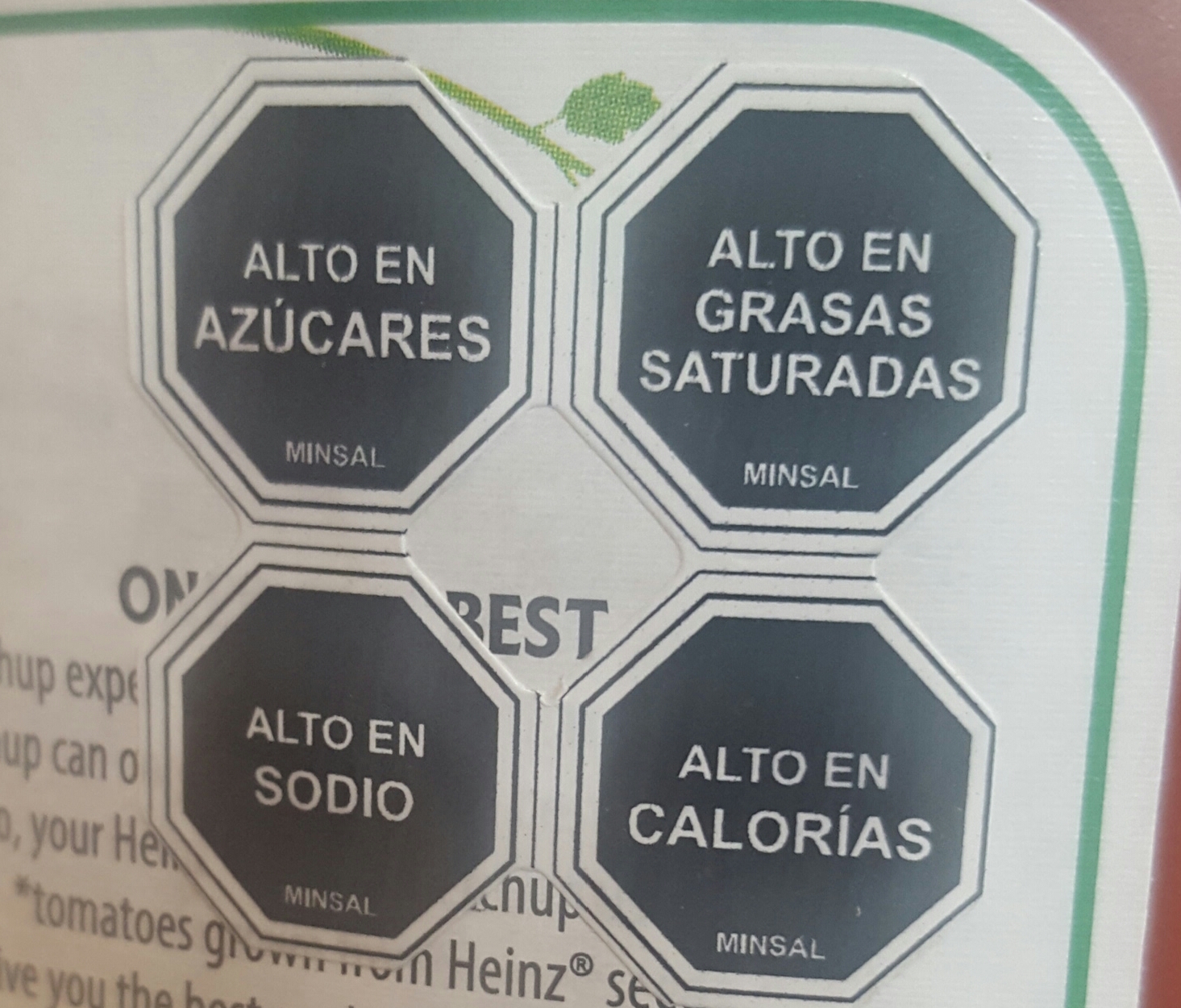

The headlines skipped two things, and the cigarette pattern predicts both. First, that result is from the whole package, the labels and the school bans and the ad limits together, not the octagons alone. You cannot actually credit the label by itself. Second, and this is the part that stopped me, the benefit was not evenly spread. The effects showed up among kids in urban schools, in subsidized schools, and among kids whose mothers had at least a high school education. For the lowest education group, the families you might most want a public health win to reach, the effect was not statistically significant. That is the cigarette fingerprint again. The detectable benefit showed up among the people already positioned to act on it.
The United States, for its part, has almost no warning labels on sugary drinks at all. San Francisco passed a law requiring such warnings on soda ads, and the beverage industry got it struck down in court on First Amendment grounds, arguing the city could not compel that speech. So the American debate over soda labels is mostly hypothetical.
To be fair to labels, the picture is not one sided. In controlled experiments, where you sit people down and show them a warning, pictorial labels reduce how much sugary drink people choose, and encouragingly the effect in those lab settings does not differ much by income or education. The problem shows up when researchers leave the lab. A recent review out of the University of Sydney found that food warning labels cut sugar intake across the population, but when they looked specifically at lower income shoppers, the ones carrying the heaviest disease burden, the evidence thinned out fast. Their conclusion was blunt. Labels alone are probably not enough to close the gap unless you also deal with what sits underneath it, the cost of healthy food, access to it, and the marketing aimed at the people you are trying to protect. A label tells you something. It does not change the price, and it does not change the product. That turns out to be the whole game.
Why the tax is the lever that reaches the people who need it
If the label is the tool that waits for you to act, the tax is the one that does not, and the data on soda taxes surprised me most, because it runs exactly opposite to the label pattern.
Mexico is the big case. In 2014 it put a tax of one peso per liter on sugary drinks, about a 10 percent bump. Purchases of taxed drinks fell around 7 percent overall in the first couple of years, which is solid but not shocking. The striking part is who cut back. The decline was largest among the poorest households, which averaged about a 9 percent reduction in the first year and were buying roughly 17 percent less than expected by the end of it. That is the inverse of the label story, and the reason is not complicated. Lower income people are more sensitive to price, so when the price goes up they respond more, not less. The tax everyone calls regressive ended up hitting hardest in the households that also carry the most diet related disease.
Britain did something even smarter with the design. Its 2018 levy was tiered, meaning the tax scaled with how much sugar the drink contained. That gave manufacturers a reason to reformulate rather than just pass the cost along, and they did, pulling roughly 46 percent of the sugar out of the drinks covered by the levy. So a lot of the British effect did not even require anyone to change what they bought. The product itself got less sugary on the shelf. And when researchers looked at outcomes, obesity among 10 and 11 year old girls dropped about 8 percent, with the biggest reductions in the most deprived areas. On that one measure, obesity in 10 and 11 year old girls, it is a rare case of a policy narrowing the gap instead of widening it, because reformulation reaches the kid whose parents never read a single article about sugar.
The standard objection here is the beverage industry’s favorite, and it is not wrong on its face. Soda taxes are regressive in dollars. A lower income family that keeps buying soda pays a larger share of its income in tax than a rich one does. True. But two things sit against that. The disease the tax is fighting is regressive too, concentrated in exactly those households, so the health benefit lands disproportionately on the people paying the tax. And cities have learned to recycle the revenue, with Philadelphia funding pre kindergarten and San Francisco funding water access and health programs in low income neighborhoods. One analysis across three American cities found low income communities got more back in services than they paid in tax. A tax can be regressive on the receipt and progressive in health at the same time, and the stronger soda-tax studies point that way, at least on what people buy. Whether the purchase drop fully carries through to less disease is the harder, slower question.
The bans keep dying in American courts
The bluntest tool of all is the outright ban, just making the product, or the size, unavailable. It has the worst track record in the United States.
The famous attempt was Michael Bloomberg’s in New York City. In 2012 the city moved to cap sugary drinks at 16 ounces in restaurants, movie theaters, and street carts. The tabloids called it the soda ban and the nanny state, and in 2014 New York’s highest court killed it. What is interesting is that the court did not rule on whether it would work. It ruled that the city’s Board of Health had overstepped its authority and that the rule was arbitrary because it applied so unevenly. A giant cup at the corner restaurant was capped, but the even bigger one at the 7-Eleven next door was exempt, because convenience stores and supermarkets fell under different rules. That hole was fatal in court, and honestly it would have been fatal in practice too, because the supermarket aisle is where most soda actually gets bought. A ban with that many exits does not change much.
That pattern repeats. The San Francisco warning label I mentioned earlier died on free speech grounds. The New York cup died on separation of powers grounds. The direct, environment changing levers keep hitting a wall in America that they do not hit in Mexico or Britain, part courts and part a deep cultural reflex against being told what to put in your own cup. Having grown up where cigarette machines stood at kid height on the sidewalk, I find that reflex a little selective about when it shows up.
The soda restrictions that did survive here are the quiet ones. Getting full sugar soda out of schools was part of Chile’s package, and the United States did its own version through school nutrition rules. Those stuck precisely because nobody could frame them as policing an adult’s lunch. They were about what we choose to sell to kids in a building we control. Same lesson as everywhere else in this story. The structural lever works, but in America only the versions that avoid the overreach fight survive.
Sixty four countries did this, and the US mostly sat it out
The scale of all this caught me off guard. A 2026 study in The Lancet Global Health tracked sugary drink taxes across 183 countries over 34 years. As of 2024, 64 countries tax sugary drinks at the national level, covering about 3.5 billion people, roughly 43 percent of the planet, and adoption has accelerated sharply since 2017. The United States is not one of them. We have a handful of city taxes, Berkeley and Philadelphia and Seattle among them, and even those live under constant repeal pressure. On the single biggest structural lever, the country that practically invented modern public health messaging has barely moved.
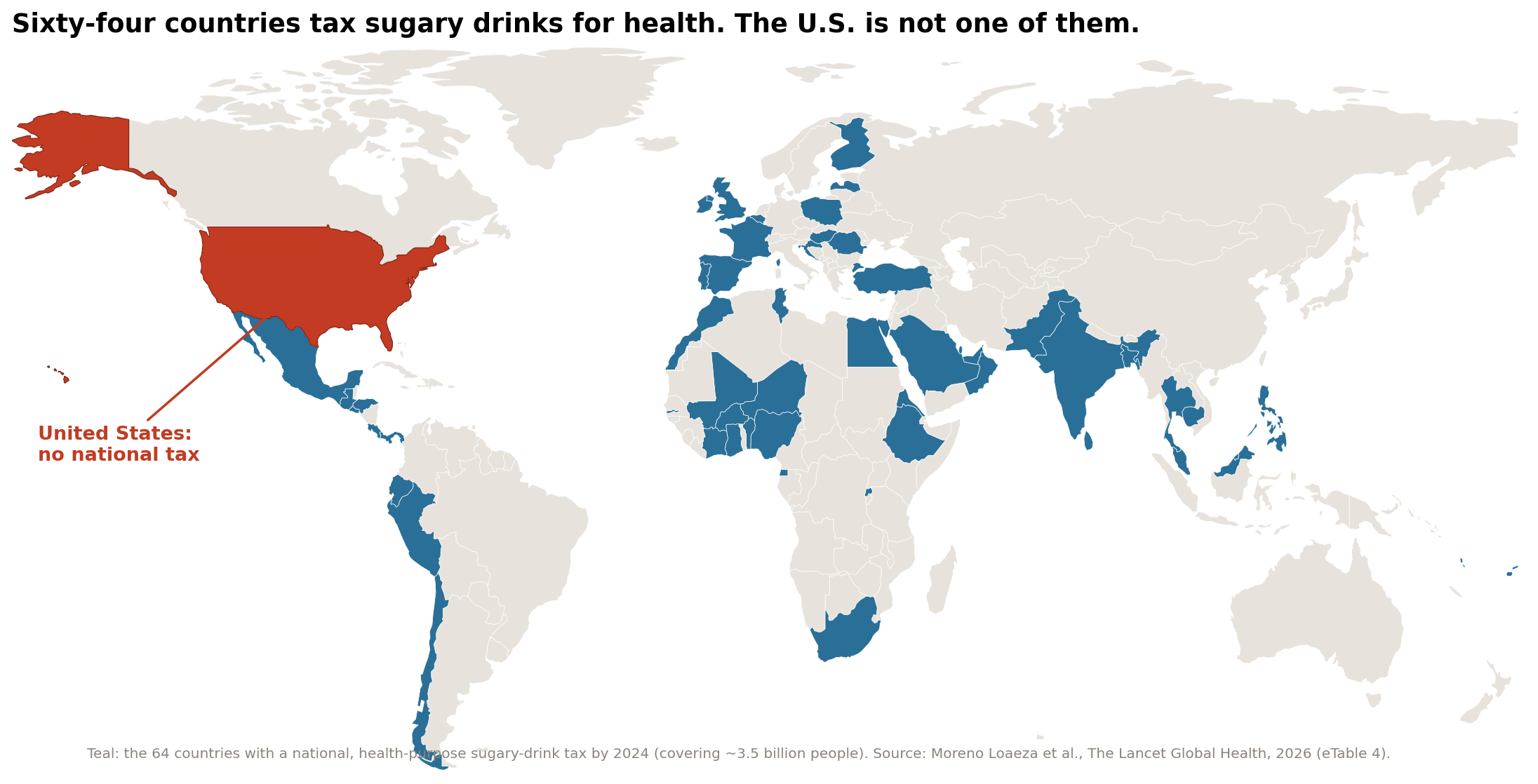
The study also asked what makes a country adopt a tax, and the answer is its own kind of indictment. Adoption tracks a country’s diabetes and obesity burden, and its government’s capacity and independence from industry pressure, but it does not track how much soda the country actually drinks. Nations tax sugary drinks when the disease bill comes due and when they have enough independence to face down the beverage lobby, not when consumption itself is high. And the cruelest detail, the one that ties the whole thing back to the cigarette lesson, is about design. The tiered sugar tax, the British model that pushes companies to reformulate and reaches the kid whose parents never read a word about sugar, is the version that looks most promising, precisely because it changes the product rather than relying on shoppers to change. It is also the least used, in only about 11 percent of the countries with a tax. Most places reach for the bluntest instrument. We know which lever works best and we mostly decline to pull it.
What I actually do in my own kitchen
So where does that leave my house, with its Coke Zeros in the fridge and the occasional Mexican Coke my wife and kids genuinely enjoy?
The first thing reading all this did was take the moralizing out of it for me. Almost every policy I just described targets sugar, not diet drinks, so my daily Coke Zero is not really what a soda tax is aimed at. Whether artificial sweeteners carry problems of their own is a separate question, and not one I am going to settle here. The Mexican Coke is real cane sugar, the actual target, and in our house it is a treat a few times a month, not a daily habit. A treat enjoyed occasionally is not the thing public health is trying to engineer out of existence. The thing it is trying to change is the default, the 20 ounce bottle that is cheaper than water and marketed hardest to the people with the least.
That is the shift in how I think now. For years I treated soda as a personal virtue test, a matter of whether I had the discipline to skip it. The cigarette story says that framing is mostly a distraction. Smoking did not collapse because a generation of people suddenly found willpower. It collapsed because the price went up, the ads went away, and eventually you could not light up on the train. Even Germany, the laggard, the country where I watched men smoke over their breakfast, got there in the end, and it got there through the environment, not through lectures. My own choices at the grocery store matter for me and my kids, but they are not where the big numbers move. I followed the same cigarette thread into the lunch aisle in a piece on Lunchables and ultra-processed food.
If a friend asked me what actually matters here, this is what I would say. The label is the part that talks to you, and it mostly reaches the people who were already listening. The tax and the reformulated drink work on everybody else. They do not ask the buyer to do anything. They just change what is on the shelf and what it costs. We spend enormous amounts of money and attention downstream, on weight loss drugs and clinic visits and apps, while one of the cheapest upstream fixes we have is spreading across 64 countries and we have barely touched it. I find that genuinely frustrating, mostly because I lived through the best example I have of the upstream approach working. I breathed it in for the first 20 years of my life, and then I watched it go away.
About Gunnar
Gunnar is 53. He lost about 170 pounds, trains in a garage gym, and writes DadStrengthDaily from personal experience, citing primary sources where he can. He also moderates r/ProactiveHealth. He is not a doctor, and nothing here is medical advice. Talk to your own doctor before acting on anything, especially GLP-1s, TRT, blood pressure, sleep apnea, and cancer screening.