
Researchers found that people on weight-loss drugs took fewer steps after starting them. I got lighter and moving got easier, which left me with a question: why did everyone else slow down?

I almost scrolled past the headline, and then it stopped me, because it described the opposite of what happened to me. Researchers at this year’s Endocrine Society meeting reported that people who started a GLP-1 drug, the Ozempic and Zepbound family, moved less after they began treatment, not more. I am on Zepbound. I have lost a lot of weight on it. And the single most obvious change in my daily life was that moving got easier, not harder. So I went and read what they actually found.
The study pulled from the NIH’s All of Us research program, which links medical records to Fitbit data, and tracked 753 adults with obesity who started one of these drugs. Average age was about 52, which is to say my demographic. After they began, their daily steps fell from roughly 5,000 to 4,500, and their minutes of brisk, get-a-little-winded activity dropped from 28 a day to 22. The declines were largest in two groups: men, and people with joint or muscle pain. And the weight they lost never showed up as the bump in movement you might expect.
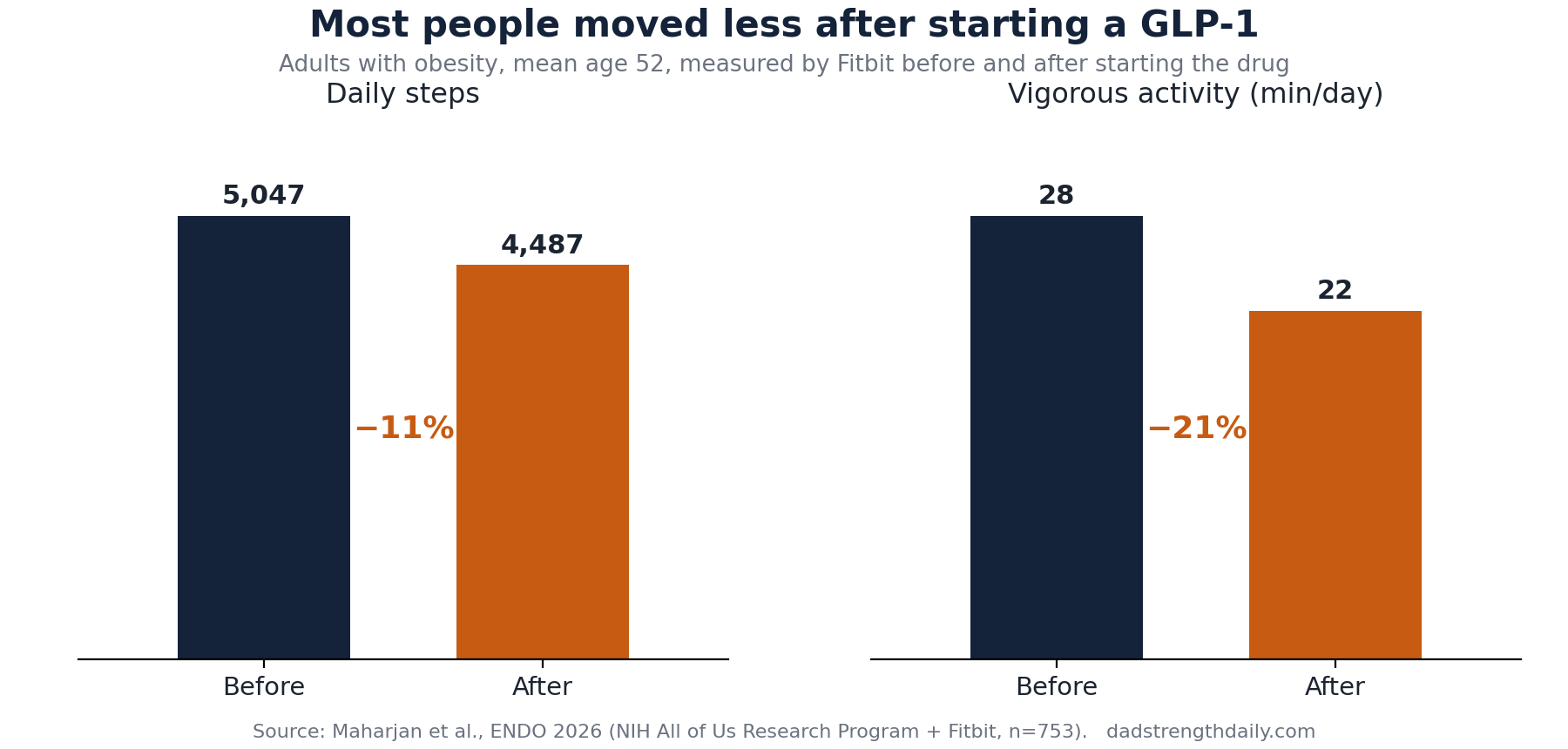
This is conference data, not a finished paper, and it is observational, so it can show that activity fell but cannot prove the drug caused it. The Fitbit crowd is not a random sample, and the finding about men comes from a group that was mostly women. Take it as a flag, not a verdict.
Here is what nobody tells you about losing a large amount of weight. The first thing that changes is not your willpower or your discipline. It is the physics. Hauling less mass takes less energy, so movement gets mechanically cheaper whether you train for it or not. By the time I was a hundred pounds lighter, ordinary movement had quietly stopped being work. I was not following a step plan. I just noticed that the body I was hauling around had gotten smaller, and everything I did with it cost less.
The clearest example is the dullest one. Stairs. I used to get to the top of a normal flight and need a second to collect myself, a little winded, a little annoyed about it. Now I go up and down without thinking, without the breath catching. I did not train for that. The stairs just got easier because there was less of me to lift.
I want to be honest about the limits of my own example, because the easy version of this story is a lie. I am not a guy who walks ten thousand steps a day. I have a bad knee (the bike and the rower are how I work around it), long walks are not my thing, and they probably never will be. So this is not the part where the weight falls off and I become a runner. What changed was smaller and more boring than that: the baseline cost of moving through a normal day dropped, and so, without deciding to, I moved through that day more.
Get the free Bloodwork Decoder
I made the one-page cheat sheet I wish I’d had at my first physical: what every number on your labs actually means, what’s worth aiming for at 50, and what to ask your doctor. Subscribe free and I’ll send it straight to your inbox. No spam, nothing to sell.
If being lighter makes movement cheaper, and it does, why did the people in that data move less instead of more? Cheaper movement does not automatically become more movement, not when appetite, energy, and the drive to move may all be shifting at once.
The researchers gave the obvious answer, and it is probably part of it. Rapid weight loss is tiring. When you are eating a lot less, exercise can feel like a tax you cannot afford, so you skip it. Fatigue is real, and it is enough to explain some of the drop.
There is a second answer, and it comes from a different corner of the research. In animal work posted this year, not yet peer reviewed, mice given semaglutide chose to run less on their wheels. The part that matters is why. It was not that they were too weak or too underfed to run. When the researchers made the mice work for access to the wheel, the drugged ones would not push as hard for it. They were not too weak to run. They wanted it less. And the brain’s reward system, the same wiring these drugs act on to quiet the urge to eat, looked turned down around running too.
If that holds up in people, and that is a real if, it reframes the whole thing. These drugs do not only make food less loud. They may make movement less compelling, the same way and through the same wiring. You would not feel it as “I can’t.” You would feel it as “I don’t really feel like it,” which is sneakier, because it never announces itself as a side effect. It just quietly makes the couch a little more appealing than it used to be.
That, I think, is what separated my experience from the study’s. For me, the physics getting easier won. For a lot of people, something else won, fatigue, or maybe that quieter drive to move. Both can be true, and which one wins is not entirely a matter of character.
It is worth adding the movement back, and not only on my say-so. In a year-long randomized trial, researchers took people who had just lost weight on a diet and assigned them to a GLP-1 drug, an exercise program, or both. The drug alone worked. The drug plus moving worked better, and kept the weight off best. That was liraglutide, an older drug than the ones in the headlines now, but the lesson travels: the medicine handles the weight, and moving is what you add to it.
Structured exercise helps. But for anyone reluctant, busy, or working around a bad knee, the practical version is not a program, and I do not think it needs to be. The window these drugs open, where moving suddenly costs less, is worth spending before something else claims it. You do not spend it with a gym membership or a couch-to-5K. You spend it in the small, daily ways you would otherwise hand to the path of least resistance.
Michael Easter makes a point I liked: only about two percent of people take the stairs when there is an escalator right next to them. We have engineered effort out of daily life so thoroughly that adding a little back is almost free.
I work on the fifth floor. For most of my life I took the elevator without a thought, because the elevator was easier and I was carrying too much of myself to want the stairs. A few weeks ago, with Easter’s line in my head and a body that no longer protests, I started taking them. Four flights. It is nothing, and that is exactly why it works. It is the kind of movement that does not require motivation I might no longer have, because it is already built into getting where I was going anyway. And it is not quite nothing. Short daily bouts of stair-climbing measurably raise fitness in people who were doing nothing, and in a pooled analysis of more than 400,000 adults, regular stair climbers had lower rates of cardiovascular death. You do not have to buy the mortality math to take the point. The stairs were free the whole time.
The drug did its job. It turned down the noise around food, the weight came off, and my life is better for it. But if these early signals are right, it may also be turning down the noise around movement, quietly enough that I would miss it if I were not looking. My story went one way. Yours might go the other. The weight coming off buys you a stretch where moving is easy. Take the stairs while they’re easy.
About Gunnar
Gunnar is 53. He lost about 170 pounds, trains in a garage gym, and writes DadStrengthDaily from personal experience, citing primary sources where he can. He also moderates r/ProactiveHealth. He is not a doctor, and nothing here is medical advice. Talk to your own doctor before acting on anything, especially GLP-1s, TRT, blood pressure, sleep apnea, and cancer screening.