
The tobacco-to-lunchbox history is real and pretty damning. The “ultra-processed food is poison” headline is shakier than it looks, and both can be true at once.
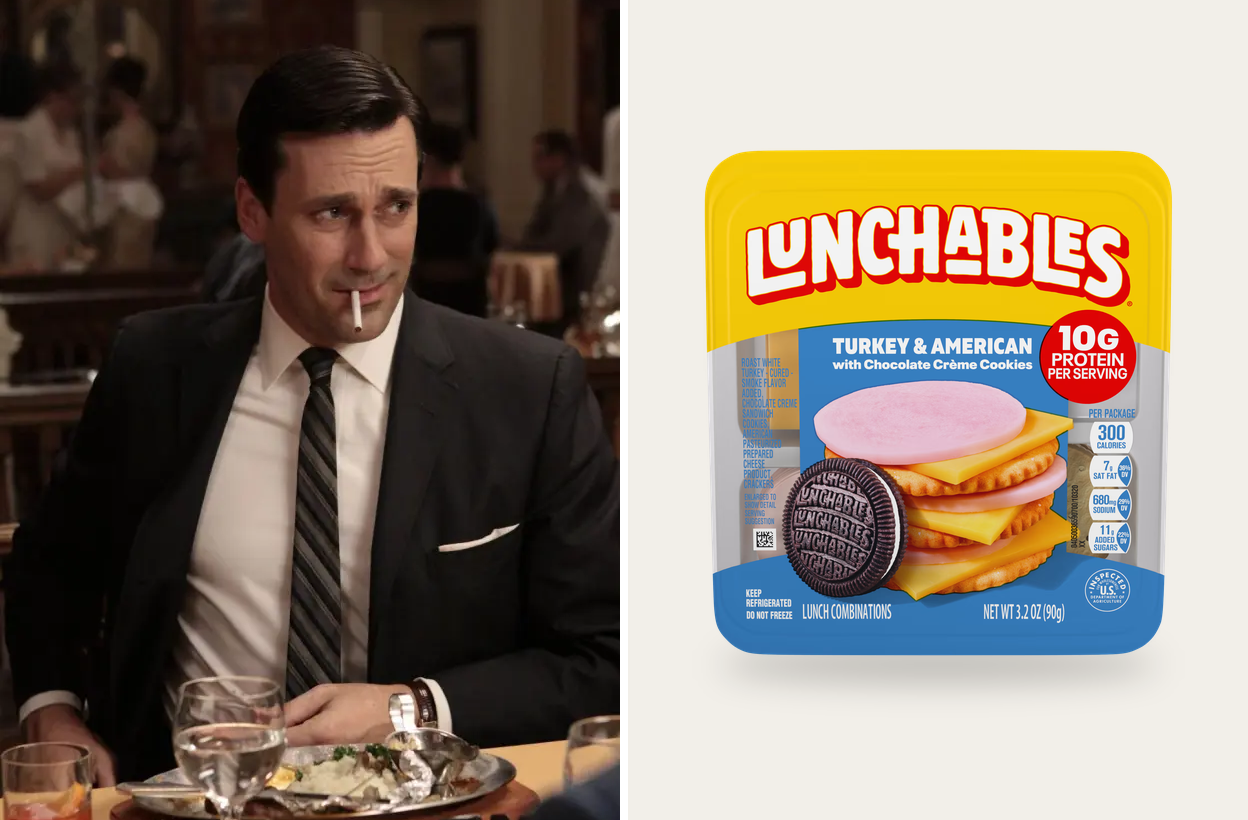
I have two school-age kids, so this one landed close to home. In 2023, two reformulated versions of Lunchables quietly qualified for the National School Lunch Program, the federal program that feeds around 30 million lower-income children. Kraft Heinz told investors the school market was a “$25 billion growth opportunity” and said the product had been built for schools.
Then it came apart. Consumer Reports bought twelve of these lunch kits and found measurable lead in every one, with a turkey and cheddar version reaching 74 percent of California’s daily limit for a child. The recipes tweaked to qualify for schools, the ones with a little added whole grain, came back saltier than the versions on store shelves. One tray climbed from 740 milligrams of sodium to 930. The school version was not really a healthier product. It was one engineered to clear a rulebook. Inside a year, Kraft Heinz pulled Lunchables from the program and pointed to slow sales.
The part I didn’t know is older and stranger. Lunchables came out of Oscar Mayer, a food company, but one a cigarette company owned at the time, and it borrowed the tobacco side’s research labs and its instincts for getting people to keep buying.
That history is having a moment. NPR ran it this week under a headline calling ultra-processed food the new war on tobacco, built on the same batch of research a public health journal published this month. The tobacco part is real, and I will get to it. What the three-minute version leaves out is the science underneath, which is shakier than the slogan and matters more for what actually goes in your cart. The question I keep coming back to, standing in the freezer aisle as a parent, is narrower than the outrage: how much of this do I need to worry about, and how much is noise?
How a cigarette company shaped Lunchables
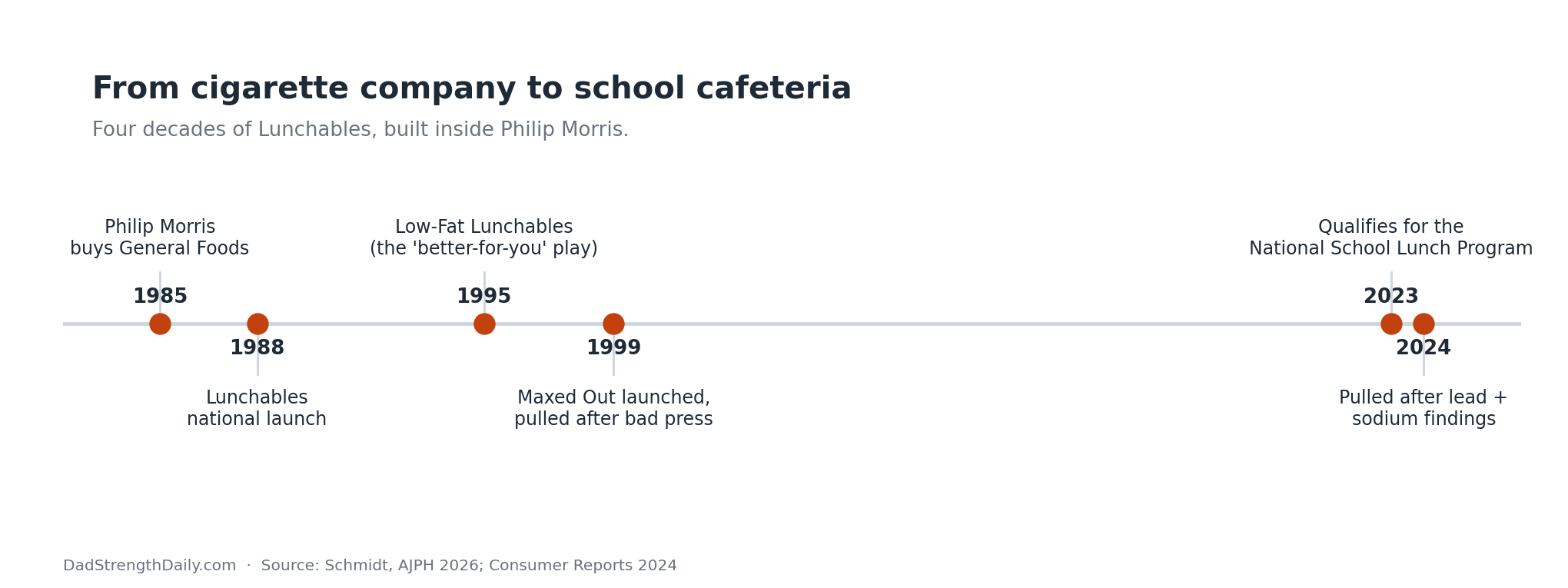
In the 1980s, Philip Morris, the company behind Marlboro, went on a buying spree and picked up General Foods and then Kraft. A public health researcher at UCSF named Laura Schmidt recently went through the company’s internal records, which are public now only because the tobacco lawsuits of the 1990s forced them into an open archive. What she found is that Philip Morris did not treat food and cigarettes as separate businesses. It ran a “Technical Synergies Committee” whose job was to move methods and people back and forth between the tobacco labs and the food labs.
Two of those tricks ended up inside Lunchables. The first was what the company called consumer-driven product development. In the Lunchables documents, that meant engineering the food to be as easy to keep eating as possible. One executive, talking about how the company found what people wanted, put it like this: “We don’t create demand. We excavate it. We prospect for it. We dig until we find it.” The Lunchables team built seventeen prototypes by watching kids play with food in a room stocked with plastic and scissors, chasing the child’s desire for control and permission to make a mess.
The second trick is the one that should bother you most. When American parents started worrying about fat and childhood obesity in the 1990s, Philip Morris reached for a strategy it had already perfected on smokers. A competitor review by a rival tobacco company had concluded that Marlboro’s real genius was “getting the guilt out of the product.” So the company applied the filtered-cigarette logic to lunch and rolled out Low-Fat Lunchables. The documents make it read less like a health upgrade than a way to keep guilty parents from walking away. The same extraction technology the company had used to pull nicotine out of tobacco was turned on meat and cheese to pull out fat.
It did not always work cleanly. A 1999 line called Lunchables Maxed Out packed nine grams of saturated fat and fifty-four grams of sugar into a single tray and drew enough bad press that the company killed it. Two years earlier the American College of Cardiology had already called Lunchables a “blood pressure bomb.”
Schmidt has skin in this fight. She works as a paid expert witness for plaintiffs suing infant-formula companies. But the documents she is quoting are not her opinion. They are the company’s own memos, and they say what they say.
Get the next one in your inbox
I write about longevity, training, and preventive health weekly — without the guru worship. Free, no spam, unsubscribe whenever.
What the engineering does to a real body
The documents tell you what Philip Morris was trying to build. They cannot tell you whether the building worked: whether food tuned that way actually makes a body eat more, or whether “ultra-processed” has just become a scary label we slap on the whole modern diet. Lunchables is one engineered example of the broader category nutrition scientists now call ultra-processed food. To find out whether the engineering does anything, you need someone who put the tuned food and the plain food head to head.
The single best piece of evidence is small, short, and run under conditions nobody actually lives in, and it is still the best we have. The nutrition scientist Kevin Hall brought twenty adults into a hospital ward at the NIH in 2019 for a month and controlled everything they ate. Two weeks on a diet of ultra-processed food, two weeks on minimally processed food, with the two diets matched for calories, sugar, fat, salt, and fiber. What still differed was the processing itself, how calorie-dense the food was and how fast it went down. The same things Philip Morris had spent decades dialing in. People could eat as much or as little as they wanted. On the ultra-processed weeks they ate about 500 more calories a day and gained weight. On the other weeks they lost it. Same person, same offered calories, different food.
That is a genuinely impressive result, and Hall has been honest in a way the headlines usually are not. He said plainly that he did not yet know which specific feature of the food was driving people to overeat. A follow-up trial published in 2025 tightened the screw. This time both diets were built to hit the UK’s healthy-eating guidelines and were matched on nutrients, and the minimally processed group still lost about twice as much weight over eight weeks, roughly two percent of body weight versus one percent. So there is a real signal here, and it has now shown up in more than one controlled trial. It is also modest, a percentage point of body weight over two months, and the size of it, the mechanism behind it, and how well it carries into normal life are all still being argued over. Soon after, the same journal ran a published rebuttal questioning how much to read into the result.
And Hall’s open question has an answer that points straight back at the tobacco labs. The features that seem to drive the overeating are energy density, how many calories are packed into each bite, and hyper-palatability, those engineered combinations of fat, salt, and sugar that go down fast, before your stomach has caught up. Those are largely the same properties the Philip Morris scientists were tuning forty years ago when they talked about excavating demand and getting the guilt out. The food was not bad because it went through a factory. It was bad because it was built to be eaten fast and in volume, in the specific ways that make the body’s fullness signals easy to ignore. “Ultra-processed” is a blunt stand-in for that design.
Two ways to read the scary numbers
I also think the case against this food gets oversold the moment people start quoting the biggest risk numbers as if they were settled. If you have seen the alarming ones, ultra-processed food raising the risk of death from heart disease by half, or dementia by 58 percent, those come almost entirely from observational studies. Those can show that people who eat the most of this food also get more disease, but they struggle to prove the food is the cause, because heavy ultra-processed eaters tend to differ in a dozen other ways. And the way the numbers get framed is quietly stacked.
The big BMJ review that pooled this evidence is more careful than its press. It graded the strength of each link, and only a handful, death from heart disease, type 2 diabetes, anxiety, and common mental disorders, came out as convincing. Nearly a third of the associations it looked at had no solid evidence at all. And those frightening percentages are built by comparing the people who eat the most ultra-processed food, around 80 percent of their calories, against the people who eat the least, around 15 percent. When you measure the risk for each additional slice of ultra-processed food instead, the numbers shrink to something like four to seven percent per ten percent of calories. It is the same data told two ways, and the headlines always reach for the scary one.
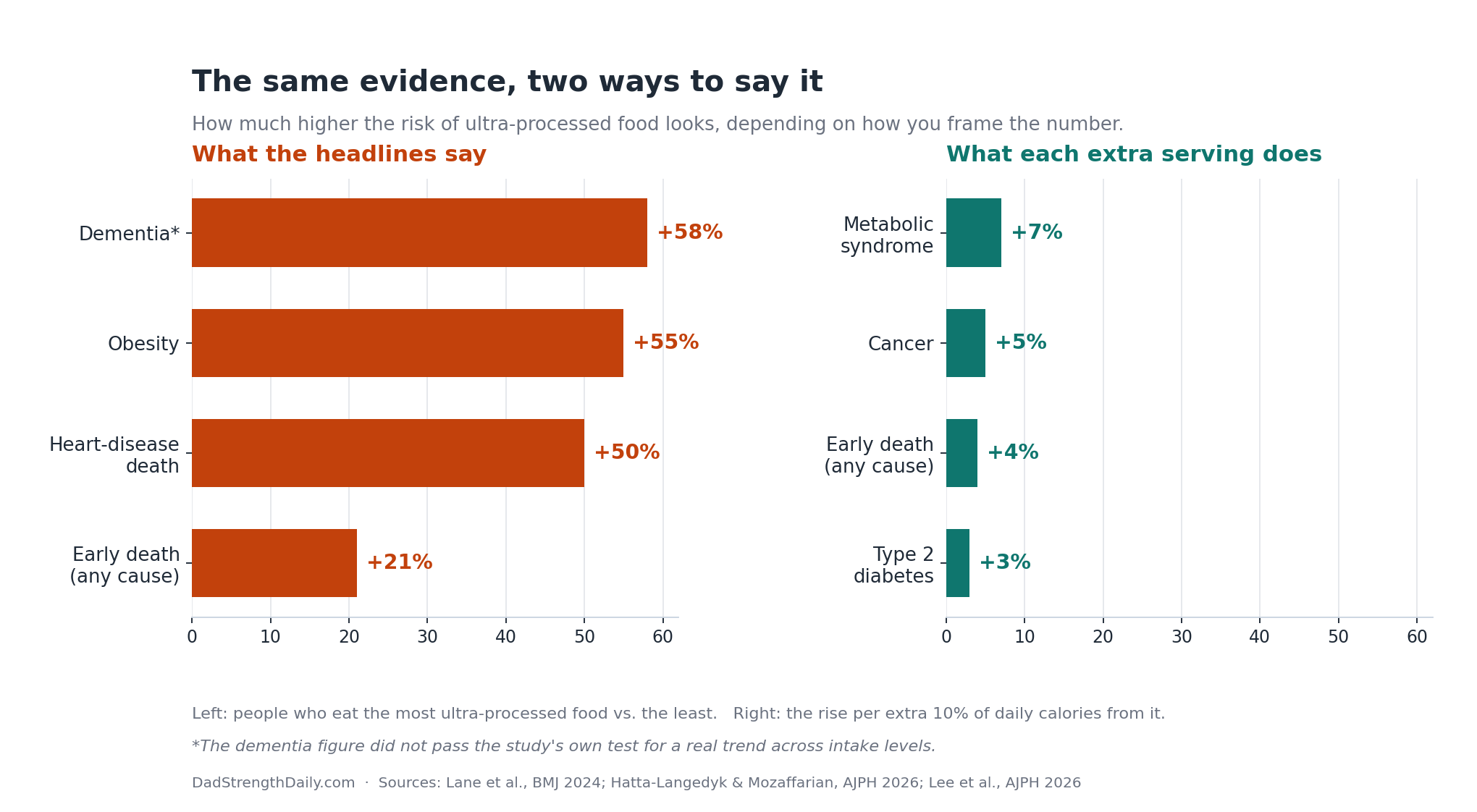
The dementia number is a good example of how this goes wrong. The study behind it found a higher rate in the heaviest-eating group, but the risk did not climb steadily as intake rose, and that trend failed the study’s own significance test. The number that got turned into “ultra-processed food raises dementia risk by more than half” came from a result the authors could not call statistically reliable. It is the same study NPR pointed to this week as a possible link to dementia, without the part where the link did not pass the study’s own test.
Then I noticed the byline. One of the papers making the skeptical case, showing that overall diet quality predicts health more consistently than ultra-processed share, was co-written by Laura Schmidt, the same researcher who dug up the Lunchables documents. The people building the case against this food are themselves finding that the processing label is a clumsy tool. Part of the reason is that almost nobody eats a clean diet that is also high in processed food. Barely a third of one percent of Americans manage a high-quality, low-processed diet, so in the real world “ultra-processed” and “junk” describe nearly the same plate, which makes it very hard to blame the processing on its own.
And the category really is clumsy. Most supermarket bread is ultra-processed. So is most breakfast cereal, most yogurt with anything added, and the protein bar in my gym bag. Even Chris van Tulleken, the British doctor who wrote the book arguing this food is a public-health emergency, admits the official definition runs nine paragraphs that almost no one has read or could repeat. When California passed a first-in-the-nation law in October to take the worst of this food out of school meals by 2035, it could not use the academic definition. It had to write its own, built on nutrient limits plus a list of industrial additives, because the textbook version was too vague to enforce.
The lawsuits are not hypothetical, either. NPR raised them as something that might arrive someday, the way states once sued tobacco. San Francisco already filed one in December, suing ten of the largest food companies, Kraft Heinz and PepsiCo among them, for borrowing the cigarette playbook to drive overconsumption. Soda is where that fight started, and I went through what taxes, warning labels and bans have actually done to sugary drinks.
My rule at the grocery store now
I am not a clean-eating purist, and it would be dishonest to pose as one. I lost a lot of weight over the last two years while eating frozen meals and protein bars that a strict chart would flag in red. The GLP-1 I take did most of the work on my appetite, but the food still mattered, and the processing label was not the thing I was tracking. I was watching the numbers that actually move my health, things like protein, fiber, calories, and sodium, which is a different question than how many factory steps my dinner went through.
So I have stopped trying to sort my groceries into clean and unclean. Frozen broccoli, canned beans, and plain Greek yogurt are all processed, and they are all fine. I do skip romaine, but that is a food-safety call rather than a nutrition one. What actually holds up is narrower and more useful. In my house, the food that was engineered to be overeaten is the food I overeat, so I keep less of it around and stop pretending willpower is the variable. That is the honest lesson of the Philip Morris papers. When you cannot put the bag down, that is not a character flaw the company found in you. It is a feature the company built into the product. I don’t want my kids growing up with a list of banned foods. I want them to clock when a product is built to play them.
I keep coming back to where I started. A snack designed inside a cigarette company, using the science of getting the guilt out of the product, came within one bad lab test of becoming a federally subsidized school lunch for thirty million kids. You do not need a peer-reviewed study to find that worth paying attention to. The research just helps you sort how much of the rest is worth worrying about.
About Gunnar
Gunnar is 53. He lost about 170 pounds, trains in a garage gym, and writes DadStrengthDaily from personal experience, citing primary sources where he can. He also moderates r/ProactiveHealth. He is not a doctor, and nothing here is medical advice. Talk to your own doctor before acting on anything, especially GLP-1s, TRT, blood pressure, sleep apnea, and cancer screening.