
The peptide craze is usually told as a wellness story. BPC-157 is stranger and narrower than that: one Croatian lab, a disputed origin, no convincing human trial, and a vessel-repair pitch that lands very differently when the vessel in question is your own aorta.
I have an aneurysm in my aorta, a weak spot in the body’s biggest blood vessel, and people keep telling me to inject a peptide that supposedly rebuilds them. It’s called BPC-157, and the vascular angle is central to its pitch. So I had one simple question, the kind you’d assume medicine could answer in 2026. Would it strengthen my aorta, or would it help it rupture?
I went looking for that answer for weeks. I couldn’t find anyone who could give it to me. Not the man who discovered the molecule, not the chemists who study it, not the clinics selling it, not the FDA’s own documents. And the reason no one can answer a yes-or-no question about a drug that so many people already inject turns out to be the actual story. What I found wasn’t a debate with two sides. In humans, there is almost no evidence at all, and the emptiness has been papered over with an enormous amount of certainty.
I went in with a narrow question about my own aorta and came out somewhere stranger: staring at a market built on rat studies, aching bodies, seller hype, and machine-made consensus, all of it arriving years ahead of any human proof.
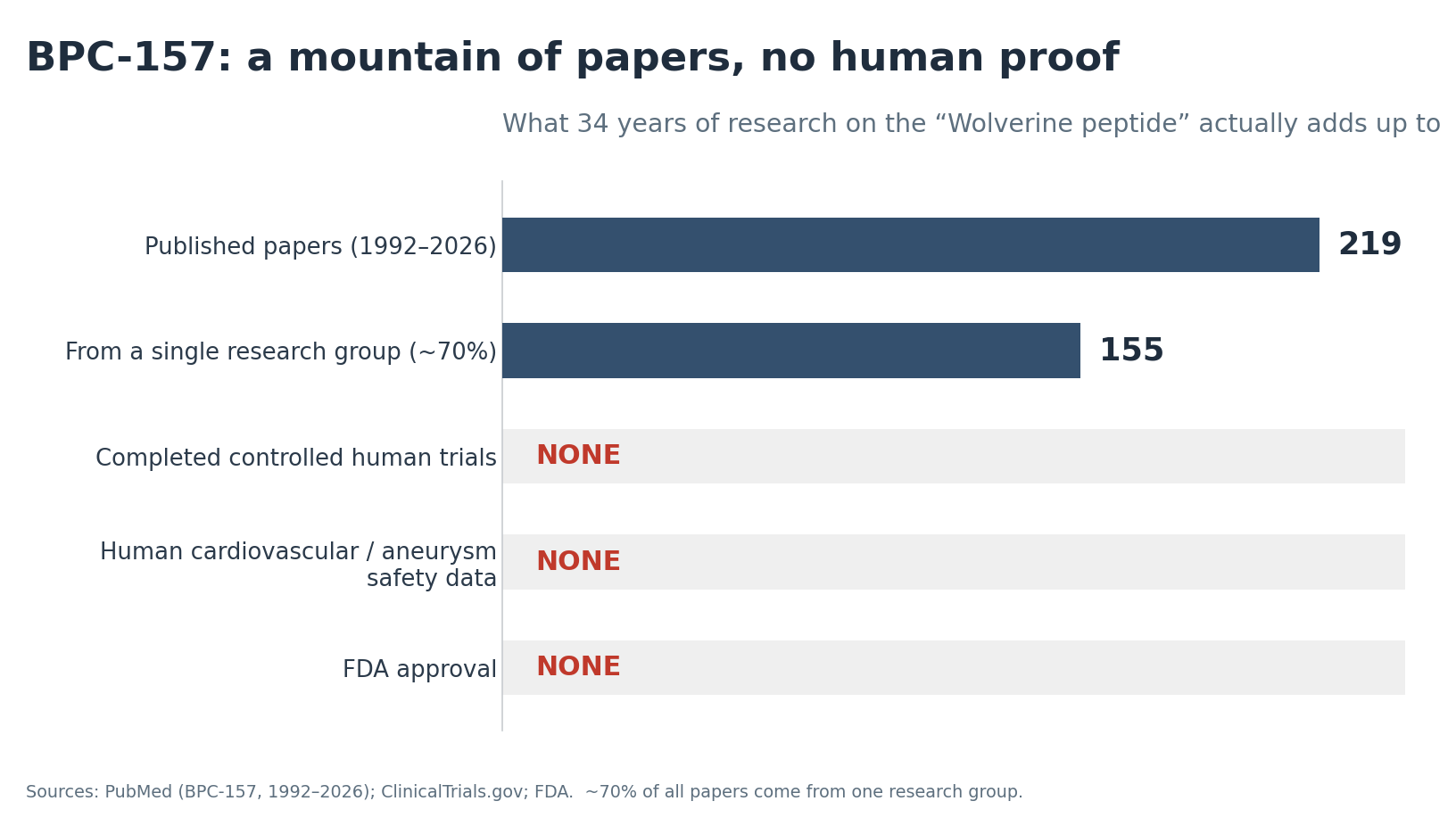
How I counted: a literature search returns roughly 219 BPC-157 papers going back to 1992; tallying their authorship, about 155 of them, close to 70 percent, list Predrag Sikiric’s Zagreb group. I found no completed, controlled human trial with published results in people. The key figures in this piece are linked to their sources in the text.
And it isn’t only me asking. I get asked about BPC-157 more than almost anything else these days, by people I like and trust. Men my age who tore a meniscus and skipped the surgery because they’d read this would heal it. Lifters nursing a shoulder that hasn’t felt right in a year. They are not chasing a high. They noticed, somewhere in the last decade, that their bodies stopped repairing on the old schedule, and they found something that promised to give it back.
Two hundred papers, one laboratory
For a compound this famous, the human evidence is essentially a blank page.
Search the medical literature and you’ll find around 219 papers on BPC-157 going back to 1992. That sounds like a real body of science until you look at who wrote it. Roughly 70 percent of those papers come from a single research group in Croatia, led by a scientist named Predrag Sikiric, who has spent his entire career on this one molecule. Filter that literature for a completed, controlled human trial, the kind of study that actually tells you whether a drug is safe and effective in people, and the count drops to zero. Not a few. None.
There are review articles, there are letters, there is one paper that was retracted at its own authors’ request. There is no controlled human trial showing that injecting BPC-157 does what the internet says it does.
Flynn McGuire, a physician at the University of Utah, went through the BPC-157 literature himself and turned up three small pilot studies totaling thirty participants, with no control groups and nothing that could answer safety or efficacy. That gap is what I mean by no convincing human trial: not literally zero people, but nothing you could trust with a decision. The human data, he told a Nature feature published this month, is “of dubious enough quality that you can essentially just ignore it.” His blunter version: “There are no long-term studies. There are no safety studies, even in animals.”
I pushed back on this myself. We don’t actually know how Tylenol works either, and it’s in every medicine cabinet in America. Aspirin was sold for roughly seventy years before anyone worked out its mechanism. Plenty of useful drugs do their job while the textbook explanation stays fuzzy. So why should “we don’t fully understand it” count against BPC-157?
It shouldn’t, and that’s not the problem. Tylenol is a known, pure, fully characterized molecule tested in millions of people over decades. The only thing missing is a tidy account of the mechanism, and the mechanism is the one thing that doesn’t matter to you when you swallow it. BPC-157 is the mirror image. The mechanism is the only thing it shares with Tylenol. Everything that actually protects a patient, the human testing, the replication by other labs, the quality control on what’s in the vial, is the part that’s missing.
The molecule is hard to locate in the human body at all. Its amino acid sequence does not appear in the human genome, and it hasn’t been found in the gut microbiome either. No receptor for it has ever been identified. Anna Mapp, a chemist at the University of Michigan who runs the American Peptide Society, has called this troubling, and questioned whether the body makes the molecule at all. Most peptide drugs work by latching onto a specific receptor, like a key in a lock. For BPC-157, nobody has found the lock.
The origin story, reported in detail by STAT and Undark, is genuinely strange. As a medical student in Zagreb in the 1970s, Predrag Sikiric wondered whether the stomach makes its own protective compound. He spent years collecting human gastric juice, including from slaughterhouses, kept his screening method to himself, and by the end of the 1980s his team said it had isolated a fifteen-amino-acid fragment. They named it BPC-157, for Body Protection Compound, with a second reading the team liked: Bože Pomozi Croatia, “God Help Croatia.” It makes a wonderful story, and none of it tells you whether the molecule is what he says it is.
The one person who could clear that up won’t. The full sequence of the parent protein that BPC-157 is supposedly a fragment of has never been released. Asked about it by reporters, Sikiric compared the molecule to a child. “If you have your own child, you want it to be yours forever,” he told them. That is not data. That is a man declining to show his work.
He is not a disinterested party. Now in his seventies, he holds a financial stake in a company that has sponsored trials of the peptide and runs another that sells BPC-157 patents, interests that don’t appear in his published papers.
One of his own longtime collaborators, Sandor Szabo, has gone further, allowing in print that the original team may have misread an amino acid sequence back in the late 1980s, when the chemistry was cruder. In plain terms, the substance at the center of a booming market might be partly an artifact of a decades-old mistake.
BPC-157 isn’t a hoax. The problem is narrower: we still can’t answer the basic stuff, what this molecule actually is, whether the body makes it, how it’s supposed to work, and whether it’s safe in people. The field knows these questions are open. A skeptical review published last year in the journal Pharmaceuticals laid out the gaps in detail, and Sikiric’s group had to publish a rebuttal. BPC-157 isn’t snake oil. The biology is plausible and there are real animal findings, though they cluster in one lab and aren’t enough to answer human safety or efficacy. It’s promising enough that someone should run a proper human trial. After fifty years, a proper randomized trial has finally been registered. But promising enough to study is not the same as proven enough to inject, and the space between those two has filled up with something other than evidence. None of which told me anything about my aorta. So I kept looking.
Get the next one in your inbox
I write about longevity, training, and preventive health weekly — without the guru worship. Free, no spam, unsubscribe whenever.
How a rat tendon becomes a miracle
Almost all of the promising BPC-157 research is in animals, mostly rats. There are studies where a rat’s Achilles tendon is cut, the animals get the peptide, and the tissue appears to heal faster. That is a real and interesting finding, and a narrow one. The rats also got pure, lab-measured peptide from scientists, not whatever is in a vial bought off a forum, a gap the gym-floor version quietly skips. “Improved tendon outgrowth in a rat transection model” is the honest version of it. Then it leaves the lab.
In a review article, the caveats get shorter. A peptide clinic blogs about it and the rat quietly disappears. A vendor’s product page turns it into “supports tendon and ligament repair.” On a podcast it becomes Wolverine, the comic-book character who regrows from any wound. By the time it reaches your buddy with the bad knee, “a cut rat tendon closed faster in a lab” has turned into “this fixes torn knees.” None of those steps is technically a lie.
Each step just drops a qualifier the last one was still carrying.
And now the last step in that chain is automated.
The selling happens in a legal gray zone that is built on a single phrase. Most BPC-157 is sold as a “research chemical,” labeled “for research use only” and “not for human consumption,” with a line somewhere that the buyer is a qualified professional. Those words do all the legal work. I looked at vendor pages that sell what is functionally a finished injectable product, including a pre-filled BPC-157 pen for around $165 that ships cold with instructions, alongside disclaimers insisting it is absolutely not for putting in a human body.
Other sellers offer vials for thirty to ninety dollars and post certificates of analysis to signal quality, while their own copy concedes that rigorous human trials are lacking and that the benefits are, in their words, anecdotal and scientifically unproven. The vendor is telling you the evidence isn’t there, in the fine print, while the storefront is merchandised exactly like a supplement shop.
A certificate of analysis is not the vial it came with. A real certification program works differently, and I went through what NSF Certified for Sport actually checks, and what it does not, when P&G bought Thorne. When researchers ran publicly available third-party tests on fourteen gray-market peptides, BPC-157 among them, more than forty percent of over six thousand samples failed to meet basic purity and dose standards, and of the smaller batch screened for bacterial endotoxins, fifteen percent carried measurable contamination, the kind that at high enough doses brings on fever, chills, and septic shock. With a product like this, you are not only betting on whether the molecule works. You are also betting on what is actually in the vial.
Set the GLP-1 weight-loss drugs aside, and BPC-157 is one of the loudest names in the peptide world. The beauty and wellness press calls it the industry’s star peptide. The gym world calls it the Wolverine peptide. Nobody can hand you a clean figure for what share of the market is BPC-157 specifically, because the entire point of a gray market is that it goes uncounted, and anyone who quotes you a precise percentage is guessing. What is measurable is the traffic around it. U.S. imports of hormone and peptide compounds from China roughly doubled in a single year, from about $164 million in the first three quarters of 2024 to around $328 million over the same stretch of 2025, according to customs data. BPC-157 is consistently named near the front of that wave.
The same molecule moves through nicer doors too. Longevity clinics and online prescribers offer it as nasal sprays and patches that can run into the hundreds of dollars a month. Some of the prescribers are strikingly candid about the gap. A functional-medicine doctor who lists BPC-157 prominently for joint healing told Bloomberg, asked whether the evidence supports it, “Is the data there to support it? Absolutely not.” She prescribes it anyway. Almost none of it currently comes through a licensed pharmacy, for the simple reason that compounding BPC-157 isn’t legally allowed yet. It moves through the research-use sellers and the clinics instead. Sport has already drawn its line. The U.S. and world anti-doping agencies prohibit BPC-157, and athletes have been sanctioned for it. That’s a sign enough people use it for performance and recovery that regulators pay attention, not proof it works.
The reviews are botted now
The newest part of the market is aimed at the exact tools a cautious person would use to check it.
If you wanted to vet BPC-157 today, you would probably ask an AI or search Reddit for real people’s experiences. Both are now being gamed on purpose. The tech outlet 404 Media reported in early June that companies are flooding Reddit with content engineered to be scraped by ChatGPT and Google’s AI answers, so the response you get about a gray-market peptide has been quietly shaped by people selling it. The trade even has a name, answer-engine optimization, and at least one firm advertises doing it at scale.
I didn’t have to take the reporting on faith. Look at r/Biohackers and you can see the moderator actions for yourself, dated months before that article ran. By April the subreddit’s moderators had posted a new rule, “If you promote peptides on this sub, you will be banned,” after “an influx of low quality posts many of which are trying to promote vendor sites.” They had already rolled out an AI-content policy in November, warning that low-effort AI-generated posts were no longer allowed. In the same announcement they flagged something darker, a wave of posts from minors asking where to buy peptides, which echoes what the mods would later tell 404 Media about companies getting kids to source product.
And the users can feel it even when they can’t prove it. One member, frustrated, wrote that the peptide market had become “hundreds of different sketchy websites,” that the reviews were “all botted,” and asked whether everyone was really just “trusting random internet comments that could be AI bots.” He was describing, from the inside, a marketplace where the evidence you can find has been manufactured to be found. That is the environment a curious fifty-year-old now walks into. The thinness of the real science stopped mattering, because the apparent consensus can be built to order. Which meant the one place I’d normally sanity-check a drug, other people’s real experience, was exactly the place I couldn’t trust for mine.
The fake certainty isn’t a side effect of this market. It’s part of the product.
The vote in July
And then the government stepped in, at what might be the strangest possible moment.
In April 2026, the FDA quietly removed about a dozen of these gray-market peptides, BPC-157 among them, from its list of bulk substances that raise significant safety concerns. As the medical journal JAMA noted, that change “was not accompanied by or the result of new scientific evidence.” Nothing new had been learned. The rules just loosened, in step with a broader political moment in which Robert F. Kennedy Jr., now the country’s top health official, told Joe Rogan in February that he is “a big fan of peptides” and has “used them myself, and used them with really good effect on a couple of injuries.” Then, on July 23 and 24, an FDA advisory committee is scheduled to vote on whether compounding pharmacies should be allowed to make BPC-157 and several of its cousins legally.
The vote is landing in the middle of a business gold rush. Bloomberg Businessweek found investors racing to pour money into peptides ahead of legalization, pegging the gray market at one to three billion dollars, even as the panel being asked to open the door has historically wanted the kind of large-scale human trials BPC-157 has never had.
I read the meeting documents, and they contain a detail that tells you how detached the regulation is from reality.
The use the FDA is actually evaluating for BPC-157 is ulcerative colitis, an inflammatory bowel condition, a holdover from the molecule’s distant origins in gut research decades ago. It is not the torn shoulders, bad knees, and aging joints that most of the market is built on. Same molecule, different illness: the committee is weighing a use almost nobody is actually buying it for.
Whatever the committee decides, the marketing will overstate it.
So here is what a yes vote would not mean. It would not make BPC-157 FDA-approved, would not prove the peptide safe, and would not prove it heals a single tendon, knee, shoulder, or artery.
All it would change is whether certain compounding pharmacies may legally make it, under specific conditions. A green light isn’t the FDA endorsing BPC-157. It’s the FDA unlocking one particular door. But you can already see how “the FDA cleared the way for BPC-157” will read on a vendor page, and how little of the nuance will survive the trip.
Update, June 29, 2026: After this piece first published, the FDA posted its briefing documents for the July meeting, and its own reviewers proposed not to add BPC-157, in either of its chemical forms, to the compounding list. Their reasons matched what I had found. The molecule is not well characterized chemically. There is no human safety data for the ways people actually take it, by mouth, under the skin, in the nose, or through the skin. And there is not enough evidence to say it treats ulcerative colitis, the single use on the table. The reviewers named one risk plainly: an injected or inhaled peptide like this one can provoke an immune response, more so if it clumps or carries impurities.
The same day, the agency named eight new members to the committee that will weigh that recommendation. Most of them run businesses that sell or prescribe peptides. One is the scientific director of a telehealth company the FDA had warned weeks earlier over compounded weight-loss drugs, and he had already written online that “the compounds are coming.” Another had posted about her teenage son using BPC-157 to heal a sports injury. A career FDA official told STAT that staff raised conflict-of-interest concerns and were overruled. So the July setup is unusually plain. The agency’s scientists have said no, and the panel picked to vote on it is stocked with people whose practices are built on yes.
A staff recommendation is not the final word. The committee still votes, and any rule would come after that. But when the agency’s own reviewers had to put their names on a judgment, they didn’t think the case for BPC-157 was there. Whether that judgment survives July depends a lot on who is now sitting on the panel.
What I’d tell a guy with my exact body
The believers would tell me BPC-157 is exactly what my aorta needs. Sikiric’s group calls it one of the most potent vessel-protecting agents they’ve studied, and claims it normalizes blood pressure in both directions, reduces both bleeding and clotting, and even helps repair the aorta itself. They have a 2026 paper, in rats, literally titled around aortic wall remodeling. If you only read that camp, you’d think I’d found the perfect drug.
But the core mechanism everyone points to is angiogenesis, the growth of new blood vessels. And an aneurysm is, in part, a disease of the vessel wall doing the wrong kind of remodeling, including growing fragile new microvessels where they don’t belong. Pushing a powerful pro-growth, pro-remodeling signal into a wall that is already failing in exactly that way is plausibly the last thing I’d want to do. Nobody has shown BPC-157 ruptures an aneurysm. Nobody has shown it’s safe for one either. The human work just doesn’t exist. The independent reviewers flagged this same double edge, the way the same mechanism that heals can also feed tumors or drive damage, and Sikiric’s team had to write a defense against it. I am not the only one uneasy about it. Vikas Patel, an emergency physician who co-founded a longevity clinic, put the same worry in cancer terms in that Nature feature: BPC-157 supposedly heals by spurring the growth of new blood vessels, and “that could also promote tumour growth. It probably could, and we won’t know unless there’s a trial done.” A molecule that supposedly fixes high blood pressure and low blood pressure, bleeding and clotting, all at once, doesn’t reassure me. The longer the list of opposite problems one substance is said to fix, the less it reads to me like a real drug and the more it reads like a wish.
The honest answer to my question is that nobody knows. There are no human cardiovascular trials, no aneurysm data, no dose anyone can point to and call safe for someone like me. The boosters say it does everything good for blood vessels. The critics warn the same machinery could be dangerous. And there is no human evidence to break the tie. For most of the men asking me about it, the stakes are lower than mine, a sore shoulder rather than a major artery, and I understand the pull completely. The body that won’t heal is a real grief, and the promise lands right on it.
There’s also a reason so many of them are sure it worked, and it isn’t proof either. A strained shoulder or a tweaked knee usually heals on its own over weeks to months. Start an injectable in week three, feel better by week eight, and the credit goes to the needle. Most people change several things at once and rest the joint while they’re at it, and on top of that comes the real lift of finally doing something about a problem you’d been ignoring. You get the exact experience BPC-157 is sold on, whether or not the molecule did anything. The relief can be real even when the drug is doing nothing.
When men ask me about it anyway, here’s what I tell them. There is no good human evidence that BPC-157 heals an injury. The July panel recommended it anyway, over the objection of FDA reviewers, and legal access is not the same as the FDA judging it safe or effective. What is actually in the vial is its own separate gamble. And if you carry cardiovascular disease, a cancer history, a clotting disorder, or any serious condition, the pro-growth biology is exactly the kind of thing to be careful with, so talk to a doctor who knows your history before you do anything. That is less medical advice than the risk calculation I ran for myself.
Strip the certainty away and look at what I’d actually be buying: a molecule with no confirmed human source and no known receptor, championed since the 1970s by a single lab that has never finished a convincing human trial, and sold through a loophole with a consensus partly written by the people profiting from it. If you’re tempted, the least you can do is see the thing clearly: the certainty is the most engineered part of this, and the evidence underneath is mostly empty. I’m not going to be the experiment. Not with this aorta, and not on evidence this thin.
About Gunnar
Gunnar is 53. He lost about 170 pounds, trains in a garage gym, and writes DadStrengthDaily from personal experience, citing primary sources where he can. He also moderates r/ProactiveHealth. He is not a doctor, and nothing here is medical advice. Talk to your own doctor before acting on anything, especially GLP-1s, TRT, blood pressure, sleep apnea, and cancer screening.