
My feed spent the morning writing the obituary. So I went looking for what happened to the last few supplement brands a conglomerate bought.
I have three Thorne products in my bathroom cabinet right now. Glycine, an AM/PM multivitamin, and a bottle of Ferrasorb I restarted this spring when my ferritin came back low. That catch came from checking my own bloodwork regularly. This morning Procter & Gamble, the company that makes Tide and Pampers and Pepto-Bismol, agreed to buy Thorne for $3.8 billion in cash.
I should say up front that I signed up for Thorne’s affiliate program a while back out of curiosity, made about ten dollars when a friend bought some vitamins, and gave up on it. I am not linking to them here.
I also called this one, which almost never happens. Back in April I posted in r/ProactiveHealth that Axios had Thorne being shopped for up to $4 billion, and wondered whether the supplement business was about to consolidate.
$680 million to $3.8 billion in under three years
L Catterton, the private equity firm associated with LVMH, took Thorne private in October 2023 at $10.20 a share, about $680 million. Reuters put their gain on today’s sale at more than $3 billion.
Neither P&G’s announcement nor Thorne’s mentions the price. P&G’s CEO Shailesh Jejurikar broke it on CNBC instead, and declined to say whether he had won a bidding war. He was not short of company. Reuters reported that Haleon bid in June, and the Financial Times had Unilever circling too, which is the same Unilever that bought the green gummies my wife orders by the case.
CNBC reports Thorne’s revenue passed $500 million last year and is on track for something like $650 million this year, which puts P&G at roughly six times this year’s expected sales for a vitamin company. Nobody pays that for a business they intend to leave alone. That price assumes growth, and growth has to come from more shelves, more customers, higher prices, lower costs, or some mix of them.
Get the next one in your inbox
I write about longevity, training, and preventive health weekly — without the guru worship. Free, no spam, unsubscribe whenever.
My feed had it settled by lunchtime
All downhill from here. Goodbye to a high quality brand. They will undoubtedly compromise on quality. Looking for a new brand immediately.
I understand the reflex, because I have the same one, and because the entire reason I pay Thorne’s prices is that I trust the testing. So I spent the afternoon on the comparable deals. Nestlé bought Pure Encapsulations and Garden of Life in 2017. Clorox put close to a billion dollars into supplement brands, wrote down $445 million of it, and sold the business at a loss in 2024. Bayer bought Care/of and shut it down in under four years. P&G bought New Chapter back in 2012.
I expected to turn up at least one clean example of an acquirer cutting corners. I did not. None of the brands I looked at had lost an NSF Certified for Sport, USP Verified, or B Corp certification after being bought, and the claims I chased that a formula had gotten worse all ended in an Amazon comment or a blog post with nothing behind it. That is me searching, not a systematic review.
I also could not find a single study comparing supplement quality or label accuracy before and after an acquisition. Not from ConsumerLab, not from Labdoor, not from anybody. So when someone tells you with confidence that a conglomerate will wreck the product, ask what they are comparing it to. I was doing the same thing this morning.
One piece of evidence cuts the other way, and it is the boring kind. USP Verified, the most rigorous pharmacopeial testing program in American supplements, is dominated by store brands and big corporate owners. Nature Made, Kirkland Signature, Member’s Mark.
P&G bought New Chapter in 2012
That one is worth knowing, because it is P&G’s own.
The early years were good. A year in, New Hope reported that the science group had doubled, that P&G had sent in supply chain and quality experts, and that the company was doing more testing than before, not less. New Chapter became a certified B Corp in 2014, two years after the sale. P&G said there were no plans for mass-market expansion.
Six years later the founders walked. Paul and Barbi Schulick left in July 2018 over what they called essential differences in vision and strategy, and Paul told NutraIngredients that financial pressures to accelerate profits meant he could not in good conscience stay. Barbi warned that profit pressure could start to influence formulation practices.
I read that at first as evidence that P&G had already changed the formulas. It is not. She was warning about what might happen, and that caveat gets dropped in most of the retellings I have seen.
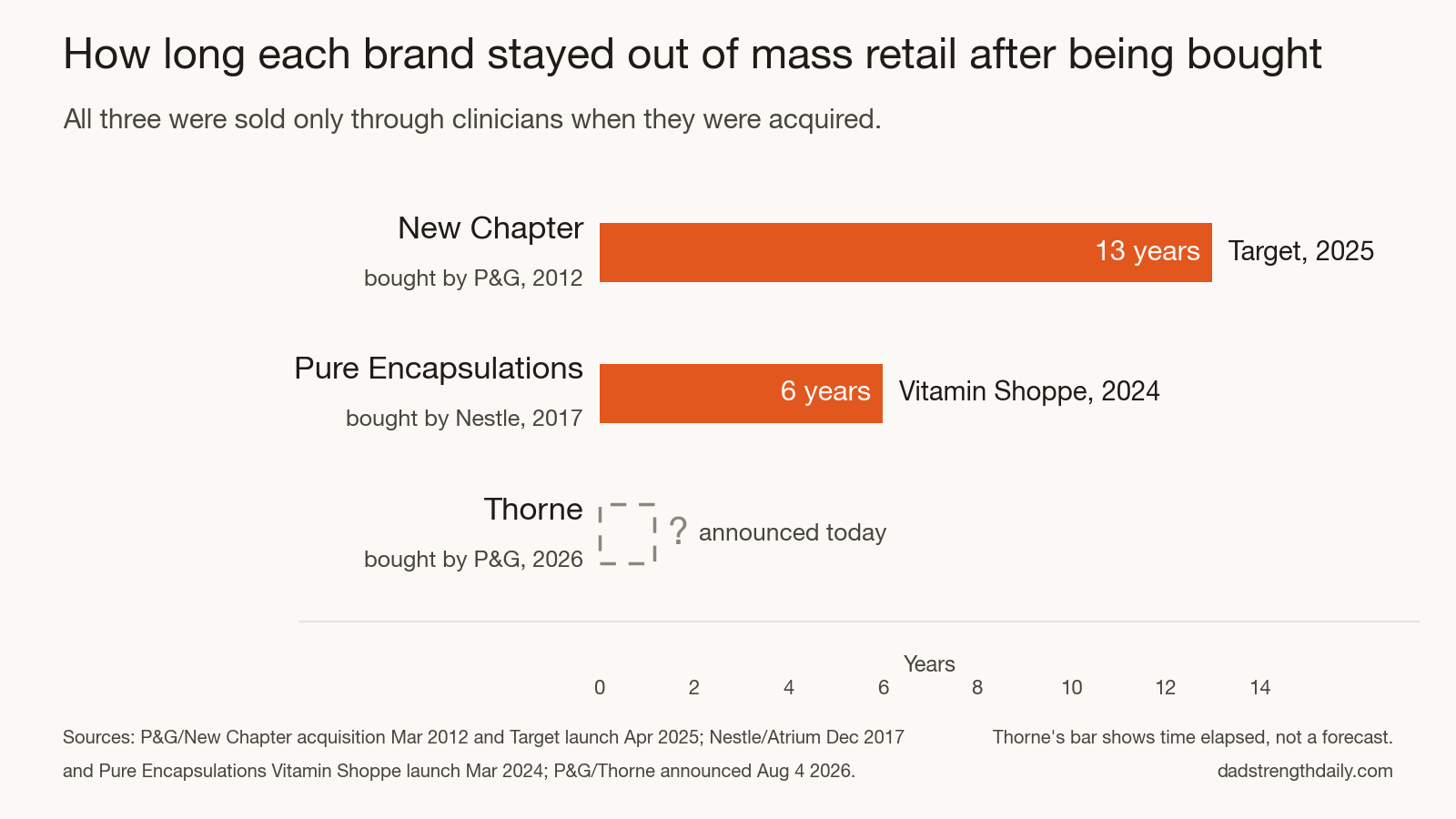
Then in April 2025, thirteen years after the no-mass-market promise, New Chapter launched in Target.
Pure Encapsulations lasted six years
The same thing happened to the brand closest to Thorne.
Nestlé’s own press release called Pure Encapsulations the number one recommended brand in the US practitioner market when it bought Atrium Innovations in 2017. That means you could not just pick it up somewhere. You bought it through a clinician, or a clinician’s storefront, which is the model Thorne runs. It stayed that way for six years, and then in March 2024 it showed up in every Vitamin Shoppe and Super Supplements in the country, more than 700 stores, plus Amazon.
Last November, NutraIngredients ran an analysis of that channel using Pure Encapsulations as the cautionary tale, and held up Thorne’s 47,000-practitioner network as the model that resists it. That comparison lasted nine months.
I would also stop pretending that channel is as clinical as it sounds. In April I described the loophole I use myself, where some random practitioner storefront link gets you 20% off from a professional you have never met and never will.
What I can check on the bottle
None of this tells me to throw out my glycine, and I am not going to.
I cannot audit P&G’s intentions. I can read a label, though. NSF Certified for Sport is not a corporate seal that transfers with the stock. It attaches to a product and a facility. By NSF’s own account, it audits the plant once or twice a year depending on risk grade, runs ongoing compliance testing, and buys product off the open market for unannounced checks, specifically to catch formulation changes made after certification. Thorne’s description goes further, saying every batch is tested before it can carry the mark and screened for nearly 300 banned substances. I do not know what NSF does when a company changes hands, and their published material does not say. What I do know is that the program re-checks the plant and the batch on its own schedule, and the mark is either printed on the bottle I reorder or it is not.
Checking my own cabinet while writing this was useful, and slightly humbling. Thorne does not put that mark on everything, and you do not have to take the company’s word for which products have it, because NSF publishes the list itself. My Multi-Vitamin Elite is on it. So is my iron, which Thorne now sells as Advanced Iron Complex. My glycine is not on it. I have been buying Thorne for years on a general feeling about the brand, and the brand is not one thing. It is a list of products with different levels of testing behind them, and I never looked at which was which until a laundry company bought it.
What I expect to change is the shelf. My guess is that the 20% practitioner discount eventually turns into a Target endcap, because that is what happened to New Chapter and to Pure Encapsulations, and because getting product onto shelves at scale is the thing P&G is built to do.
If that happens, be precise about the complaint. When a health-food retailer stopped selling Garden of Life after the Nestlé deal, its argument did not rest on the product getting worse. It was that “if the quality standards remain the same, you are still now supporting NESTLE.” That is a real reason to walk, and it is not the reason people usually give.
Mine would be simpler, and it corrects something I said further up. I told you I pay Thorne’s prices for the testing. That is half true. The testing is real and I can verify it product by product, and if it holds it is worth paying for whoever owns the company. The other half of that price was the feeling that I was buying something most people at Target could not, and that half was never worth anything.