
I lift, track my labs, and read the studies. I still ended up with a cabinet full of maybes, while my wife just buys the one gummy she likes at Target. So I stopped asking which ones work and started asking who got paid when I bought them.
I cleaned out my medicine cabinet last week, which is how this post started.
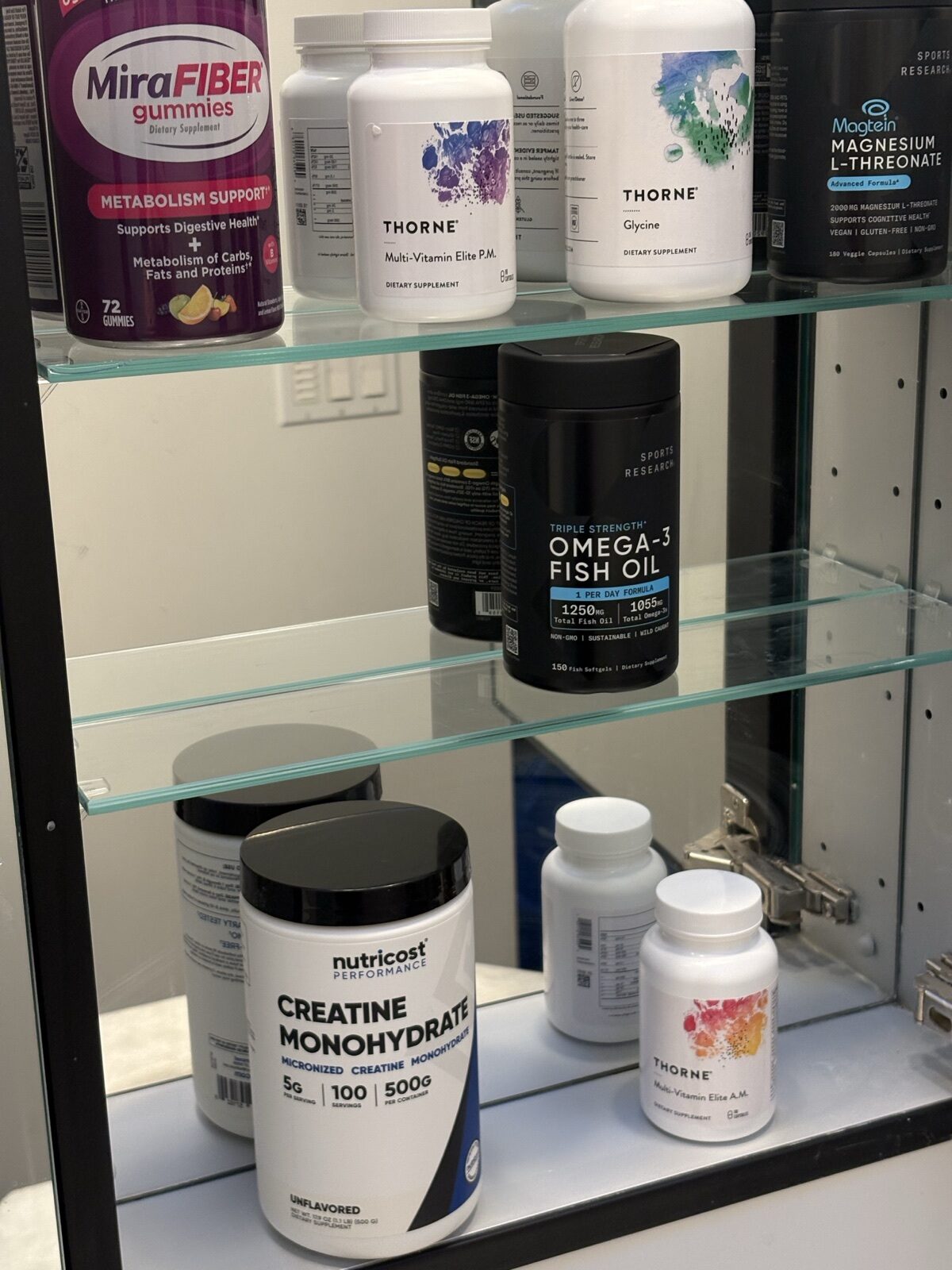
There was more in there than I remembered buying. Creatine, fish oil, vitamin D, fiber gummies, two different pills for sleep, magnesium in the fancy expensive form, tart cherry capsules, a bottle that just says Homocysteine Supreme. I had bought every one of them on purpose, for a reason that made sense at the time, and standing there I could not reconstruct half the reasons.
I am the target customer for the supplement industry. A man in his fifties who reads the studies, lifts in his garage, tracks his bloodwork, and carries both the disposable income and the real fear of decline that the whole business runs on. If supplements work on anyone’s psychology, they work on mine.
My wife is the opposite kind of customer, and she may be the smarter one. She does not read the studies or track a single number. She found a green gummy bear on Instagram, decided it was, in her words, yummy and fun, and now buys it at Target without a second thought. I interrogate every bottle I own. She bought the one she enjoys and moved on. The whole time I was sorting, I was not sure which of us had it right. I did once go read the papers on something she brought home, and wrote up what the evidence says about her calcium chews.
So I stopped asking the question the industry wants me asking, which is “does this help.” For most of these the honest answer is “probably not, but we can’t be sure, so why not,” and that question has no bottom. You can always justify one more bottle against a maybe. The better question is who made money when I bought this, and how. Follow that, and the business behind the bottles turns out to be more interesting than the bottles.
By the time I finished, a few bottles were in the trash, two were sitting on the counter waiting on a blood test, and the ones that survived were mostly the cheap, boring ones. The sorting was easy. Understanding how I had accumulated the rest took longer.
The factory makes the same gummy for everyone
Start at the bottom, with the part nobody sees.
Many supplement brands are not really manufacturers. They have no lab or chemist of their own, just a logo and a marketing channel. The actual product comes from a contract manufacturer, a company you have never heard of that runs the lines and ships the same formulas to hundreds of brands.
NPR’s Planet Money laid it out. The hosts called a Florida contract manufacturer and asked, on tape, how hard it would be to launch their own supplement. Not hard at all. For about $5,500 they could slap their label on one of the company’s eight hundred ready-made stock products, a gummy or capsule already sold by other brands under other names. Same color, same dose, different sticker. A custom formula meant a minimum order around 8,300 bottles, roughly $33,000. (NPR Planet Money)
That is the entire barrier to entry. Thirty-three thousand dollars and a name. Making supplements for other brands is a fast-growing business, one Grand View Research expects to top a hundred and twenty billion dollars worldwide by 2030 (Grand View Research), and a large share of the vitamin-store shelf, plus much of what the influencer brands sell, came out of a facility like that one.
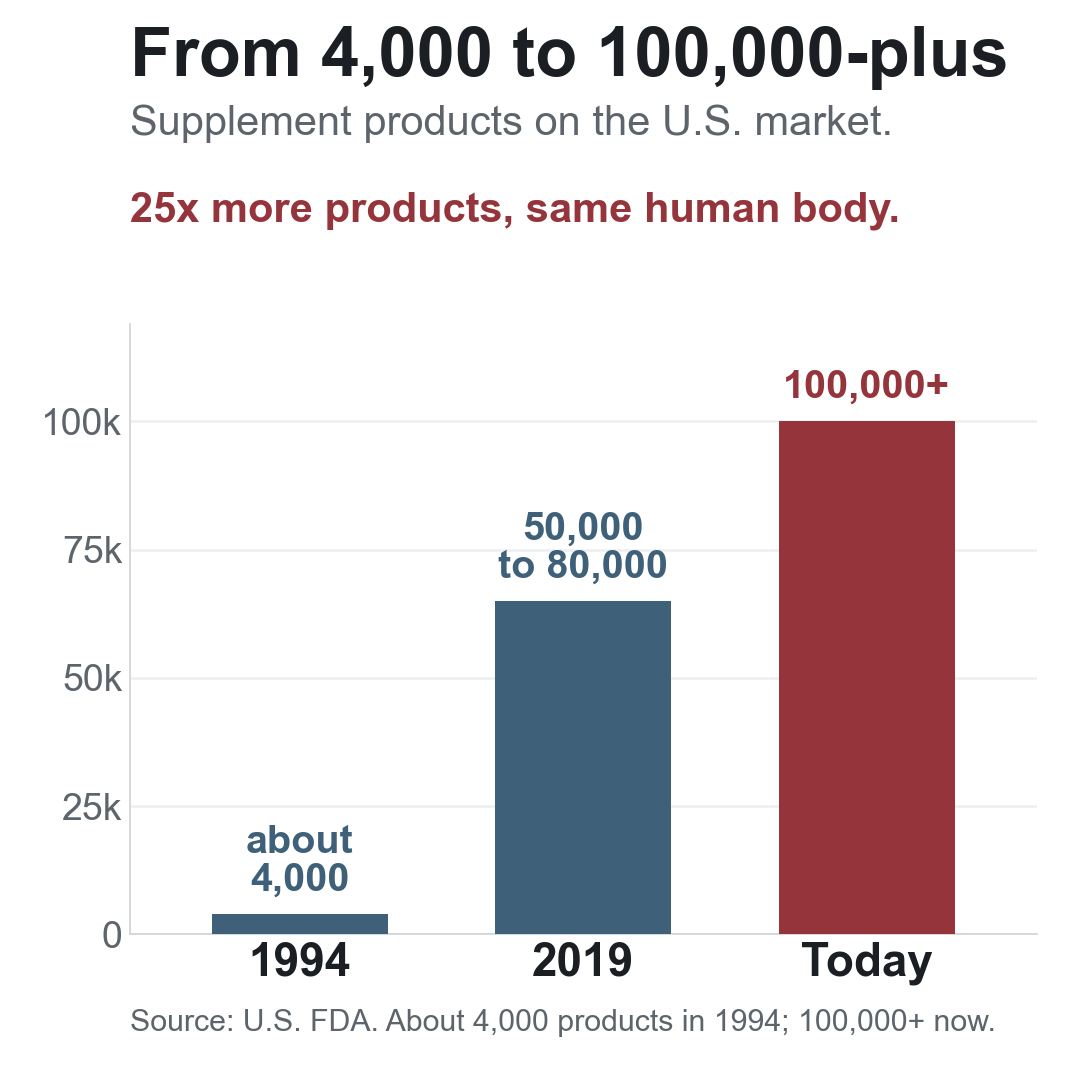
This is why there are now more than a hundred thousand supplement products on the American market, up from about four thousand when the law changed in the early nineties. (FDA estimate) We did not discover a hundred thousand new things the body needs. The cost of inventing a brand collapsed to near zero. The molecule is a commodity. The brand is the whole business. When you pay a premium for the trustworthy-looking label over the cheap one, you are often paying more for what may be the same base formula out of the same kind of facility. A few weeks after I wrote this, P&G agreed to buy Thorne for $3.8 billion, which put that question to one of the brands I do pay up for.
The man on Planet Money was no villain. He runs a certified plant, turns down customers who want to jam dangerous doses into a pill, and believes in the products. But he explained why people get into this. They come from selling T-shirts, yoga mats, or water bottles, and they switch to supplements because a yoga mat is a one-time sale and a supplement is something you sell the same person every month, forever.
Get the next one in your inbox
I write about longevity, training, and preventive health weekly — without the guru worship. Free, no spam, unsubscribe whenever.
The label is written by lawyers, not scientists
The reason the factory can ship a hundred thousand barely-regulated products is a law from 1994.
Before then, the Food and Drug Administration kept trying to regulate supplements like the drug-adjacent products many of them are. Every time, the public revolted. The famous moment was an ad the industry ran with Mel Gibson, in which a SWAT team kicks down his door to confiscate his vitamins. Congress got more mail about supplements than it got about Watergate. The result was a law that did something strange. It inverted the burden of proof.
For a prescription drug, the company has to prove it is safe and works before selling it. For a supplement, it can go on the market with none of that, and the FDA usually acts only after a problem shows up. As Peter Attia puts it, the front-end filter was simply removed. Sell now, investigate maybe later. That is why the shelf looks the way it looks.
The same law wrote the language on every bottle. A supplement cannot legally claim to treat, cure, or prevent a disease, so it doesn’t. Instead it “supports immune health,” “promotes metabolism,” “helps maintain healthy blood sugar.” Those verbs are not fluff that slipped past a regulator. They are careful legal engineering, chosen to imply a medical promise while making no claim anyone has to back up. The Planet Money manufacturer coached the hosts on it: you can’t say it burns fat, say it supports metabolism, and your brain bridges the gap on its own. I read my own bottles after I heard that. My fiber gummies say they support digestive health and metabolism. Of course they do.
And if even that loose standard is too much trouble, there is a workaround.
In the nineties a man decided a protein from glowing jellyfish would improve memory. The FDA repeatedly balked at clearing the synthetic protein as a new dietary ingredient, on safety grounds, so he routed it through a food instead. A company can declare its own ingredient “generally recognized as safe” for food, so once it was in a shake he could certify it himself and skip the supplement review entirely. (MedShadow) Then he sold the pill. Between 2007 and 2015 that product, Prevagen, did at least 165 million dollars in sales, and the Federal Trade Commission and New York attorney general sued in 2017 on the grounds that the company’s one clinical trial did not actually show a memory benefit. (FTC) The label now just says it is “for your brain,” which means nothing and is therefore legal. It still bills itself as the best-selling brain-support supplement in the country.
I find that clarifying. It is not a scam product slipping through the cracks. It is a product using the system exactly as the system is built to be used.
The benign version is a product that merely does nothing. The same system lets through products that do real harm. Supplements send an estimated 23,000 Americans to the emergency room a year, mostly energy and weight-loss products. (Geller et al., New England Journal of Medicine, 2015) The FDA has flagged nearly 800 products spiked with undeclared pharmaceuticals, real prescription drugs hidden in “natural” pills. (Tucker et al., JAMA Network Open, 2018) Independent testing routinely finds far more, or far less, of the active ingredient than the label claims, and concentrated botanical extracts have caused acute liver failure, with green tea extract among the worst offenders. (NIH LiverTox) The 1994 law did not just let useless products through. It lets dangerous ones through too, and you find out which is which the hard way.
The funnel runs through your earbuds
How does the same gummy under a hundred names actually find a buyer? For a guy like me, it found me through my headphones.
I did not buy most of what was in my cabinet because of an ad. I bought it because someone I had listened to for a hundred hours mentioned it. The sale never feels like a sale, because it comes from someone you chose. Trust used to live with your doctor, who now gets twelve rushed minutes with you and orders a statin. It moved to the podcaster, who gets three hours a week of your full attention and feels like the smartest, fittest friend you have. He is not lecturing you about your weight, he is letting you in on what he takes.
There is a predictable arc to how that relationship gets monetized. First the creator takes an affiliate cut, a code for ten or twenty percent of sales. Then, if the audience is big enough, an equity stake in the company he is promoting. Eventually he launches his own house brand and keeps all of it.
You can watch every stage of that arc in the wild right now. The green-powder company AG1 has reportedly spent more than 27 million dollars since 2022 advertising across seven hundred-plus podcasts, which is not a supplement strategy, it is a media strategy that happens to ship a powder. (Fortune, citing Podscribe) The wellness clinics that sell hormone therapy, including the kind I use, will happily sell you their own supplement line on the way out, because once you trust them with your testosterone you will trust them with your fish oil.
Then there is Peter Attia himself. The careful, evidence-first doctor turns out to be an investor in AG1. (TechCrunch) I am not saying that makes his analysis wrong. His framework is excellent and I am about to use it. I am saying that if even the here-is-the-evidence guy has money in it, there is almost no one standing outside the funnel telling you the truth for free. Everyone who talks about supplements, including the skeptics, has some relationship to what they are describing, so I stopped looking for the one clean voice. I read the evidence first and decide for myself afterward how much the sales pitch behind it should bother me.
The yoga-mat guy was right about the economics. You take supplements every day, run out on a schedule, and reorder without thinking. A McKinsey study of online subscribers found auto-refill products like supplements keep about 45 percent of their customers a year later, stickier than any other kind. (McKinsey) The 15 percent discount brands dangle for auto-ship is not generosity, it is the cheapest retention tool in retail.
The placebo effect is the strongest argument the other side has, and it is real, not a euphemism for “imaginary.” If a man takes a sleep blend, relaxes about his sleep, and sleeps better, he actually slept better. As the food-politics scholar Marion Nestle told Planet Money, arguing people out of their vitamins is like arguing about religion. A daily ritual that makes you feel like you are taking care of yourself can nudge you toward the gym and away from the second drink. It is just worth knowing that is what you are paying for, instead of believing you are buying a documented effect on your arteries.
My wife is my proof of this. I take a supplement and tell myself a story about its mechanism. She takes hers because she likes the taste, and because she likes it, she takes it every day. That consistency is the real advantage of the gummy, and it is not a small one. The best multivitamin is the one she will actually take, and the candy shape is the only version that has ever gotten her to take one day after day, where a plain pill is one she would skip. A habit you keep beats a better one you quit. She has never claimed it does anything for her arteries or her brain, and she knows exactly what she is paying for, which is more than I could say about half of what I just threw out.
The tell is who is selling, not who is buying
So much for the demand side, all the reasons people like me keep buying. The most honest signal in this whole industry came from the supply side this past year, and almost nobody noticed it.
The big, serious consumer-goods companies are quietly getting out of vitamins.
Through 2025, Nestlé quietly shopped its mainstream supplement brands, Nature’s Bounty and Puritan’s Pride among them, looking to keep only the premium lines it sells through doctors. (NutraIngredients) This is a company with some of the best market data in the business, telling you plainly which end of the aisle it no longer wants.
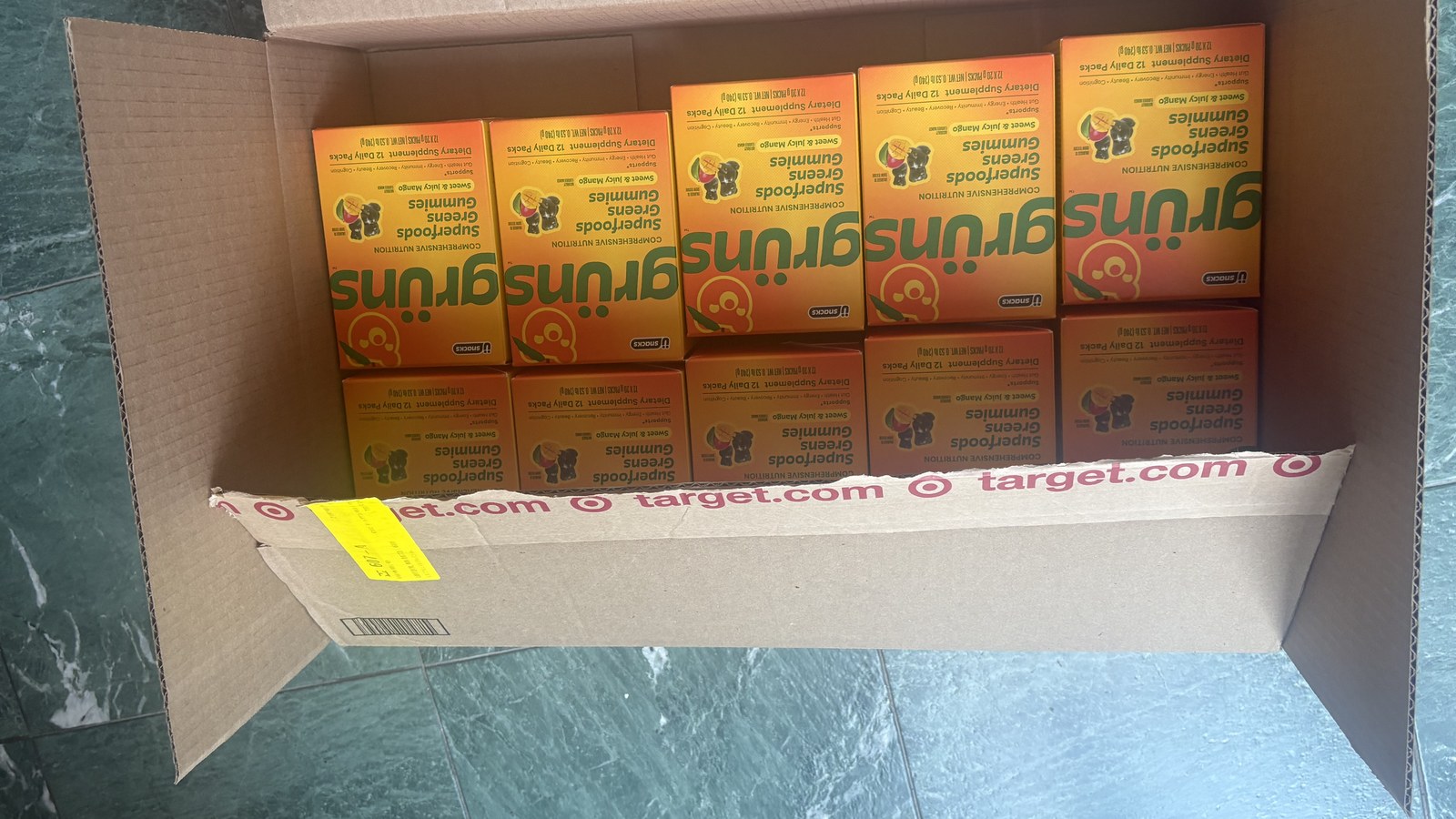
While Nestlé was trying to unload Nature’s Bounty, Unilever paid a reported 1.2 billion dollars for a company called grüns that did not exist three years earlier. (Unilever) grüns sells a greens vitamin shaped like a gummy bear, sixty-plus ingredients and a long list of things it “supports”, energy and gut health and immunity and even beauty. It is the gummy my wife buys, by the case from Target, the same one Costco now stacks on a pallet next to the AG1. Look at what the smart money actually did. It sold the boring multivitamin that competes on price and bought the gummy that competes on story, and it paid more for the three-year-old brand than for the older mainstream lines being shopped around. One reviewer who went looking pointed out that grüns itself has never actually been studied. (Innerbody) Unilever did not buy a formula. It bought the funnel.
The joke of it is that the multivitamin is the single most-studied product in the cabinet, and actually the studies are not kind. A 2024 analysis that followed nearly 400,000 healthy adults for more than two decades found that daily multivitamin users did not live any longer than non-users, if anything slightly the opposite. (Loftfield et al., JAMA Network Open, 2024) The U.S. Preventive Services Task Force, the most cautious body in American medicine, looked at the whole field and concluded there is not enough evidence to recommend multivitamins for preventing heart disease or cancer, and recommended actively against two common supplements, beta-carotene and vitamin E. (US Preventive Services Task Force, JAMA, 2022)
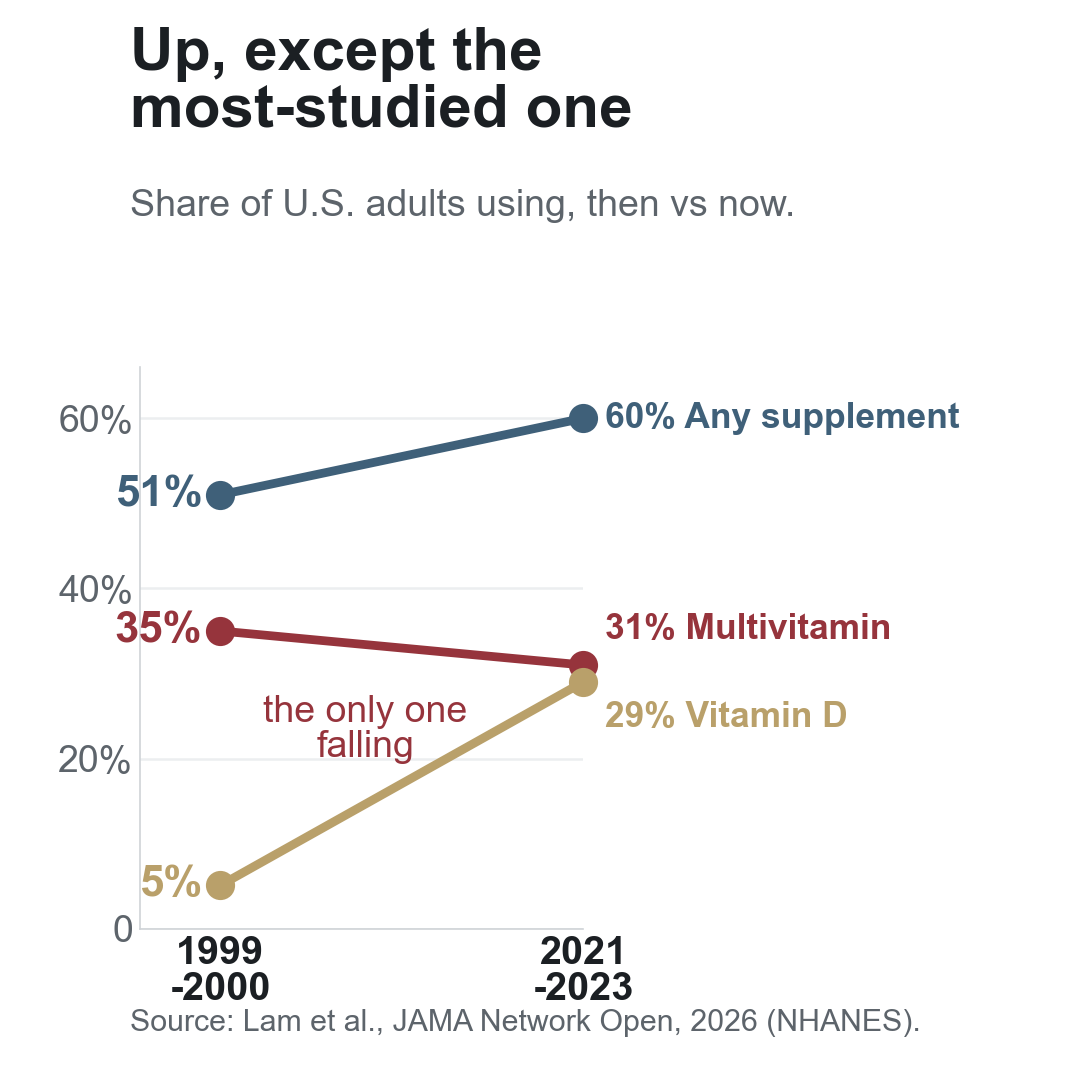
American supplement use climbed from about half of adults in 1999 to sixty percent now, but the growth is not in the boring multivitamin, which actually fell. The growth is in single ingredients with a story: vitamin D went from five percent of adults to nearly thirty, and turmeric, collagen, ashwagandha, and probiotics went from rounding errors to mainstream. (Lam et al., JAMA Network Open, 2026) The industry learned that one boring pill that quietly does little is a worse business than a parade of exciting single ingredients, each with its own podcast moment, each sold one month at a time.
What made the cut, on my shelf
I did not throw everything out. Saying all supplements are garbage is as lazy as the influencer line that you need nineteen of them. A few genuinely work, for the right person, for a reason that is not a podcast ad.
So I ran three questions at each bottle. What am I actually fixing, is there a number I can track, and would I start this today if it were not already in the cabinet. Miss all three and you are not making a health decision, you are shopping.
The sorting went quick, and it was a little embarrassing. None of what follows is a recommendation for your cabinet. It is how I sorted mine, with my own labs and my own doctors, not a protocol for anyone else.
Creatine stays, the easiest call in the cabinet. It is among the most-studied supplements there is, it reliably builds and keeps muscle when you lift, and at fifty-something not losing strength is the whole game. The cheap plain monohydrate is the right version. Fish oil stays, because I do not eat enough fatty fish and I can watch my omega-3 index on a blood test. Fiber stays, because the soluble-fiber and cholesterol evidence is real and I fall short, even if a gummy delivers less than a spoon of psyllium.
Glycine, L-theanine, and the magnesium L-threonate stay on a softer basis, sleep and calm, where the effect is modest and the downside near zero. The threonate is the pricey one, sold on the weakest claim in the magnesium evidence, and I keep it only because I think it helps me sleep. Same small bet across all of them, almost no downside, worth a little as long as I know that is the deal.
The multivitamin stays for now, eyes open. Even if it is doing little, I am fine with it as cheap insurance for the days my diet is bad.
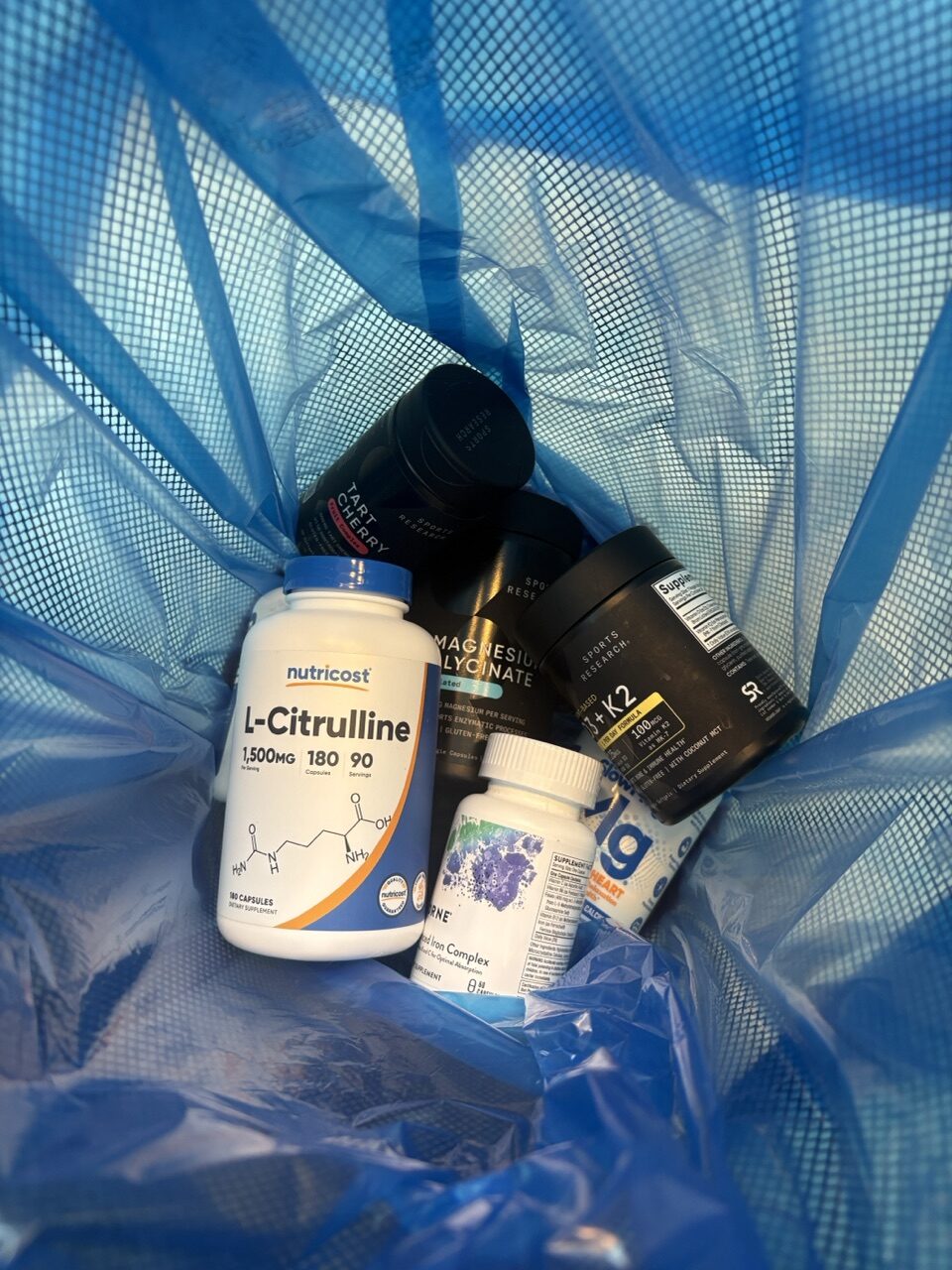
The biggest group leaving is the one I am almost proud of, because I bought each of these for a real problem and then fixed the problem. The citrus bergamot has the cleanest exit. I grabbed it in the scariest stretch of losing the weight, when my LDL spiked to 131 mid-drop and I wanted anything that might pull cholesterol down. The spike was temporary, the way it often is when weight comes off fast, and once I added ezetimibe, a cheap old drug that actually has evidence, my LDL settled in the 60s with no statin. I told that whole story, chart and all, in the post about losing the weight. The bergamot almost certainly had nothing to do with it.
The standalone vitamin D is the same story in miniature. I panicked about my level, bought the big 5,000 IU pills, and my labs now read fine while the multivitamin already carries a sensible dose. The iron I am genuinely glad about. I had a real dip, low enough that I got a colonoscopy to rule out anything worse, took iron until my ferritin climbed back to normal, and now I hold it there with steak instead of a capsule. The framework running backwards. A real number, fixed the proven way, and the bottle has no job left.
Two more leave because they never earned their place. The tart cherry I bought on the antioxidant-and-recovery pitch, and after a fair trial I cannot tell it ever did a thing, the small-studies-and-good-story problem in one bottle. The magnesium glycinate goes for a more embarrassing reason. I got pulled into which form of magnesium matters, ended up owning several, and once I paid attention the glycinate did nothing I could notice while the pricier threonate seemed to help my sleep.
And one never made it into the cabinet at all. I had eyed l-citrulline for a better pump, the kind of why-not buy I would have made without thinking a few years ago. Then I got diagnosed with an aortic aneurysm, and the framework’s other question, would I start this today, had a hard answer. I was not adding something that acts on my blood vessels on a why-not basis without a doctor signing off, and a better pump was never worth the phone call.
One bottle goes on probation. The Homocysteine Supreme has the best excuse of anything I own, because I did not buy it on a vibe. My labs through Marek came back last May with homocysteine at 17.9, over the 14.5 cutoff, and lowering it is at least a real hypothesis for the heart and brain. So I started the capsules, and then never retested. A year of blood draws have come and gone, and not one rechecked the number I started it to fix.
One dumb question did most of the work. If this came in a plain white bottle with no ad behind it, would I still buy it. Most of what I owned failed. My cabinet is a lot emptier now, and I trust what is left in it more than I trusted the full version.
My wife’s side of the counter did not change at all. The one orange pouch of green gummy bears is still there, and she still reaches for it because it is yummy and fun. We both landed right. I read down to a handful of boring bottles I can defend. She bought the one thing she enjoys and never lost a night’s sleep over it. The industry has a version for each of us, the spreadsheet and the candy, and it makes money either way. What it cannot sell against is knowing exactly what you are buying, and after this month we both do.
About Gunnar
Gunnar is 53. He lost about 170 pounds, trains in a garage gym, and writes DadStrengthDaily from personal experience, citing primary sources where he can. He also moderates r/ProactiveHealth. He is not a doctor, and nothing here is medical advice. Talk to your own doctor before acting on anything, especially GLP-1s, TRT, blood pressure, sleep apnea, and cancer screening.