
MVX tracks mortality across several cohorts, but nobody has shown that lowering the score improves survival, or what a healthy person should do with the result.
I have been ordering my own bloodwork for a few years now, and I thought I had a decent map of what is on offer. Lipids, ApoB, Lp(a), a calcium score, the insulin resistance markers. This week Peter Attia released episode 402 of The Drive with Jim Otvos, the biophysical chemist who invented NMR lipoprotein testing, and I spent most of it hearing about a marker I had never come across. It is called MVX, the Metabolic Vulnerability Index, and the claim attached to it is stranger than anything on my usual panel.
Every risk marker I track predicts a disease. ApoB, the count of the particles that carry cholesterol around, predicts atherosclerosis, and a self-ordered ApoB test now runs $17 to $69 at checkout. The calcium score tells me whether the disease has already started. Lp(a) tells me how much of the risk I inherited. Each one names a thing that might happen to me and gives me something to do about it.
MVX does not do that. Otvos is explicit that it is a mortality risk factor and not a disease risk factor. It does not name what you are going to get. What it tracks, across groups of people, is how likely they are to survive whatever they get. Whether it says anything that precise about one specific person is a different question, and a harder one.
What the MVX test actually measures
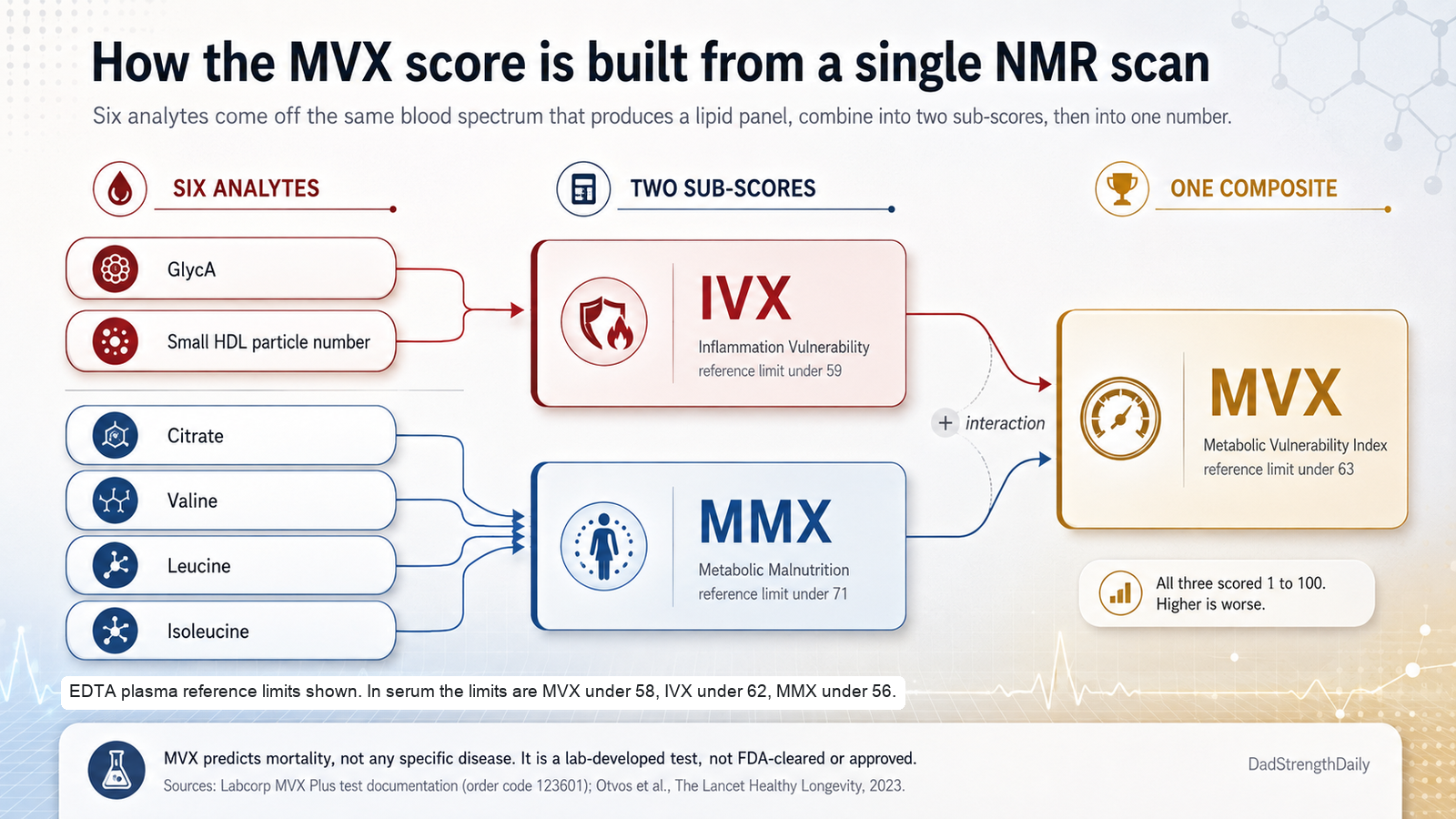
The mechanics are the part I find genuinely elegant. Labcorp runs a 400 MHz proton NMR scan on a blood sample using an instrument called the Vantera. NMR is nuclear magnetic resonance, the same physics as an MRI, pointed at a tube of blood instead of your knee. The same scan that produces a lipid panel also quantifies six other analytes, and those get folded into two sub-scores.
IVX, the Inflammation Vulnerability Index, combines GlycA with the number of small HDL particles. MMX, the Metabolic Malnutrition Index, combines citrate with the three branched-chain amino acids, valine, leucine and isoleucine. MVX puts those two together with an interaction term between them. All three come back on a scale of 1 to 100 where higher is worse, and Labcorp’s sample report sets the reference limits at under 63 for MVX, under 59 for IVX and under 71 for MMX.
The analysis itself uses about 150 microlitres of plasma, though the lab asks you to send a good deal more than that, half a millilitre at minimum and a millilitre preferred. The spectrum takes seconds and there are no reagents to consume. Otvos says that at high volume these tests cost a dollar or less to run.
The history explains how it got that way, and Otvos is a good narrator of his own field. He founded LipoScience in 1994 wanting to build instruments, the goal being an NMR analyser in every lab that a technician could run without knowing any NMR. Labcorp was one of the labs running a Vantera and paying LipoScience for every test. In 2014, after the company had gone public and Otvos had left the board, Labcorp bought it for about $85 million, which he calls a purely financial decision, cheaper to own the machines than to keep paying per scan. Labcorp runs labs, it does not build instruments, so the manufacturing plan ended there.
He is careful about how he says it. He describes Labcorp as “understandably not sharing the IVD vision,” in vitro diagnostics being the business of building machines other labs buy rather than keeping the testing to yourself, and adds that he is not claiming they do a bad job at what they do, only that they never worked out what to do with the science they had bought. That is a more generous account than I would have managed in his position.
There is a catch in the hardware, and it is the thing Otvos seems most worried about. The Vantera is the only NMR analyser of its kind in the world. All of the units were built around fifteen years ago, and while the superconducting magnets do not degrade, the machines run on ten-year-old PCs and have moving parts that will not last much longer. He left Labcorp in 2022 and has been pitching diagnostics manufacturers to pick up the technology, so far without a taker. A second-generation machine would cost four or five hundred thousand dollars to build. So the whole family of tests that comes off this scan, including the LDL particle number that a lot of people reading this have had run, depends on a finite number of aging machines with no successor.
I had assumed the research meant rerunning thousands of old samples. It did not. Once a spectrum is recorded it sits on a disk forever. When Otvos’s group worked out how to extract a new number from the old spectra, they could go back to a twenty-year-old study and ask whether the new number predicted who died, and have an answer in an afternoon. He calls this irrational discovery, and he means it as a description of the method rather than an apology for it. There was no mechanism to start from. They had the stored spectra and went looking.
Get the next one in your inbox
I write about longevity, training, and preventive health weekly — without the guru worship. Free, no spam, unsubscribe whenever.
The part that surprised me
The foundational study, published by Otvos and colleagues in The Lancet Healthy Longevity in 2023, looked at 5,876 people in the CATHGEN cohort at Duke and 2,888 more in a second cohort in Utah. These were people who had turned up for a cardiac catheterisation, so the presumption going in was that they would die of heart problems.
They mostly did not. About 60 percent of the deaths were from non-cardiovascular causes. MVX predicted them anyway. It predicted death from causes nobody had built it to detect.
Then they cut the cohort apart looking for a subgroup where the association would break, and did not find one. It held about equally in men and women, in people with and without obesity, diabetes, heart failure or kidney disease. If anything it was stronger in the people who had none of those conditions.
Two things about it are genuinely strange. MVX is close to unassociated with age, which for a mortality marker is not what you would expect, since age is the single best predictor of death we have. And it barely tracks physical frailty. In a community heart-failure cohort its correlation with a frailty score was 0.21. Separately, it accounted for only 3 to 5 percent of the statistical relationship between frailty and death. Whatever it is measuring, you cannot see it by looking at someone.
Otvos calls it metabolic frailty, and the phrase has grown on me. Susceptibility to dying, sitting underneath the specific disease you happen to get.
GlycA is the component worth ordering on its own
Of the six inputs, GlycA is the one I would be most inclined to order by itself, and it turns out I can. Own Your Labs lists the standalone Labcorp test, order code 123850, for $32. It is a composite signal coming off the sugar coating on several of the proteins your liver pushes out when you are inflamed, and it works as a measure of chronic, low-grade, whole-body inflammation.
Its advantage over hs-CRP, the standard blood test for inflammation, is stability. Otvos’s illustration is that an infection can move hs-CRP a thousandfold while GlycA moves about twofold. Anyone who has had an hs-CRP come back at 4 and spent a week wondering whether they were inflamed or just fighting a cold knows the problem GlycA solves. Clinical guidance for hs-CRP tells you to average two or three readings, and almost nobody does that. GlycA reads closer to a steady state on a single draw.
The small HDL particle number is the other input with a life of its own. In a study of older adults that measured 186 different variables and followed people for 27 years, small HDL particle number was the strongest single predictor of dying within two years. I would have guessed cholesterol, or one of the frailty scores.
The amino acids run backwards from what I expected. In the diabetes literature, high branched-chain amino acids go with insulin resistance. In MVX, low branched-chain amino acids push the score worse. Otvos says plainly that the mechanism is not understood, and points at muscle protein turnover and mTOR, the pathway that tells cells when to grow, as the likely neighbourhood. I would rather be told that than be given a tidy story.
Who the MVX test is actually for
MVX is at its strongest over short horizons. In the Duke data the hazard ratio for dying within one year is 3.00, against 1.53 for dying more than five years out. That pair is scaled differently from the group-against-group numbers I quote later, so do not line the two sets up against each other. The shape is the point. Most markers I follow do the opposite, telling me something vague about the next thirty years. Attia made the point that a short window is a feature here, because we have almost no biomarkers that speak to the near term.
The first real uses look clinical rather than personal. A paper published in June, in Nature Communications, followed 1,613 people with fatty liver disease for a median of four years. Adding MVX to the usual fibrosis staging predicted who would die better than the staging alone. For liver cancer the combined model moved from an AUROC of 0.78 to 0.84, where a coin flip is 0.5, but MVX on its own was not significantly associated with who developed cancer. The combination is doing the work there, not MVX by itself. Otvos is not an author on that one, though Margery Connelly, the Labcorp scientist who wrote the company’s MVX white paper, is. When Otvos first described the work to his collaborators at Duke, the first thing the clinicians said was that surgeons would want it, because there is no good objective way to screen someone for resilience before you operate. The other obvious use is picking people for a trial who are more likely to have something happen, so the trial needs fewer of them.
None of those uses is me, at 53, ordering a test online out of curiosity.
Is the MVX test worth ordering?
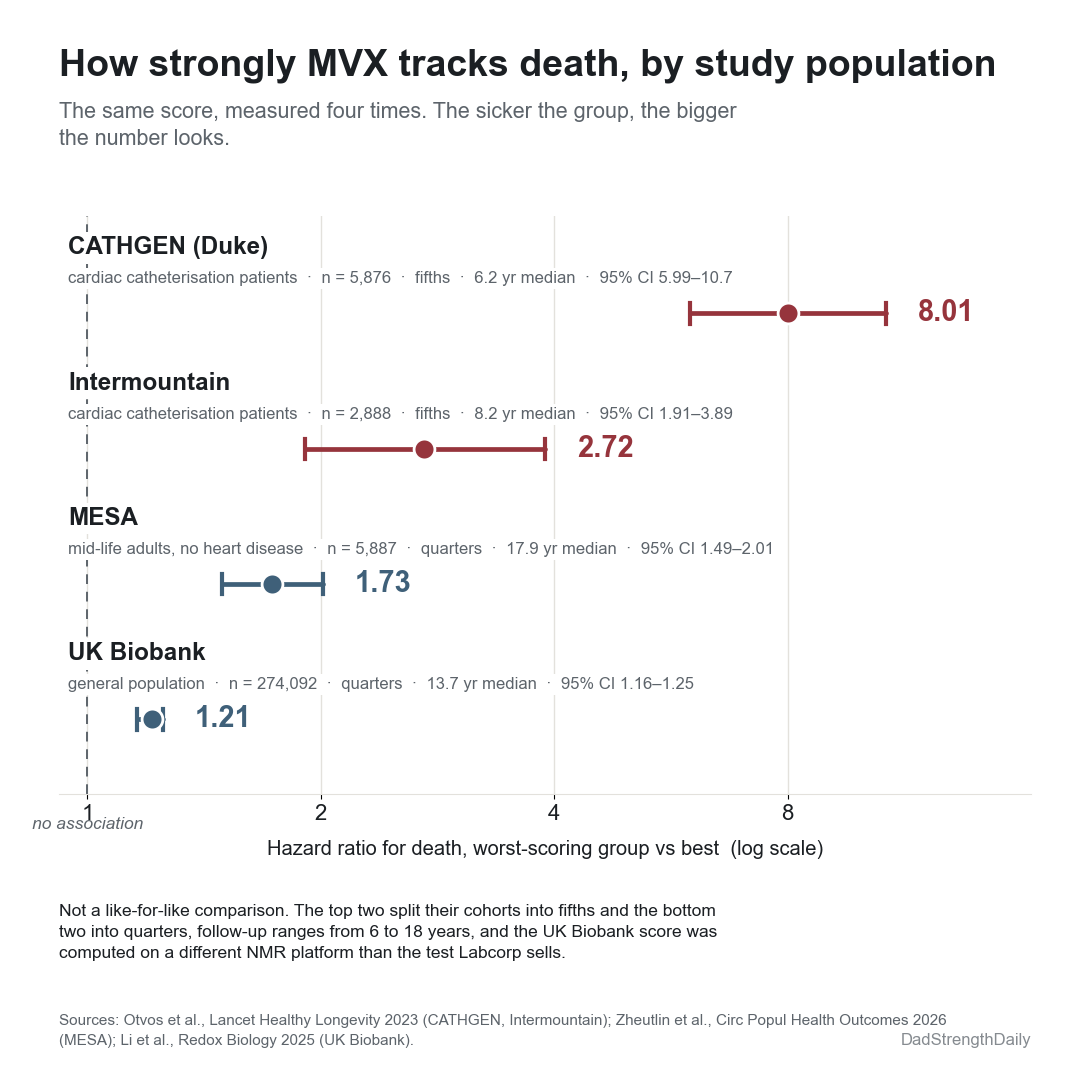
The dramatic numbers come from sick populations. The hazard ratio for death, worst-scoring group against best, is 8.01 in that Duke cardiac cohort and 2.72 in the Utah replication. It falls to 1.73 among mid-life adults free of clinical cardiovascular disease in MESA, a long-running US heart study, and 1.21 across 274,092 general-population adults in UK Biobank. Those four are not measuring quite the same thing. The first two compare fifths of a cohort, the second two compare quarters. And the UK Biobank one was run on a different NMR platform than the one Labcorp sells, so it is the same idea rather than the same test. The direction holds anyway. The further you get from a hospital the smaller it gets, and I am the last two rows, not the first. One thing to keep straight about all four: a hazard ratio compares one group against another. The 8.01 does not mean anybody had an 8 in 10 chance of dying, and it does not tell any individual his odds.
Most of that work has Otvos or a Labcorp scientist on the author list. He is also the man out pitching the technology to manufacturers, so that is not nothing. The UK Biobank analyses are the exception, and they are the interesting ones, because independent groups are computing MVX off someone else’s NMR data with no connection to him or the company. MetaboHealth is an older score that was itself trained on mortality, and in two of those comparisons, on cardio-renal-metabolic multimorbidity and on macular degeneration, it looked stronger than MVX, which faded once the two were adjusted for each other. That is not the same as proving it predicts death better, because those were not all-cause-mortality comparisons. It does make its absence from the episode conspicuous.
Nobody has shown the number can be moved on purpose. There is no trial of any design with MVX as an endpoint. Otvos treats the question as open and says the intervention study is the next step. Labcorp’s white paper is already marketing the test for tracking progress, and says a high MMX score “may call for mitochondrial support, amino acid repletion, or detoxification strategies,” which is running well ahead of anything published. That gap between what the inventor says and what the seller says is worth noticing.
And the most striking claim in the episode is not published yet. Otvos describes healthy 25-to-30-year-olds whose MVX predicted death 35 years later, which would genuinely change how I think about this. His words are that the work is about to be submitted. He also says the effect in the young is weaker, and that he has no idea why. I am not building anything on a paper I cannot read.
What the MVX test costs, and which version to order
The Metabolic Vulnerability Index is cheap to buy, which surprised me given how it gets talked about. As of August 5, Own Your Labs lists both versions at $40: order code 123590, which returns only the three scores, and order code 123601, MVX Plus, which adds the six individual analyte values. At the same price there is no reason to buy the first one, because without the components you cannot tell whether inflammation or low amino acids is driving your number. DrSays lists the same Labcorp test higher, plus a collection fee. Prices move, so check the order code rather than the test name.
The sites also disagree about preparation. Own Your Labs says to fast 10 to 12 hours because measurements taken after a meal are inconsistent, which matches what Labcorp says. Another lists no special instructions. Four of the six components move substantially after a meal, so I would fast whatever the order page says. It costs nothing and I would rather not spend the money and then wonder.
Two details worth knowing before you compare a result to anything. Labcorp’s reference limits, the under 63 and under 59 and under 71 above, are for EDTA plasma. Draw serum instead and the limits become MVX under 58, IVX under 62 and MMX under 56, because MMX alone runs about 15 points different between the two. Switching tube types between draws would move your score more than most real biological change. It is a lab-developed test, so it has not been cleared or approved by the FDA. I have no relationship with any company named here, and no affiliate links.
I am not ordering it this week. But GlycA looks like a steadier inflammation marker than the one I use now, and the next time I get an NMR panel run I am going to look at small HDL particle number instead of skipping past it. The idea underneath it is the part I cannot put down: that how likely you are to survive something might be measurable separately from whatever it is you get. When the intervention study lands, I will be first in line with a fasted arm out.