
Updated with the weekly price recheck.
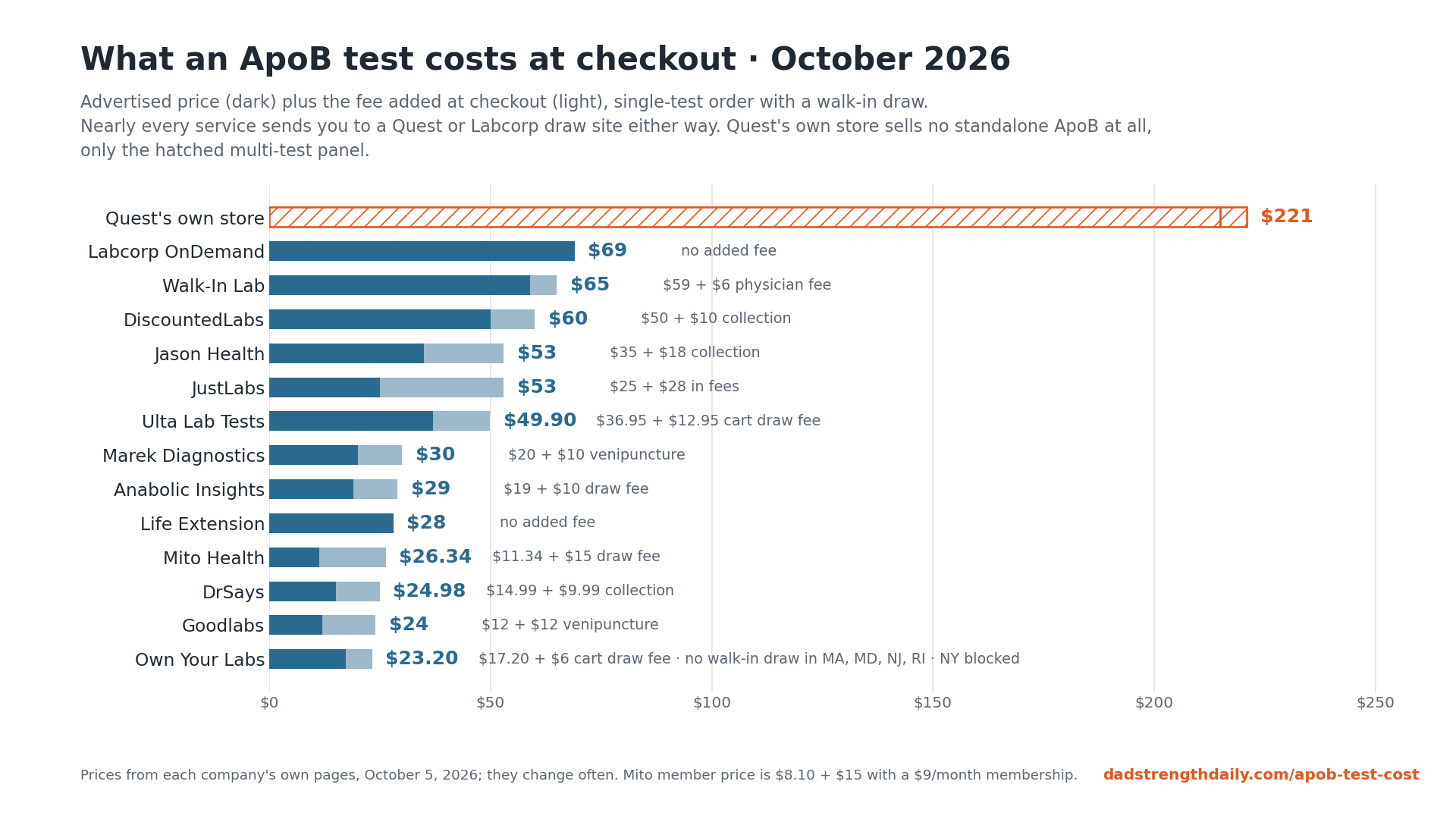
In August 2026 I emailed all thirteen services and asked them to check their rows. Ulta wrote back that its cart adds a $12.95 draw fee its product page never mentions; I re-verified that at the cart, and its row is now $49.90. DiscountedLabs and Anabolic Insights confirmed their numbers. Every row in the table now shows whether the provider has confirmed it.
Thirteen services will sell you the same ApoB blood test. The advertised prices start at $11. The checkout totals mostly start at $24, because almost every cheap price adds a draw fee at the end. I first priced all of them on the same day in August 2026, and I have rechecked the whole table roughly every week since. Here is the table.
I have been paying for my own bloodwork for a couple of years, first through my TRT clinic and then on my own through DiscountedLabs; along the way I drove my ApoB from flagged-high into the 50s, which I wrote about in the 170-Pound Rebuild. ApoB, if the marker is new to you, counts the particles that clog arteries instead of weighing the cholesterol inside them; it is not part of a standard cholesterol panel, and when it and your LDL disagree, the particle number is usually the better read of your risk. Where a given number lands, band by band, is in the full ApoB levels chart. The same test, run by the same national labs, sells for anywhere from $23 to $221 depending on which website you type your name into.
Every comparison I could find on Google was either an aggregator with affiliate links or a testing company ranking itself first. There are no affiliate links here and nobody is paying me. I priced one standalone ApoB test at every service that sells one and wrote down what the checkout actually charges, not what the banner advertises.
What an ApoB test costs in 2026
Prices checked October 5, 2026. Screenshots of every price are archived here, and I re-check this table weekly, because these prices move.
| What you want | Cheapest I verified | Where |
|---|---|---|
| ApoB alone, the one people are most likely to repeat | $23.20 | Own Your Labs (skips MA, MD, NJ, RI, NY); $24 at Goodlabs on its Quest route everywhere else |
| Lp(a) alone; once is usually enough | $28 | Goodlabs, Labcorp route |
| First-time baseline: lipids + ApoB + Lp(a), one draw | $52 | Goodlabs, verified in its order screen |
| Service | You pay | Sticker + fee | Lab & limits |
|---|---|---|---|
| Own Your Labs○ contacted | $23.20 | $17.20 + $6 draw fee in the cart | L · kits only in MA, MD, NJ, RI · no NY |
| Goodlabs○ contacted | $24.00 | $12 + $12 fee, Quest route | Quest $24 all-in / Labcorp $36 · NY, NJ via BioReference |
| DrSays○ contacted | $24.98 | $14.99 + $9.99 fee | L · not NY, NJ, RI |
| Mito Health○ contacted | $26.34 | $11.34 + $15 fee | Q or L · varies by state |
| Life Extension○ contacted | $28.00 | $28 flat | Q |
| Anabolic Insights✓ confirmed | $29.00 | $19 + $10 draw fee, Quest route | sticker Q $19 / L $24 / BioReference $25 · limits not stated |
| Marek Diagnostics○ contacted | $30.00 | $20 + $10 fee | Q · not NY, NJ, RI · ~2-week results |
| Ulta Lab Tests✓ confirmed | $49.90 | $36.95 + $12.95 cart draw fee | Q · not HI, NY, NJ, RI |
| Jason Health○ contacted | $53.00 | $35 + $18 fee | Q |
| JustLabs○ contacted | $53.00 | $25 + $28 fees | Q |
| DiscountedLabs✓ confirmed | $60.00 | $50 + $10 collection | Q · not HI, NY, NJ, RI |
| Walk-In Lab○ contacted | $65.00 | $59 + $6 fee | Q or L |
| Labcorp OnDemand○ contacted | $69.00 | $69 flat | L |
I emailed every service in this table on August 22 and asked them to check their row. ✓ confirmed = the provider replied and verified the numbers. ○ contacted = no reply yet; the row stands on my own checkout verification.
One standalone ApoB test, ordered online, drawn at a lab near you, single-test order. Mito’s $11.34 is the non-member price; members pay $8.10 plus the same $15 draw fee, and membership costs $9 a month. Marek waives its draw fee on orders over $199. Q means the blood draw happens at a Quest patient service center and L at Labcorp; a lab code with nothing after it means the service listed no state restrictions when I checked, though state law can still surprise you at checkout.
If you want ApoB inside a big panel instead: Empirical Health bundles 100+ biomarkers for $190, and Function Health charges $365 a year, which I took apart in my Function Health review.
The company you buy from is not the lab that draws you
Apart from Labcorp’s own store, every row in that table is a reseller; none of them runs a lab. What you are buying is an order form: a physician on their side signs the requisition, and you walk into an ordinary Quest or Labcorp draw site, the same building your doctor would send you to.
Quest’s catalog number for the assay is 5224. Order it through Goodlabs and your total is $24. Quest’s own consumer store sells no standalone ApoB at any price; the only way to get it there is a panel that bundles five other markers you may not want — $221. Same company, same tube of blood, nine times the money. Labcorp sells its own test, code 167015, for a flat $69, and the resellers get you the identical test for as little as $23.
The two labs also price differently through the same service: Goodlabs charges $12 for a Quest ApoB but $24 at Labcorp, so the same order totals $36 at a Labcorp site. Marek, where I get my TRT bloodwork, moved its draws from Labcorp to Quest in late 2025; my own requisitions flipped.
So “ApoB test near me” is not a real question. The test near you is whatever Quest or Labcorp location is near you. In most states the only decision is who writes the order form, and that is a $200 decision. The exceptions are below.
Get the free Bloodwork Decoder
I write about longevity, training, and preventive health weekly — without the guru worship. Free, no spam, unsubscribe whenever.
Where the cheap prices hide the fee
Almost nobody in that table charges you what the banner says. Goodlabs advertises ApoB at $12, and its order screen then adds a $12 venipuncture line, “for order form and lab draw,” so the real total is $24. Mito advertises $11.34 and adds a $15 draw fee, and JustLabs turns a $25 test into $53 with fees. None of this is hidden, exactly. It is disclosed the way resort fees are disclosed. DiscountedLabs, the service I have actually used, is $50 plus a $10 collection fee. It also turns out to be one of the expensive ones, and this table is why I know.
The fee is per visit, not per test, so stack the draw. At Goodlabs, ApoB plus Lp(a) plus a lipid panel runs $52 all in through Quest, and its 11-marker Heart Health panel, which adds hs-CRP and homocysteine, is $55 plus the $12 fee. Marek waives its fee entirely over $199.
Own Your Labs has the lowest total in the group, $23.20: $17.20 for the test plus a $6 draw fee that shows up in the cart. The catch comes next.
Update, October 5, 2026: I had Own Your Labs at $17.20 with the draw included, going by its FAQ. When I opened its cart on October 5, it added a $6.00 draw fee, so the total is $23.20. I don’t know whether the fee is new or whether I missed it in August. The title, table and chart now say $23.20.
The states where this breaks
Direct-access testing is state law, not company policy, and the map has holes; what each seller can offer inside its states depends on its physician network and lab contracts. New York, New Jersey and Rhode Island prohibit most of it: DrSays and Marek exclude exactly those three, Ulta and DiscountedLabs add Hawaii, and Goodlabs reroutes NY and NJ customers to BioReference, the one big lab that works there. Quest’s own consumer panel can’t do collections in Arizona, Hawaii or Puerto Rico.
Own Your Labs, the cheapest row, cannot do a walk-in draw in MA, MD, NJ or RI; it ships an at-home kit instead, and it cannot serve New York at all. I live in Massachusetts, and since this guide prices a venous draw at a real lab, my walk-in floor is Goodlabs at $24.
How to order an ApoB test without a doctor
The mechanics are the same everywhere: pick the test, pay, answer a short intake, and the signed requisition PDF follows. Pick a lab location, walk in for a normal draw, and results land in the service’s portal a few days later at most of these companies; Marek is the slow exception, closer to two weeks. Nobody asks why you want it. Insurance is never involved: no prior authorization, no coding, no surprise bill months later.
I have done this through DiscountedLabs, and the strangest part is how ordinary it is. The phlebotomist does not know or care that your doctor didn’t send you.
Will insurance cover an ApoB test?
Usually not, and the reasons are specific enough to be worth two minutes. ApoB bills under CPT code 82172, and that code is the most useful fact in this section: quote it when you call the number on your insurance card and ask whether the test is covered for you, before the draw rather than after. For scale, Medicare’s 2026 clinical laboratory fee schedule lists 82172, “Apolipoprotein, each,” at $21.09. That is the going rate between parties that bill at contracted prices, and it frames the whole question: nobody is saving hundreds of dollars by getting this test covered.
Does Medicare cover an ApoB test?
On Medicare, a curiosity test is a flat no. The lipid-testing coverage rules (NCD 190.23) are blunt: routine screening for lipid disorders is not covered because the statute does not allow it, and testing an asymptomatic person counts as screening no matter how many risk factors you have. Medicare’s separate cardiovascular screening benefit (42 CFR 410.17) covers total cholesterol, HDL and triglycerides once every five years, and ApoB is not on that list. The $21.09 applies to claims Medicare accepts as diagnostic rather than screening.
Commercial plans run narrower than most people expect. Aetna publishes its criteria in Clinical Policy Bulletin 0381, last reviewed in June 2026, and the ApoB rules reward a slow read: covered for adults who are already on stable lipid-lowering therapy, have already reached their LDL-C or non-HDL-C goal, and on top of that have established cardiovascular disease, type 2 diabetes, high triglycerides or a cluster of metabolic risk conditions. The covered patient is someone whose treatment is already working. The reader with a normal-looking panel who wants to know whether the particle count agrees, the person this test helps most, is exactly who the criteria exclude. Other insurers write their own policies; Aetna’s is simply the one published where anyone can read it.
Here is the split that makes the question simple for me. Most people, I hope, get the basics from their own doctor, a CBC, a metabolic panel, a lipid panel, an A1C, with insurance paying the way it is supposed to. ApoB is not part of that routine, so I treat it as what it is: an individual choice with an individual cost, the $23 to $69 in the table above. If you bill it and the claim is denied, you owe the lab’s billed charge, a number you learn from the explanation of benefits after the draw; the cash price is the one number you know before it. Lab memberships and big bundled panels are a different calculation, worthwhile mainly if you want a lot of tests at once or have no insurance at all. For one marker, buy the one marker: pay cash, or, if you want to try billing it, ask your doctor whether a lipid-disorder diagnosis fits your chart and ask your insurer what 82172 pays under your plan, in that order, before anyone draws blood.
Do you need to fast for an ApoB test?
The sellers cannot agree. Labcorp OnDemand’s page says “No special preparation needed” in its details and “fasting for 12-14 hours” in its FAQ, on the same page. Own Your Labs demands a 12 to 14 hour fast for the same assay Mito draws after breakfast.
The 2026 guideline, unpacked in my plain-English cholesterol guide, settled the question: nonfasting works for most people, and fasting matters mainly when triglycerides run high (how long to fast before a blood test, test by test). Follow the fasting instructions on your requisition, especially when triglycerides are part of the order. That guideline also gave ApoB formal standing for people already on cholesterol treatment.
What counts as a good ApoB number
Two scales get mixed up. The reference range on the lab report describes the population; on my own Labcorp and Quest reports it tops out at 90 mg/dL, and anything over comes back flagged high. Treatment targets are a different scale and depend on your risk tier: where the 2026 guideline sets an LDL goal under 100 mg/dL, the matching ApoB goal is also under 100, and for people at very high risk, roughly two major cardiac events, or one plus a stack of risk factors, it calls checking ApoB with a goal under 55 reasonable once the LDL and non-HDL goals are already met. There is no official “optimal for healthy people” number, whatever a testing company’s marketing page says.
Mine was 95 and flagged high in May 2025, near my heaviest. Fourteen months, 170 lost pounds and one ezetimibe prescription later, it read 59, and I will not pretend I can split the credit between the weight loss and the pill. There is no established retest interval either; anyone selling a subscription built around one is guessing. I test at my annual physical, and about three months after changing anything that should move the number. Under $50 a year, and it earns that only if the result could change what you eat, what you take, or what you ask your doctor.
I did not push my ApoB down because a guideline told me to. I pushed it because I could watch the number move for less than the cost of the pizza I wasn’t eating. That is the product, and the $12 fee that turns a cheap test into a signed order is the rare markup in American healthcare I pay without complaint.
I pay for my own bloodwork, including as a customer of Marek (whose diagnostics store is in the table) for my TRT labs and of DiscountedLabs for self-ordered tests. No company in this post paid to be included or excluded, and there are no affiliate links. Prices are what each company’s own pages showed on the date printed above the table; this market reprices constantly, and I keep dated screenshots of every price in the table. Nothing here is medical advice.