
Updated with a note on calculated vs directly measured LDL.
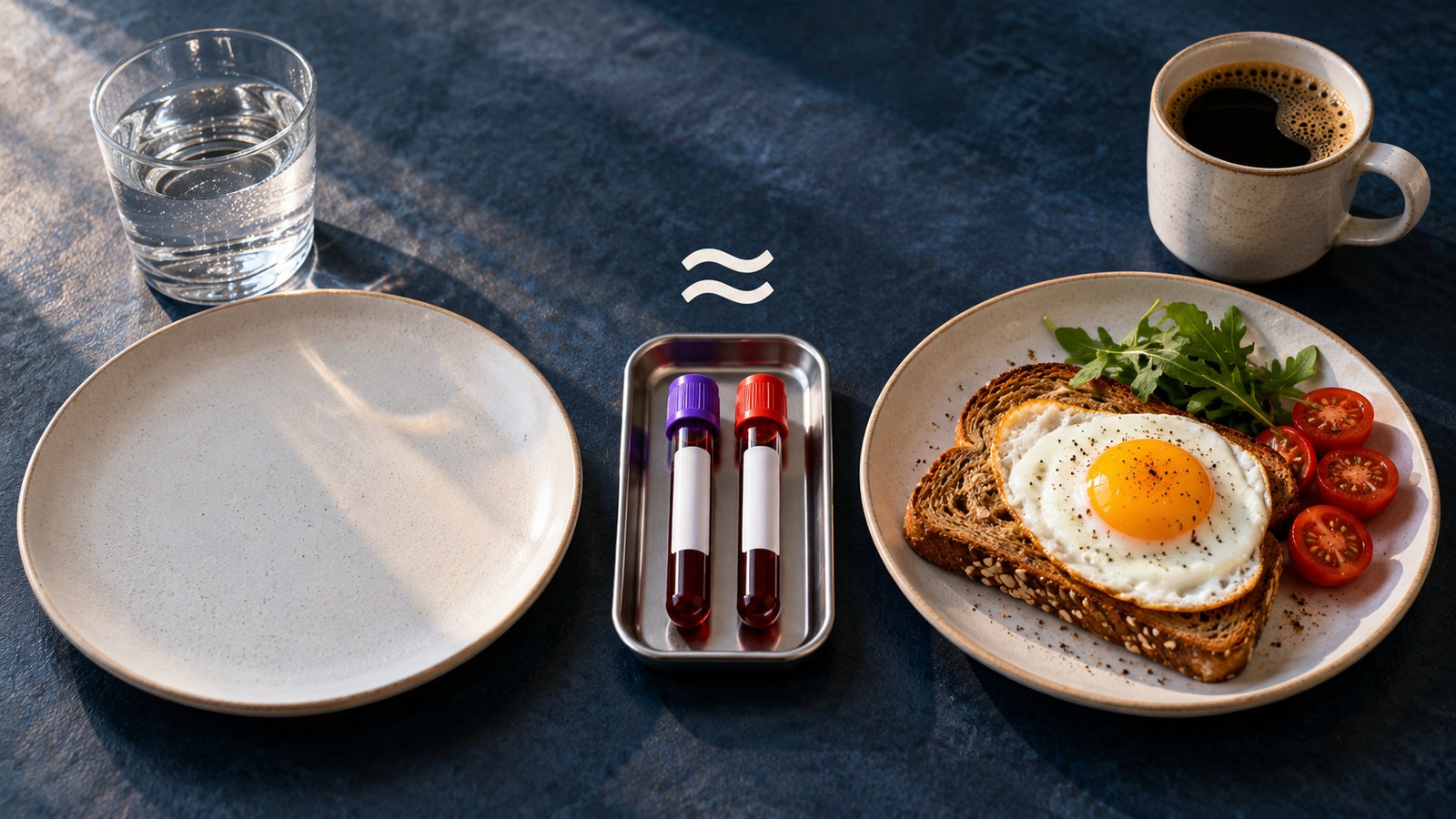
I skipped breakfast before 11 of my last 14 blood draws, mostly because the requisition told me to. A study of 101,148 patients published September 28 in JAMA Internal Medicine says that for most of what gets ordered, it made little difference.
Glucose, triglycerides and a few other tests read differently after a short fast. Cholesterol, most of the blood count, kidney tests and most electrolytes barely moved. So how long should you fast before a blood test? At least 8 hours if glucose or a precise lipid number is the goal, the authors say. Fasting longer than 12 hours showed no meaningful additional difference, compared with 8 to 12, in the comparisons the researchers could evaluate.
How the study worked
The team pulled 9.8 million results from adult outpatients at one hospital near Seoul, 2021 to 2023, with the fasting time recorded at each draw. Many patients were drawn more than once at different fasting times, so the authors could compare each person with themselves. That mattered. Comparing different people, 27 of 121 tests looked sensitive to fasting. Comparing the same people, 10 did. LDL cholesterol looked about 8% different between fasting groups, but no difference held up within the same person. Same-person comparisons still aren’t a controlled experiment: medication, illness and time of day could differ between visits, as the authors note.
To judge whether a difference might matter clinically, the authors used a European lab-federation threshold for each test, based on how much it varies naturally.
What changed after a short fast
In draws taken half an hour after eating, glucose averaged 134 mg/dL. At four hours the average was 113, and it stayed about there. Within the same person, glucose read 10.8% higher less than 8 hours after eating than after more than 12 hours, enough to matter if your number sits near the prediabetes line. Triglycerides read 20.1% higher, which is why a fasting triglyceride is the one lipid number where a meal counts. A few other tests, including the liver enzyme GGT and vitamin D, also shifted. If the doctor wants a fasting glucose, the authors say to fast at least 8 hours.
Total cholesterol and HDL moved 3% or less, and directly measured LDL showed no meaningful within-person difference. The paper doesn’t report ApoB or Lp(a). My one non-fasting panel, drawn mid-morning in July, read triglycerides 49, LDL 56 and ApoB 59, against 63, 60 and 62 fasting in May. Lower triglycerides without fasting is the opposite of the study’s average, and two draws months apart can’t tell me why.
Update, September 29, 2026: A reader pointed out a catch. Most US lipid panels, including my Quest ones, calculate LDL from total cholesterol, HDL and triglycerides rather than measuring it. Because the formulas subtract a triglyceride term, the post-meal rise in triglycerides can make a calculated LDL read a little lower even when nothing real has changed. An older study of more than 200,000 people, cited in this paper, found LDL varied by up to 10% with fasting time. This study measured LDL directly, so its result may not carry over exactly to the calculated LDL on a typical US panel.
The limits
This is one hospital in Korea, fasting times were self-reported, and the study couldn’t account for what people ate. The authors didn’t check how often a short fast pushed someone across a diagnostic cutoff. The median patient was 61.
For cholesterol this isn’t new. A 2016 European consensus statement said routine fasting isn’t needed for a lipid panel (my guide to reading the panel covers the US side). The new part is the breadth of tests and the same-person comparison.
Biotin can skew some tests
Biotin (vitamin B7) is a separate problem. Many lab tests use biotin in their chemistry, and a high level in your blood can push results falsely high or falsely low, including a falsely low troponin, the heart-attack test the FDA has warned about since 2017. Hair, skin and nail supplements can carry 20 mg or more. If you take one, tell your doctor and the lab which supplement and how much, and ask what to do for the specific tests ordered. My Thorne multivitamin has 1 mg a day, a dose the AACC (now ADLM), the US lab-medicine society, says in its guidance hasn’t been reported to cause interference, though one test maker has flagged possible trouble at lower doses on some of its assays.
How long I’ll fast next time
If most tests didn’t need a fast, draws wouldn’t have to be squeezed into the early morning, and scheduling would get much easier. If the order says fasting glucose or fasting triglycerides, I’ll fast 8 hours overnight and stop there. For a routine cholesterol panel, the 2016 European consensus says a non-fasting draw is fine, though this paper’s authors still advise 8 hours when a precise lipid number matters. For an ApoB draw or anything else, I’ll follow the requisition, but the extra hours past 12 are the first thing I’m dropping.
Get the free Bloodwork Decoder
I made the one-page cheat sheet I wish I’d had at my first physical: what every number on your labs actually means, what’s worth aiming for at 50, and what to ask your doctor. Subscribe free and I’ll send it straight to your inbox. No spam, nothing to sell.
If this was useful, read next
- Reading Your Cholesterol Panel at 50 — what each number on the lipid panel means under the 2026 guideline
- ApoB Test Cost: 13 Services Priced at Checkout — where to get the one lipid test this study didn’t cover, and what it costs
- Check your bloodwork (regularly)! — why I started getting labs drawn at all