
Key points
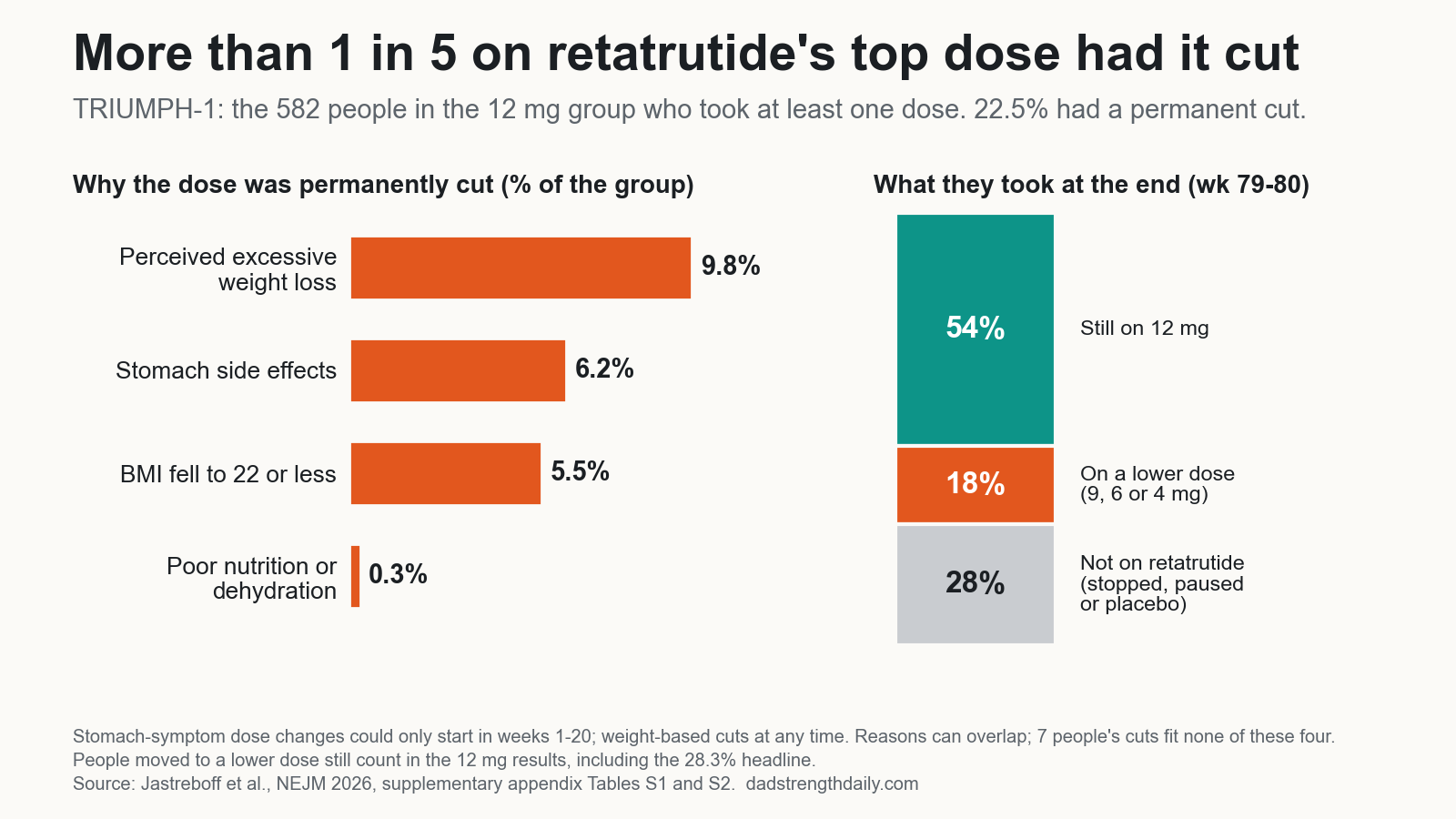
- In Lilly’s main obesity trial of retatrutide, 22.5% of people assigned to the 12 mg top dose had it permanently lowered. The most common reason was perceived excessive weight loss (9.8%), ahead of stomach side effects (6.2%) and reaching a BMI of 22 or less (5.5%). The trial’s rules made weight-based cuts easier to get than side-effect cuts, so that is not a ranking of tolerability.
- People moved to a lower dose still count as “12 mg” in both of the trial’s main results, including the 28.3% Lilly headlined. By the end of the trial, only 54% of that group were still taking 12 mg.
- On retatrutide’s low dose, 4 mg (the lowest target dose in TRIUMPH-1), three in four were still on it at week 80, and about as few quit for side effects as on placebo (4.1% against 4.6%).
Disclosure: I own Eli Lilly stock and I take tirzepatide, which is a Lilly drug. Read what follows with that in mind.
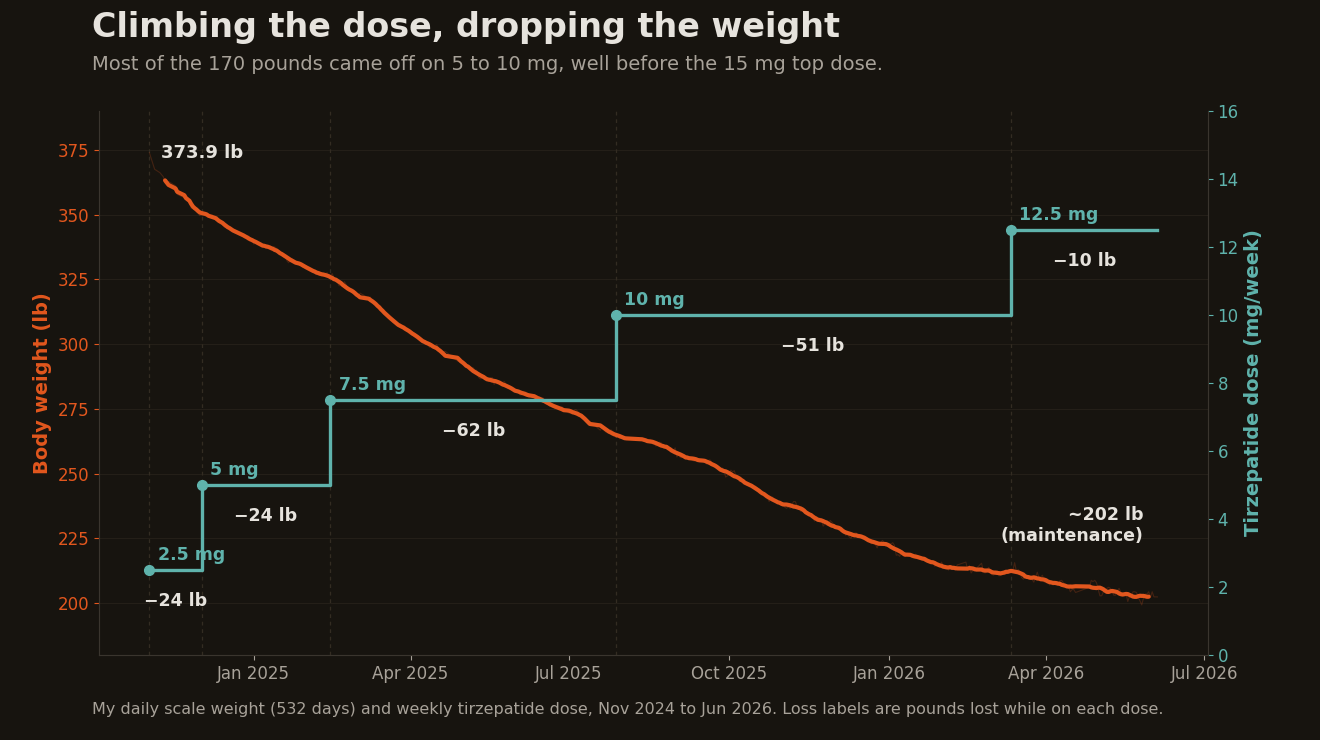
I never made it to the 15 mg top dose of Zepbound while losing 170 pounds. I raised the dose slowly, and most of the weight came off on 5 to 10 mg. So when the full TRIUMPH-1 paper came out in the New England Journal of Medicine on September 29, the first thing I looked for in its 87-page appendix was what happened to the people on retatrutide’s top dose, and what that says about the low dose.
What happened on the 12 mg dose
TRIUMPH-1 randomized 2,339 adults with obesity and no diabetes to weekly retatrutide at 4, 9 or 12 mg, or placebo, for 80 weeks. Of the 582 people in the 12 mg group who took at least one dose, 131 had their dose permanently lowered at some point during the 80 weeks. The trial allowed four reasons, and the appendix counts each one (7 of the 131 people had no cut for one of those reasons, and a few had more than one): perceived excessive weight loss (9.8% of the group), stomach side effects (6.2%), reaching a BMI of 22 or less (5.5%), and poor nutrition or dehydration (0.3%). Two of the three main reasons were about weight. On placebo, 0.5% had a (sham) cut.
“Perceived” means the participant or the trial doctor thought the loss was too much. There was no fixed threshold. The trial protocol tells doctors to consider a cut when the weight loss “may lead to participant decision to discontinue,” so it was also a way to keep people on the drug.
Permanent cuts were blinded, went to a lower dose (9 mg, 4 mg or placebo), and never went back up. In the last two weeks of the trial, only 54% of the 12 mg group were still taking 12 mg. Another 18% were on a lower retatrutide dose, mostly 9 mg, and 28% were not taking retatrutide at all (stopped, paused, or moved to placebo). One step down, 16.6% of the 9 mg group finished on 4 mg.
The 28.3% describes the 12 mg plan, step-downs included
The trial’s analysis plan, published with the protocol, says dose changes “will not be considered” among the events that change how someone’s results are counted, “since they are part of treatment condition.” So people moved to 9 mg or 4 mg stay in the 12 mg group in both main results: the 25.0% that counts everyone randomized, whatever happened to them, and the 28.3% “efficacy” estimate, which models what would have happened if everyone had stayed on treatment. (That second one sets aside data collected after someone quit, got moved to placebo or started another weight-loss drug, and models what would have happened instead.) Both are about the group assigned to the 12 mg plan, with the adjustments the protocol allowed. Neither is what people lost on a steady 12 mg: the planned climb from 2 mg took 16 weeks, one step every four weeks.
The paper doesn’t report what happened to the weight of the people who were cut.
The rules made weight cuts easier than side-effect cuts
The protocol didn’t treat the two kinds of reason the same way. A dose change for stomach symptoms could only start in the first 20 weeks, and a permanent cut came only after diet advice, symptom medication (anti-nausea or anti-diarrhea drugs), a skipped dose and a temporary four-week step-down, if the symptoms came back when the dose went up again or the doctor judged going back up a bad idea. A cut for weight loss or a low BMI was allowed at any time.
Other side effects, like the burning skin sensation retatrutide is known for, were not a reason for a cut at all. Side effects of any kind made 11.1% of the 12 mg group stop the drug, against 4.6% on placebo. Another 5.3% stopped because they, or the trial doctor, felt they had lost enough or too much weight, against nobody on placebo. So I can’t use the dose cuts to say that too much weight loss was a bigger problem than side effects. The protocol simply gave people more ways to cut for weight.
Get the next one in your inbox
I cover the latest GLP-1 trials and access changes weekly. Free, no spam, unsubscribe whenever.
Retatrutide low dose results and side effects on 4 mg
Three in four people assigned to 4 mg (74.5%) were still taking that dose at week 80. On 12 mg, just over half were. Side effects made 4.1% of the 4 mg group quit, compared with 4.6% on placebo.
4 mg isn’t side-effect free: 28.6% reported nausea against 14.8% on placebo (and 42.4% on 12 mg), and 5.1% reported the skin sensation against 0.9% on placebo.
Average weight loss on 4 mg was 17.6% counting everyone (19.0% on the efficacy estimate), and 57% of the group lost at least 15%. In these two trials, people with type 2 diabetes lost less on average at every dose. In TRIUMPH-2, published in The Lancet the same day, 4 mg gave 11.9% counting everyone, against 18.8% on 12 mg and 5.1% on placebo. The tolerability pattern held: 4% of the 4 mg group stopped treatment because of side effects or death, against 5% on placebo, and nobody on 4 mg stopped because of stomach problems. So few people stopped 4 mg in the diabetes trial either, but its 12% is well short of the 17.6% it gave people without diabetes in TRIUMPH-1, a different trial.
Seven of the 11 authors are from Lilly, and they write: “We speculate that these observations highlight the need to reconsider the use of the maximum tolerated dose as the treatment strategy, thereby aiming for the minimum effective dose needed to reach treatment targets for each patient, as is common in the treatment of other chronic metabolic diseases.” I made the case for the low dose when the topline came out in May, in what TRIUMPH-1 showed, and wrote about why it matters for the price. The rest of the trial program is on my GLP-1 pipeline tracker.
The trial doesn’t prove that stopping below 12 mg works better, and the authors call their idea speculation. But its own numbers make a good case for treating 12 mg as a ceiling to reach if you need it, not a goal. That is how I ended up using Zepbound: I climbed slowly and never went to the top dose, because the middle doses were doing the job.