
Updated with the FDA’s October 2 decision that retatrutide is a drug, not a biologic.
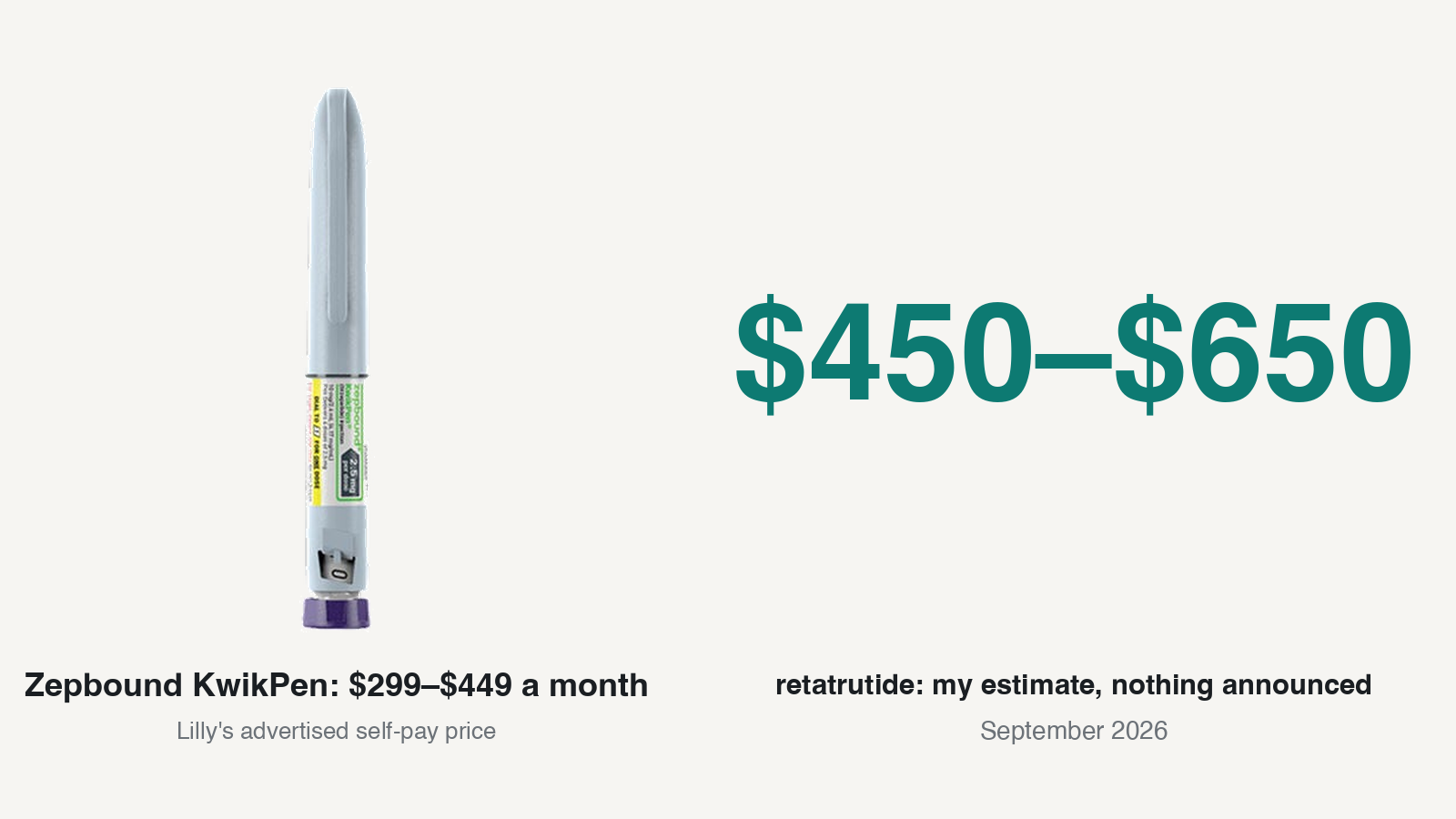
Retatrutide cost, checked September 4, 2026: nothing announced by Lilly. So here is my estimate: $450 to $650 a month at launch if you pay cash, most likely near $550, and lower within a couple of years after that. It is a guess, but not a blind one.
I bought Zepbound with my own money for months, after my insurance denied it and before it changed its mind. So I have paid Lilly’s cash price myself.
Disclosure up front: I own Eli Lilly stock and I take Zepbound, a Lilly drug.
| Retatrutide status | |
|---|---|
| FDA approved | No |
| FDA application | Planned Q1 2027 (Lilly intends to file it as a biologic; the FDA calls it a drug) |
| Brand name | Not announced |
| Last checked | September 4, 2026 |
Retatrutide price per month: my $450 to $650 estimate
When Zepbound arrived in November 2023, Lilly’s launch release put it at “as low as $550” a month for people whose insurance would not cover it. The same release published a list price of $1,059.87. Ignore it; almost nobody pays list. What matters is what a commercially insured patient without coverage could pay, and on day one that started at $550.
Retatrutide should land above today’s Zepbound, Lilly’s tirzepatide. Retatrutide loses more weight in its trials, and it is new. That is the floor.
| Drug | Self-pay price per month |
|---|---|
| Foundayo (orforglipron), Lilly’s pill | $149 to $299 by dose |
| Zepbound KwikPen or vial | $299 to $449 by dose |
| Wegovy pen (Novo, for contrast) | $349 to $399 by dose |
Self-pay prices checked September 4, 2026 on LillyDirect, Foundayo’s terms and NovoCare. Wegovy’s first two fills at the two starter doses are $199 for new patients. Zepbound’s card and Wegovy’s $199 starter offer expire December 31, 2026.
The ceiling is competition. Most of those prices are Lilly’s own, so a $900 drug would likely move people to Zepbound. Novo’s CagriSema has a US decision expected in late 2026 and will probably be selling before retatrutide is filed. And a $2,000 price would leave people buying retatrutide as a research chemical where they are. Lilly has sued six sellers and flagged more than 14,000 websites and social posts, and that market has not gone away.
Floor and ceiling give the band. The middle sits near $550 because that is where Lilly’s offer to uncovered buyers started on Zepbound’s first day, and I put the ceiling at $650 because a bigger premium sends buyers back to Zepbound. Expect about $150 to $200 a month above Zepbound’s ladder, and less if Zepbound falls first.
Prices also fall: Zepbound’s cash price is well below its launch number, and Lilly’s newest weight drug, Foundayo, launched cheaper still, starting at $149. Whatever retatrutide launches at, I expect it lower by 2030.
The way I am most likely wrong is the opposite of cheap: Lilly could sell the extra weight loss as a premium to a smaller group. CagriSema’s price will probably test that premium first.
Some of the prices you will find in a search are bait. One of the results on Google’s first page for retatrutide prices is the website of a small town in North Carolina that somebody broke into and filled with articles about peptide prices. When I checked on September 16, 2026, opening it on a phone forwarded you into a WhatsApp chat with a seller, with a message already typed asking for a price list and 30 percent off a first order. I wrote that operation up in how a hacked North Carolina town website funneled Google searches to peptide sellers in China, and whatever those pages quote, it is not the price of an approved drug.
Get the next one in your inbox
I cover the latest GLP-1 trials and access changes weekly. Free, no spam, unsubscribe whenever.
Who needs retatrutide?
Probably not you, if Zepbound is working.
Retatrutide has produced greater average weight loss. Its Phase 3 obesity trial reported 28.3 percent at the top dose; SURMOUNT-1 reported 20.9 percent on 15 mg of tirzepatide. You cannot subtract one from the other, because the trials count weight loss under different statistical rules; by my own matching of the two counts, the gap is about four points. The head-to-head, TRIUMPH-5, has not reported.
In that obesity trial, TRIUMPH-1, retatrutide also produced a dose-related burning or tingling skin sensation in 5.1 to 12.5 percent of people, against 0.9 percent on placebo.
The lowest dose Lilly tested, 4 mg, is one escalation step up and lost 19.0 percent by Lilly’s headline count, with a slightly lower observed dropout rate for side effects than placebo. Counted the way Zepbound’s 20.9 percent is counted, it lands about three points behind Zepbound’s top dose. If a low dose gets most people most of the way, fewer climb, and a price ladder built on titration gets harder to sell.
Update, October 3, 2026: The full TRIUMPH-1 paper is now out in the New England Journal of Medicine. Its primary analysis counts everyone, including people who stopped the drug: the 4 mg dose lost 17.6 percent at 80 weeks and the 12 mg dose 25.0 percent, against 3.9 percent on placebo. That matches the comparison above, with the top dose 4.1 points ahead of Zepbound’s 20.9 percent and the 4 mg dose 3.3 points behind it, so my price estimate doesn’t change.
The people with the clearest reason to wait are the ones who stalled on tirzepatide or could not tolerate it. If you are losing weight on Zepbound, holding out for a drug two years away and unpriced is a bad trade. I compared the two in retatrutide vs Zepbound.
Retatrutide cost without insurance
Retatrutide itself will be only part of the bill, as tirzepatide is today. If you are insured, your own doctor sending a script to a direct pharmacy can run $27 to $108 a year in copays. Hims, Ro and LifeMD charge $39 the first month then $149, medication not included, or $1,678 in year one. Same drug, up to sixty times as much for the prescription, and I do not expect a new molecule to change that. I priced that market in what to do when insurance won’t cover your GLP-1.
Retatrutide cost with insurance
Will insurance cover retatrutide? There is no formulary tier and no prior-authorization form for it yet.
On a commercial plan, ask why a payer already covering Zepbound would pay more for an average weight-loss edge of about four points. I do not think most of them will, at least not first. My guess is that plans will make people try tirzepatide first, which would leave retatrutide a cash drug for many of the people who want it. A denial is not always permanent; mine reversed after a few months.
Medicare is harder, and the timing is bad. The way in today is the CMS GLP-1 Bridge, a demonstration outside normal Part D, the Medicare drug benefit, that costs a flat $50 a month and covers Foundayo, Wegovy and the Zepbound KwikPen. It expires December 31, 2027, and retatrutide will probably not be approved before it does. Ordinary Part D is the other route, and plans can add drugs mid-year, so the common claim that you must wait until January is wrong.
When will retatrutide be available?
Not in 2026, and probably not in 2027 either. Lilly said in its July 23 results release that it now has the clinical data package to support filings for obesity, obstructive sleep apnea and knee osteoarthritis pain, and that it plans to file with the FDA in the first quarter of 2027. A standard review runs about a year from submission, which points at 2028. A priority review would pull approval into late 2027, if the FDA grants one.
There is also a fight over what retatrutide legally is. The FDA calls it a drug, worth five years of exclusivity; Lilly is suing to have it called a biologic, worth twelve, and the Seventh Circuit hears argument on September 24, 2026. For a buyer it barely matters this decade: even five years runs to 2032 or 2033 once the clock starts. I wrote that fight up in my Zepbound will go generic, and Lilly is in court to make sure retatrutide doesn’t.
Update, October 14, 2026: The Seventh Circuit heard the case on September 24 and hasn’t ruled. A lower court had sent the classification question back to the FDA, and on October 2 the FDA gave the same answer: retatrutide is a drug, not a biologic. Unless Lilly wins in court, that means five years of exclusivity rather than twelve. My price estimate doesn’t change.
I would bet the first complaints are about prior authorization, not the price.
Disclosure: I own Eli Lilly stock, the only pharmaceutical stock I hold, and this page discusses Lilly products and forecasts Lilly’s pricing behaviour. I take Zepbound, a Lilly drug. I have no affiliate relationship with any company named here and nobody paid for this page. Nothing here is medical advice, and no drug decision should be made on a price table.