
My last lipid panel came back with an Lp(a) of 12, an ApoB of 59, and an LDL of 56. The ApoB is the best number I have on record, and I was pleased with myself about it for a solid week. The Lp(a) line I barely looked at, because for as long as I’ve been tracking my own bloodwork, there’s been nothing anyone could do about it.
For background, since not everybody reads these panels for entertainment: Lp(a), short for lipoprotein(a), is a cholesterol-carrying particle whose level in your blood is set mostly by the genes you inherited, and diet and training move it hardly at all. ApoB is a count of every artery-damaging particle in the sample, which is why I watch it harder than plain LDL cholesterol. The story I’ve been told about Lp(a), including by my own cardiologist, is that lowering it is the next frontier in preventing heart attacks. Drugs were coming. I believed it.
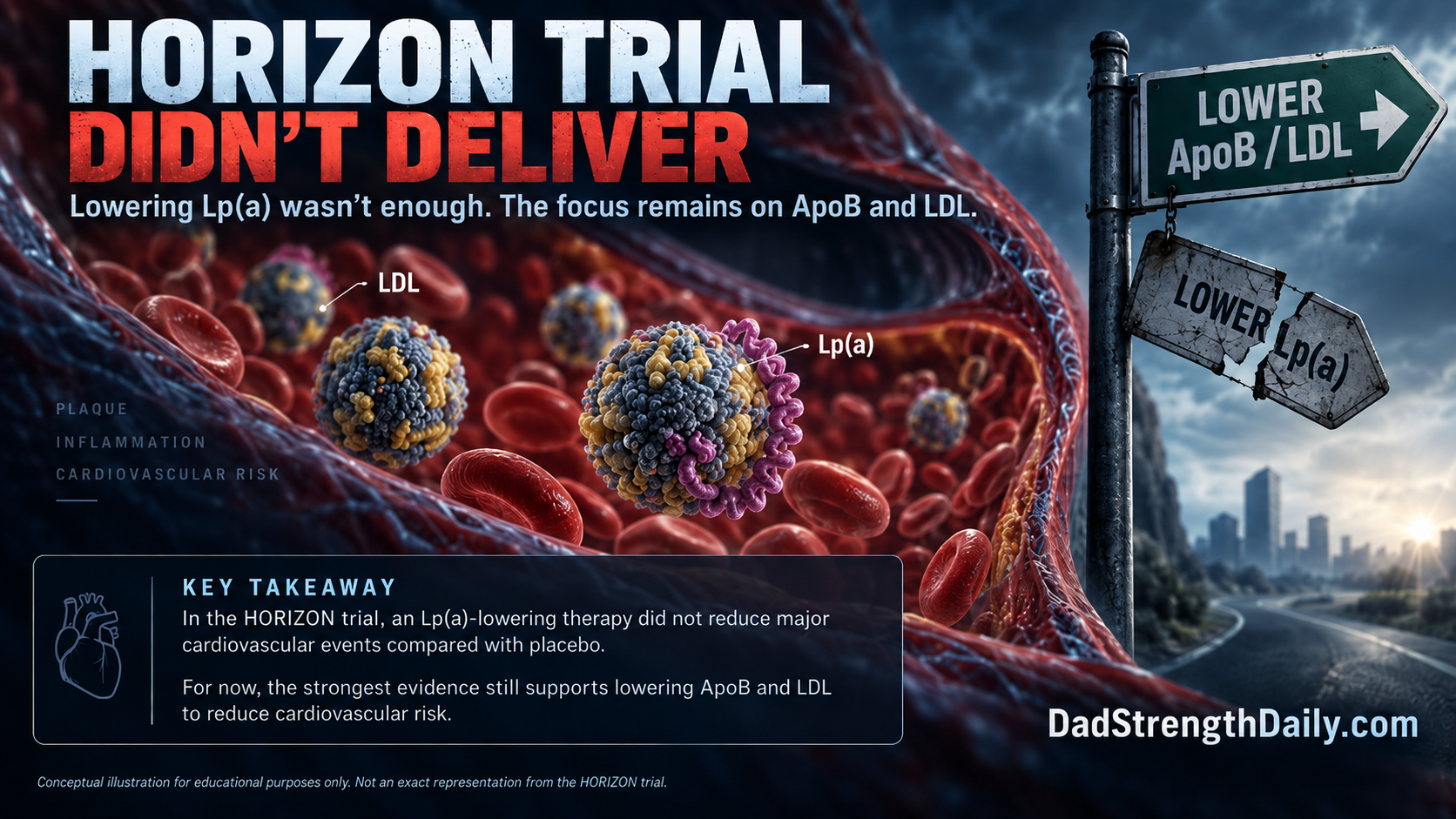
Yesterday Novartis released the Lp(a) HORIZON trial results, and the furthest-along of those drugs did not do what it was built to prove.
What Novartis said, and the long list of things it didn’t
The drug is pelacarsen, a monthly injection Novartis licensed from Ionis that gets the liver to make less Lp(a). The trial, Lp(a)HORIZON, enrolled 8,323 people who already had cardiovascular disease, meaning a prior heart attack, an ischemic stroke, or symptomatic peripheral artery disease, plus a screening Lp(a) of 70 mg/dL or higher. Everyone stayed on optimized standard care, and on top of that got either the drug or a placebo.
| Trial | Lp(a)HORIZON, NCT04023552, sponsored by Novartis |
| Design | Phase 3, randomized, double-blind, placebo-controlled |
| Who | 8,323 adults with established cardiovascular disease and Lp(a) of 70 mg/dL or higher |
| Drug | Pelacarsen, 80 mg under the skin once a month, added to optimized standard care |
| Primary endpoint | Cardiovascular death, non-fatal heart attack, non-fatal stroke, or urgent hospitalized coronary revascularization, counted together |
| Announced Sept 4, 2026 | Primary endpoint not met in the overall population; Lp(a) levels did come down |
| Not disclosed | Hazard ratio, confidence interval, p-value, events per arm, size of the Lp(a) drop, the Lp(a) 90+ subgroup, safety data |
Pelacarsen missed that composite endpoint. It lowered Lp(a), but Novartis didn’t say by how much, and whatever drop they got didn’t translate into a statistically significant cut in events across the full 8,323-person trial.
What came out is a topline announcement: the company released the headline result and is holding the actual numbers for an unnamed, undated medical congress. It’s not a published paper or a peer-reviewed readout, and the table above says so. There’s no hazard ratio to tell us how much the drug actually moved events relative to placebo, and no confidence interval to tell us whether that number would even be precise. Novartis also hasn’t touched the subgroup that started at Lp(a) of 90 mg/dL or higher, the one the trial was built in advance to look at.
So what’s known is that the drug didn’t clear the bar. Whether the curves separated a little, not at all, or in the wrong direction isn’t known, and that’s a murkier situation than an ordinary null result. I’m not going to pretend it’s cleaner than it is.
Get the next one in your inbox
I write about longevity, training, and preventive health weekly — without the guru worship. Free, no spam, unsubscribe whenever.
Two explanations, and both are still guesses
Sam Tsimikas, a cardiologist who co-authored the published HORIZON design paper and has direct history with this drug’s development, raised the possibility that background care in this trial was simply too good. If the people enrolled were already being treated hard, there may not have been much room left for a second drug to show extra benefit. He estimated their baseline LDL cholesterol was somewhere around 65 mg/dL, and noted that the true “free” LDL is probably lower still once you back out the cholesterol riding on the Lp(a) particles themselves. That’s his estimate, not something checked against a HORIZON baseline table, because that table hasn’t been released either.
Michael Albert, a physician who writes a health Substack, came at it from a different angle: the absolute amount of Lp(a) you remove may matter more than the percentage you knock off. His anchor is genetics, a 2018 JAMA Cardiology analysis by Burgess and colleagues, which found that a roughly 100 mg/dL inherited difference in Lp(a) tracked with about the same drop in coronary risk as lowering LDL cholesterol by about 39 mg/dL. Albert is upfront that HORIZON hasn’t disclosed how much Lp(a) it actually removed, which makes his account a hypothesis too, and one worth being careful with: that genetic number comes from comparing people who inherited different Lp(a) levels over a lifetime, not from dosing anyone with anything. It’s not a threshold a drug has to clear. A smaller reduction could still help, and a bigger one wasn’t guaranteed to work.
There’s a problem for the too-good-background-care idea, too. In FOURIER, an unrelated trial of the LDL drug evolocumab, higher Lp(a) still predicted more cardiovascular events regardless of LDL-C level, across that trial’s range. So very low LDL doesn’t just make Lp(a) irrelevant on its own. That fact doesn’t predict or explain what happened to pelacarsen in HORIZON, and I’d rather leave the two apart than force a connection that isn’t there.
What it actually changes for me
My Lp(a) is 12, so I was never the patient this drug was for. The framing got into my head anyway. When your own cardiologist calls something the next frontier, you start mentally reserving a spot for it, and you quietly downgrade the unglamorous stuff you’re already doing. HORIZON knocked that out of me. The unglamorous stuff is the part with outcomes trials underneath it: statins for people who take them, ezetimibe, PCSK9 inhibitors. Lp(a)-lowering, as of yesterday, has one large outcomes trial that missed its primary endpoint and two others still running.
I got my ApoB to 59 without a statin, through losing weight, a GLP-1 medication, and generic ezetimibe that costs almost nothing. That’s a lever with real evidence behind it, and it’s available now. If your Lp(a) is high and you’ve been half-waiting on a drug before you get serious about your LDL and ApoB, stop waiting.
Get the test regardless. The American Heart Association’s patient guidance still says adults should have Lp(a) measured at least once, and none of this changes that. The number tells you how much risk you’re carrying, which is worth knowing whether or not there’s a prescription that lowers it yet.
What I’m watching next
The Lp(a) 90+ subgroup comes first. It was prespecified in the trial design, with a statistical plan for testing more than one thing without fooling yourself, so it’s a lot more believable than a subgroup somebody went digging for afterward. Novartis hasn’t said how it came out. My guess is a clean positive result there would have made the press release, but that’s a guess, and guessing is what a topline release leaves you doing.
Then the full readout, whenever and wherever it lands. The hazard ratio and confidence interval will tell me whether this was a drug that did nothing or a drug that did a little and couldn’t prove it, which are very different situations for the field.
And then the other two. Amgen’s olpasiran is in an outcomes trial called OCEAN(a)-Outcomes, Lilly’s lepodisiran is in one called ACCLAIM-Lp(a), and there’s an earlier-stage olpasiran trial, OCEAN(a)-PreEvent, in people who haven’t had an event yet. Pelacarsen missing its mark here doesn’t settle whether lowering Lp(a) helps anybody. It settles one thing about one drug.
For now, though, the frontier I’m betting on is the boring one. Get your ApoB and LDL as low as the tools that have already proven they prevent heart attacks can take them, and treat Lp(a) drugs as a promising idea that hasn’t proven anything yet.
About Gunnar
Gunnar is 53. He lost about 170 pounds, trains in a garage gym, and writes DadStrengthDaily from personal experience, citing primary sources where he can. He also moderates r/ProactiveHealth. He is not a doctor, and nothing here is medical advice. Talk to your own doctor before acting on anything, especially GLP-1s, TRT, blood pressure, sleep apnea, and cancer screening.