
Updated with a 2008 implant study that measured knee force on a rowing machine.
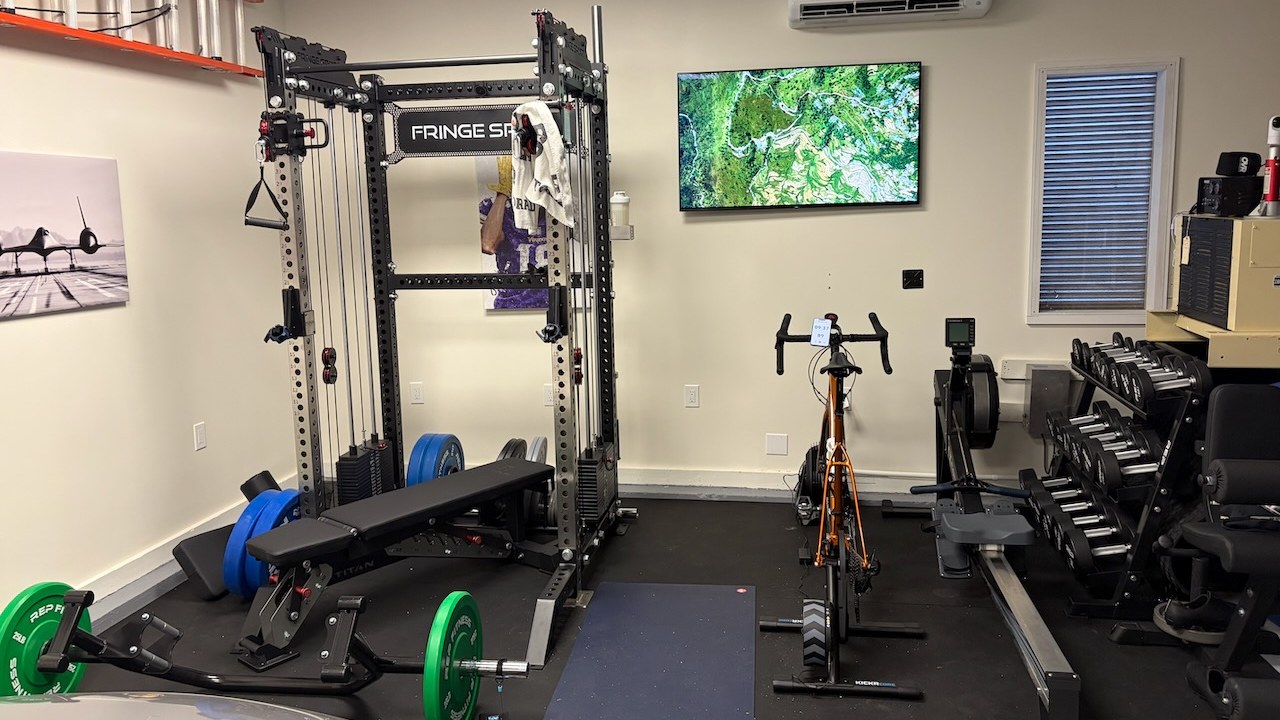
I own both. The inside compartment of my left knee is bone on bone, I cannot run, and long walks are not my thing. My cardio happens in the garage on a road bike clamped into a Wahoo KICKR trainer, with a Concept2 rower next to it. I use the bike more. If you have knee osteoarthritis and are deciding between the two, buy the bike first. The rower still has a job in my garage.
Key Points
- In people with instrumented knee replacements, easy cycling (60 watts) produced a peak knee force of about 119% of body weight; the same people walking produced 252%. A second study put going down stairs at 346%.
- One small implant study measured knee force on a rower. In three older people with replaced knees, the peak knee force on a Concept2 rower was 85% of body weight, lower than the 103% on a stationary bike in the same study and well under the 205% measured during treadmill walking. In trained rowers, the clearest finding is that rowing harder raises the load on the low back, and the commonly reported knee problems are overuse pain around the kneecap.
- Asked to rate 30 aerobic activities, people with knee osteoarthritis put the indoor bike first, at 82%.
How much of your body weight goes through the knee on a bike
The best knee-loading numbers come from instrumented knee replacements, implants that transmit the force on the joint while the person moves. In Kutzner et al., Journal of Orthopaedic and Sports Physical Therapy (2012), nine people about a year after knee replacement pedaled an ergometer at 25 to 120 watts. At a moderate 60 watts and 40 rpm, the peak force through the knee was 119% of body weight, during the downstroke. Force rose in a straight line with power, faster pedaling lowered it, and a low seat did not raise the total force but did add shear across the joint.
The same nine people also walked a ten-meter hallway that day, at whatever pace they chose: 252% of body weight. The same team measured going down stairs in a 2010 paper, at 346%. These are peak forces inside the joint, not extra weight on the leg, and easy cycling produces less than half the force of an ordinary walk.
Their lowest-force setup was low power, the faster of the two cadences and the higher of the two seat positions. The force does rise with the watts, but it stayed under walking everywhere they looked: 163% of body weight at 95 watts and the slower cadence, 131% at 120 watts and the faster one. Two limits: these were replaced knees, not knees like mine, and 120 watts was the hardest condition they tested. A hard interval session goes past that.
Does the bike help the knee itself? Luan et al., Clinical Rehabilitation (2021) reviewed eleven trials of stationary cycling in knee osteoarthritis and pooled eight. Against no exercise, cycling reduced pain. The gains in stiffness, function and quality of life stayed below the thresholds the studies count as clinically meaningful. Cycling will not fix the joint.
Get the next one in your inbox
I write about longevity, training, and preventive health weekly — without the guru worship. Free, no spam, unsubscribe whenever.
What a rowing machine does to a bad knee
The worry with a rowing machine for bad knees is the catch, where the knees are folded and loaded. One implant study has measured knee force on a rower. In D’Lima et al., Clinical Orthopaedics and Related Research (2008), three people with instrumented knee replacements, two men aged 83 and 81 and a woman of 67, were tested a year after surgery on a range of exercise machines, including a Concept2 rower. The peak knee force on the rower averaged 85% of body weight, against 103% on a stationary bike at 60 to 90 rpm and 205% walking on a treadmill. The authors write that rowing “generated the lowest peak knee forces of all activities reported here, less than stationary bicycling.” So on force, both machines came in well below walking, and the rower came in lower than the bike. That is three elderly people with replaced knees, exercising at an intensity they chose; the paper does not report stroke rate or effort on the rower. It does not tell me what a hard 2k does to a knee with arthritis.
The other rowing studies calculate joint loads in trained rowers from their movement and the forces at the handle and footplate. In Buckeridge et al., Journal of Sports Sciences (2016), twelve elite female rowers rowed an ergometer at rising stroke rates. Peak knee moments, the turning force around the joint, fell as the rate rose, while loads at the ankle and low back grew, with large shear and compressive forces at the base of the spine as the rowers’ lower backs rounded. A lower knee moment does not necessarily mean a lower force between the joint surfaces, so this says nothing about the contact force the implants measure. It does show that the clearest cost of rowing harder, in that group, was at the back.
In a review of rowing injuries, Hosea and Hannafin, Sports Health (2012), the knee was the most common site of pain in a three-year survey of 180 injuries at two college programs, ahead of the back. The knee diagnoses were chondromalacia patella and iliotibial band friction, pain under and beside the kneecap from repeated loaded bending, and the authors call rowing’s loading of the kneecap joint “extreme.” My arthritis is in the inside compartment of the main joint, a different part of the knee, and none of these studies looked at advanced arthritis there. So the kneecap findings are the known risk; my compartment is the unknown one. The implant studies settle neither: their sensors sit in the shin-bone part of the replacement and measure force through the main joint, not behind the kneecap, and a replaced knee has no arthritic cartilage left to load.
Rowing has also been tested as therapy. Lin et al., BMC Geriatrics (2022) randomized 38 adults aged 65 to 85 with mild knee osteoarthritis: 20 spent 12 weeks on a computer-aided rowing system that gave feedback on each stroke, 18 did a standard resistance-exercise program. The rowing group finished with better knee pain and function scores and stronger muscles straightening the knee. So rowing is possible with an arthritic knee, on the strength of one small trial in mild arthritis with a supervised system, not a Concept2 in a garage.
What people with bad knees actually pick
When Pedersen et al., ACR Open Rheumatology (2025) asked 349 people with knee osteoarthritis to rate 30 aerobic activities for knee friendliness, indoor biking came first, nominated as knee friendly by 82% of them, and water exercise second at 70%. Indoor rowing was on the list and was not one of the two they singled out. They were nominating the activities they expected to be kind to the knee, not comparing pain after doing them, and it is not a force measurement.
Which rower, and which trainer
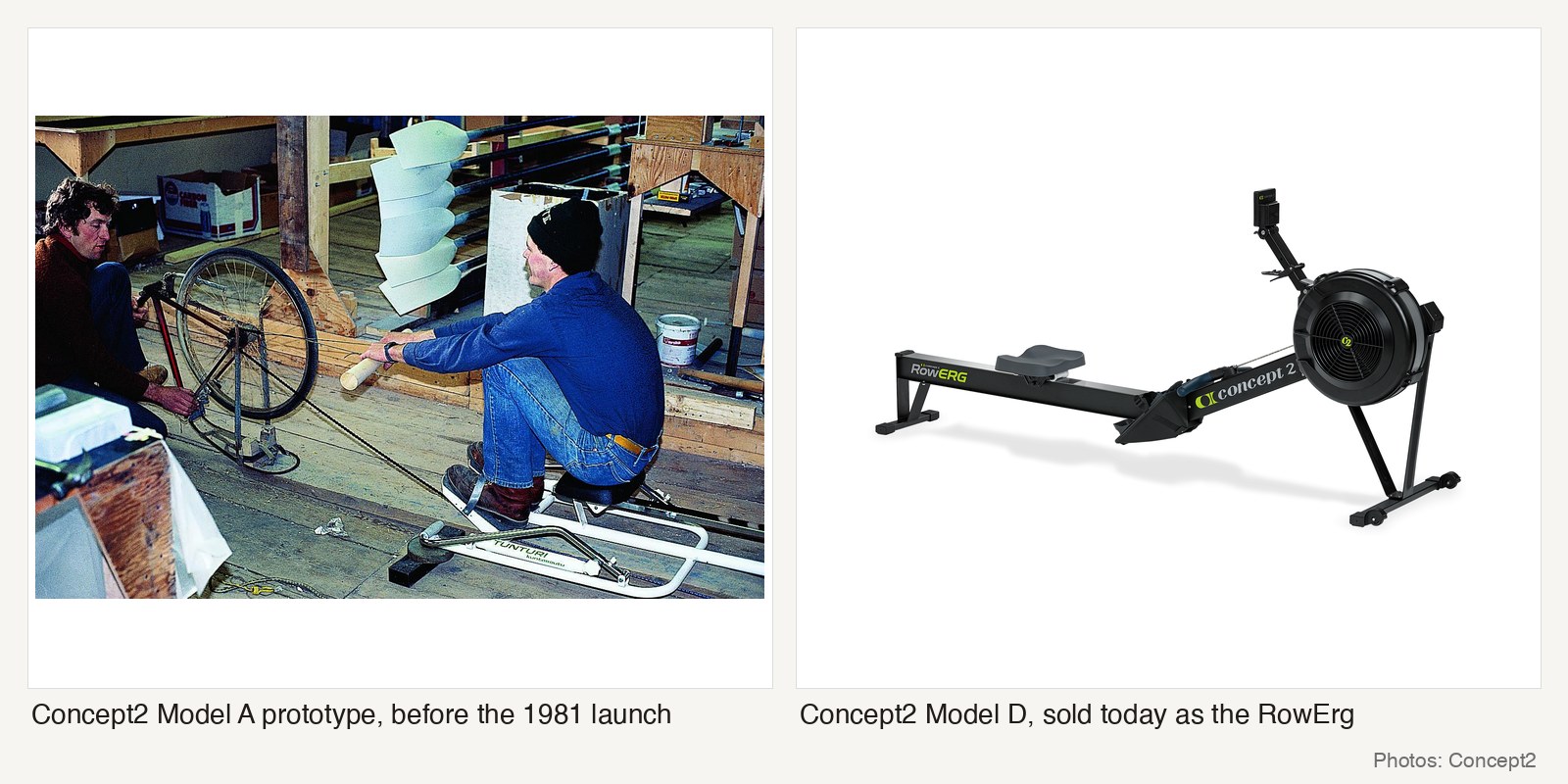
The rower was the easy purchase. Concept2 has been the standard indoor rowing machine for as long as I have been paying attention; the one in my college boathouse thirty years ago was a Concept2, and the company shipped its first erg in 1981. The Model D in my garage, sold today as the RowErg, is the current version of that machine.
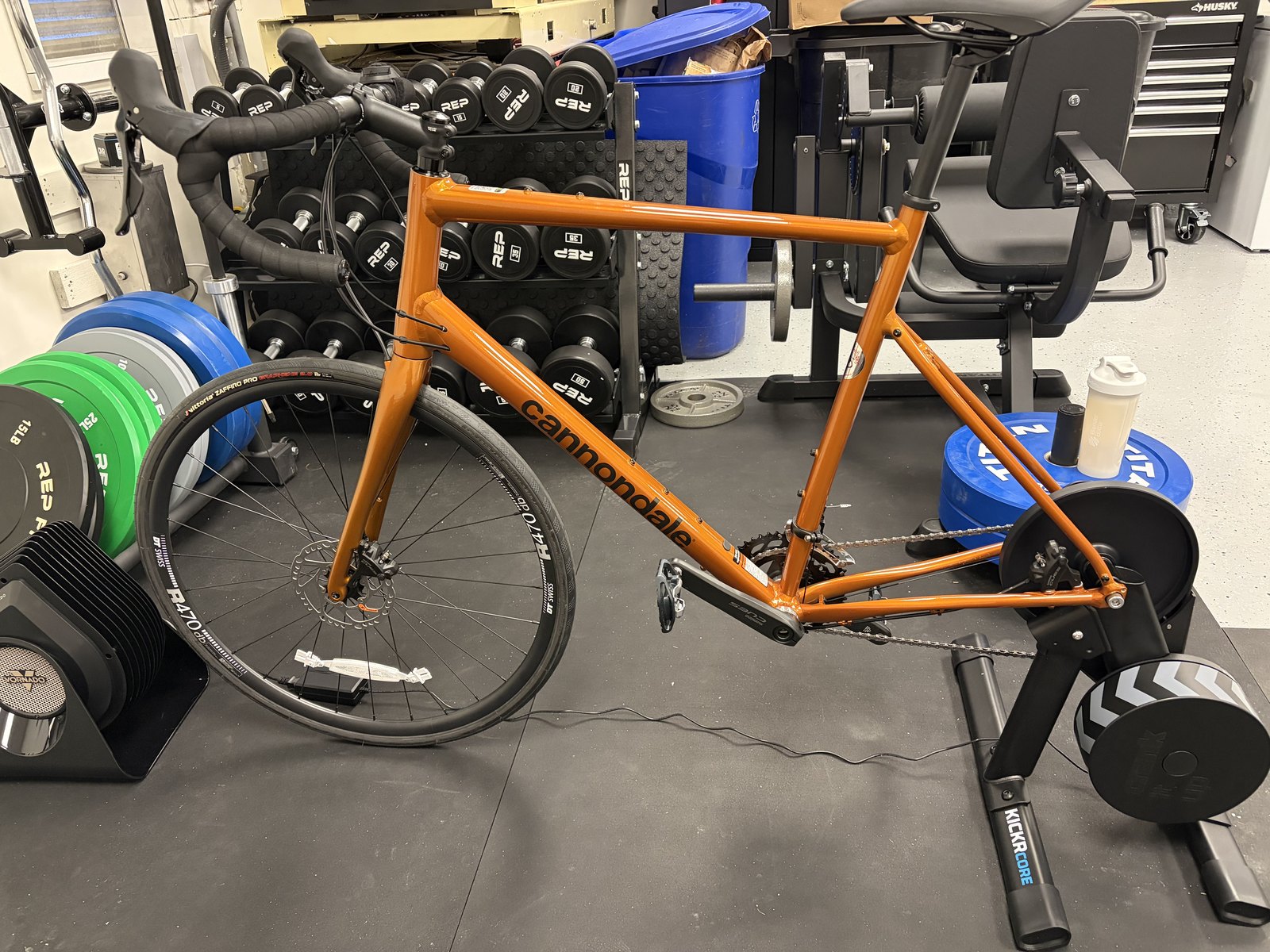
The trainer took me longer. I did not know much about indoor bike trainers (my British friends call them turbos) until a couple of years ago, when I started hearing about Zwift, and the Wahoo KICKR kept coming up as the trainer to pair with it. What sold me is that it takes a real bike. I did not want a spin bike, a Peloton or something like it; I wanted a road bike in my frame size, a 61 cm Cannondale, with the fit and the parts that come with buying a bike rather than a machine.
How I split the two machines
The bike gets 45 to 60 minutes at an easy zone 2 pace (conversational effort), or a 30-minute interval session. The rower stays because it works my back and arms as well as my legs, which the bike does not, and it is still low impact. I row an occasional 2k and, lately, Power 10s (ten all-out strokes) for peak wattage, which is where my training is now, not where I would start with an arthritic knee. Mostly, though, my coach programs shorter rows mixed in with core and mobility work, and I stop when my lower back starts to round. After rowing, what I check the next morning is soreness under the kneecap.
I have no affiliate relationship with Concept2 or Wahoo; I bought both machines, along with the rest of my home gym, and would buy both again, the bike first. The force numbers alone would not decide that, since the one study that measured both machines found less knee force on the rower. I put the bike first because of the kneecap and low-back problems in rowers, because none of the force measurements, on either machine, was made in a knee with arthritis like mine, and because of how my own knee responds. Cycling lets me train hard without the knee being worse the next day. With one arthritic knee, that decides the order.