
Updated with the Aesthetic Envy dismissal.
Is retatrutide legal to buy? Eli Lilly just sued six sellers of it, and the suits target sellers, not buyers. The catch is that the drug isn’t approved anywhere, so there is no legitimate version to buy, whatever the label says.
Disclosure: I take Zepbound, a Lilly drug, and I own Eli Lilly stock, the only pharmaceutical stock I hold.
Where retatrutide stands
| FDA approved | No |
| Development stage | Phase 3. Lilly said in July 2026 the clinical data package for registration is complete and the manufacturing package is still being finished; other Phase 3 trials are still running |
| FDA application | Planned Q1 2027, as a biologic rather than a conventional drug (Lilly is in court over that classification), for obesity, sleep apnea and knee osteoarthritis pain |
| Brand name | Not announced |
| Last checked | September 4, 2026 |
How it compares with the drug you can actually get: retatrutide vs Zepbound.
On August 12, Eli Lilly filed six lawsuits against U.S. sellers of retatrutide, its next weight-loss drug. Four are peptide vendors you may have scrolled past on a checkout page: Astra Peptides, Legendary Peptides, Texas Peptides, and Lone Star Peptide. The other two are a med-spa, Aesthetic Envy, and a compounding pharmacy, Striker Pharmacy. Several ship under the “research use only” label. The same practice shows up beyond the defendants: Sam Sulek’s peptide company NewBioRx sold a $285 “research use only” retatrutide pen while a NewBioRx-branded site showed you how to inject it. The pen and the site vanished four days after these suits. Lilly also said it had referred more than 200 individuals and businesses to the FDA, the Justice Department, and state licensing boards, and flagged more than 14,000 websites and social posts across more than a hundred countries.
Update (August 12): The complaints are now public, and they run on two different theories. Lilly sues the compounding pharmacy and the four peptide vendors under state consumer-protection laws (eight states, plus a Texas claim for exemplary damages, the extra damages a court can add as punishment) for selling an unapproved “new drug.” It sues the med-spa alone under federal false-advertising law, for marketing retatrutide as a “cutting-edge therapy” that “outperforms semaglutide and tirzepatide” while never disclosing it isn’t approved. The pharmacy and vendor complaints make a reputational argument: that harm from black-market retatrutide, including Reddit posts Lilly quotes of heart rates dropping to 43 beats a minute and hospitalizations from contamination, will teach the public to fear the molecule itself and damage its eventual approved version. The safety evidence in these complaints is Reddit anecdotes, not lab tests of any vial, assembled by the company with the most to gain from retatrutide’s reputation. These are freshly filed allegations the sellers have not answered. All six filings are now public:
| Defendant | Court / case no. | Filing |
| Striker Pharmacy (pharmacy) | S.D. Tex., 4:26-cv-06563 | Read |
| Aesthetic Envy (med spa) | E.D. Cal., 2:26-cv-02764 (dismissed by Lilly, Sept. 11) | Read |
| Legendary Peptides | E.D. Tex., 1:26-cv-00347 | Read |
| Lone Star Peptide | S.D. Tex., 4:26-cv-06562 | Read |
| Texas Peptides | W.D. Tex., 5:26-cv-05146 | Read |
| Astra Peptides | W.D. Tex., 5:26-cv-05147 | Read |
Update, September 27, 2026: Lilly voluntarily dismissed its suit against Aesthetic Envy, the med spa, with prejudice on September 11, before Aesthetic Envy had filed an answer; the court closed the case September 14. The dismissal notice gives no reason, and there’s no public settlement to point to. That leaves five of the six suits active. In the Astra case, Lilly dropped Astra LLC as a defendant on September 2 after the company said it’s an unrelated transportation business with no ties to the site being sued over; Astra Peptides remains a defendant. As of September 26, no court has ruled on the merits in any of the five remaining cases: no answers, no motions to dismiss, no defaults.
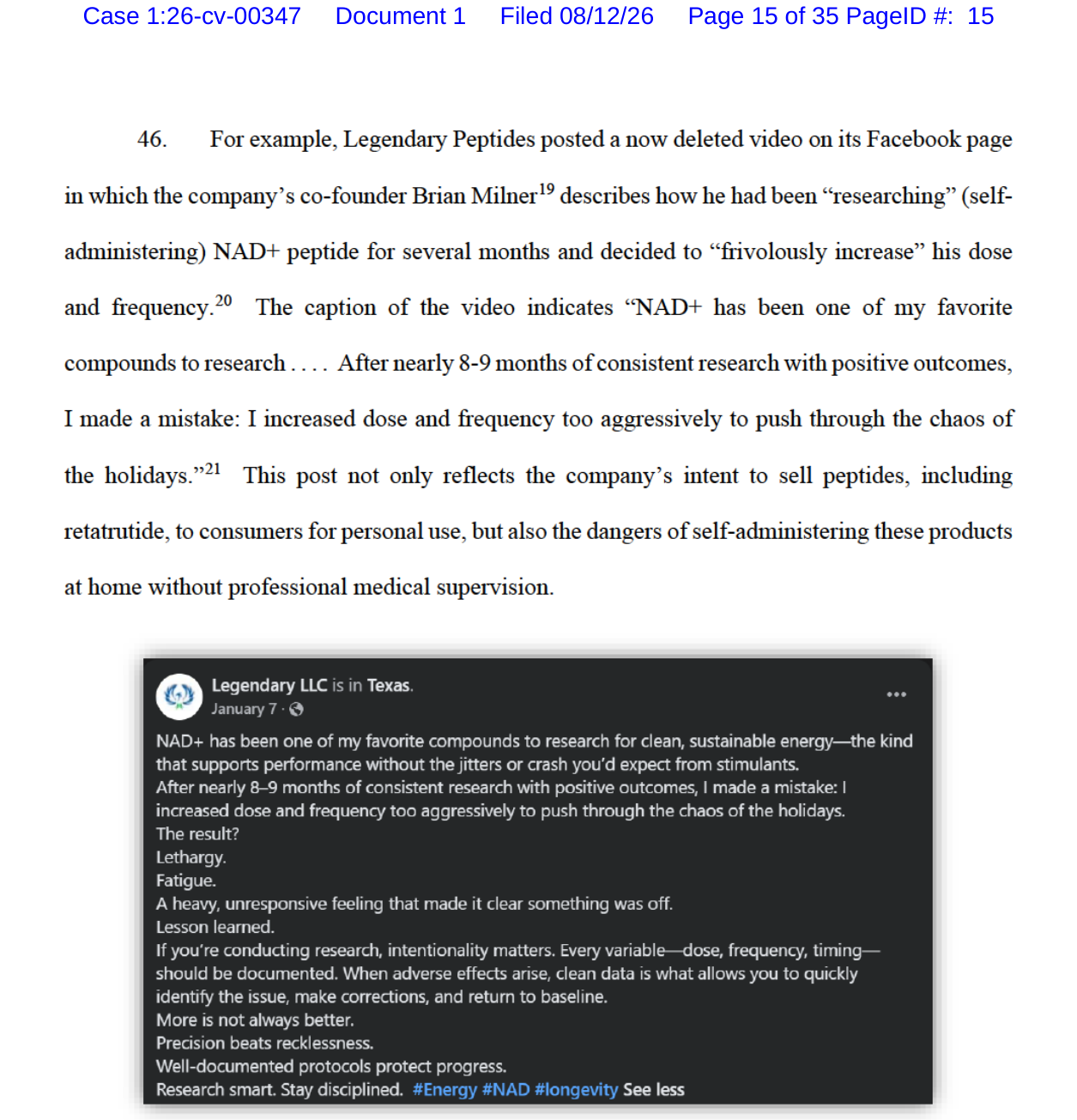
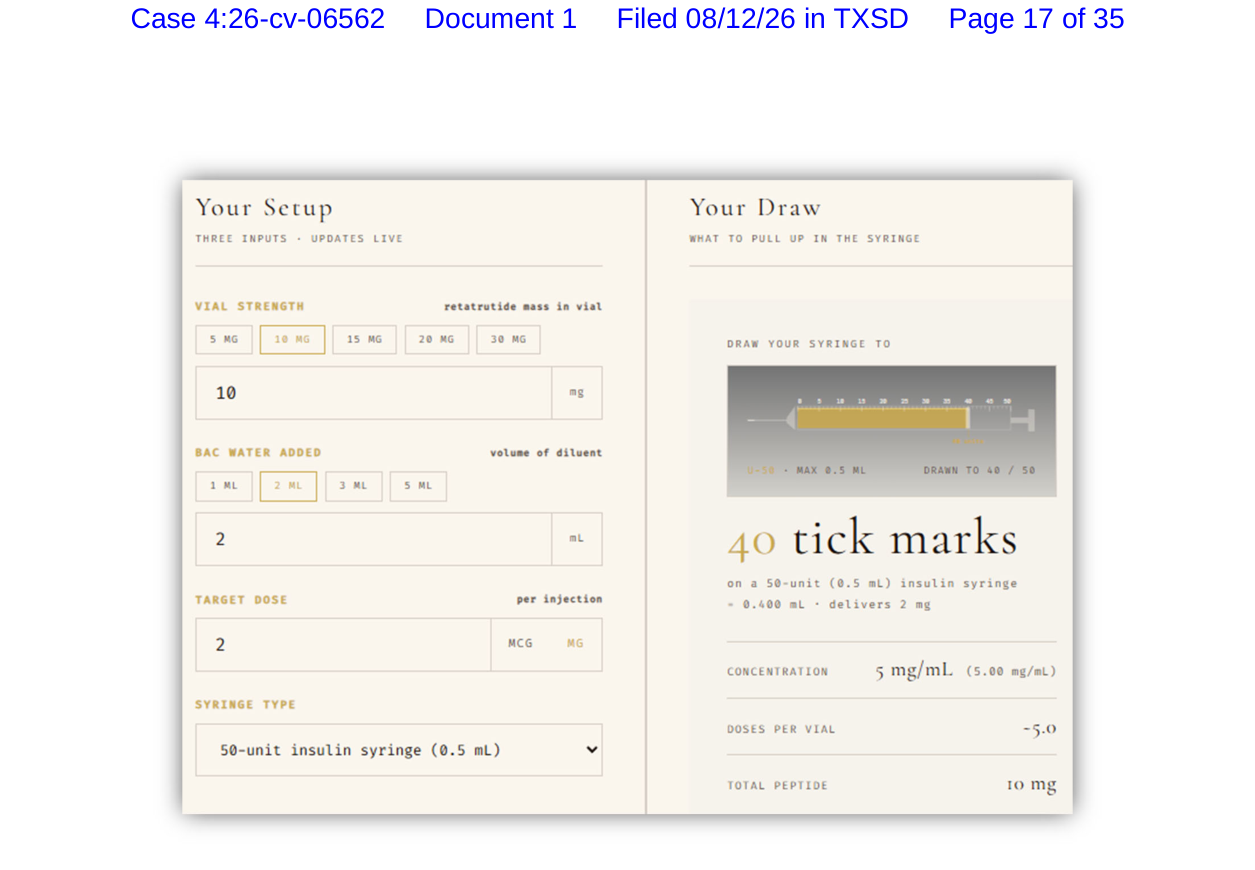
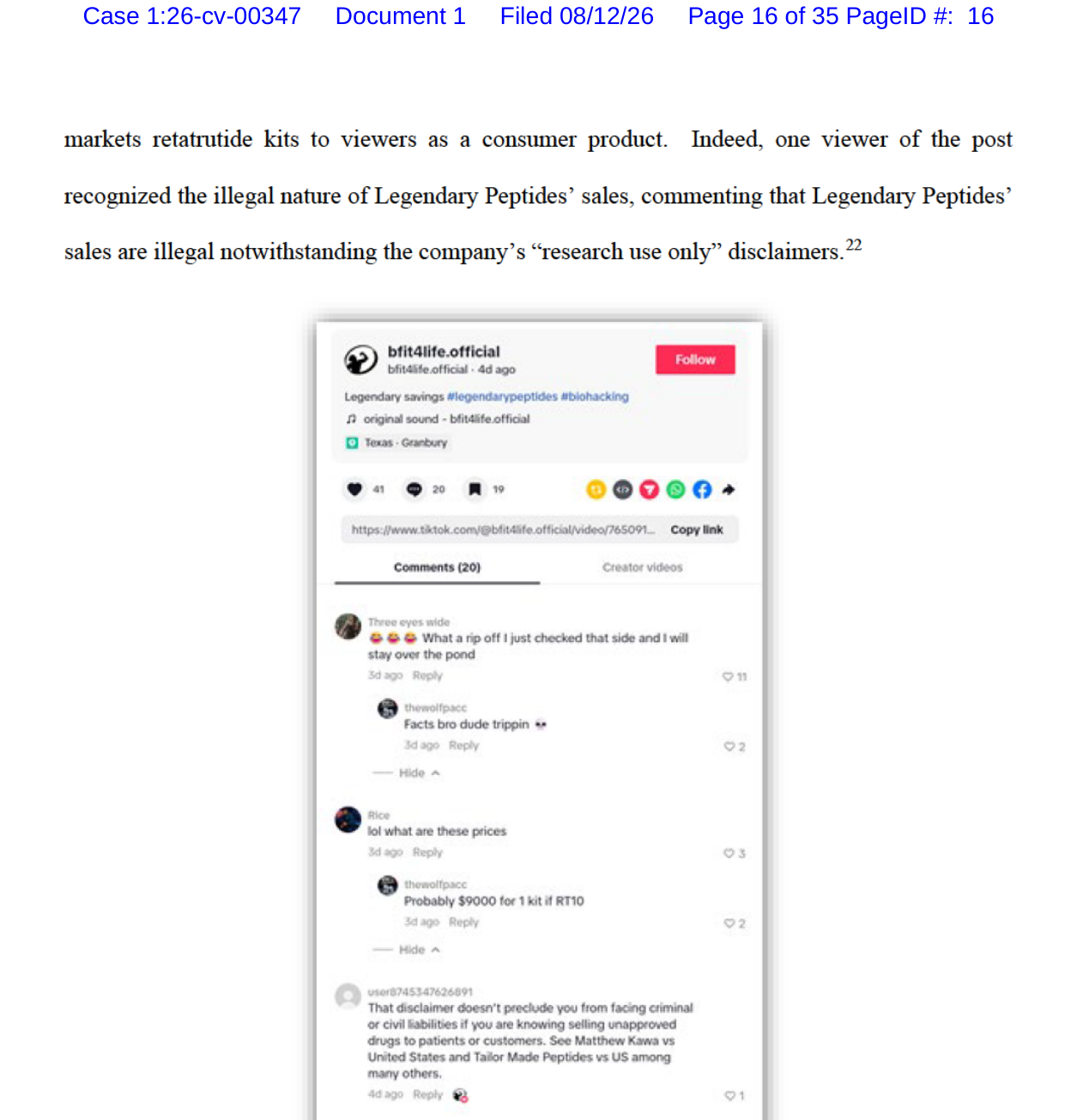
The vendor filings are worth skimming just for how much the sellers handed Lilly. Texas Peptides brands itself a “Texas-Built Research Reagent Supplier” while actually being a Wyoming corporation (¶11). And a lot of the evidence is the sellers’ own screenshots, reproduced right in the complaints:
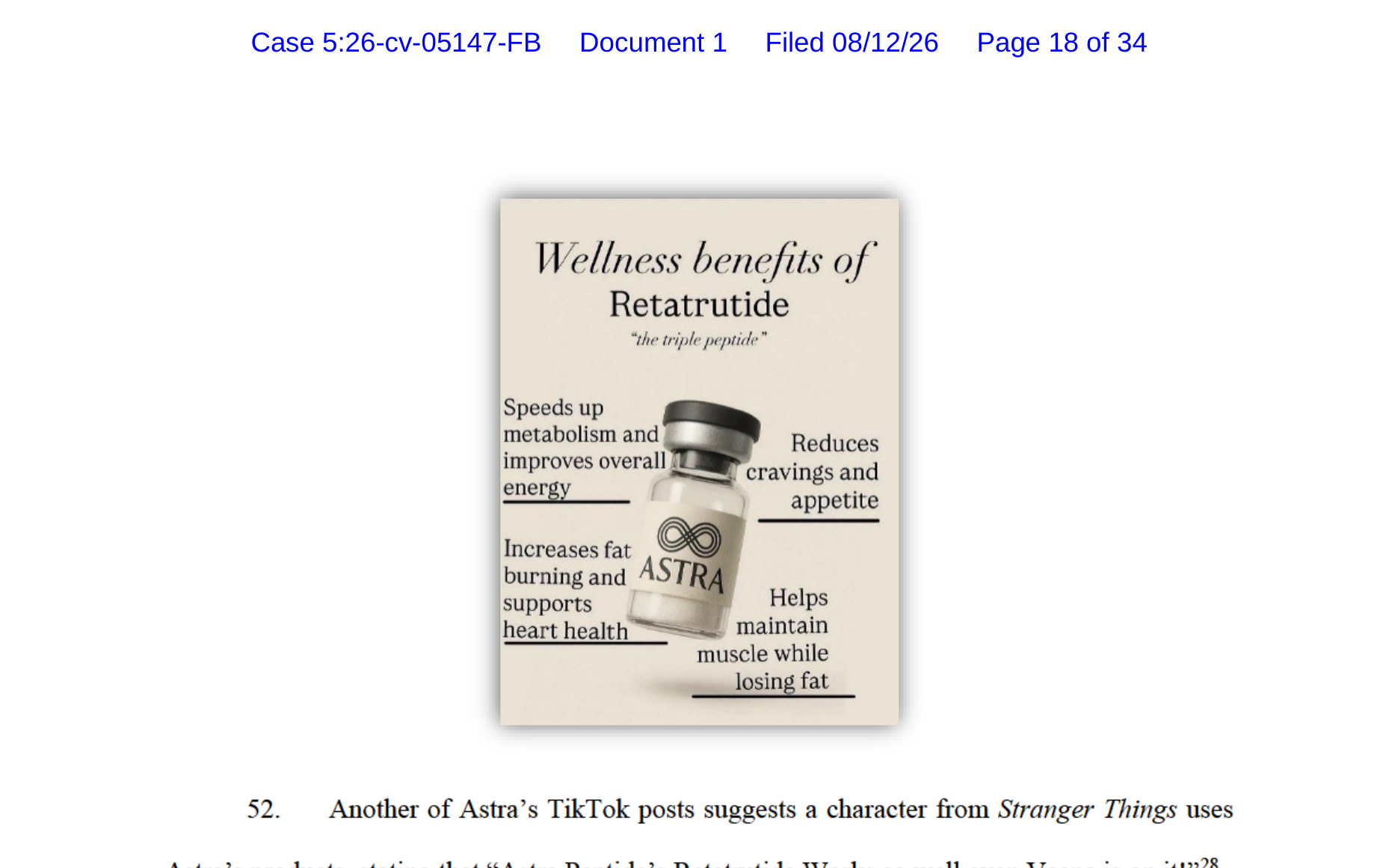
Update (August 13): The sixth complaint, against Astra Peptides, is public now too, so the table above is complete. I searched “buy retatrutide” the day after the suits to see whether they had changed anything. Not much. Three of the six named sellers took down their retatrutide listing and one marked it “sold out,” but Astra hadn’t touched its page (as of September 2 the domain redirects to a new address, where a product called RT-3 is listed), and most of the vials that come up are from sellers no one sued, one of them at $79.99 with free shipping over $200, and some of what ranks for the defendants’ own names is not a seller at all but a hacked North Carolina town website that sends visitors to a WhatsApp peptide group. Astra’s own TikTok bleeps out the word “retatrutide” and calls it “RT-3,” and the ad it runs, reproduced in Lilly’s complaint, calls the same thing “the triple peptide” that “supports heart health.” If you are here because you want the legal version, I estimated what retatrutide will cost when it arrives.
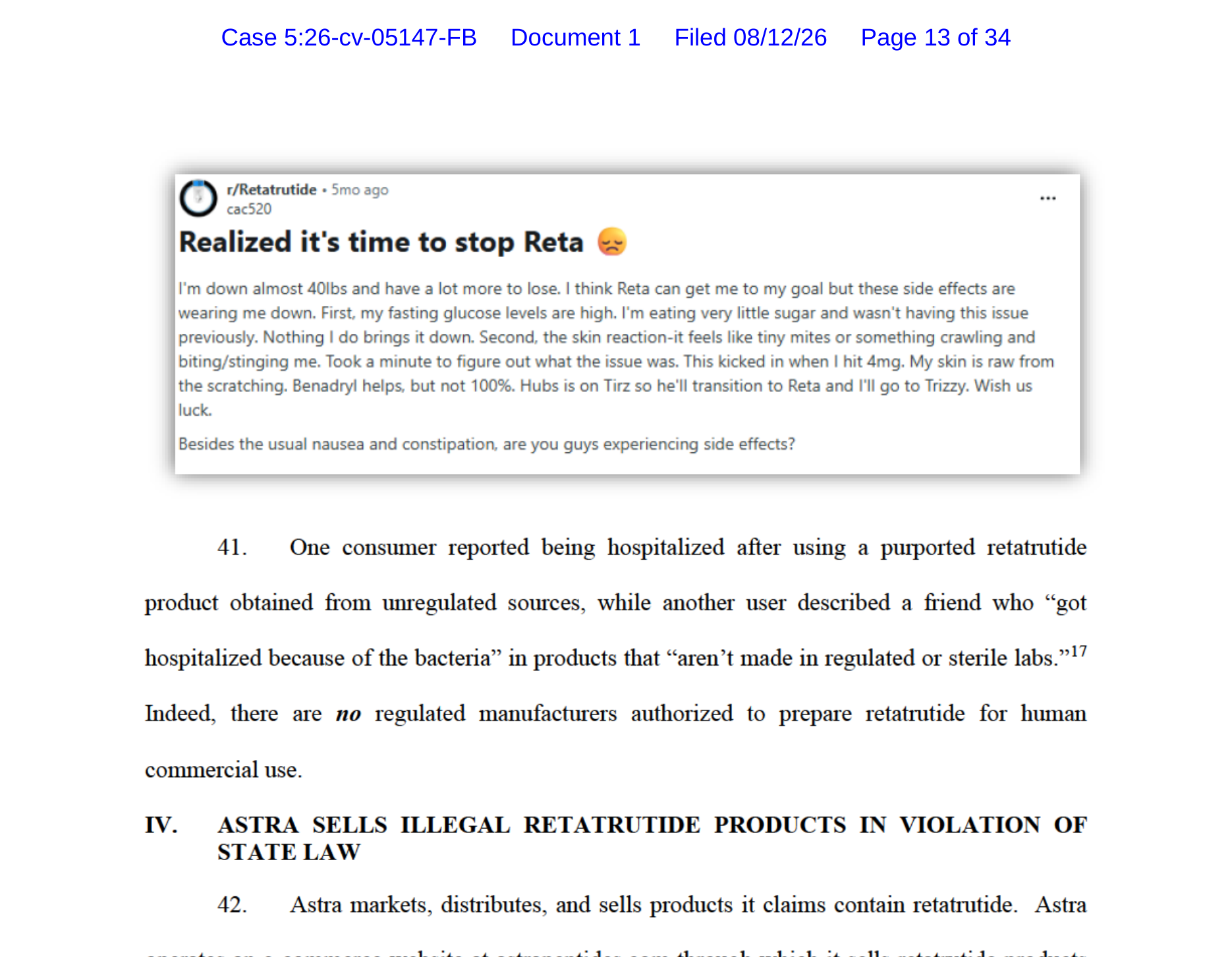
That same complaint puts a buyer’s own Reddit post into the record as an exhibit, to show people are injecting this rather than studying it: someone down almost 40 pounds, quitting over a skin reaction that felt “like tiny mites or something crawling and biting.” The company picked one anonymous post and put it in a federal complaint.
Lilly’s legal case looks harder to me than the ones drugmakers have brought over knockoffs of approved drugs. Retatrutide has no brand name to protect yet, and there is no one to go after on the buyer’s side, so against sellers like Astra it relies on eight states’ consumer-protection rules, asking each court to call the sale unfair competition.
Lilly is also pressuring the businesses these sellers depend on to operate: the social and e-commerce platforms, the credit-card companies and payment processors, the shipping and logistics carriers. It is asking all of them to cut the sellers off. That aims at a real weak point. Domestic resellers take PayPal or credit cards, and cutting off the payment processing makes the business harder to run whether or not any single lawsuit succeeds.
Retatrutide is not approved anywhere and is still in Phase 3 trials, so there is no legitimate version of it to counterfeit, which means the usual “real drug versus fake drug” framing does not apply. Whatever is being sold as retatrutide came from outside the regulated supply. Lilly’s own chief medical officer called it “entirely unverified, unapproved and not worth the risk.”
That includes Striker Pharmacy. A licensed pharmacy keeps inspection records, and that is real. But a pharmacy license does not make retatrutide lawful to compound. The FDA has said retatrutide may not be used in compounding, and Lilly alleges Striker was selling an unapproved new drug.
When will retatrutide be approved?
I would not expect approval before late 2027, and on a standard review not before 2028. Lilly’s July 23 results release says the company now has “the clinical data package to support global submissions” for the three indications in the table above, and plans to file with the FDA in the first quarter of 2027. A standard FDA review runs about ten months from the day the agency accepts the filing, itself about two months after submission, so a first-quarter 2027 submission points at early 2028. The FDA’s new priority-voucher program can compress that by months, as it just did for the cholesterol pill Lipfendra, but neither Lilly nor the FDA has said retatrutide gets one.
There is also a court case running alongside that timeline. Lilly wants to file retatrutide as a biologic, a classification the FDA refused and Lilly is suing to obtain, because biologic status carries twelve years of exclusivity. The appeals court hears argument on September 24, 2026. Until approval, anything sold as retatrutide is still what this post is about.
This is not only Lilly. A week earlier, a Dutch court ordered a company to stop selling compounded semaglutide as a nasal spray, an unapproved form of the drug in Ozempic and Wegovy. Semaglutide is approved and retatrutide is not, so the two cases are not the same problem. But both makers are now in court trying to pull unauthorized copies off the market.
I inject a compounded hormone myself twice a week, so I am not going to tell you compounded means dangerous. It doesn’t. What separates a real pharmacy from a gray-market seller is not how pure the drug is. It is whether anyone is required to inspect the place and write down what they find. A compounding pharmacy leaves a paper trail, sometimes an unflattering one. A “research use only” website leaves none: no one who has to test it for sterility, and no recall when a batch goes wrong.
And say the vial is clean. There is still the person holding the syringe. When a University of Connecticut team watched twenty people reconstitute and inject semaglutide themselves, on average they got fewer than half the steps right: expired or cloudy vials used anyway, mixed with the wrong amount of water, the needle put into muscle instead of the fat under the skin, no alcohol swab on the vial top or the skin. The younger, most confident volunteers kept their confidence even after they got it wrong.
Is retatrutide legal to buy?
The suits are aimed at sellers, and I still wouldn’t buy from one of those websites, for a reason that has nothing to do with the law. (Here is the full hierarchy I use for anything I inject, and where my own testosterone sits on it.) You cannot check the one thing that matters. Even the licensed pharmacy in Lilly’s complaint could give you a recognizable name and a paper trail. But for a drug it was not allowed to sell, neither one tells you the retatrutide in the vial is what it claims to be. You have no way to confirm who made it, what dose is in the vial, or whether it is sterile. Maybe it is exactly what the seller says. You are taking the seller’s word for all of it, on a drug its own maker will not sell you until it is approved.
Get the next one in your inbox
I write about GLP-1s, training, and preventive health once a week — what the evidence actually says, from someone using it. Free, no spam, unsubscribe whenever.
If this was useful, read next
- Sam Sulek’s own peptide company — who is selling it, and how the marketing works
- Zepbound vs grey-market tirzepatide — what the legal route actually costs now
- What retatrutide will cost when it’s legal — my estimate, and how I got there