
Updated with a September 2 preprint sizing the compounded and gray-market channels.
Updated August 28, 2026: On August 27 the Fifth Circuit upheld the FDA’s GLP-1 shortage delistings, which closes the two middle rungs of this ladder for compounded tirzepatide and semaglutide.
I inject compounded testosterone into my thigh twice a week, and until recently I had never once thought about who actually makes it. I thought about the needle and the dose and the way the oil sits under the skin, but never the factory behind any of it. It arrives in MCT oil through Marek Health, my telehealth provider, labeled and unremarkable. According to that label it is made by a sterile compounder called Carie Boyd. (What TRT actually did for me is a separate story.)
Being an engineer, I eventually tried to understand the whole chain behind it. That is how I learned that Carie Boyd has a 2024 warning letter from the FDA, and that the letter names testosterone directly: dark particulates and filaments found in a lot of testosterone cypionate and propionate, and a test for bacterial toxins the company had not repeated. That is the pharmacy named on the label of the drug I put in my body.
The obvious worry took about ten minutes to settle. The batch the FDA flagged was the combined cypionate-and-propionate product, filled in December 2023. I am on straight cypionate and did not start until July 2025. Those vials were never in my drawer.
But ruling out one lot is not the same as clearing the pharmacy. Most of what the letter described was the room the drug is filled in and the way it is filled, problems that would touch anything made there. So it doesn’t tell me my vial is clean. What it tells me is that someone with the authority to shut the place down walked in and wrote down what was wrong. The longer I looked, the less that felt like the worst thing to learn about a drug.
The five tiers, and where my vial sits
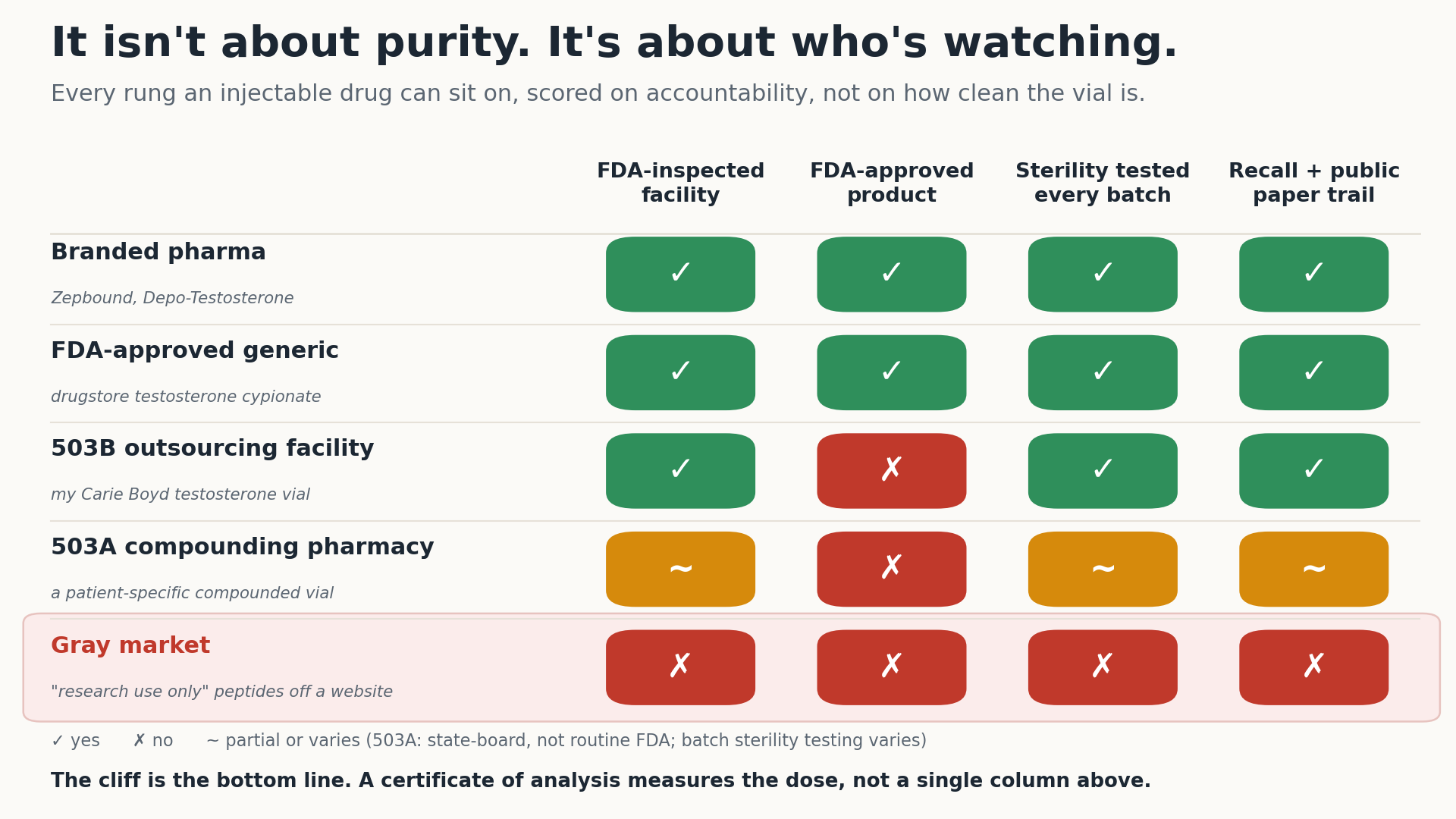
Every injectable drug a guy like me might put in his body sits on one of five rungs, and the rungs are not what I assumed. I thought the higher ones were purer. What actually changes as you climb is how many people are watching.
From the top down: branded pharma, its FDA-approved generic, a 503B outsourcing facility, a 503A compounding pharmacy, and the gray market. Two things about that list surprised me. The top two are really one rung on the thing that matters, because a brand and its generic run under the same manufacturing rules, the same inspections, the same duty to recall a bad lot; patent and price separate them, not who is watching. And the middle is not one rung but two, which is where my own vial turns out to sit.
A 503A pharmacy mixes a drug to order for one patient and answers mainly to its state board. A 503B registers with the FDA, works under commercial-drug-plant rules, and gets inspected on a risk-based schedule. Carie Boyd is a 503B, which is exactly why there is a warning letter to read at all: the FDA was in that building because it is required to be. And Carie Boyd is the name on my label, so that is the record I can actually go and read. A 503A with no federal file is not hiding something, it answers to a state board instead, and how hard those look varies a lot by state. The bottom rung is the one to worry about: “research use only” peptides off a website, from a seller with no pharmacy, no board, no inspector.
My compounded vial is still not an FDA-approved product the way a bottle of generic testosterone from a drugstore is, and that generic runs about ten to thirty dollars a month a rung above it. Here is the part I didn’t see coming: I can’t simply switch. Marek doesn’t hand me a script I can fill at a pharmacy. I get what they ship. That is the quiet catch of telehealth prescribing, and I understand this ladder better than most people.
Get the next one in your inbox
I write about longevity, training, and preventive health weekly — without the guru worship. Free, no spam, unsubscribe whenever.
A warning letter is the system working, not failing
I went looking at the other big compounding pharmacies expecting Carie Boyd to be an outlier, and found the opposite. Of the 27 biggest sterile compounders I could identify for testosterone and GLP-1 drugs, 21 had an FDA warning letter on record, or the untitled letter the FDA sends when violations sit below that bar. The category is not pristine. But a warning letter on its own does not mark a pharmacy as uniquely bad, it mostly tells you the pharmacy is big enough to get inspected in the first place.
A warning letter, once you stop flinching at it, is a record: the FDA walked in, found something, and demanded a fix, on a public page you can read. It does not prove the fix worked. That takes a closeout, posted only after the agency verifies the corrections. Twenty months on, Carie Boyd’s closeout has not appeared, and the original letter had already judged several proposed fixes deficient. But the document I had been reading with alarm was itself proof that someone was checking, which is more than the gray market ever produces.
You can usually get a certificate of analysis saying the vial contains the dose it claims, and people treat it as proof the drug is safe. It is not. The kind a website waves at you measures potency and stops. For something you inject, potency alone tells you almost nothing about whether the vial is safe. It can be the labeled strength and still be growing bacteria. A 503B must test sterility and bacterial toxins on every batch, and the Carie Boyd letter is the reminder that a requirement is not a result: one finding was a toxin test the company never repeated. So the question is never whether a certificate exists. It is whether it covers sterility, on that lot, from a lab that answers to someone. And I will admit the obvious: I have never once asked for mine.
The system did its job here, and it was ugly to watch. In 2025 Empower, one of the country’s largest compounding pharmacies, recalled roughly 8,000 vials of testosterone cypionate, the same injectable I use. A recall means a defective product was already out in the world. But it also means the defect got found, the lots got named, and the product came back, which is the one thing a gray-market seller will never do: admit in writing that something went wrong and take it back.
This is what I mean when I say FDA-approved is not a purity guarantee. It is an accountability guarantee, and approval is only the top of it. My own vial isn’t an approved product at all. What it has is an inspected maker, a rung down and still worth something. What inspection and even the embarrassing letters buy is a standing requirement that someone look, and post what they find where you can read it.
The gray market generates no paper at all
If a warning letter is what accountability looks like, the gray market is what its absence looks like. The peptides people inject for recovery and longevity, the BPC-157 and TB-500 and the rest, are mostly sold as “research use only.” That label is a legal dodge. It lets a seller ship a vial without the obligations of selling a drug for people to use: no pharmacy of record, no required sterility testing, no recalls. You will almost never see a gray-market peptide recall, and not because the products are clean. No one is inspecting, so there is no one to issue it.
People aren’t down there out of stupidity. The branded GLP-1s run several hundred dollars a month in cash if your insurance will not pay, and plenty will not. Retatrutide can’t be bought legally at any price. For most buyers the gray vial is a price decision, or the only way to get the molecule, and no lecture about accountability makes that math go away. My argument is narrower than “don’t.” It is: know what you are giving up in the trade, because it is more than the price difference suggests.
The makers are suing the sellers, and I should disclose before leaning on that: Lilly makes the tirzepatide I inject, and I own Lilly stock. The useful detail in Lilly’s six August filings is that two defendants weren’t anonymous websites but a med spa and a licensed compounding pharmacy, which shows the rung depends on the drug, not the address.
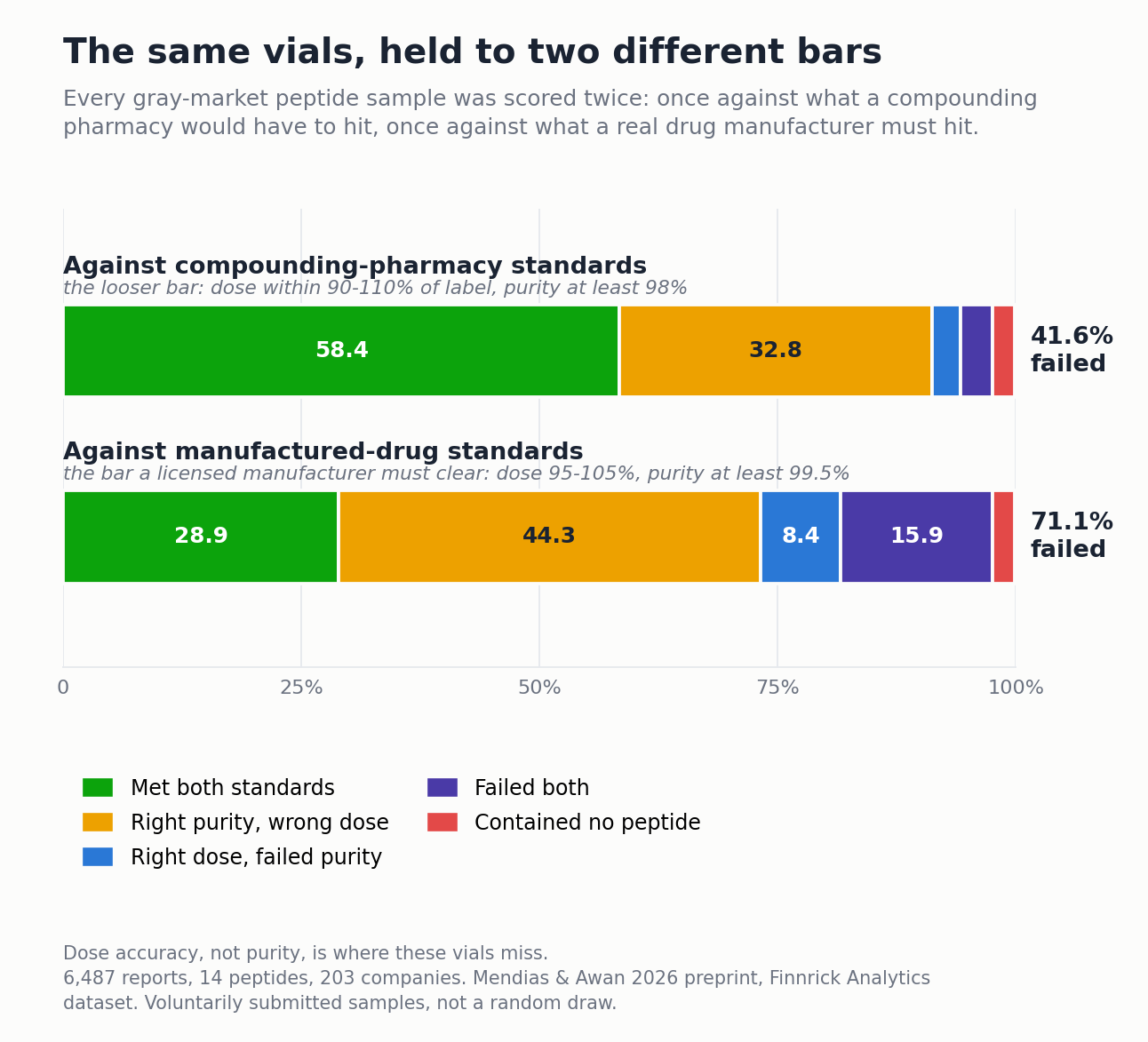
There is now a number on the trade, and it does not come from a drug company. A preprint posted this week went looking for retatrutide in the records of twenty-nine million Americans and found 652 people who had taken it. Of those whose source was documented, 71 percent got it from an online vendor, a compounding pharmacy or a wellness clinic rather than a trial or a prescription. The people in the trials are the useful comparison. On protocol they lost 15.5 percent of their body weight, close to what the manufacturer’s own trials reported. The people who bought it lost 7.2 percent, statistically indistinguishable from what matched tirzepatide users got with a prescription. Heart rates rose in both groups, 2.5 beats a minute in the buyers and 4.3 in the trial patients at three months, while matched semaglutide and tirzepatide users did not rise at all. That rise belongs to the molecule, and the buyers got it.
So the trade, measured: you take an unapproved triple agonist, keep its cardiovascular signature, and get about the weight loss of a drug someone could have prescribed you. The same records show what was in some of those vials. Retatrutide mixed with cagrilintide, high-dose tirzepatide, BPC-157, NAD+ and growth-factor analogues, some sold under invented names like GLP-3 and triple-G that mean nothing at all.
It is a preprint, not peer reviewed, and the authors work for the analytics company whose method it showcases. People who buy an unapproved peptide differ from people filling a prescription in ways no matching fixes, and the authors say plainly their own approach probably overstates the gap. It isn’t proof. But until this preprint, all anybody could do was argue.
Update, September 3, 2026: A second preprint, posted September 2 by the Understanding America Study team, asks a different question: how many people are buying this way. Among 9,150 respondents to a nationally representative panel, use of a GLP-1 or GIP drug, the class Wegovy and Zepbound belong to, rose from 8.2 percent in March 2024 to 12.0 percent in October 2025, which the authors put at about 32 million Americans. One user in three, about 9 million people, got the drug through something other than a regular prescription filled at a regular pharmacy. Among people taking it for weight loss, a third had no prescription or got one from an online provider or a med spa, 41 percent filled somewhere other than a retail pharmacy, and 43 percent had no coverage for it. The paper’s Table 3 splits that 41 percent: 14 percent used a compounding pharmacy, 12 percent an online pharmacy, and 15 percent an international source, a free sample or a friend. Among the 9 million non-traditional users that last channel was the biggest, at 39 percent. All of it is self-reported, and the survey cannot tell a licensed 503A from a website that calls itself one. What it can say is that roughly 9 million users are largely invisible to the insurance claims most safety studies run on. Same caveat as the last one: a preprint, not yet peer reviewed.
One case puts a face on it. A report in a BMJ journal describes a thirty-one-year-old woman in Italy who bought what she believed was Ozempic from a website and injected it. She reached an emergency room in a hypoglycemic coma. The vial contained insulin.
Be careful with that one too, including the way I just told it. It is a single case report, the abstract does not say whether she recovered, and it isn’t news: it went online in October 2025 and resurfaced only because the journal assigned it to a print issue, which is how a ten-month-old case becomes somebody’s breaking headline. I nearly made that mistake myself. Frightening stories get recycled, usually by someone with something to sell.
What it is good for is the sharp end of the failure mode the records only describe in aggregate. Insulin and semaglutide both lower blood sugar. Only one keeps lowering it until you are unconscious.
Even the top of the hierarchy fails
I do not want to leave you thinking the top of the ladder, branded and approved generic alike, is spotless, because it is not, and pretending otherwise would make me the kind of salesman I am trying not to be. In 2024 Sun Pharma, an approved maker of generic testosterone cypionate, recalled a batch over a manufacturing problem: the approved, inspected, retail version of my own drug. And failures up here can be worse, because the scale is bigger. The nitrosamine recalls that began in 2018 pulled common blood-pressure pills off shelves over a probable carcinogen. In 2008, contaminated heparin was linked to at least 149 death reports in the United States, traced to an adulterated ingredient made in China. So no, approved does not mean safe by definition.
The risk is not spread evenly either. In its annual report on drug quality, the FDA found that over five years, 72 percent of its actions against makers of raw drug ingredients fell on sites that supply only compounding pharmacies, though those sites are 18 percent of those makers. I do not want to over-read it. Heavier enforcement can mean heavier scrutiny as much as worse actors. But it tells you where the FDA is spending its attention, and it is not among the drugs most of us take without a second thought.
What I actually do about it
So where does that leave a 53-year-old who injects testosterone and reads too much? Two rules and an admission.
Where an FDA-approved retail version exists, get that one. It is usually the highest rung and often the cheapest, a rare combination.
I’m not going to do it. Switching means finding a prescriber who will write a portable script and leaving a setup that has worked for a year. I know which rung I’m on and I know the one above it is better watched and probably cheaper. I’m staying anyway, and I’d rather write that down than pretend I took my own advice.
There’s also a question I skipped. Why does Marek ship me a compounded vial at all, when the approved generic sits a rung up at ten to thirty dollars a month? I haven’t asked them. But look at the structure: a vial they source and mail is a product, and a prescription I could fill at any drugstore isn’t. That’s the arrangement, whatever the reason for it. I audited the pharmacy, the FDA and the gray market in this piece, and never once the company I actually pay.
Sometimes the approved version doesn’t exist, or not for you. Compounded GLP-1s filled a real gap during the shortages. When you’re there, the useful question is who is watching the place that made your vial, not whether somebody will show you a certificate. A 503B leaves a public trail: warning letters, recalls, how the FDA graded its last inspection. A 503A answers to a state board, a real regulator even with no federal file. What you do not want is the third thing, a seller with no license, no board, and no inspector, whose spotless record only means nobody has ever looked. A warning letter by itself doesn’t tell you whether to run. An unresolved one might. What should worry you more is nobody having the authority to write one.
Update, August 28, 2026: For the GLP-1s specifically, the two middle rungs are now closed. Compounded tirzepatide and semaglutide stopped being legal to make in early 2025, once the FDA declared both shortages over, and on August 27 the Fifth Circuit upheld those decisions on appeal. The ladder still describes every injectable a guy might put in his body. It is just that for these two drugs there is no longer a licensed middle to stand on, which pushes the people who were priced out toward the bottom rung rather than off the ladder.
And the peptides. If you inject the gray-market stuff, be honest about which rung you are on. It is the bottom one, and it is the only rung where nobody signed for the vial.
What I’d tell my past self, the one who thought about the needle but never the factory, is that the question was wrong all along. It isn’t whether you can see a certificate of analysis. Anyone can print one. It’s who inspects the place this came from, and whether you can read what they found.