
Update — July 24, 2026
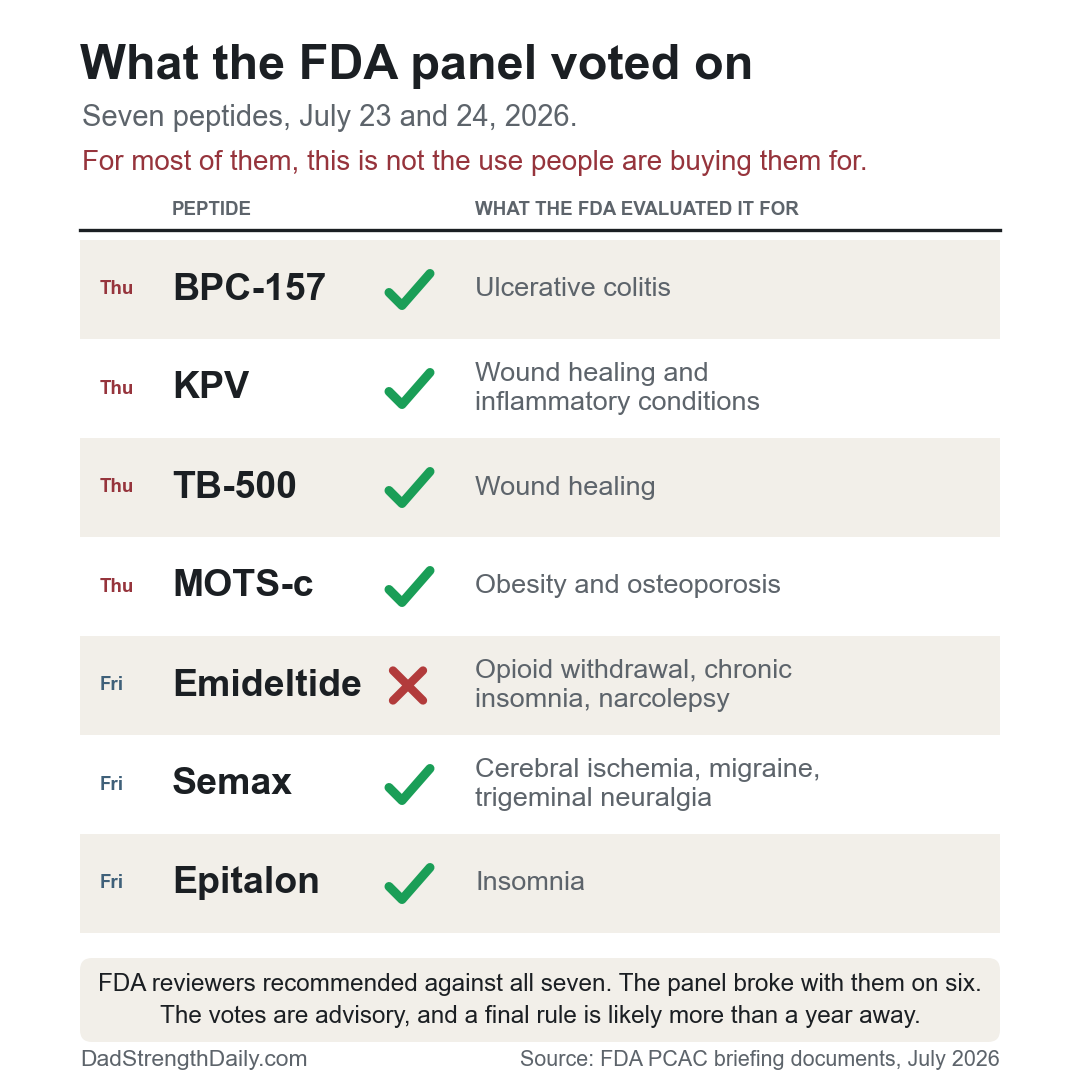
All seven are decided, and six of them cleared. The committee recommended BPC-157, KPV, TB-500, and MOTS-c on Thursday, then epitalon (7 to 4) and semax (8 to 5, one abstention) on Friday. It rejected one: emideltide failed 6 to 7, the only compound the panel turned down. FDA reviewers had urged rejecting all seven, so the outside advisers broke with the agency’s scientists six times and agreed with them once. The votes are advisory; the FDA still makes the final call, likely more than a year out.
BPC-157 and TB-500 will heal any injury as if you were an X-Men character. Reta, as everyone shortens retatrutide, will make you skinny, and ipamorelin will make you tall and muscular. You have run into some version of these claims by now even if you were not looking for them, because peptides are suddenly everywhere, sold as two revolutions at once: a way for ordinary people to take their health into their own hands, and a cure for a long list of conditions.
This week an FDA advisory committee finally weighed in, and it did not do what its own scientists had asked. On Thursday, July 23, the Pharmacy Compounding Advisory Committee voted 8 to 6, with one abstention, to recommend BPC-157 for the list of raw ingredients a pharmacy is allowed to compound with, then handed KPV and TB-500 the identical 8-to-6 result. MOTS-c went 7 to 5, so all four of Thursday’s peptides cleared. The agency’s own staff had urged the panel to reject all seven in front of it — BPC-157, TB-500, KPV, MOTS-c, semax, epitalon, and emideltide, also known as DSIP.
Friday broke the streak. The committee recommended epitalon 7 to 4 and semax 8 to 5 with one abstention, but it turned down emideltide 6 to 7, the only compound it refused all week.
You might read that as the FDA ruling on whether this stuff works, but that is not what happened. The panel was not deciding whether these peptides work. It was deciding whether they belong on the list of raw ingredients a pharmacy may compound with for an individual patient. And the medical uses it judged them on are mostly not the reasons anyone is buying them.
What a peptide actually is
A peptide is just a short chain of amino acids, and some of them carry messages around the body. That description covers insulin, and it covers the GLP-1 drugs, where the P literally stands for peptide. BPC-157 sits in the same bucket.
One word covering both of those is why every argument about peptides goes sideways in the first minute. It sweeps up drugs that went through years of trials and drugs that have barely been given to a human being. Calling something a peptide tells you what kind of molecule it is. It tells you nothing about whether it works, or whether the vial holds what the label says. On the supplement side there is at least a program that tests every batch and audits the plant, which is worth understanding before you trust any label.
The names do not help. CJC-1295 and MOTS-c sound like parts I would order for an appliance, and sellers bundle combinations under names like Wolverine, KLOW, and Zeus. All of it gets talked about as one new class of medicine, when really these are unrelated compounds with wildly different amounts of proof behind them.
What the FDA panel actually voted on
The FDA took a strange route to this week. In 2023 it labeled 19 peptides unsafe to compound, and most pharmacies dropped them. In April of this year, after the people who had nominated the peptides withdrew their nominations, the agency took 12 of them off its “do not compound” list without moving them onto the permitted one. They have been in limbo since, and the FDA held the vote anyway.
The meeting is about the 503A Bulks List, which is simply the list of raw ingredients a compounding pharmacy is allowed to work from. Thursday covered BPC-157 and KPV, then TB-500 and MOTS-c. Friday takes emideltide, epitalon, and semax.
Here is the part that caught me off guard when I went through the FDA’s paperwork. The agency was mostly not weighing these compounds for the reasons anybody is buying them. BPC-157 was on the agenda for ulcerative colitis, not the bad knee or the torn tendon. KPV and TB-500 were up for wound healing. MOTS-c was up for obesity and osteoporosis, emideltide for opioid withdrawal and sleep disorders, semax for cerebral ischemia and migraine and trigeminal neuralgia, epitalon for insomnia.
The committee’s yes on BPC-157 did not mean it decided the peptide repairs a knee, and a no would not have settled that either. All the panel weighed was whether the ulcerative colitis evidence is good enough to let a pharmacy make the stuff. That is a much smaller question than the one being argued about in gyms and longevity clinics.
In practice it would not stay that narrow. The condition on the agenda was what the FDA judged the evidence against, not a limit stamped on the ingredient afterwards, and NPR reported this week that if these compounds are added, doctors would not be held to the single use the agency evaluated. So a vote decided on ulcerative colitis data could still end with a compounded vial going into somebody’s shoulder.
The FDA’s own staff had said no. Their review recommended against adding a single one of the seven — the advice the committee brushed aside on BPC-157.
Their reasoning on BPC-157 is not the argument you would expect. BPC-157 is a common name, not a standardized one, and the agency says it has found several different salts and derivatives being sold commercially under it. Its words: a patient “may be dosed with a different bulk drug substance than the physician ordered.” On top of that there is no human safety data for the routes people actually take it by, the evidence that it helps ulcerative colitis is thin, approved drugs for that condition already exist, and staff flagged the risk of an immune reaction.
The composition of the committee turned into a fight. STAT reported in June that it had been reseated with eight new members, most of them tied to businesses that promote or prescribe peptides. That picture shifted on Tuesday, when the FDA added a group of temporary voting members, largely academics brought in for named compounds, several of whom can vote on only one peptide. NPR asked the agency why and got no answer.
The FDA streamed both days on YouTube free, starting at 8 a.m. Eastern — Thursday the 23rd and again on Friday the 24th. Thursday was the day that mattered most, since that is when BPC-157 and TB-500 came up. The agency had pushed Thursday’s end time back from 4:30 to 6:20 in the evening, which told you how much public comment it was bracing for. One quirk of the schedule: the public spoke before the FDA’s scientists presented, so the panel heard the advocates first and its own reviewers second.
The vote is advisory, and an advisory vote is not the same as anyone watching the factory. The agency does not have to follow the committee, and a final rule is likely more than a year away regardless of which direction this goes. FDA leadership still makes the final call. No switch flipped on Thursday, and none flips when the meeting ends Friday.
Get the next one in your inbox
I write about longevity, training, and preventive health weekly — without the guru worship. Free, no spam, unsubscribe whenever.
Why peptides are suddenly everywhere
I tried to find quantitative evidence of how big this whole thing actually is. US search interest in peptides peaked this year at about fifteen times its 2021 level, and in November it went past testosterone, which is the topic I would have bet on dominating. Testosterone climbed too, roughly two and a half times over the same five years, and that is what a popular health subject growing normally looks like.
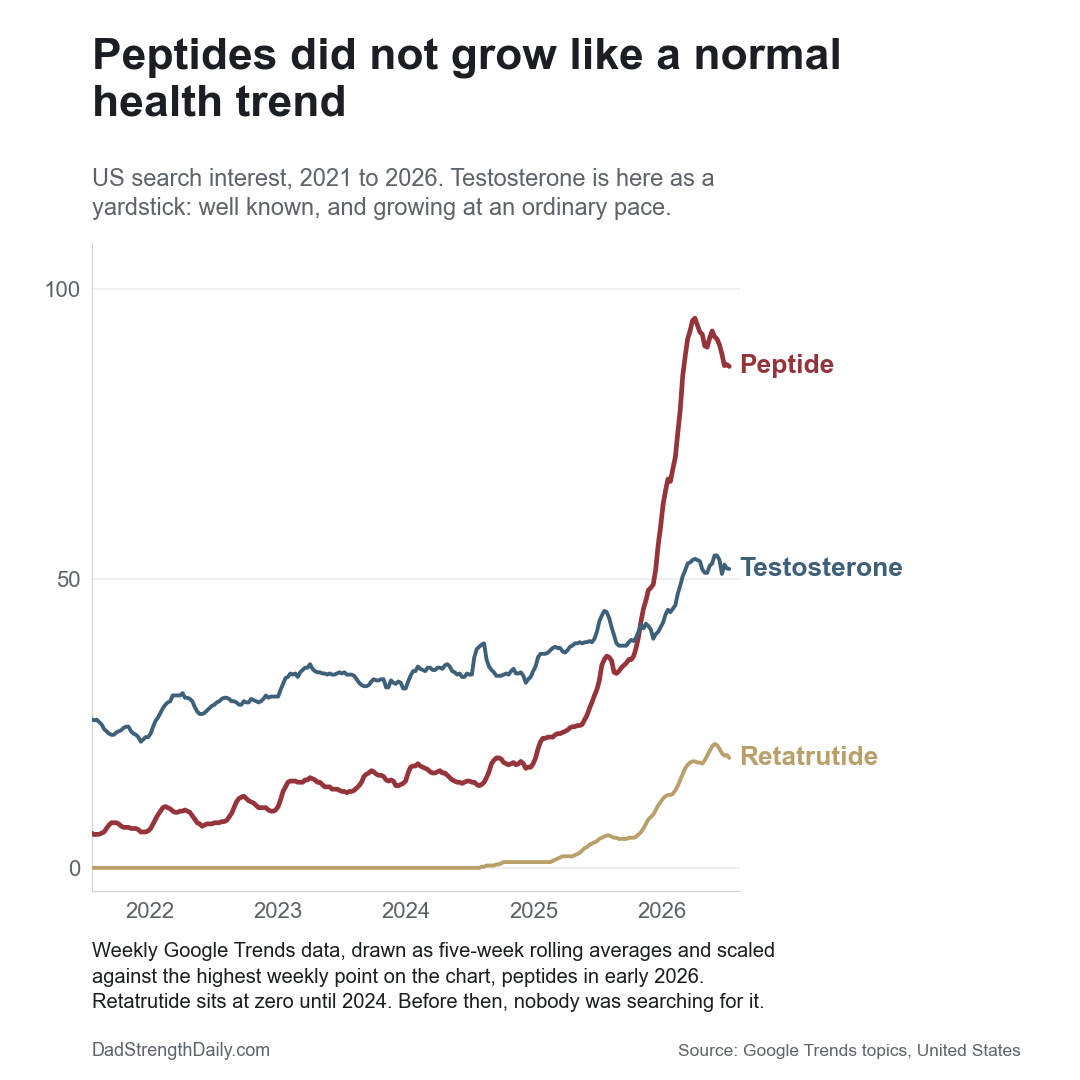
GLP-1s undoubtedly were part of the explosion in interest. KFF found that 12% of Americans were taking one, according to Bloomberg Businessweek’s June 2026 feature on the peptide gold rush. Peter Magic, the founder of peptide-testing company Janoshik, told Bloomberg that GLP-1s had pulled the rest of the peptide market up with them.
Celebrity attention helped: Jennifer Aniston told the Wall Street Journal in August 2023 that she swore by weekly peptide injections, and Bloomberg named Joe Rogan and Andrew Huberman as prominent amplifiers.
The politics arrived on Rogan’s show on February 27, when Robert F. Kennedy Jr. said he was “a big fan of peptides” and had used them himself “with really good effect with a couple of injuries.” He said he wanted about 14 of the restricted compounds moved somewhere people could get them from ethical suppliers. A Fabrizio Ward poll of 1,000 voters found strong support for easier access on both sides of the aisle, strongest among MAHA voters.
The gold rush started before the vote
Almost none of that demand is going through a pharmacy. A gray market grew up to meet it, with sellers on Discord and Telegram taking crypto for powder labeled “for research use only,” which buyers reconstitute with sterile water and dose themselves. In one analysis of 6,441 of those vials, more than 40% missed basic quality marks, usually by holding a different amount of peptide than the label promised. Some of that demand gets routed there through search results, not Discord: I found a hacked small-town government website funneling Google searches into a WhatsApp peptide sales group.
The people inside it put the black market somewhere between $1 billion and $3 billion, according to Bloomberg, and the margins explain the enthusiasm: an importer might pay a few dollars for powder that sells to you for $50 to $300. Janoshik, one of the labs this market uses to check its own supply, saw peptide testing volume rise more than 1,200% between 2023 and 2025.
The legal side is already placing bets. Hims & Hers bought a peptide compounding facility in early 2025. Noom bought a compounder licensed in 46 states this April. A Leerink analyst told the Wall Street Journal a yes vote could open a $2.2 billion telehealth market next year.
Nobody is waiting for the result. Mino’s chief executive, Elizabeth Straus, told the Journal her competitors were already stockpiling raw ingredients. “When July 23 comes, do you think everyone is going to purchase APIs? They’re purchasing them right now.” Some of them were in the room, too. Fortune reported on Monday that Hims & Hers’ chief medical officer testified Thursday.
The money is coming from stranger places than telehealth. Axios reported this month that Chainalysis traced $27 million in crypto to gray-market peptide sellers in the first quarter of this year alone, up about 150% from the quarter before, and that some of the Chinese suppliers taking it used to sell fentanyl precursors.
Gary Brecka, whose company markets peptides, put the case for access at an industry briefing this week: when the regulated pharmacies stopped carrying peptides, the demand did not go away, it went underground. NPR reported the remark, and he is right about it. That is the strongest argument anyone makes on this side. Kennedy has made the same case, arguing that compounding would pull people away from “a dangerous black market that puts Americans at risk.” Jerome Adams, the 20th Surgeon General, argued in STAT this month for a middle path, letting licensed pharmacies compound selected peptides under clinician supervision with mandatory disclaimers and outcome tracking, instead of choosing between a free-for-all and a ban. The pushback came from inside Kennedy’s own department. An HHS spokesperson, Emily Hilliard, told the Journal that a big black market and a lot of curious customers do not change what the FDA requires of a drug.
A market this size proves that a lot of people want this stuff to work. It does not prove that it does. The panel said yes to six of them, and the guy with the bad shoulder will still be buying the powder online on Monday morning, the same place he bought it last week.
About Gunnar
Gunnar is 53. He lost about 170 pounds, trains in a garage gym, and writes DadStrengthDaily from personal experience, citing primary sources where he can. He also moderates r/ProactiveHealth. He is not a doctor, and nothing here is medical advice. Talk to your own doctor before acting on anything, especially GLP-1s, TRT, blood pressure, sleep apnea, and cancer screening.