
Updated with a newly registered BPC-157 rotator cuff trial.
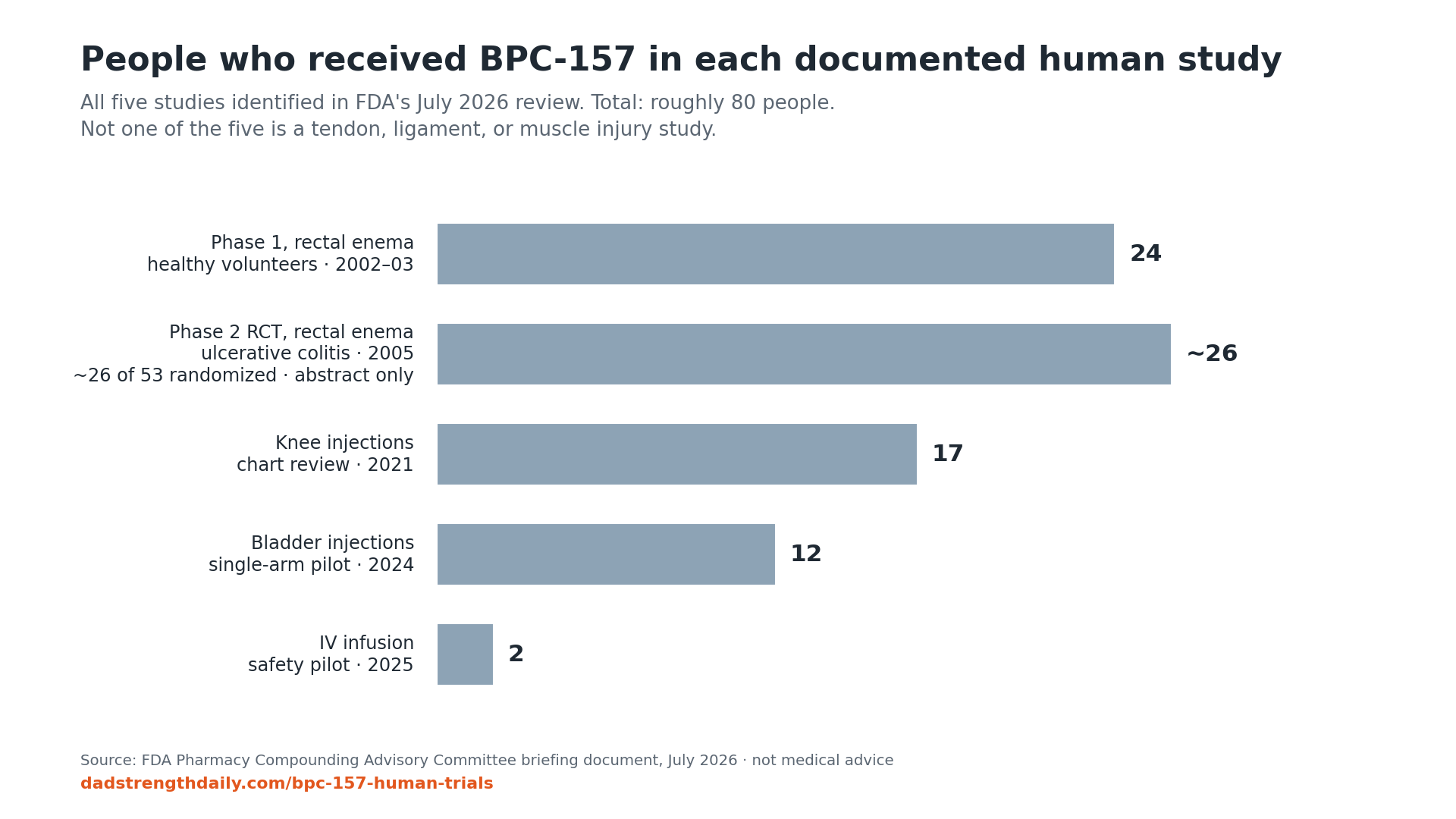
Not one of them tested an injury. I pulled every record in FDA’s July 2026 review and the registries behind it.
FDA’s July 2026 review identified five studies in which humans received BPC-157, roughly 80 people in all. Only one was a randomized trial of whether it works, and it did not show a statistically significant benefit over placebo. No human trial has tested whether BPC-157 heals tendon, ligament, or muscle injuries, which is the thing everyone is actually injecting it for.
Update, September 28, 2026: The University of Arkansas has registered a randomized, placebo-controlled pilot trial of BPC-157 after rotator cuff repair surgery, with shoulder strength as the main outcome. It isn’t recruiting yet; the planned start is January 2027. What the BPC-157 rotator cuff trial will test, and what it can’t.
Search for BPC-157 human trials and you’ll find every possible answer: no human studies, three human studies, five, a Phase 2 recruiting right now. I got tired of the contradictions and went through the primary records myself, starting with the FDA briefing document from the July 2026 advisory committee meeting, then PubMed and ClinicalTrials.gov.
The five: a randomized Phase 1 safety study and a randomized Phase 2 ulcerative colitis trial that survive only as conference abstracts from two decades ago, plus three small recent studies sharing a lead author, covering knee pain, interstitial cystitis, and a two-person IV infusion.
And the famous “successful Phase 2 trial” cited in dozens of review papers? The numbers are in FDA’s own briefing document and I haven’t seen a single site report them.
Last verified August 27, 2026. My counting rule: a human study means BPC-157 was actually administered to people; registrations without results are listed separately, because planned enrollment is not people treated.
Every BPC-157 human study, in one table
For its July 2026 review, FDA searched PubMed and Embase and found five clinical studies in which humans received BPC-157. Nobody, including me, has surfaced a sixth.
| Study | What it was | Dose & route | Got BPC-157 |
|---|---|---|---|
| Veljaca et al., 2002–03 | Phase 1 safety, healthy volunteers · abstracts only | Up to 2 mg/kg rectal enema, daily × 8 days | 24 |
| Ruenzi et al., 2005 | Phase 2 RCT (double-blind, placebo), ulcerative colitis · abstract only | 80 mg rectal enema, daily × 2 weeks | ~26 of 53 |
| Lee & Padgett, 2021 | Chart review, knee pain · full article | 2–4 mg into the knee, 1–2 doses, some with thymosin beta-4 | 17 |
| Lee, Walker & Ayadi, 2024 | Single-arm pilot, interstitial cystitis · full article | 10× 1 mg bladder-wall injections, one procedure | 12 |
| Lee & Burgess, 2025 | IV safety pilot, healthy subjects · full article | 10 mg IV day 1, 20 mg day 2 | 2 |
Why do some articles say only three human studies exist? They’re counting the three modern journal articles and ignoring the two older abstract-only studies. FDA counts all five. Same with the participant numbers: 31 people in the three published studies, roughly 80 with the abstracts included.
What you won’t find anywhere in that table is a study of tendon, ligament, or muscle injury. The use case driving basically all of the gray-market demand has zero human data behind it.
Get the next one in your inbox
I write about longevity, training, and preventive health weekly — without the guru worship. Free, no spam, unsubscribe whenever.
The Phase 2 trial everyone cites and nobody has read
The strongest claim in the BPC-157 literature is that a Phase 2 trial evaluated it for ulcerative colitis and found it effective and well-tolerated. Some version of that sentence appears in dozens of review papers, almost all tracing back to the same Zagreb research group that has driven BPC-157 research since the 1990s.
Here is what the abstract actually reported, per FDA’s summary. The abstract itself has no page to link you to: it ran in a 2005 conference supplement, before individual abstracts got DOIs, and it never became a paper. Fifty-three patients with mild-to-moderate ulcerative colitis were randomized 1:1 to a daily 80 mg BPC-157 enema or placebo for two weeks. In the trial records the drug goes by PL 14736, the sponsor’s internal code name for BPC-157. The primary endpoint was change in a Disease Activity Index, where a bigger drop means the patient got better. The BPC-157 group’s score fell by a mean of 3.2 points, the placebo group’s by 1.6, and the between-group estimate of −1.6 came with a 95% confidence interval of −4.84 to 1.62. That interval crosses zero. The trial did not show that BPC-157 beat placebo. FDA says as much: the data are inadequate to support efficacy, and because the trial only ever appeared as a meeting abstract, basic details like the endpoint definition and statistical methods were never published. The trial also lost people fast for a two-week study: seven of the 53 didn’t finish. Three in the BPC-157 group and two on placebo were withdrawn for adverse events, mostly worsening colitis, and one from each group was lost to follow-up.
Skeptics who say BPC-157 has never been in a randomized human trial are technically wrong twice over: an earlier Phase 1 safety study, in 2002–03, was randomized too, and then this one happened, in 2005. But the sellers repeating “a Phase 2 trial proved it works” are wrong in a way that matters more. The one randomized trial that tested whether it works showed no significant benefit over placebo, and its sponsor, the Croatian pharma company Pliva, never published it, and I can find no sign the program ever advanced.
One more detail before you extrapolate from enemas to injections: in both PL 14736 studies most plasma samples were below the detection limit, and FDA concluded BPC-157 does not appear to be absorbed systemically from an enema. Whatever happened in those colons mostly stayed local, which says little about injecting the compound into a hamstring.
The forgotten Phase 1, and the trial that vanished
Most current coverage acts like human research on BPC-157 started in 2021. It started in 2002, with a randomized, placebo-controlled Phase 1 program that gave 24 healthy volunteers rectal BPC-157 at up to 2 mg/kg daily for eight days. The most common adverse events were headache and flatulence, at rates FDA says weren’t obviously different from placebo. It exists only as meeting abstracts, so treat it as evidence of human exposure, not a complete trial report.
Then in December 2015, a Phase 1 trial of oral BPC-157 tablets was registered as NCT02637284, planned for Mexico with an estimated 42 healthy volunteers. No results were ever posted and FDA found no associated publication. A registration doesn’t demonstrate a trial ran; we simply don’t know whether anyone ever received a dose.
The animal work goes back thirty-plus years and the commercial demand is huge. In all that time, the only sponsor I can find with a documented formal program, Pliva, walked away after an unpublished Phase 2 that didn’t separate from placebo. I couldn’t confirm whether any company holds an active IND, the FDA authorization you need before testing a drug in people, for the compound today. My guess is a weak patent position plus human data that wasn’t compelling enough to build on, and I’ll say plainly that’s my inference, not something FDA’s briefing document states.
The three modern studies
The 2021 knee study is a retrospective chart review. Seventeen patients were identified, 16 of them reachable for a follow-up call, and they received 2 to 4 mg of BPC-157 injected into the knee, some in combination with thymosin beta-4. The published paper reports most felt better. No validated pain instrument, no control group, no blinding, and a combination product confounding any attribution to BPC-157. A design like this cannot establish that the peptide does anything.
The 2024 interstitial cystitis pilot treated twelve women with ten separate 1 mg injections around the bladder wall in a single procedure. Single arm, no comparator, same lead author as the knee study but a different clinic, same alternative-medicine journal. No adverse events were reported, which is not the same as demonstrating safety.
The 2025 IV study gets overinterpreted the most: two participants, 10 mg IV on day one and 20 mg on day two, with labs drawn. No adverse events were reported. An n=2 experiment cannot estimate the frequency of uncommon adverse effects, and it certainly can’t tell you whether BPC-157 heals anything.
All three modern studies share a lead author and a publication venue. I’m not alleging misconduct, I’m describing how thin and concentrated the independent evidence is. FDA’s safety verdict was blunt: insufficient information to characterize the safety profile at all. Nobody has published basic pharmacokinetic work for any injected or oral route, and there aren’t carcinogenicity studies in any species, which bothers me more for a compound reported to promote new blood-vessel growth in animal studies.
Is the “recruiting 2026 Phase 2 trial” real? I have serious doubts.
Search ClinicalTrials.gov today and you’ll find NCT07437547, a randomized, double-blind, placebo-controlled Phase 2 trial of BPC-157 for MRI-confirmed grade II hamstring strains, sponsored by “Hudson Biotech” and listed as recruiting since February 2026. A compounding-pharmacy newsletter and several peptide dosing guides have already cited it as the first real BPC-157 RCT.
I don’t consider that registry entry reliable evidence that a genuine trial is underway, and once you look at the sponsor you probably won’t either.
Hudson Biotech isn’t a drug developer, it’s a peptide vendor, and I see no evidence it has ever run a real clinical program. Its website sells retatrutide, BPC-157, GHK-Cu, and TB-500. The same sponsor filed a cluster of eight trial registrations between February and March 2026, all listing the same study site, all marked recruiting, together claiming nearly 3,400 participants, per the count of an independent investigator who writes under the name Dr. Noc. Two of the records describe themselves as fictional or mock studies in the official text: the TB-500 record (NCT07487363) opens its summary by calling itself a fictional example of a ClinicalTrials.gov-style record, and another, for tesamorelin, has “(Mock Study)” in the title. Two more are near-copies of real Eli Lilly GLP-1 trials, one reusing Lilly’s trial name SURMOUNT-1, another using Lilly’s internal code for retatrutide, LY3437943; Lilly told Dr. Noc it has no relationship with Hudson Biotech and never authorized either. The vendor’s site carries the standard “research use only” boilerplate and says nothing about its trial listings being fictional.
The hamstring record itself doesn’t self-declare as fictional, and I can’t prove no such study exists. Maybe the trial turns out to be real. But right now nothing besides the sponsor’s own registry entry says it exists, and given the self-described mock listings and apparently copied records sitting next to it, I’m not counting it. If you read my reporting on the gray-market retatrutide sellers Lilly sued in August, this playbook will look familiar.
Trial registries are also exactly the kind of source AI answer engines trust, and Dr. Noc caught chatbots and search summaries repeating the fictional TB-500 record as a genuine trial. The same reporting says three commercial pharma-intelligence platforms (DataLookout, Veeva, PatSnap Synapse) scraped the cluster and presented it to paying clients as Hudson Biotech’s real pipeline. Checking the primary record isn’t enough anymore. You have to check who filed it.
The marketers aren’t the only ones getting this trial wrong. Dr. Jordan Feigenbaum, a Barbell Medicine co-founder who doesn’t sell peptides and says he won’t prescribe BPC-157, brought this hamstring trial up on the podcast Two Percent with Michael Easter as a reason for skepticism: “what they’re looking at is like MRI changes,” he said, “so just stuff on an image, which is not nothing.” That’s half right. MRI-assessed injury volume is one co-primary endpoint. The other is the functional one: time until a clinician who doesn’t know the treatment assignment clears the athlete for unrestricted sport. Pain, strength symmetry, and a function questionnaire are in there too, as secondary endpoints. The outcome he said he’d want to know about is in the record he was describing. Even a source with nothing to sell can undersell a trial from memory. Check the primary record yourself.
Why is it so popular if the human evidence is this thin?
The reputation rests almost entirely on animal work: roughly 200 preclinical papers, most of them from one Zagreb group, reporting accelerated healing in rat models of tendon, ligament, muscle, gut, and liver injury. FDA’s reviewers read a slice of that literature, and their notes on the gut-injury studies stand out: no dose-response relationship was established there, and a 10 ng/kg dose kept producing the same effect as a dose a thousand times larger, which is pharmacologically strange. No molecular target has been identified. To me that reads as a reason to run a proper human trial, not a reason to skip one. Nobody selling BPC-157 for a torn hamstring has a validated human dose to point to.
How many people are actually taking it
More than have ever been in a study, by a wide margin. A preprint posted on September 7, 2026, not yet peer reviewed, had a large language model read de-identified clinical notes from a network of US health systems, with physicians checking its extractions. It found 1,536 patients whose notes mentioned BPC-157 and confirmed actual use in 1,039 of them. Quarterly new confirmed users rose 33-fold between 2020 and 2026. Set that against the roughly 80 people in the table above.
Who is taking it is specific, and it looks a lot like my readers. Among newly documented users the male share went from 57% in 2020 to 70% in 2026, and mean age fell from 55 to 49. Pain was the recorded reason for 33% of confirmed users, gut conditions for 14%, a prior injury for 11%, and post-surgical healing for 10%. Half of them, 525 of 1,039, were taking something else at the same time, most often testosterone (17%), NSAIDs (14.7%), TB-500 (12.9%) and corticosteroids (11.7%). Where the vial came from was documented for only 205 patients, and among those it split between compounding pharmacies (36%) and gray-market peptide vendors (35%).
None of that says whether it works. A direction of response was written down for 354 users, 79% of them improvement and 5% worsening, and nothing at all for the other 685. The authors say these notes cannot separate BPC-157 from the peptide stacking, the other drugs, the physical therapy, the surgery, or a doctor recording the good news and not the rest. Flynn McGuire at the University of Utah, who has published on BPC-157 and had no part in this study, told Reuters the same thing: no placebo group, no comparator, and no standardized indication, formulation, dose, route, duration or outcome measure.
Two caveats on the paper itself. The authors are employees of nference, the analytics company whose platform produced the data, which they disclose. And adverse events were recorded in roughly 1% of users each for neuropsychiatric, injection-site and gastrointestinal problems, numbers the authors themselves call likely under-reported. Among the 80 patients whose start date could be pinned down, use began an average of 60 days before any doctor wrote it down.
Where the FDA fight stands
BPC-157’s US regulatory status has moved twice in the past year and a half, and a compounding pharmacy still can’t legally make it. It sat on FDA’s restricted Category 2 list, meaning significant safety concerns, until April 2026, when FDA removed it and several other peptides. Then on July 23–24, 2026, FDA’s Pharmacy Compounding Advisory Committee took it up. FDA’s own scientists recommended against listing it. They cited the poor characterization of the compound, the unknown risk of immune reactions to it, and the thin effectiveness evidence you just read about. The committee voted 8–6, with one abstention, to recommend it anyway. That vote is advisory. It didn’t change what’s legal, and a final rule could be a year or more out.
None of that makes BPC-157 an approved drug. No product containing it is approved in any country, and it’s still on WADA’s prohibited list. FDA’s reporting from the large outsourcing facilities it regulates shows zero compounded BPC-157 products from January 2017 through June 2025, though it wasn’t legally compoundable for part of that stretch, so zero is partly the expected baseline. And FDA’s adverse-event database, while nearly empty, includes one case worth knowing about: a user of a “research use only” BPC-157/TB-500 combo who developed skin and gum hyperpigmentation, stopped, tried it again, and got the identical reaction, though with a two-peptide product FDA can’t say which peptide caused it. The unregulated vial and the molecule in the rat studies are not the same product.
What would change my mind
I went into this expecting to find fewer studies than the skeptics claimed and better ones than I got. FDA found five, covering about 80 people, none of them injury patients, and the only randomized result on whether it works missed significance and never became a paper. When any of that changes, and I mean published results from a sponsor that actually exists, this page will say so.
FAQ
Are there BPC-157 human trials?
Yes. FDA’s July 2026 review identified five clinical studies in which people received BPC-157: a randomized Phase 1 safety study and a randomized Phase 2 ulcerative colitis trial, both surviving only as 2002–2005 conference abstracts, plus three small recent studies covering knee pain (17 patients), interstitial cystitis (12), and IV infusion (2). No published full-length randomized controlled trial exists.
Has BPC-157 been proven to heal tendons or muscles in humans?
No. FDA’s search didn’t turn up a single human study built around a tendon, ligament, or muscle injury. The only musculoskeletal data is an uncontrolled 17-patient knee-pain chart review, partly using a combination product.
Has BPC-157 been tested in a randomized controlled trial?
Once, for efficacy: a 2005 randomized, double-blind, placebo-controlled ulcerative colitis trial enrolled 53 patients. Per FDA’s summary, the between-group difference was not statistically significant (95% CI −4.84 to 1.62), and full results were never published. The 2002–03 Phase 1 safety study was randomized and placebo-controlled too, per the same FDA briefing document (32 volunteers randomized, 24 assigned to BPC-157), but it tested tolerability, not whether the drug worked.
Is BPC-157 safe in humans?
Unknown. FDA concluded in 2026 that there is insufficient clinical information to characterize its safety profile. Documented human exposure totals roughly 80 people, all short-term, with no human pharmacokinetic data for injected or oral routes and no carcinogenicity studies.
Is a real BPC-157 clinical trial recruiting in 2026?
A ClinicalTrials.gov record (NCT07437547) claims a recruiting Phase 2 hamstring trial, but the sponsor is a peptide vendor whose related registrations include self-described fictional and mock records. I don’t consider the entry reliable evidence that a genuine trial is underway.
How many humans have received BPC-157 in studies?
About 80 across the five FDA-identified studies, 31 of them in the three modern published studies. Registered trials without posted results add zero verified exposure.