
Updated with the revised label now posted to DailyMed.
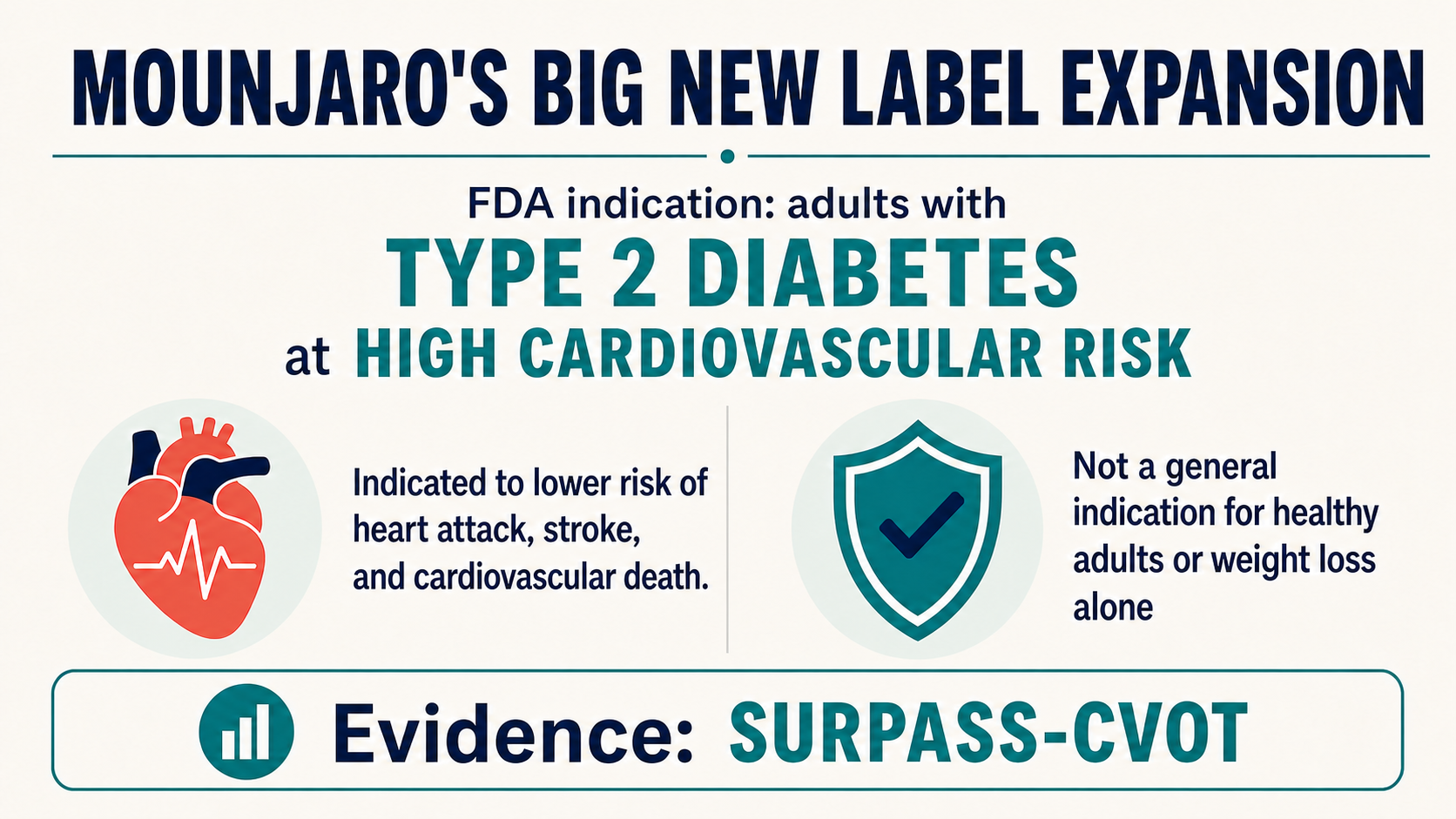
The FDA approved Mounjaro today to lower the risk of heart attack, stroke, and cardiovascular death in adults with type 2 diabetes who are at high risk for those events. That is a real expansion, and for a lot of people it is genuinely good news. It is also going to be reported badly by tonight, so here is what the approval says and what the trial underneath it actually found.
I inject tirzepatide every week. Not this brand. I take Zepbound, which is the same molecule sold for obesity. So I read this one carefully, and the headline turns out to be fine. The fine print is where the interesting part lives.
What the FDA actually approved
Per Lilly’s announcement, the agency approved Mounjaro
to lower the risk of major adverse cardiovascular (CV) events (MACE), including CV death, non-fatal heart attack, or non-fatal stroke in adults with type 2 diabetes who are at high risk for these events.
Read that population line twice, because it is the part that will get dropped. This is adults with type 2 diabetes, and specifically those at high cardiovascular risk. It is not an obesity indication. It is not a general heart-health claim for anyone who wants one. Its existing diabetes indication did not change. Mounjaro is still approved for blood sugar control in adults and in kids 10 and older with type 2 diabetes, and the cardiovascular claim sits on top of that. One caveat if you go looking: the revised label had not posted to DailyMed the morning this went up. It has since. Version 40 of the label, dated August 27, 2026, posted to DailyMed on September 2, and the indications section now reads, in the label’s own words, “to reduce the risk of major adverse cardiovascular (CV) events (CV death, non-fatal myocardial infarction (MI), or non-fatal stroke) in adults with type 2 diabetes mellitus who are at high risk for these events.”
If you take tirzepatide for weight and you do not have type 2 diabetes, nothing about your prescription changed today.
Get the next one in your inbox
I cover the latest GLP-1 trials and access changes weekly. Free, no spam, unsubscribe whenever.
The number everyone is going to get wrong
The approval rests on SURPASS-CVOT, published in the New England Journal of Medicine in December 2025. More than 13,000 people, 30 countries, over four and a half years. Lilly calls it the largest and longest tirzepatide study run so far.
It was also not a placebo trial. Lilly tested Mounjaro head to head against Trulicity, an older Lilly GLP-1 that Lilly describes as “a GLP-1 treatment with established cardiovascular benefit.” Everything about how you read this result follows from that.
Here is the finding, in Lilly’s own words:
Mounjaro demonstrated non-inferiority to Trulicity (dulaglutide) … with an 8% lower rate of cardiovascular death, heart attack or stroke (MACE-3). The estimated hazard ratio for time to first MACE was 0.92 (95.3% CI: 0.83, 1.01).
That confidence interval runs from 0.83 to 1.01. It crosses 1. The trial set its bar in advance: an upper limit under 1.05 counted as non-inferior, and an upper limit under 1.00 would have counted as superior. At 1.01 it cleared the first bar and missed the second by a hundredth. In plain terms: the point estimate came out 8% in Mounjaro’s favor, but the range of values compatible with the data still includes no difference at all. Mounjaro did not beat Trulicity. It cleared the bar the trial actually set: not worse by more than a margin agreed in advance.
You will see “8% lower risk of heart attack and stroke” in a lot of places this week. That number is real as a point estimate and it is not statistically significant for superiority. Anyone reporting it as a proven 8% reduction is adding a claim the trial did not make.
Credit where it is due. Lilly is not the one overselling this. Their release says “non-inferiority” plainly, prints the confidence interval, and their cardiometabolic president says outright that they “set a higher bar by testing Mounjaro against a GLP-1 medicine with proven cardiovascular benefit.” The overstatement will come downstream, from people summarizing a press release they did not read to the end of.
Why not beating Trulicity is still good news
I would not dismiss this because the confidence interval crossed 1. The comparator was dulaglutide, not placebo, and Trulicity already carries its own cardiovascular indication in type 2 diabetes. Matching it is useful. It is just not proof that tirzepatide is better.
So the honest reading of SURPASS-CVOT is not that tirzepatide did nothing for hearts. It is that tirzepatide performed like a drug already established to help, in a trial big enough and long enough to have caught it doing meaningfully worse.
A placebo-controlled trial would have been the easier route and would almost certainly have produced a bigger-sounding number. Lilly ran the harder comparison instead and got a less quotable result out of it.
There is also a practical read here. If you have type 2 diabetes and high cardiovascular risk, you now have one weekly injection that controls blood sugar, drives substantial weight loss, and carries an approved indication for lowering cardiac risk. Consolidating three goals into one shot is a real clinical win even when the trial that got it there stopped short of superiority.
What this does not change
The obesity question is still open. Nothing has yet shown that tirzepatide cuts heart attacks and strokes in people who have obesity but not diabetes, which is what SELECT did for semaglutide. SURMOUNT-MMO is the trial built to answer that, and it has not reported. The closest evidence we have is SUMMIT, which gave tirzepatide to 731 people with obesity and heart failure with preserved ejection fraction and found fewer cardiovascular deaths or worsening-heart-failure events, 9.9 percent against 15.3 percent. That is a real result, but it is a narrower group and a different endpoint, and the benefit came from the heart-failure half: cardiovascular deaths alone were 8 against 5, a count too small to read anything into. So “does this shot protect my heart if I am on it for weight” is still not answered, and today’s approval does not answer it.
The data is not new either. SURPASS-CVOT published in December 2025. What happened today is regulatory, not scientific. The FDA agreed that an eight-month-old result supports a label claim. Nothing was discovered this morning.
I wrote a longer piece a few weeks ago on how tirzepatide and semaglutide actually compare on hard outcomes, and the core of it holds. Semaglutide still has the placebo-controlled trial showing fewer major cardiovascular events, the combined count of cardiovascular death, heart attack and stroke. Tirzepatide now has a cardiac indication built on a head-to-head non-inferiority trial. I wish that gave us a clean comparison. It doesn’t, and I would not pretend the two results answer exactly the same question.
The approval is good news. It is narrower than the headlines will make it sound, and the population line is the whole ballgame: type 2 diabetes, high cardiovascular risk.