
I do not take a statin. I got my ApoB to 59 with about 170 pounds of weight loss and a generic ezetimibe that runs me twenty dollars a month, so when a big statin trial reads out I have nothing invested in the answer. I have also written here about why most of the muscle-pain fear around statins is nocebo, so I am not hostile to the drug either. This morning’s result is more complicated than either position.
STAREE was presented at the European Society of Cardiology meeting in Munich on Saturday and published the same day in the New England Journal of Medicine (Zoungas et al., 2026). It is the first large randomized trial of statins after 70 in primary prevention, a question the guidelines have never settled: what happens if you start atorvastatin (generic Lipitor) in a 74-year-old who has never had a heart attack.
Here is what it found. In 9,971 Australians aged 70 and over, atorvastatin 40 mg cut major cardiovascular events by 30 percent over a median of 5.9 years, hazard ratio 0.70, with a number needed to treat of 37. The trial’s second primary endpoint, survival free of dementia and physical disability, did not improve: hazard ratio 0.94, p equals 0.25.
Most stories will summarize that as a 30 percent reduction. The full result is more subtle, and worth dissecting.
What the trial did
Participants were randomized to atorvastatin 40 mg or a matching placebo. Mean age 74.7, about 52 percent women, and the authors note that more than 40 percent were older than 75. Starting LDL averaged 126.6 mg/dl. There was no commercial or industry involvement at all, which for a statin trial is worth noting.
These were not pristine elders. Almost half were on blood-pressure medication, a quarter had a BMI over 30, one in five took five or more drugs. What they did not have was diagnosed cardiovascular disease, diabetes, or dementia.
Which makes them the group the guidelines are least sure about, and that is the whole reason the trial exists. The 2026 ACC/AHA dyslipidemia guideline makes a firm recommendation only for 40- to 75-year-olds who have diabetes, kidney disease or HIV, none of which these people had. Past 75 it softens to saying LDL-lowering “can be considered.” Its risk calculator stops at 79 altogether. The trial’s own authors say the same thing more bluntly: no strong recommendation for anyone 70 or over, and the evidence thinnest of all past 75.
Two primary endpoints were prespecified: major cardiovascular events, and disability-free survival, meaning survival without dementia or persistent physical disability. They were tested in order: the cardiovascular endpoint first, and disability-free survival only if that one came in under a p of 0.05. It did, so both were tested.
Get the next one in your inbox
I write about longevity, training, and preventive health weekly — without the guru worship. Free, no spam, unsubscribe whenever.
The 30 percent is heart attacks and revascularizations
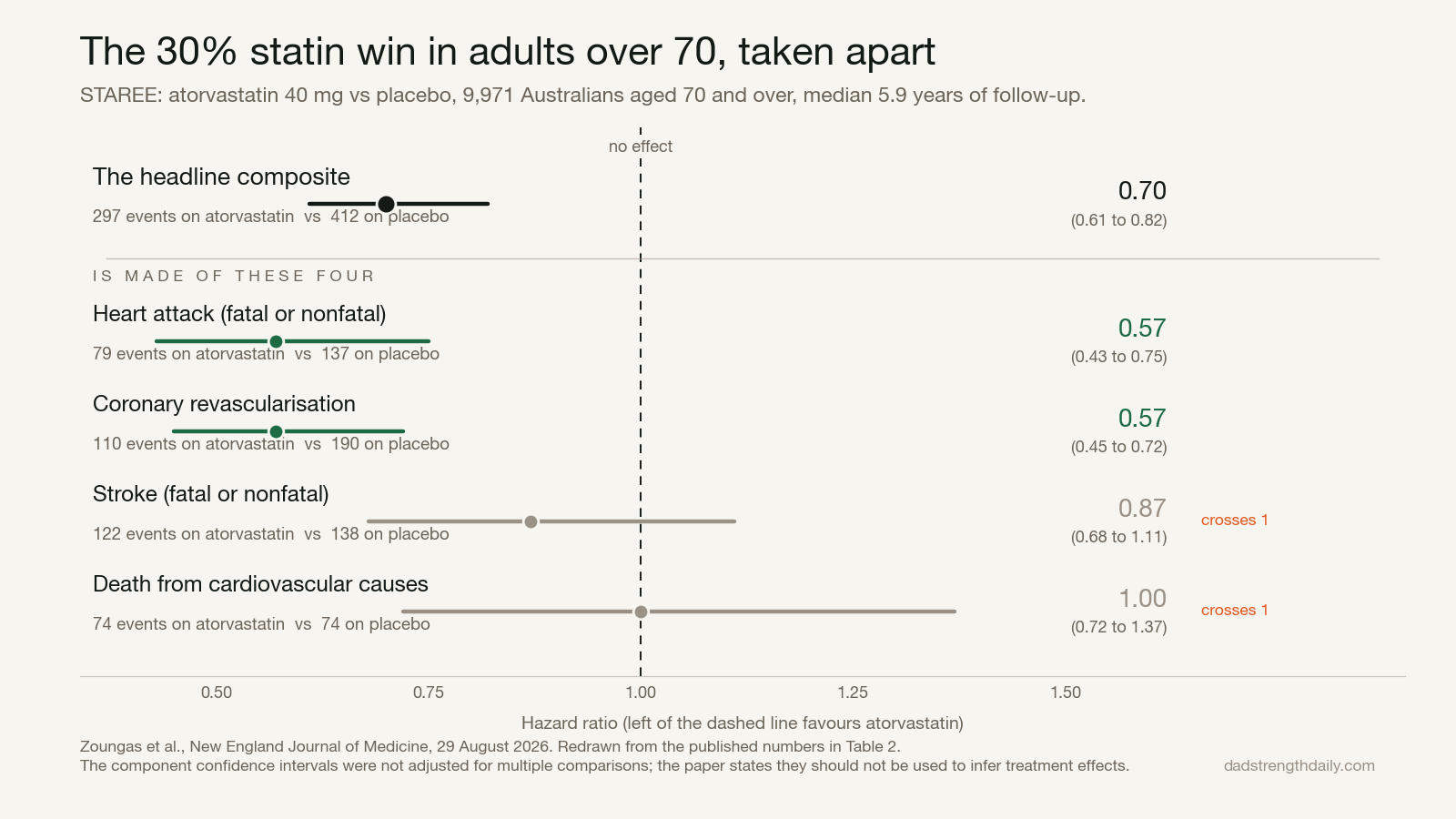
That 30 percent is real: 297 events on atorvastatin against 412 on placebo, an interval of 0.61 to 0.82, p below 0.001. I am not trying to talk anyone out of it.
But the endpoint is a composite of four things and they did not behave alike. Heart attacks fell hard, 79 versus 137, hazard ratio 0.57. Coronary revascularization, meaning a procedure to reopen a blocked heart artery, either a stent or a bypass, fell just as hard, 110 versus 190. Stroke did not reach significance, 122 versus 138. And there was no detected reduction in cardiovascular death: seventy-four in each arm, hazard ratio 1.00, on an interval from 0.72 to 1.37 that rules out neither a real reduction nor a real increase.
That reading is the authors’, not mine. They write that the treatment effects were driven primarily by nonfatal events, especially myocardial infarction and coronary revascularization, and that cardiovascular deaths were few overall. Their explanation is that Australia’s universal cardiac care meant these people mostly survived their heart attacks, so preventing one shows up as fewer events rather than fewer funerals. How much of that transfers to an American on a high-deductible plan, the trial cannot say.
The authors attach a caution to all of those component numbers. The confidence intervals on the component endpoints were not adjusted for multiple comparisons, and the paper says plainly that they should not be used to infer treatment effects. So I will not tell you STAREE proved statins do nothing for stroke. What stands is the count, 74 to 74, and the authors’ own reading that the win came from nonfatal events.
The endpoint that did not move
Disability-free survival did not improve. There were 637 events versus 676, hazard ratio 0.94, p equals 0.25. In the paper’s survival curves the two lines sit on top of each other for nine years.
Underneath it: all-cause death 395 versus 433, dementia 290 versus 280 at a hazard ratio of 1.03, persistent physical disability 60 versus 80, and no detected difference in hospitalization for any cause at 0.99.
The dementia number is the one readers ask me about. Unlike the older trials that logged dementia as a reported side effect, STAREE built it into a primary endpoint in advance and used a standardised cognitive test. Ten more cases appeared in the statin arm out of 570, and nervous-system adverse events were 23.5 percent in both. I see no evidence here that statins harmed cognition and none that they protected it. The interval runs 0.87 to 1.21, unadjusted, so a large effect either way looks unlikely and nothing is formally excluded. The statins-and-dementia argument is not closed by this result, in either direction.
STAREE moved cardiovascular events without moving disability-free survival, and the reason is in the paper. Eighty percent of the deaths were noncardiovascular. Only about a fifth of the dying was cardiac, and no reduction in cardiac deaths was detected.
The side effects, and the nocebo
Serious adverse events were similar between groups, 2.7 percent in both arms. That is the most flattering true sentence in the safety table. One category down, medically important adverse events ran 8.8 percent against 6.7. Hepatobiliary events of any kind, meaning the liver and the bile ducts that drain it, were 3.3 percent against 0.9, a near four-fold gap and the widest in the table. Diabetes-related events ran 4.0 against 2.7, and musculoskeletal ones, the muscle and joint complaints statins are famous for, 32.0 against 29.4. More people stopped the drug for side effects, 7.2 against 6.1.
By my arithmetic that is roughly one extra medically important adverse event for every 48 people treated, against an NNT of 37. Those two numbers belong side by side before anyone decides what the drug is worth.
Then the other half of it. Muscle symptoms were already present in 46.1 percent of these people at baseline, before anyone swallowed anything. And fewer participants permanently quit atorvastatin than quit placebo, with the most cited reason on either arm being simple unwillingness, 15.6 percent on the drug and 16.2 on the sugar pill. Both things are true at once. The drug causes real events, and people cannot tell those events apart from the aches they already had.
What I take from this
In people in their seventies without cardiovascular disease, diabetes or dementia, atorvastatin meaningfully reduced heart attacks and coronary revascularizations over about six years. The trial detected no change in whether you die over the following six years, how often you are hospitalized, or your dementia risk, though not detected is a weaker statement than does not happen. The benefit appeared similar past 75 and did not depend on your starting LDL.
Two limits. Participants were 98.3 percent White, and the authors say plainly that the findings do not generalize to older adults who are frail or carrying several conditions. That second one is the bigger problem, because frail and multimorbid describes a lot of the people actually being handed a statin at 78. The healthiest slice of the age group is the slice that got studied.
None of this makes me want to start one, and none of it would make me warn anyone off. What changed is how I talk about statins. I have stopped calling them life-extending in this age group, because this trial had 9,971 people and six years to show that and did not. Fewer heart attacks is what the evidence supports, and that is reason enough on its own. Where statins sit against everything else that lowers ApoB is in my guide to heart health and bloodwork after 50.