
I have a coronary calcium score of zero, and I’ve been shopping for the fancier scan that promises to see what a zero misses. Then I read what the evidence actually says about it.
I listen to a podcast called The Proof, where Simon Hill ran an episode with the headline every middle-aged man worried about his heart wants to hear. His coronary plaque, the gunk that narrows the arteries feeding the heart, had dropped about forty percent in sixteen months. He had the scans to prove it, an AI overlay coloring in exactly where the plaque used to be and where it had gone.
I wanted to believe it, because I’m in the market. My own coronary artery calcium score, the cheap ten-minute scan that counts hardened plaque in the heart’s arteries, came back zero. My doctor ordered it, insurance wouldn’t cover it, and I paid about a hundred and fifty dollars out of pocket. A zero is reassuring. The nagging question, the one Simon’s whole episode is built on, is whether it’s the whole story. So I looked into the scan that promises to answer that. The answer turned out to be more complicated, and a lot more expensive, than the episode lets on.
A zero is not a clean bill of health
A calcium score only counts plaque that has sat in your arteries long enough to harden into calcium, the way an old injury eventually turns to scar. The younger, softer plaque that cardiologists actually worry about most, because it’s the kind more likely to rupture and trigger a heart attack, doesn’t register on a calcium scan at all. So a zero tells you that you have no hardened plaque. It does not tell you your arteries are empty.
How often does a zero hide something? In people like me, with no chest pain and no symptoms, the best numbers come from a meta-analysis of fourteen studies and nearly thirty-eight thousand people. About one in ten with a zero score had some soft, non-calcified plaque when they got the more detailed scan. About one in a hundred had a narrowing bad enough to call obstructive. And in one of the cohorts they pooled, the real-world event rate at a zero score ran about two heart attacks or equivalents per thousand people a year. Being male is the strongest of the things that raise the odds of hidden soft plaque, roughly tripling them, and high blood pressure nudges them up further. I’m both. Even so, a zero is one of the most reassuring numbers in preventive cardiology, because the event rate behind it stays low.
A study published at the end of August comes at the same question from the other side. REACT, presented at the European Society of Cardiology meeting and published in the New England Journal of Medicine, enrolled just over sixteen thousand adults aged eighteen to seventy, none of whom had ever had a heart attack, a stroke, or diagnosed artery disease, and imaged the arteries of the heart, the neck, and the legs. Among the thirteen thousand who got a complete set of all three scans, plaque turned up somewhere in fifty-seven percent. That figure describes the group the researchers assembled, who were recruited to fill age brackets evenly, rather than the population at large. The number that matters for a zero is narrower. Among men in their thirties who had plaque in their heart arteries, nearly forty-two percent had a calcium score of zero. The researchers’ own conclusion is that calcium scoring alone does not rule out early coronary disease. The study was funded by the Novo Nordisk Foundation, and Philips and Zeiss supplied imaging equipment.
That number points the opposite way from the one I’d assume. It does not say that four in ten young men with a zero are hiding plaque. It says that among the young men who already had plaque, four in ten would have been handed a zero and sent home. That share fell in each older age bracket, though REACT compared different people at different ages rather than following anyone over time, so it can’t tell you what will happen inside one man’s arteries. Plaque without calcium still turned up in the sixty to seventy group. Its most striking figure, though, describes men about fifteen years younger than I am. Simon Hill was thirty-eight when he had his first scan.
I’ve unpacked what a calcium score is, and why the 2026 guideline leans on it, in Reading Your Cholesterol Panel at 50. This is the sequel: what a zero doesn’t rule out, and whether it’s worth real money to find the rest.
The scans that promise to show you the rest
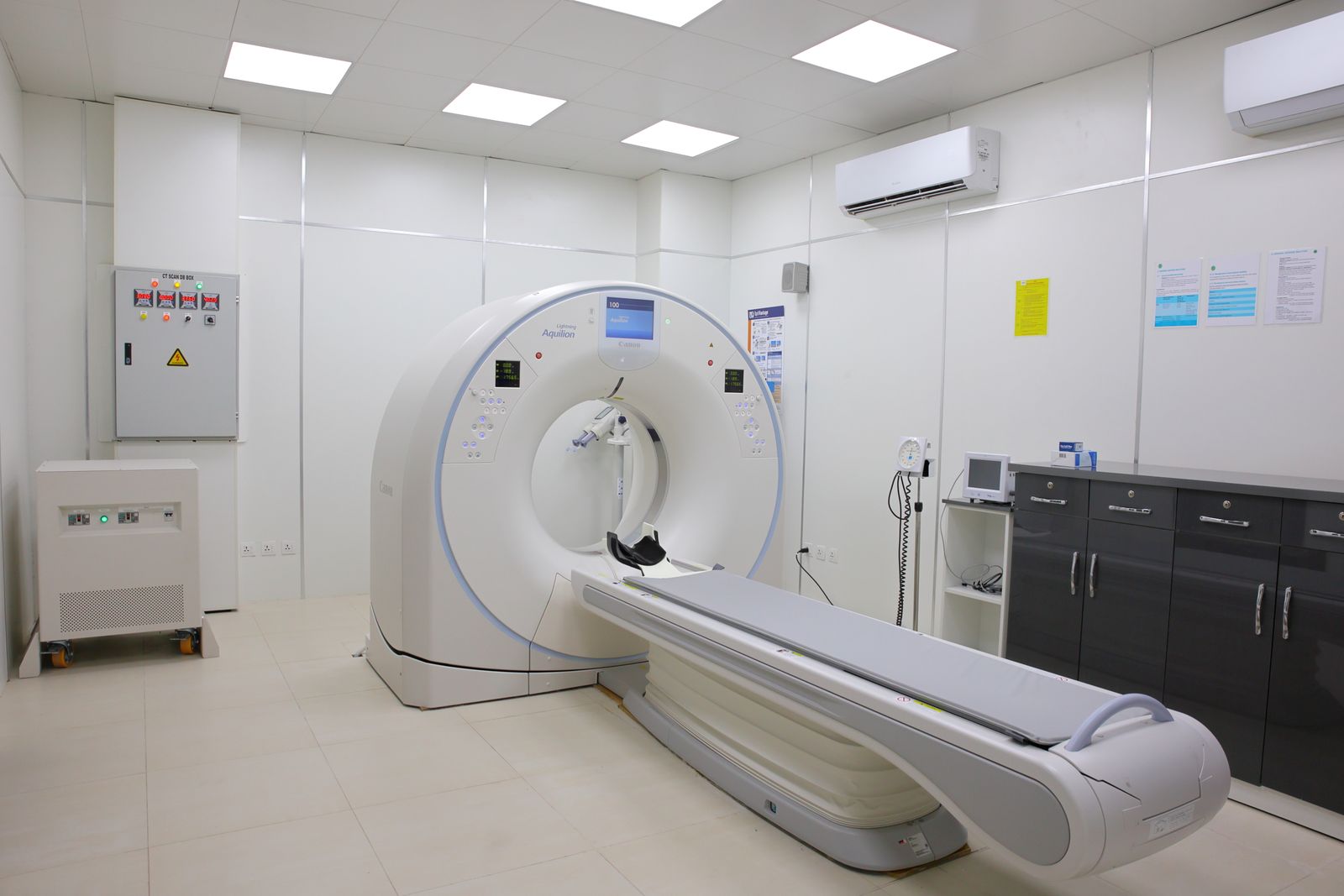
The tool Simon used goes a step past a calcium scan. It starts with a coronary CT angiogram, a CT scan with contrast dye that actually pictures the inside of the coronary arteries, then runs artificial intelligence over the images to measure how much plaque you have, what it’s made of, and where it sits. Two companies dominate this. Simon ran his scans through both, plus a third research tool, and the three did not agree.
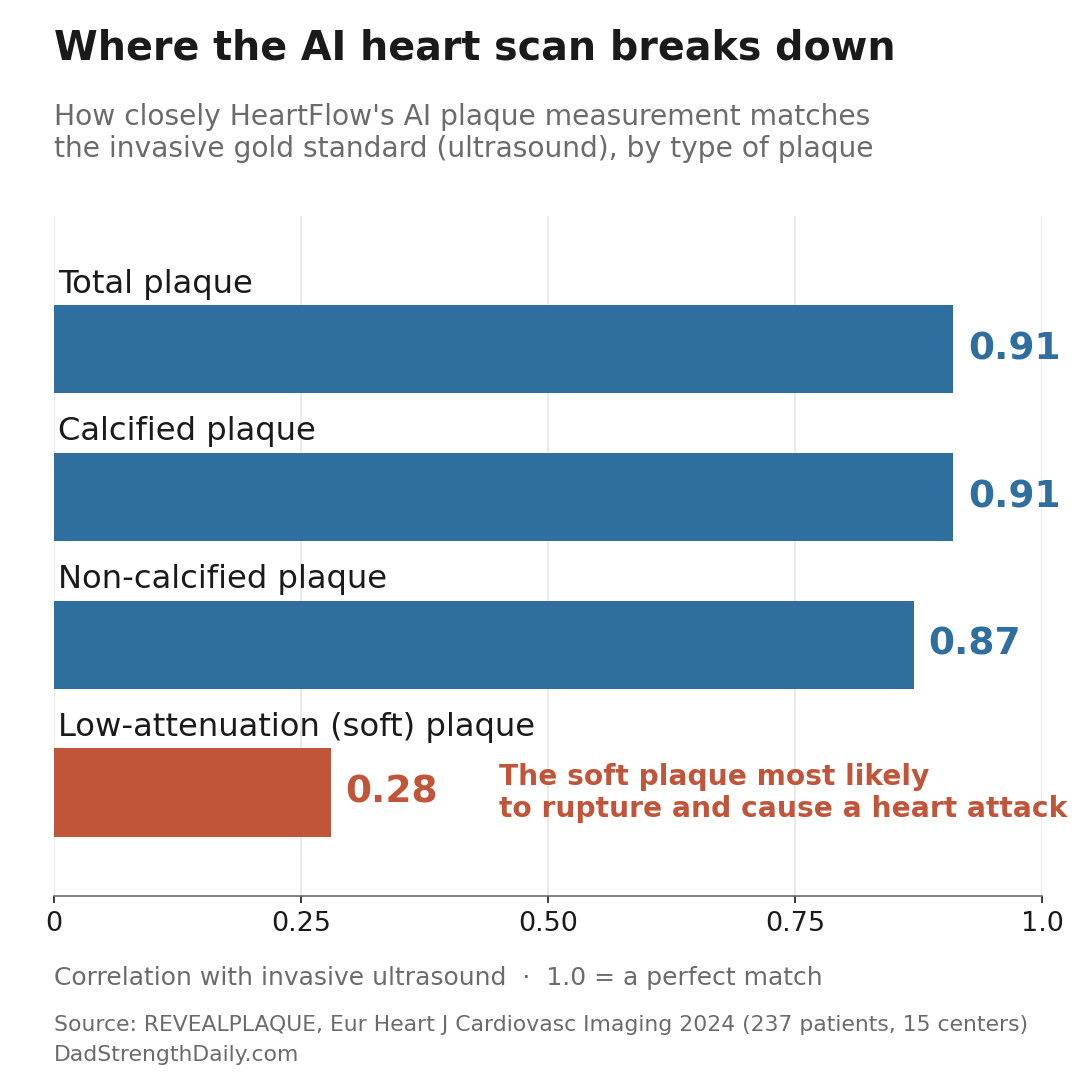
HeartFlow has the strongest evidence behind it, and not by coincidence its chief medical officer was the guest on the episode. Its validation study, REVEALPLAQUE, did the thing you want a company to do. It compared the AI’s plaque measurements against intravascular ultrasound, the invasive gold standard where a probe goes inside the artery, in a genuinely prospective study across fifteen centers. Agreement was strong for total plaque, a correlation around 0.91. That’s the number the marketing leads with. Here’s the one it leaves off. For low-attenuation plaque, the soft, dangerous kind everyone most wants to track, the correlation was 0.28. A correlation that weak means the tool and the invasive gold standard mostly disagree about how much of that plaque you actually have. Even the best-validated scanner looks far less reliable on the plaque that matters most. And nearly every author on that study is a HeartFlow employee holding company equity, which doesn’t make the numbers wrong, but is the sort of thing worth saying out loud.
Cleerly, the one I’d been leaning toward, has the nicer experience for someone like me. It stages your disease from zero to three and tells you what percentile you land in for your age, exactly the kind of number I’d find hard to look away from. It’s also the tool at the center of a mess. The most famous study claiming that sky-high cholesterol on a keto diet doesn’t build plaque, known as KETO-CTA, ran on Cleerly, and it was retracted in March of this year. The journal said the errors were too large to fix. One of the flagged problems was that the Cleerly analysis wasn’t fully blinded, and one of the authors had been Cleerly’s own chief medical officer and, it later came out, held equity in the company. That’s a failure of how a study was run, not proof the device can’t measure plaque. But if I’m handing over two thousand dollars partly on the strength of a company’s credibility, it belongs on the table.
Both tools are FDA-cleared. That phrase buys less than it sounds like. It means the software cleared the FDA’s bar for its intended use. It does not mean the FDA decided that using it makes you live longer.
The scan can find plaque. What I don’t trust is its ability to measure the kind of change people are tempted to celebrate.
Why “forty percent in sixteen months” is mostly noise
This is where I got off the train. Simon’s headline, forty percent regression in sixteen months, runs straight into a problem that has nothing to do with his arteries and everything to do with the tape measure.
Measuring soft plaque on a CT scan is noisy work. A review that pulled together the reproducibility data put hard numbers on it. Scan the same person twice on slightly different settings and the soft-plaque measurement can swing by nearly ninety cubic millimeters on technique alone, no change in the actual artery. Lock down the identical scanner and identical settings both times and you still need a change larger than about nine cubic millimeters before you can call it real rather than the machine’s margin of error.
It gets worse for the plaque you’d most want to watch. For the highest-risk soft plaque specifically, the reviewers wrote flatly that the volumes are so small, and the scan-to-scan wobble so wide, that serial measurements “will not be statistically meaningful.” A 2024 expert consensus put it even more bluntly: the plaque number you get depends on which patients you’re looking at, which physician reads the scan, and which software platform they read it on.
The American College of Cardiology folded all of this into a formal statement in December 2025. Its advice for tracking plaque over time is to wait at least two to five years between scans, on the same machine, and to watch what the plaque is made of rather than just the running total. Simon’s two scans were sixteen months apart. And to his real credit, he says the quiet part himself in the episode: he ran his scans through three different tools, and they disagreed not only on how much plaque he had, but on which direction it had moved. He even admits the natural pull to trust the tool that handed him the happiest answer. That’s not a knock on Simon, who is more honest than most people selling you a health story. If his own three scans can’t agree on which direction his plaque moved, the forty percent was never a solid number to begin with.
Who the scan is actually for, and what I’m doing
The guidelines are clear about who this scan is for, and it isn’t me. That statement says the AI plaque analysis should be used with patients who already have visible plaque on a coronary CT. It stops short of endorsing the scan as screening for people without symptoms, and says nothing at all about a calcium score of zero. Insurance draws the same line. Medicare set a price for the AI analysis this year, but every path to coverage requires symptoms. For an asymptomatic guy with a zero score, that means paying cash, somewhere between fifteen hundred and twenty-five hundred dollars.
To be fair, not every cardiologist thinks the guidelines have this right. Troy Badger, a preventive cardiologist who posts as cardiostrong_md and turns up in the r/ProactiveHealth threads I moderate, makes an honest case for the other side. He’d run the coronary CT even in people without symptoms if they’re genuinely higher risk: a strong family history of early heart attacks, endurance athletes, high-risk jobs like firefighting, and women, whose soft plaque he says a calcium score misses more often. He’s right that a zero isn’t the whole story, and REACT puts numbers on that: close to half the women in their thirties with coronary plaque had a calcium score of zero, and so did about four in ten of the men. Those two figures carry wide, overlapping error bars, so the study doesn’t settle his point about women specifically. Where I part ways is his bottom line, that there’s no clinical reason to prefer one scan over the other and the real holdup is cost and access. The measurement noise, the missing outcome trials, and the guideline’s own caution are clinical reasons, not just economic ones. And I don’t land in any of his higher-risk groups, which is its own kind of answer.
Greg Katz, a cardiologist on the other side of that debate, framed the objection better than I can. These tools predict risk, he grants, and there is still no evidence that acting on what they find prevents heart attacks or saves lives, as opposed to labeling healthy people high-risk and pushing some toward procedures they may never have needed. REACT hits the same wall. It counted how many people carry silent plaque, and the trial that would test whether finding it helps anyone is still only planned. Prediction is not the same as treatment. At a calcium score of zero, the lever with decades of hard outcome data behind it is not one more scan (what a zero does and doesn’t change about a statin decision is its own post). It’s the boring stuff: keeping apoB, the protein that ferries cholesterol into your artery walls, low, and keeping blood pressure down. I’m already on a pill for the second one.
Katz wrote that before this week. On the last morning of the European Society of Cardiology meeting in Munich, the trial that tests his objection head-on finally reported. CorCal randomized 5,772 people with no known heart disease, average age sixty-four, half of them women, and let a coin decide whether their statin conversation started from the old risk calculator or from a calcium score. After four point two years both arms sat at 2.7 percent for heart attacks, strokes, deaths and stents. Identical. The catch is that the confidence interval stretches from a twenty-nine percent reduction to a thirty-eight percent increase, and Muhlestein, who ran the trial, told the room himself that the events had come in too rare to settle anything.
What I keep going back to is a number that wasn’t the headline. The calculator told people to start a statin more than three times as often as the calcium score did. But of the people the calcium score flagged, sixty-two percent were still taking the pill. Of the people the calculator flagged, twenty-three percent were. Fewer people told to take a statin, and far more of them actually taking it.
There is a second randomized answer, and it is older. DANCAVAS invited thirty-one thousand Danish men aged sixty to sixty-four to a screening package built around a calcium score, then put whoever screened positive on a statin and aspirin. After seven years, 9.3 percent of the invited men had died against 9.9 percent of the men nobody called. Major cardiac events landed in the same place. Severe bleeding was higher in the screened group, six percent against five, and that is the aspirin talking rather than the scan. Only sixty-three percent of the invited men turned up, which drags any real effect toward nothing, and the trial was built to count events over ten years, not seven.
None of which shows the scan changes what happens to anyone. What it might change is whether you do the boring thing afterwards. That is a better argument for it than any I have been sold.
For someone with symptoms, existing plaque, or a genuinely high-risk profile, this is a different conversation. For me, asymptomatic with a zero score, already treating my blood pressure, and trying to make one preventive decision, the scan feels more likely to hand me a number to worry about than a decision I’d actually act on differently.
So I’m not booking the scan this month. The technology is real and it’s improving fast, but I’d be paying two thousand dollars to watch a number that, in my situation, the evidence can’t yet separate from noise. I’ll look again when someone has run the trial that shows it changes anything.
Get the next one in your inbox
I write about longevity, training, and preventive health weekly — without the guru worship. Free, no spam, unsubscribe whenever.
About Gunnar
Gunnar is 53. He lost about 170 pounds, trains in a garage gym, and writes DadStrengthDaily from personal experience, citing primary sources where he can. He also moderates r/ProactiveHealth. He is not a doctor, and nothing here is medical advice. Talk to your own doctor before acting on anything, especially GLP-1s, TRT, blood pressure, and prostate or cancer screening.