
When a zero lets you hold off on a statin, and when it doesn’t. My calcium score is zero and my ApoB was flagged high.
Key Points
- For men at borderline or intermediate ten-year risk, the 2026 guideline says a calcium score of zero is a reasonable reason to defer a statin and rescan in three to seven years.
- A zero generally should not be used to defer a statin in four situations: an LDL of 190 or higher or its inherited form (FH), diabetes if you are over 40, current smoking, or a strong family history of early cardiovascular disease.
- A zero counts calcified plaque only. It signals low near-term risk. It does nothing to your cholesterol, and cholesterol exposure adds up over decades.
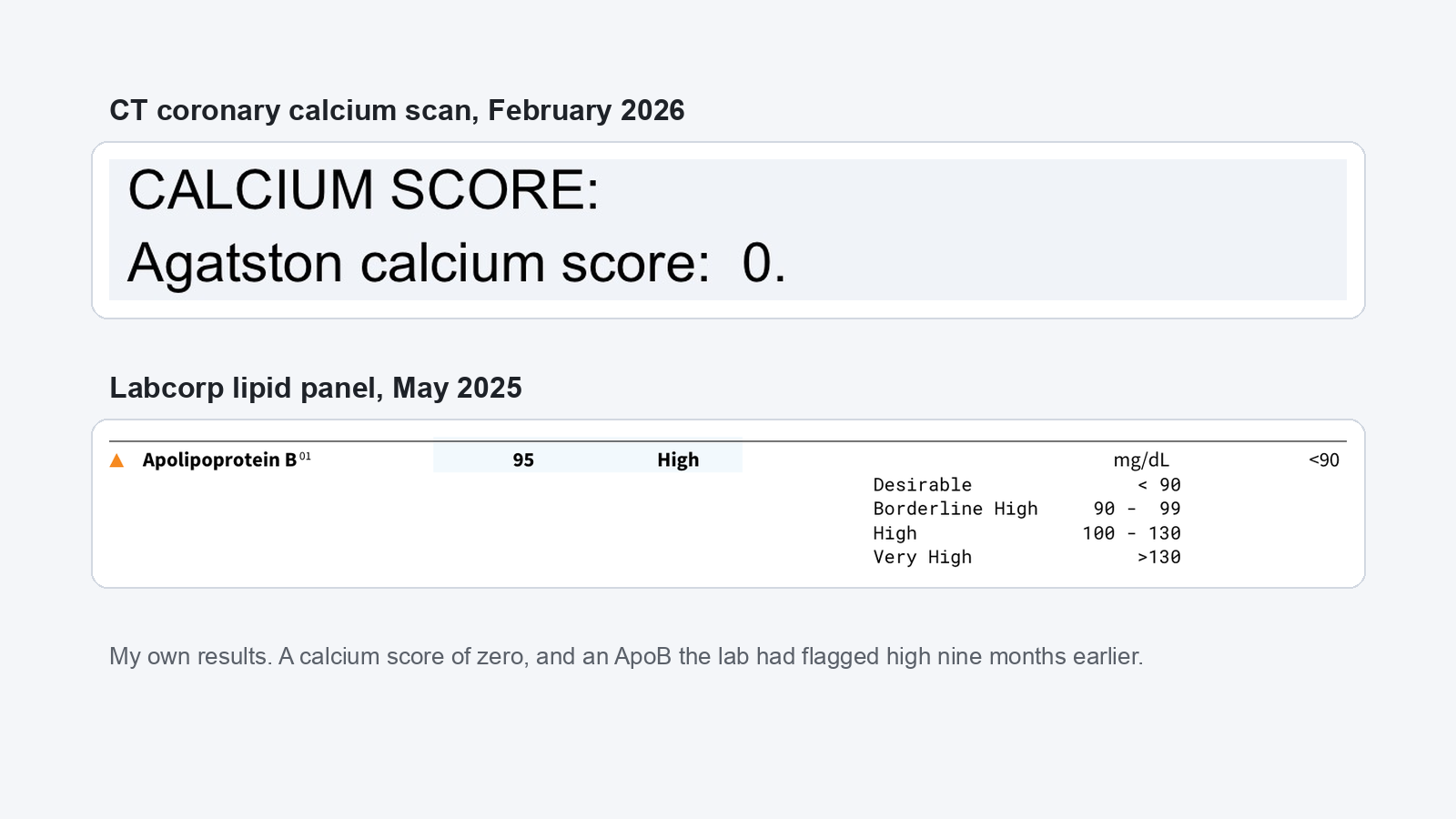
Labcorp flagged my ApoB at 95 in May 2025, above its cutoff of 90. This February my coronary calcium scan, ordered by my doctor, about $150 out of pocket, came back zero. I paid for it because the Task Force still grades calcium scoring insufficient evidence, which is what keeps it off the no-cost-sharing list. Weight loss and ezetimibe had already pulled the ApoB under 90, but the question remained: with a zero calcium score but high cholesterol on the record, does a statin belong in the plan? I deferred the statin. I didn’t leave the cholesterol untreated.
Under the 2026 guideline, a zero can be a legitimate reason to defer a statin if your ten-year risk is borderline or intermediate and you have none of four high-risk conditions. A zero doesn’t mean no plaque, and it doesn’t erase decades of high LDL or ApoB.
Does soft plaque show up on a calcium score?
No. A calcium scan counts calcified plaque. Noncalcified plaque, the softer kind, doesn’t register. A zero means no calcified plaque, not no plaque.
A 2024 review in the Journal of Cardiovascular Computed Tomography (Sama et al.) pooled fourteen studies of nearly 38,000 symptom-free people with a zero score who had also had a CT angiogram, which can show soft plaque. About one in ten had some. About one in a hundred had a narrowing bad enough to call obstructive. Being male roughly tripled the odds of soft plaque.
Can a zero coexist with high LDL and soft plaque? Yes. In western Denmark, Mortensen and colleagues followed 23,143 patients referred for a CT angiogram because of symptoms suggesting heart disease (JAMA Network Open, 2022). Nearly half of those with an LDL of 190 or higher had a calcium score of zero, and among everyone with a zero, 13 percent had soft plaque, including 6 percent with a real narrowing. Over a median of 4.2 years, heart attack, stroke or death from any cause ran 6.3 per thousand per year with a zero, 6.9 with a zero plus an LDL of 190 or higher, and 21.9 at a score of 100 or more. These were symptomatic patients, and the authors still warn against using the result to withhold long-term statin therapy, especially in younger people.
Should you take a statin if your calcium score is zero?
If your ten-year risk is intermediate, or sometimes borderline, your scan comes back zero, you would rather avoid medication and work on lifestyle, and none of the conditions below apply, the guideline says it is “reasonable to defer therapy and reassess with repeat CAC testing in 3 to 7 y.” That is a class 2a recommendation, the second-strongest grade.
Two boundaries. The scan is meant for men 40 and older, women 45 and up. And it only enters the decision when your ten-year risk on the PREVENT calculator is at least 3 percent and the statin call is uncertain. If your LDL is 170 and the calculator says 2 percent, a different recommendation applies. There a moderate statin is “reasonable” on LDL alone, “to reduce cumulative exposure to atherogenic lipoproteins,” and no calcium scan is called for.
In a MESA analysis of 6,098 adults with calcium scores added to their PREVENT estimate (Huang et al., JAMA, 2026), the borderline-risk group’s rate of cardiovascular events was 1.9 percent with a zero and 14.3 percent with a score of 300 or higher.
The four exceptions
The guideline names four conditions where a zero does not justify deferring a statin:
- An LDL of 190 or higher, or familial hypercholesterolemia, the inherited form. For FH it says flatly that a zero “may not be used to ‘de-risk'” you.
- Diabetes if you are over 40. A zero predicts a low five-year event rate in diabetics, but the risk “increased substantially thereafter.”
- Current smoking. In one observational study, smokers with a zero died at the rate of nonsmokers with mild to moderate calcium.
- A strong family history of early cardiovascular disease. One parent or sibling with it still leaves you at a low ten-year rate, but “the absence of CAC may not be that reassuring” with several.
If an ultrasound has found plaque in your carotid arteries, the guideline encourages treatment even with a coronary score of zero.
Get the free Bloodwork Decoder
I made the one-page cheat sheet I wish I’d had at my first physical: what every number on your labs actually means, what’s worth aiming for at 50, and what to ask your doctor. Subscribe free and I’ll send it straight to your inbox. No spam, nothing to sell.
How long does a calcium score of zero last?
Omar Dzaye and colleagues analyzed ten years of follow-up scans for 3,116 MESA participants whose baseline score was zero (JACC: Cardiovascular Imaging, 2021). At ten years, 53 percent had some calcium. Their modeled time for one in four to develop detectable calcium, which they call the warranty period, ran three to seven years depending on sex and ethnicity, shorter in diabetics. And 19 percent of the decade’s coronary events happened in people whose baseline score was zero, before a repeat scan at three to five years.
Once you start a statin or another lipid drug, though, don’t rescan. The guideline says repeat testing is not indicated at that point, because statins often raise the calcium score even as they may stabilize plaque.
What I did with mine
I still don’t take a statin. I also didn’t leave my cholesterol where it was. I lost a lot of weight on Zepbound and added generic ezetimibe (Zetia), at about twenty dollars a month. My ApoB went from 95 to 59 by this July, and my LDL to 56. In April, at an LDL of 75, I posted on r/ProactiveHealth asking whether I should try for 55. By July it was 56.
Deferring the statin was easier to justify, since the guideline says a zero can support that in someone with my risk profile. Leaving the number alone bothered me. The same guideline says the absence of a risk enhancer “does not warrant delay or avoidance” of treatment, cholesterol exposure is cumulative, and a zero in my early fifties is no guarantee about 70. I took the zero as a reason to hold off on a statin. It said nothing about whether an ApoB of 95 was fine to live with, and I decided it wasn’t.