
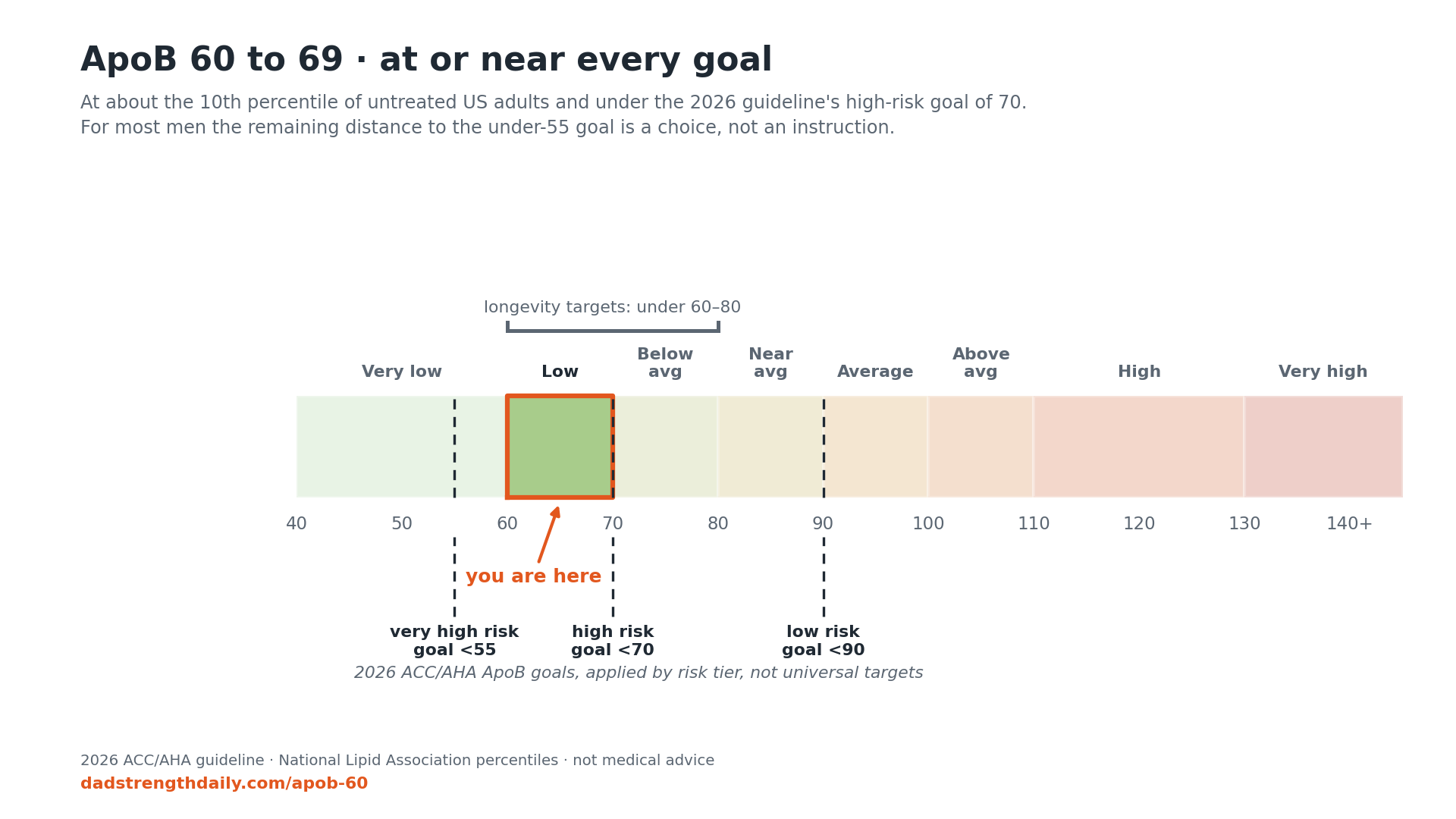
An ApoB of 60 mg/dL sits at about the 10th percentile of untreated American adults, lower than roughly nine of every ten, under even the goal the 2026 guideline reserves for its high-risk patients, and inside the range the longevity crowd treats as the destination. By every framework I can find, a 60 is a good number. The interesting question anywhere in the 60s is not whether you are OK. It is whether you are done.
I have skin in this one: my last ApoB was 59, one point under the band, down from a first-ever result of 95 that Labcorp flagged high. So this page is partly me arguing with myself about whether to keep pushing (my calcium score is zero, which is its own argument). It is the 60s entry in the full ApoB levels chart, which maps every band from 40 to 140 and up.
Who lands in the 60s
Three kinds of people get this number. People on a statin or other lipid therapy checking their response, for whom the 60s usually means the drug is doing its job. People who moved it themselves; in my case the weight, a GLP-1 and generic ezetimibe took me from 95 to 59, and that year has its own post. And people with fortunate genetics who were never going to have this conversation at all.
Get the next one in your inbox
I write about longevity, training, and preventive health weekly — without the guru worship. Free, no spam, unsubscribe whenever.
What the 2026 guideline says about a 60
The March 2026 ACC/AHA guideline attaches ApoB goals of under 90, under 70 and under 55 to its risk tiers, and a 60s result clears the first two; that is as true of a 61 or a 63 as of a 67, because the band reads as one number. The exception is the under-55 goal, and the guideline is specific about who can face it. People at very high risk: more than one cardiovascular event already (a heart attack, an ischemic stroke, symptomatic leg-artery disease), or one event plus a stack of compounders like diabetes, kidney disease or familial hypercholesterolemia. People with established disease whose LDL started at 190 or higher. And people with a heavy coronary calcium score: over 1,000 the under-55 goal is the recommendation, and from 300 up a doctor can reasonably reach for it. If any of that describes you, the last few points are a real clinical conversation, and the newer drugs exist for the case where an ApoB will not come down any other way; I covered the practical version of that decision in the Lipfendra vs Repatha comparison.
For everyone else, the guideline has no instruction for you at 60 beyond the one it has for anyone on treatment: recheck 4 to 12 weeks after any change, then every 6 to 12 months once stable. A 60s ApoB is what “at goal” looks like on paper.
The argument for going lower anyway
The longevity school reads the same number differently. Their argument is that ApoB-carrying particles cause atherosclerosis and the damage compounds for as long as they stay elevated, so the commonly quoted ceilings land between 60 and 80, with the aggressive end of that crowd wanting you under 60. On that reading, a 65 is good and lower is still better, indefinitely.
The argument is real, but it buys less the lower you start. Dropping from 95 to 65 removes a lot of exposure; dropping from 65 to 55 removes far less, and no trial exists that tells a healthy man with a 62 he must become a 52. The guideline reserves its under-55 goal for people whose risk justifies drug-level effort. Below the 60s you are past every line the evidence draws, and what is left is a question about you: how much residual risk you are willing to live with, and what you would take or spend to shrink it further. I hold at 59 with tools I would be using anyway. I would not add a drug I do not otherwise need to chase a 40-something number, and nothing published says I should.
Keeping it
ApoB responds to the same levers that put it up: diet composition, weight, insulin sensitivity, and whatever therapy you are on. A 60s number is not a trophy that stays on the shelf by itself; regain the weight or stop the drug and it walks back up. My own rhythm while things were changing was a test roughly every quarter, which is cheap to do without a doctor’s visit; when I priced the self-order labs, a retest came to between $19 and $69 at checkout.
Short version: you are below most of America and below every goal that could apply to you, unless the under-55 group above is your situation, and the remaining distance is optional. Decide it on purpose, with your clinician, rather than by drift.
The guideline referenced throughout is the 2026 ACC/AHA multisociety dyslipidemia guideline (Circulation, March 13, 2026); the percentile figures are the National Lipid Association’s.
I am an engineer who reads trial data, not a physician. Nothing here is medical advice; decisions about testing and treatment belong with your clinician.