
Updated with a Lipfendra vs Repatha comparison table up top, an Lp(a) row, a monthly-cost chart and an insurance section, and cut by a third.
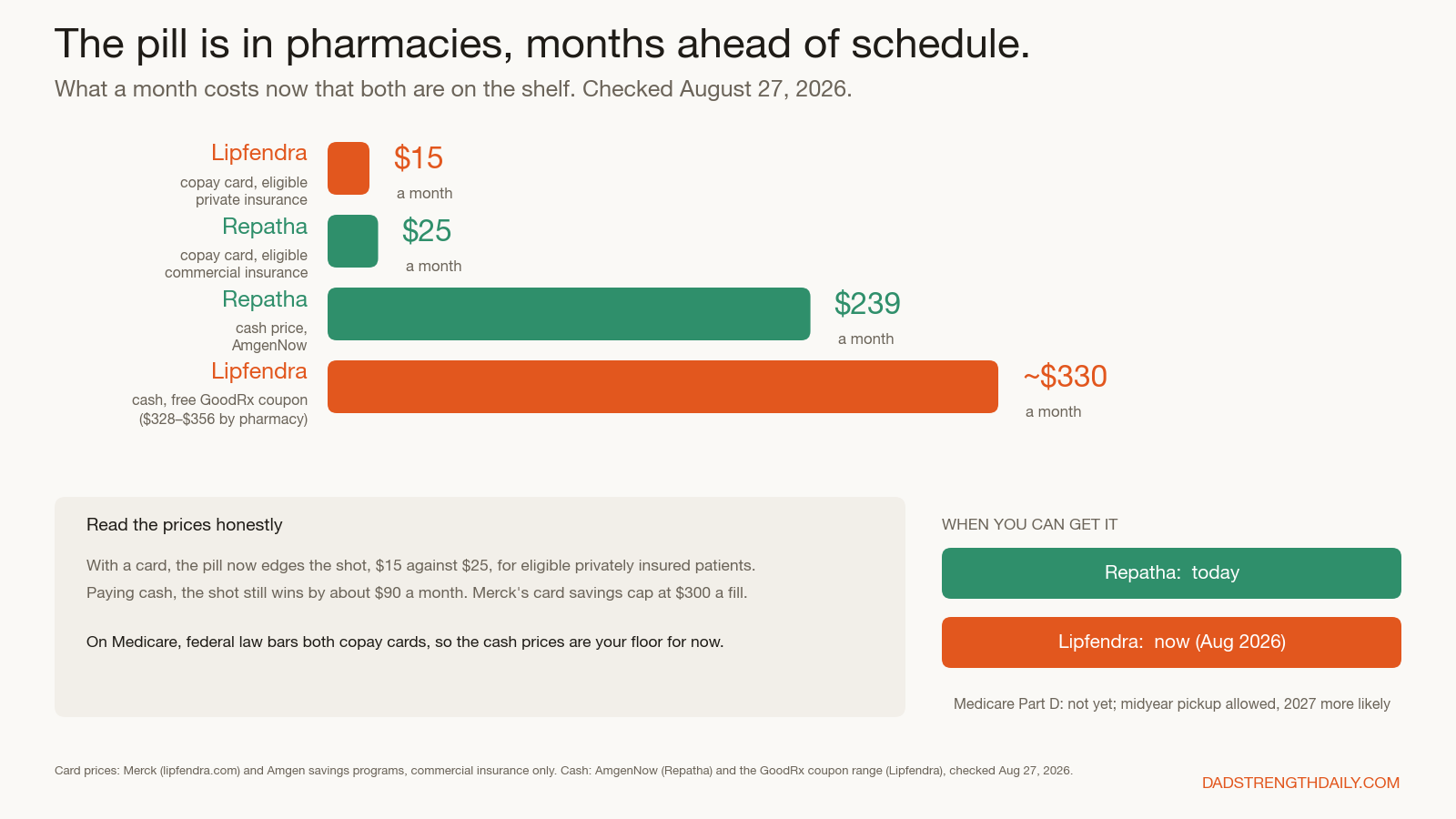
The new pill saves you the injection. It costs you a fasting window every morning, and a cash price $89 to $117 a month above the shot’s.
Since the FDA approved Lipfendra (enlicitide) on July 16, 2026, the question I keep seeing is why anyone would keep injecting Repatha. I am not the guy either drug is for (LDL 56, ApoB 59 on tirzepatide, weight loss and generic ezetimibe, calcium score zero), but I have read both sets of trials and both price sheets.
Unless you genuinely hate needles, stick with Repatha for now. It has the finished heart-outcomes trials, and paying cash it is $89 to $117 a month cheaper. Lipfendra spares you the injection but asks for a fasting window every morning. The one group with a real price case for the pill is eligible privately insured patients, whose Merck copay card runs as little as $15 a fill against Repatha’s $25.
Which lowers LDL more, Lipfendra or Repatha?
Not by any margin the trials can show. Lipfendra cut LDL by about 56% at 24 weeks in CORALreef Lipids, and by 48 percentage points against placebo at one year. Repatha cut it by about 59% in FOURIER. Both are add-ons to a statin, or the next step when you genuinely cannot take one, rather than a first drug. The figures come from different trials in different populations and there is no large head-to-head trial, so read them as the same neighbourhood rather than a ranking. Everything that separates the two drugs is in the other rows.
| Lipfendra (enlicitide) | Repatha (evolocumab) | |
|---|---|---|
| Route | Oral, once daily, empty stomach | Injection, every 2 weeks or monthly |
| LDL reduction | ~56% at 24 weeks, 48 percentage points vs placebo at one year (CORALreef Lipids) | ~59% (FOURIER) |
| Lp(a) reduction | 28 percentage points more than placebo at 24 weeks, median (CORALreef Lipids) | 27% from baseline at 48 weeks, median, no placebo adjustment (FOURIER, abstract only) |
| List price | $315/month (~$3,780/yr) | ~$633/month (~$7,594/yr: $292.08 per prefilled syringe on Amgen’s January 2026 list, 26 a year) |
| Commercial copay card | As little as $15/fill if eligible (savings cap $300) | As little as $25/month if eligible |
| Cash price | $328–$356/month with a GoodRx coupon | $239/month via AmgenNow |
| Outcomes data | Not yet; primary completion Nov 2029 | Yes, FOURIER and VESALIUS-CV |
| Medicare | No Part D listing seen yet; copay card barred | Copay card barred; coverage depends on your Part D plan |
| FDA approved | July 16, 2026 | 2015 |
| Available now? | Yes, since summer 2026 | Yes |
Get the next one in your inbox
I write about longevity, training, and preventive health weekly — without the guru worship. Free, no spam, unsubscribe whenever.
Lipfendra vs Repatha cost: list price, cash price, and the copay cards
The launch coverage led with Lipfendra’s list price of $315 a month, about $3,780 a year, and called it the aggressive number because it sits below the list prices of the injections. That only works if you assume people pay list for the injection. Many do not. An eligible commercially insured patient can pay as little as $25 a month for Repatha with Amgen’s copay card, and someone paying cash with no insurance is quoted $239 a month through AmgenNow, which Amgen describes as roughly 60% below its own list.
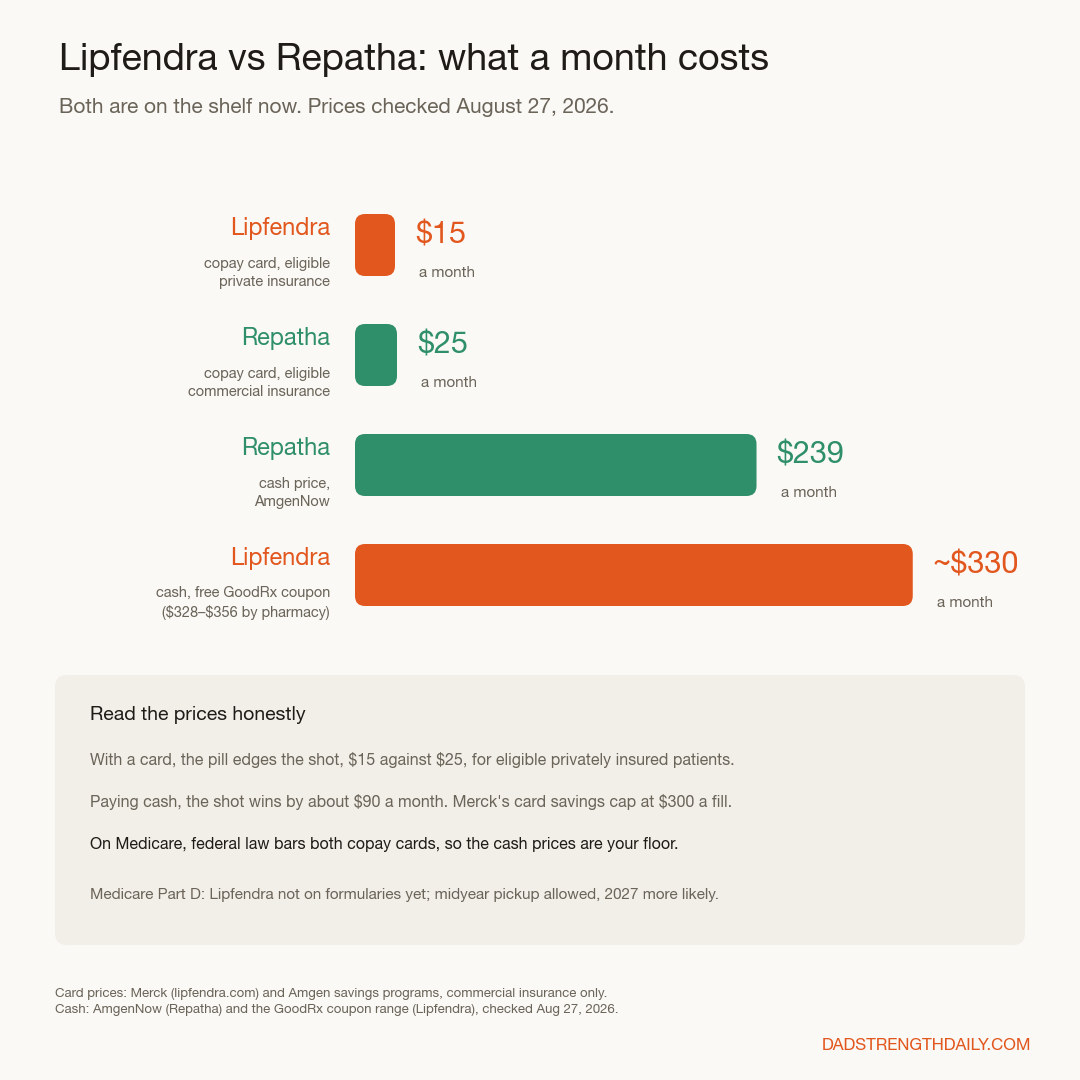
Lipfendra’s own prices arrived after launch. GoodRx coupons put the cash price at $328 to $356 depending on the pharmacy, and Merck’s copay card takes eligible privately insured patients to as little as $15 a fill, with savings capped at $300 per fill. With a card, the advertised floors are $15 for the pill against $25 for the shot. Paying cash, the shot is $89 to $117 a month cheaper, and the new pill is the most expensive cash price on the board.
Does insurance cover Lipfendra or Repatha?
On commercial insurance, both copay cards are live and neither is automatic. Lipfendra’s place on commercial formularies is still settling in its first months, so before assuming either card price, ask the pharmacy what your plan actually charges. In a study of more than 45,000 Americans prescribed evolocumab or alirocumab during the injections’ first year on the market, only 47.2% got insurance approval, and 34.7% of the approved prescriptions were never filled. That was 2015 and 2016, when list prices were far higher, and access has improved since, but a pill does not skip the approval step.
On Medicare the picture is worse for the pill. Manufacturer copay cards cannot be used on Medicare, Medicaid or other government coverage, because the federal anti-kickback statute treats them as a kickback risk on federally paid drugs, so the $15 and $25 figures are commercial insurance only. I could not find Lipfendra on a Part D formulary at launch, and I have not seen a plan add it since. Plans are allowed to add a new drug midyear and their committees get about six months to decide, so pickup could start before the 2027 plan year, but I would not count on it. I went through when Medicare is likely to start covering Lipfendra separately.
Lipfendra is a pill, Repatha is a shot: what the fasting window means
Lipfendra’s label has you take the tablet in the morning on an empty stomach, then wait 30 minutes before eating or drinking anything other than water, black coffee, or plain tea. Every day. That is more forgiving than it first sounds. Black coffee is allowed, which matters to most men I know, and the label says it can be taken alongside other medicines, with an interaction study showing no meaningful effect alongside oral semaglutide. But it is still a fasting window bolted onto the start of every day, indefinitely, against an injection every two weeks or once a month. If you already take a thyroid tablet, which wants the same empty stomach, it may be no easier at all. Daily dosing also gives you 365 chances a year to forget, against 12 to 26.
That cuts both ways. A lot of people handed a prescription for an injectable never end up taking one, and a trial is unlikely to show you that problem. Adherence in CORALreef Lipids ran 97%, with the reminders and monitoring that come with being in a study. So if you will not inject, and I mean genuinely will not, to the point where the alternative is taking nothing, the pill is a real option and it is on the shelf now. Ask your doctor about it this month.
Lipfendra vs Repatha side effects
Neither drug has an alarming safety profile, so tolerability is unlikely to decide this one. In Lipfendra’s heterozygous familial hypercholesterolemia trial there was somewhat more diarrhea, 7 percent against 2 percent, and more dizziness, 9 percent against 4 percent; in the larger CORALreef Lipids trial diarrhea was no more common than on placebo, 2.5 percent against 2.8. In FOURIER, across 27,564 people, there was no significant difference in adverse events against placebo, including new-onset diabetes and neurocognitive effects, with the one exception of injection-site reactions at 2.1 percent against 1.6 percent. The difference that matters is length of record. Lipfendra’s main safety data runs to one year in a trial of 2,909 people. Repatha has years of follow-up in tens of thousands.
Is Lipfendra better than Repatha?
It is better if what you mean is that you would rather swallow something than inject it. That is a real advantage and I am not going to talk anyone out of it. On everything else, not yet. Repatha has finished the outcomes trials. In FOURIER, 27,564 people with established cardiovascular disease saw the primary composite endpoint drop from 11.3% to 9.8%, a hazard ratio of 0.85, and a prespecified analysis found first heart attacks fell from 6.3% to 4.4% over three years, a hazard ratio of 0.73. VESALIUS-CV then tested it in people with atherosclerosis or high-risk diabetes but no previous heart attack or stroke; a prespecified analysis of 7,557 of them put the number needed to treat over five years at 28 in people with high Lp(a) and 40 in everyone else, to prevent one major coronary event. Lipfendra’s outcomes trial, CORALreef Outcomes, has finished enrolling about 14,550 people; primary completion is scheduled for November 2029, and full completion for late 2031.
I do not think that gap should decide this for you. LDL is a validated causal risk factor, Lipfendra hits the same target by the same mechanism, and it cuts ApoB by roughly half. The reasonable expectation is that it reduces events. Biologically plausible, not yet demonstrated. If you are at high risk and starting a drug this month, I would still take the one with the finished trials, but that is a tiebreaker, not the reason to choose. And if Repatha is working, you tolerate it, and it is covered, stay where you are. If you are skipping doses because of the needle, or have quietly stopped, that is a different conversation, and the pill is on the shelf and priced.
If you are at or near your LDL and ApoB goal on generics, none of this is your next move anyway. Generic ezetimibe costs me about a dollar a day, and the guideline puts a statin or ezetimibe first for nearly everyone. If you do not know your ApoB, getting that number is a better use of your next appointment than either of these drugs; I wrote a plain-English guide to reading the panel, and the 2026 guideline’s ApoB targets are charted band by band. If you do need PCSK9-level lowering, from genuine statin intolerance, familial hypercholesterolemia, or an ApoB that will not come down any other way, the conversation with your doctor can now include both drugs, with real prices on the table.