
Semaglutide for alcohol use disorder finally got a pill trial. The VA’s new 622-person Phase 3 counts success as a two-level drop in drinking risk, and two Phase 2 readouts in late July split on whether the drugs clear that bar.
I wrote in June about a friend who has been sober for years and still gets the cravings. He does everything the program asks, he has the chips that mark the time, and the wanting never fully switches off. A month before I wrote that post he started the Wegovy pill, hoping the thing that quiets food noise might quiet the other kind. I left the piece with an open question, because every randomized trial of semaglutide for alcohol use disorder had used the shot and he was taking a pill.
Since then the pill has done what he hoped it would. The cravings have largely gone. That is one man with no control group and it settles nothing, and it is also why I went looking when two new trials landed.
The last week of July answered more than I expected. Two trials of two different drugs, semaglutide pills and pemvidutide, a new injection that hits the glucagon receptor as well as GLP-1, reported a day apart. Neither is approved for drinking. Semaglutide is approved for weight and diabetes, and pemvidutide is still investigational. The two trials sent very different signals, and in the same stretch of days the VA opened a 622-person Phase 3 built on the endpoint they landed on opposite sides of.
What the pill trial found
Fifty people with moderate to severe alcohol use disorder, all of them seeking treatment, randomized to oral semaglutide or placebo for eight weeks by Schacht’s group at the University of Colorado, published as Oral Semaglutide for Alcohol Use Disorder in the American Journal of Psychiatry. They were drinking hard at baseline, averaging 7.6 drinks on every drinking day. Mean age 51, so, people my age.
The answer to my open question arrived with a catch. The trial used 3 mg a day, then 7 mg, which are the diabetes doses sold as Rybelsus. The Wegovy pill my friend takes is 25 mg. Novo’s own label supports switching straight between that 25 mg pill and the 2.4 mg weekly shot: stop one and you start the other the next day at full strength, with no working back up. It does not claim the two put identical drug levels in your blood, and those vary from person to person. But 3 to 7 mg sits well under the 25 mg he is on, so the trial that finally tested a pill tested a much smaller dose of it.
The table below is full of p values, which are roughly the chance of seeing a result at least this extreme if the drug truly did nothing. Under 0.05 is the line this paper treats as worth reporting, so 0.008 clears it and 0.15 does not.
One thing to know before you read it. They ran about ten of these tests and did not raise the bar to account for that. With ten independent tests at 0.05, the chance of at least one false positive approaches 40 percent. These outcomes are correlated rather than independent, so treat that as a ceiling rather than an estimate. A conservative Bonferroni correction would move the cutoff to about 0.005, and none of the secondary results below clears it. That is a harsh standard for a fifty-person study whose job is to generate leads rather than settle them, which is exactly what the authors call it. So read the green as promising, not as proven.
| Outcome | What happened |
|---|---|
| Lab craving, one question (the primary endpoint) | No difference. p=0.68 |
| Heavy drinking days | Fell. p=0.008 |
| Drinks per day | No difference. p=0.057 |
| Drinks per drinking day | Fell. p=0.041 |
| Craving, multi-item questionnaire | Fell. p=0.027 |
| Craving, weekly, in normal life | Fell. p=0.030 |
| Alcohol-related consequences | Fell faster than placebo. p=0.025 |
| Dropped one or more WHO risk bands | 81% vs 54%. p=0.045 |
| Dropped two or more WHO risk bands | 48% vs 31%. No detectable difference. p=0.15 |
| Abstinence | No detectable difference |
The primary endpoint was a single question, rated on a 20-point scale, after holding and smelling your preferred drink in a lab. It missed badly. A longer craving questionnaire the same people filled out in the same session did move, and so did a weekly craving scale they filled out at home. The authors take the honest read, which is that one question may be a poor instrument for the thing they were trying to measure.
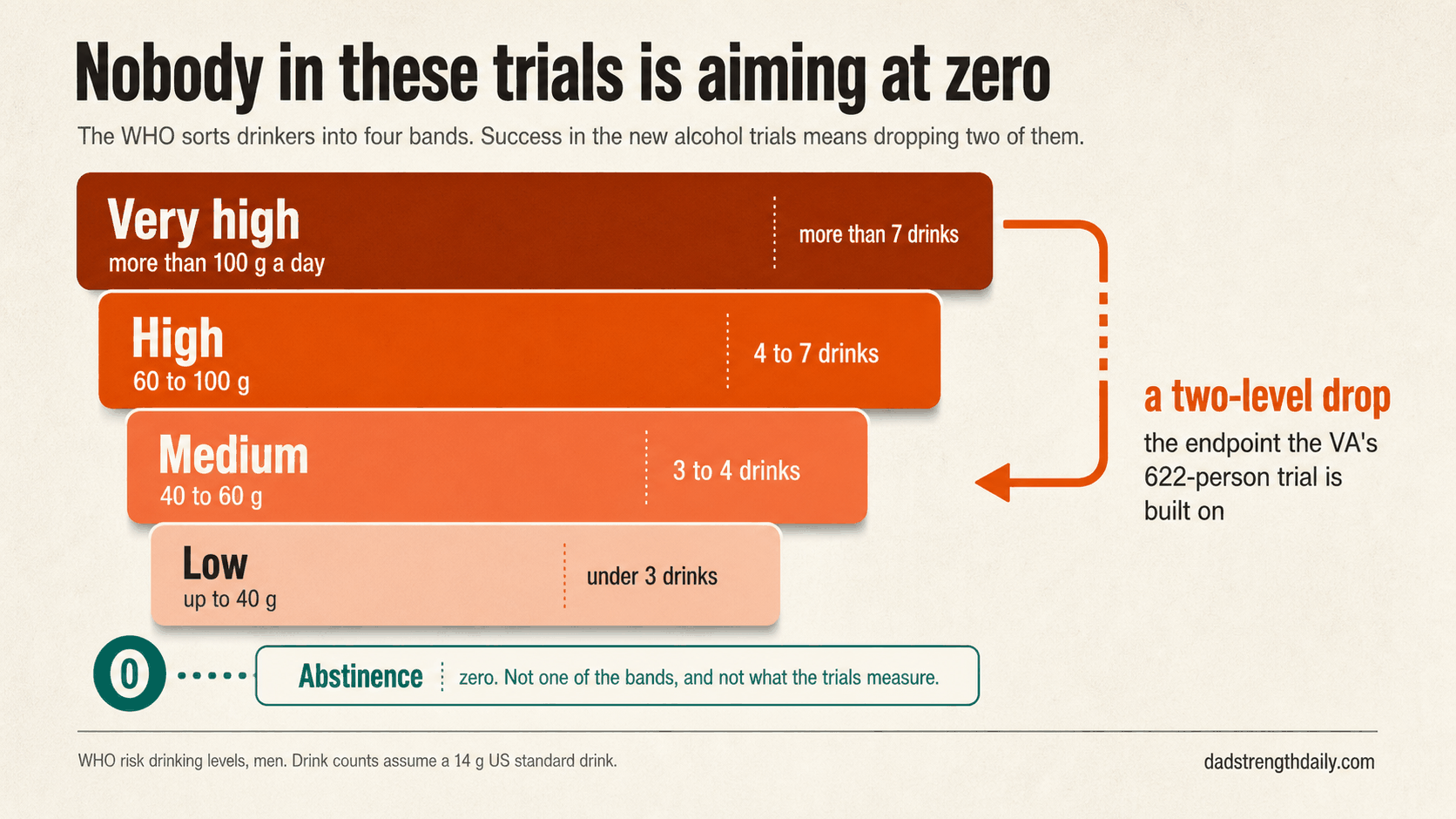
The row worth holding on to is the second-to-last one, because it is the one the VA has built its Phase 3 on. Dropping two bands means going from more than seven drinks a day to three or four, or from four-to-seven down to under three. A real change in a life, and one you can reach without ever quitting.
A second drug cleared that same bar the day before
The semaglutide trial got the press push. The University of Colorado and the American Psychiatric Association both put out releases the day it published, and the coverage that followed ran headlines about oral Ozempic cutting heavy drinking. None of what I read mentioned the endpoint the trial actually missed.
A second alcohol trial had reported twenty-four hours earlier and mostly just moved a stock price. On July 28, Altimmune reported topline results from RECLAIM, a Phase 2 of pemvidutide, which hits the glucagon receptor as well as GLP-1. A hundred people with moderate to severe alcohol use disorder, all with a BMI over 25, twenty-four weeks instead of eight.
It hit its primary endpoint on heavy drinking days at p=0.0014. And on the two-band drop, the row semaglutide missed, 29 of 45 people on the drug moved two bands against 16 of 46 on placebo, at p=0.0049. It also cut phosphatidylethanol, a blood marker of alcohol intake, at p<0.0001, which matters because everything else on that list is self-reported and this one is not.
Look at those denominators, though. Forty-five and forty-six, out of a hundred people randomized. Nine are unaccounted for, and the release does not say how they were handled. That is the exact question that gutted the Colorado percentages when its authors did the conservative recount, and I cannot run the same check here.
So the two-band drop can separate a drug from placebo. In Colorado it did not, though 48 percent of the semaglutide group got there. Plenty of people cleared the bar. The trial just could not show that the drug was why.
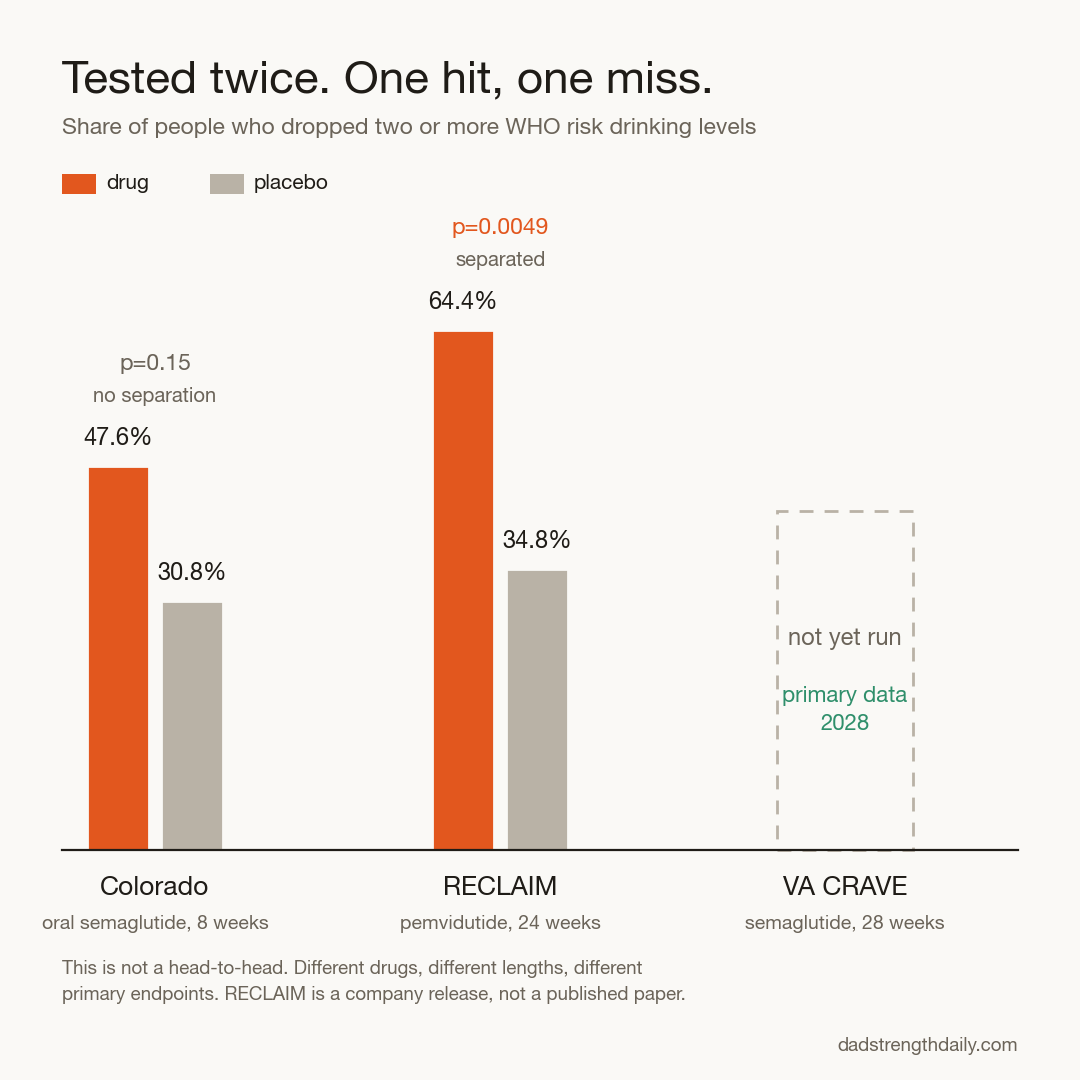
I would not read the two trials as a head-to-head, and neither should anyone selling you the comparison. Different molecules, different durations, different primary endpoints. The thing they do share is that both of them only enrolled people carrying extra weight, so neither one tells you anything about a lean drinker. Altimmune’s chief medical officer suggests the glucagon arm is doing liver-directed work that GLP-1 alone would not, which is a hypothesis from a company with an obvious interest in it, not a finding. RECLAIM’s principal investigator is Henry Kranzler, who directs Penn’s Center for Studies of Addiction. A serious academic investigator does not turn a company press release into a peer-reviewed paper. And RECLAIM is a press release, where the semaglutide trial is a published paper that went through peer review. That is the harder thing to do, so I would not lean on the pemvidutide numbers until the paper comes out.
The GI side effects were not trivial either. Nausea in 44 percent against 24 percent on placebo, constipation 26 against 6, and five people quit the drug over side effects where nobody quit placebo for that reason.
The VA’s bet looks better than it did a week ago
| Colorado, published July 29 | RECLAIM, reported July 28 | VA CRAVE, opening now | |
|---|---|---|---|
| Phase | 2 | 2 | 3 |
| People | 50 | 100 | 622 (planned) |
| Drug | oral semaglutide, 3 then 7 mg daily | pemvidutide, weekly shot | semaglutide, weekly shot built up to 2.4 mg |
| Length | 8 weeks | 24 weeks | 28 weeks |
| Two-band drop | 48% vs 31%, p=0.15 | 64.4% vs 34.8%, p=0.0049 | the primary endpoint |
| Primary data | done | done | 2028 |
CRAVE stands for Cessation or Reduction of Alcohol Consumption in Veterans. The name offers both. The primary endpoint only asks for the second. It runs at 18 VA medical centers. Everyone starts at a quarter of a milligram a week and begins escalating at week five, working up to 2.4 mg weekly if they tolerate it. That is the dose Novo’s label pairs with the pill my friend takes. Its primary endpoint is the two-band drop, tracked every four weeks from week five to week twenty-eight.
When I first read the semaglutide paper, the VA’s Phase 3 looked staked on the flimsiest drinking result in it. The Colorado authors had even shown how soft it was: when they redid the WHO numbers counting the three people who withdrew as unchanged, which is the conservative way to handle a dropout, neither the one-band nor the two-band result held up.
I am less sure of that now. RECLAIM ran three times as long and the endpoint moved anyway, with a blood test pointing the same way as what people said about their own drinking. My guess is that Colorado was too short, and possibly dosed too low, rather than that the endpoint is bad. But it is a guess. RECLAIM used a different drug, so I cannot tell you which of those differences mattered.
What still nags at me is that my new comfort with the endpoint comes from pemvidutide, and CRAVE is testing semaglutide. The VA designed this trial long before either result landed, so it was not reacting to anything. I am the one borrowing confidence from a molecule the VA is not studying.
Get the next one in your inbox
I cover the latest GLP-1 trials and access changes weekly. Free, no spam, unsubscribe whenever.
These drugs did not lower the bar. They are what takes it mainstream.
The recovery culture my friend lives inside runs on a binary, you are drinking or you are not, and that binary earns its keep. AA is built on it, and the 2020 Cochrane review by Kelly and colleagues, covering twenty-seven studies, found the manualized twelve-step version really does produce more continuous abstinence than other talk therapies, with moderate-certainty evidence that it costs less. Abstinence is not a folk belief that medicine outgrew.
So who decided success could mean three drinks instead of none, and when? Not these trials, and not recently. Naltrexone has long been measured on reduced heavy drinking rather than abstinence, and the FDA formally qualified the two-level drop as an acceptable primary endpoint in February 2025, after years of work showing that dropping two levels tracks with real improvements in health and functioning. The FDA offers it alongside abstinence and no-heavy-drinking-days, not in place of them.
I wanted to write that the regulator got there ahead of the drug companies. That is too clean. The review that consolidated the case, by Witkiewitz and colleagues in JAMA Psychiatry, published only last December, ten months after the FDA had already moved. The workgroup behind it has been supported by pharmaceutical companies for over a decade, and one of its authors discloses personal fees from Altimmune, whose drug is in this piece. All of that is disclosed and none of it invalidates the evidence. It does make the history more tangled than a regulator-versus-industry story.
What these drugs change is not the standard. It is the size of the room. Every earlier drug measured this way was one you only ever met inside addiction treatment. Semaglutide is already in millions of medicine cabinets for weight and diabetes, so when a 622-person trial says success means dropping two bands, that framing does not stay inside addiction medicine. It reaches everyone who has the drug in the fridge and a drinking habit they have been privately counting.
I would not call three drinks a day recovery, and I would not tell my friend it was. If you believe any drinking eventually reopens the whole thing, then parking someone at three a day is not a win at all. But of roughly 28 million Americans with alcohol use disorder in 2024, about 7.6 percent got any treatment. For the other 26 million, no treatment of any kind ever reached them, and drinking less beats the nothing they are getting now.
What I would tell my friend
He should know how little either trial proves about him. The semaglutide study was fifty people over eight weeks, its main endpoint came back empty, and the authors did not adjust for the fact that they were testing ten things at once. They also think some of the placebo group worked out they were on placebo, which is what happens when you study a drug whose side effects everyone has already read about. RECLAIM is a hundred people and still unpublished. I would want more than that before changing anything that is currently holding.
The VA said as much. It published a safety advisory alongside the announcement telling veterans not to self-medicate and not to swap out treatment that is already working. More than 400,000 veterans carry a diagnosed alcohol use disorder. Adding a drug on top of a program that is holding is a different decision from trading the program for the drug, and the second one is what the VA is warning about.
And CRAVE will not answer his question anyway. It tests semaglutide for alcohol use disorder in veterans who are currently drinking, and measures whether they drink less. He is not drinking. Only 14 percent of the Colorado participants even wanted to quit, and that trial found no effect on abstinence at all. RECLAIM did better on that front, raising the share of days people spent not drinking by 18.4 points over placebo, but days off are not sobriety, and it enrolled current drinkers too. The one result in either study that touches a sober man is the weekly craving score, in fifty people, over eight weeks, unadjusted.
That is the gap I keep pointing at. Two trials in two days, one that missed its craving primary and one that hit its drinking primary, and both of them asking whether a drug moves a number in people who are still drinking. None of these trials was designed around people who have already stopped drinking and still live with the wanting. My friend is not an edge case. He is what long-term recovery looks like, and the trials keep being built for someone else.
I keep a running tracker of every GLP-1 and incretin drug, approved and still in the pipeline, with what each one targets, how far along it is, and what's coming next.
See the full GLP-1 Pipeline Tracker →