
Updated with the HERMES and ATHENA trials both stopped early.
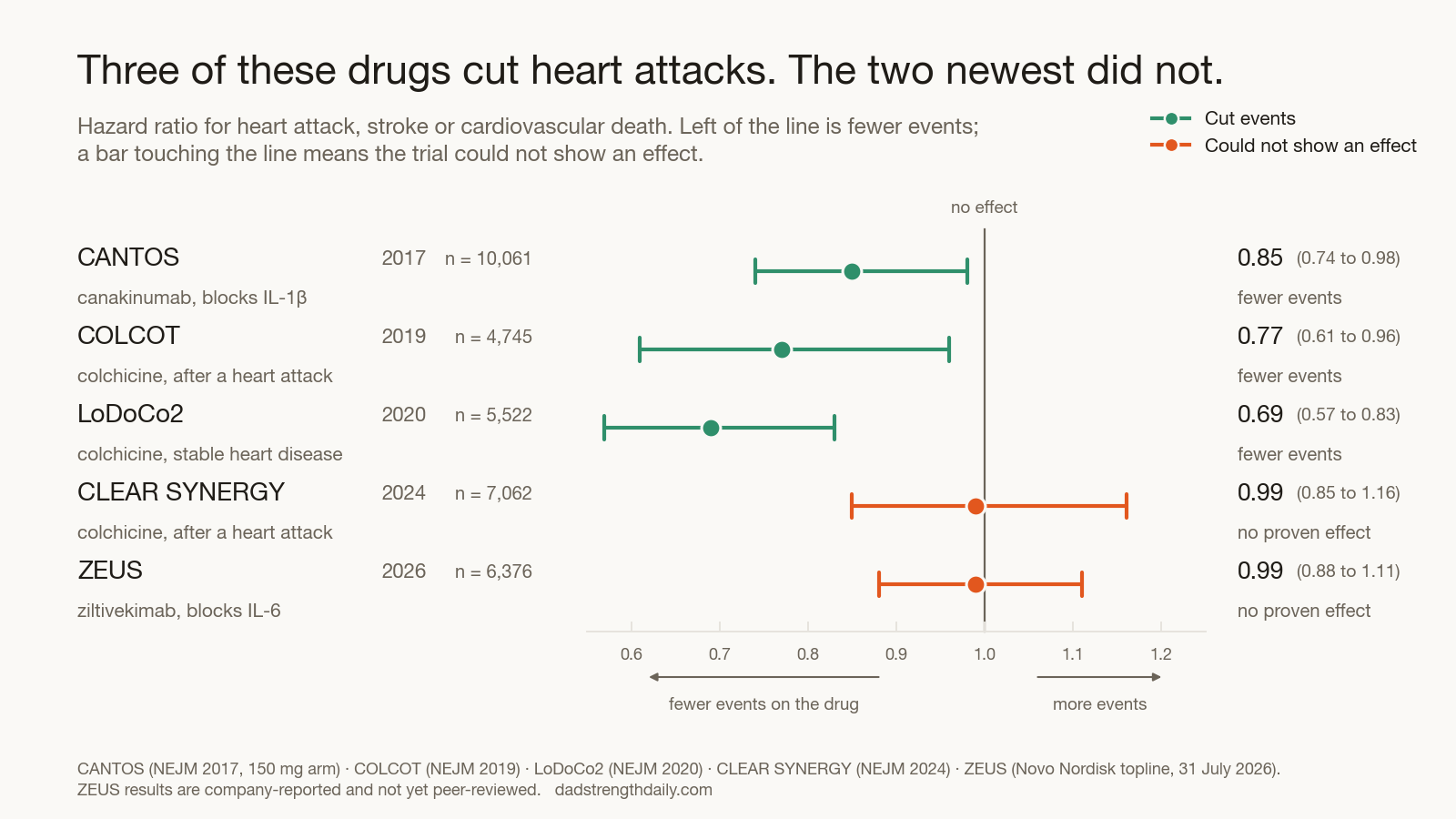
ZEUS lowered inflammation exactly as designed and did not cut cardiovascular events. That weakens hs-CRP as something to treat, not as something worth measuring.
Update, August 22, 2026: the people behind the colchicine trials have answered ZEUS, and a new UK Biobank analysis sharpens what IL-6 actually predicts. Both are covered at the end of this post.
Update, September 7, 2026: HERMES and a second trial, ATHENA, have both been stopped early. Covered at the end of this post.
In April I posted a Scientific American piece to r/ProactiveHealth headlined heart disease patients can be saved by drugs that calm inflammation. I hedged in the body. I wrote that “inflammation” gets blamed for basically every bad thing in health, and that I did not think the piece meant anyone should start chasing anti-inflammatory drugs or biomarkers.
Last Friday the trial built to settle that question reported, and it came back flat.
I would like to claim I saw it coming. I didn’t. I was hedging because the word gets thrown around sloppily, not because I knew the first thing about interleukin-6, and a hedge that broad would have looked just as clever if the trial had been positive.
Before I go further: I own a little Eli Lilly stock and I take tirzepatide, which is a Lilly drug. The trial that just failed belongs to Novo Nordisk, Lilly’s main competitor. Read what follows with that in mind.
The number I was proud of
During my weight loss journey I started tracking hs-CRP, the high-sensitivity C-reactive protein test, which is a general measure of inflammation.
Mine was 2.83 in May of 2025. It was 1.4 that October. By this May it was under 0.2, which is below the level the lab will report, and it was still there on 15 July, two weeks before ZEUS reported. That is a drop of more than 90 percent. I liked it a lot. It felt like proof that something invisible had changed, the kind of result that does not show up on a scale.
Here is the problem with liking it that much. It was not the only thing moving. Over the following year my LDL cholesterol went from 110 to 56 and my ApoB from 95 to 59, because I lost about 170 pounds, started training seriously, and went on ezetimibe. Four numbers fell across the same stretch, and I quietly gave the credit to the one I found most interesting.
I also left something off that list. I take tirzepatide, and tirzepatide lowers hs-CRP: in a biomarker substudy of SURMOUNT-1 it cut the number by 37 to 55 percent against placebo, more at the higher doses. Whether that is the drug itself or the weight it takes off, nobody has separated. That is my own problem exactly, one layer down.
The trial built to test exactly this
Novo Nordisk paid $725 million up front in 2020 for the company that owned ziltivekimab, an antibody that blocks interleukin-6, one of the main signals the body uses to run inflammation. hs-CRP is the downstream readout of that signal, which is why the drug and the blood test belong to the same story.
ZEUS randomized 6,376 people with established cardiovascular disease, chronic kidney disease, and an hs-CRP of 2 mg/L or above. My own 2.83 cleared that last bar comfortably. My lab never flagged it, because Labcorp prints a reference range that runs up to 3.0 and 2.83 sits inside it. On paper I was fine. By the trial’s definition I was inflamed.
It is also the only thing about me that resembles these patients. My kidney function is normal, I have no established heart disease, and I am in my early fifties against their average of 69.5. I am not going to pretend a result from that group automatically says something about a man like me.
The design was published in JAMA Cardiology in December, first author Paul Ridker, the Harvard cardiologist who has spent his career building the case that inflammation drives heart disease.
These were sick people, and sick in a particular way. Their kidney function was around half of normal, four in ten had heart failure, and the median hs-CRP was 4.5. But the cholesterol side was handled: 88 percent were on a statin and the average LDL was 77.7 mg/dL. What was left untreated was the inflammation, and here was a drug that could switch it off.
The result, announced on 31 July, was a hazard ratio of 0.99 for heart attack, stroke, or cardiovascular death, with the uncertainty running from 0.88 to 1.11. A hazard ratio compares event rates on the drug against placebo, so 1.0 means the two groups were indistinguishable, and the range tells you what the data could still be hiding. This one sits squarely across 1.0.
And ziltivekimab did its job. Novo reports the expected reductions in both free IL-6 and hs-CRP. There were more serious infections in the treated group, which follows from the mechanism, since IL-6 is part of how the body fights infection. There was no difference in deaths.
Two caveats. These numbers come from a company press release, not a published paper. No subgroups yet, and there was a kidney endpoint they planned in advance and have still not reported. Full results go to a scientific meeting later this year. And this is one drug against one pathway in one unusual group of patients, not a referendum on inflammation.
It happened before, with a different drug
The thing that actually changed my thinking is that this has now happened twice.
In 2024, CLEAR SYNERGY gave colchicine, a cheap old anti-inflammatory, to 7,062 people after a heart attack and followed them a median of three years. It pulled their CRP down about 1.28 mg/L further than placebo. Its hazard ratio for the primary outcome was 0.99, range 0.85 to 1.16.
None of that means inflammation is irrelevant. Anti-inflammatory drugs have cut real events in real people more than once, most clearly two colchicine trials: COLCOT after a heart attack and LoDoCo2 in stable heart disease.
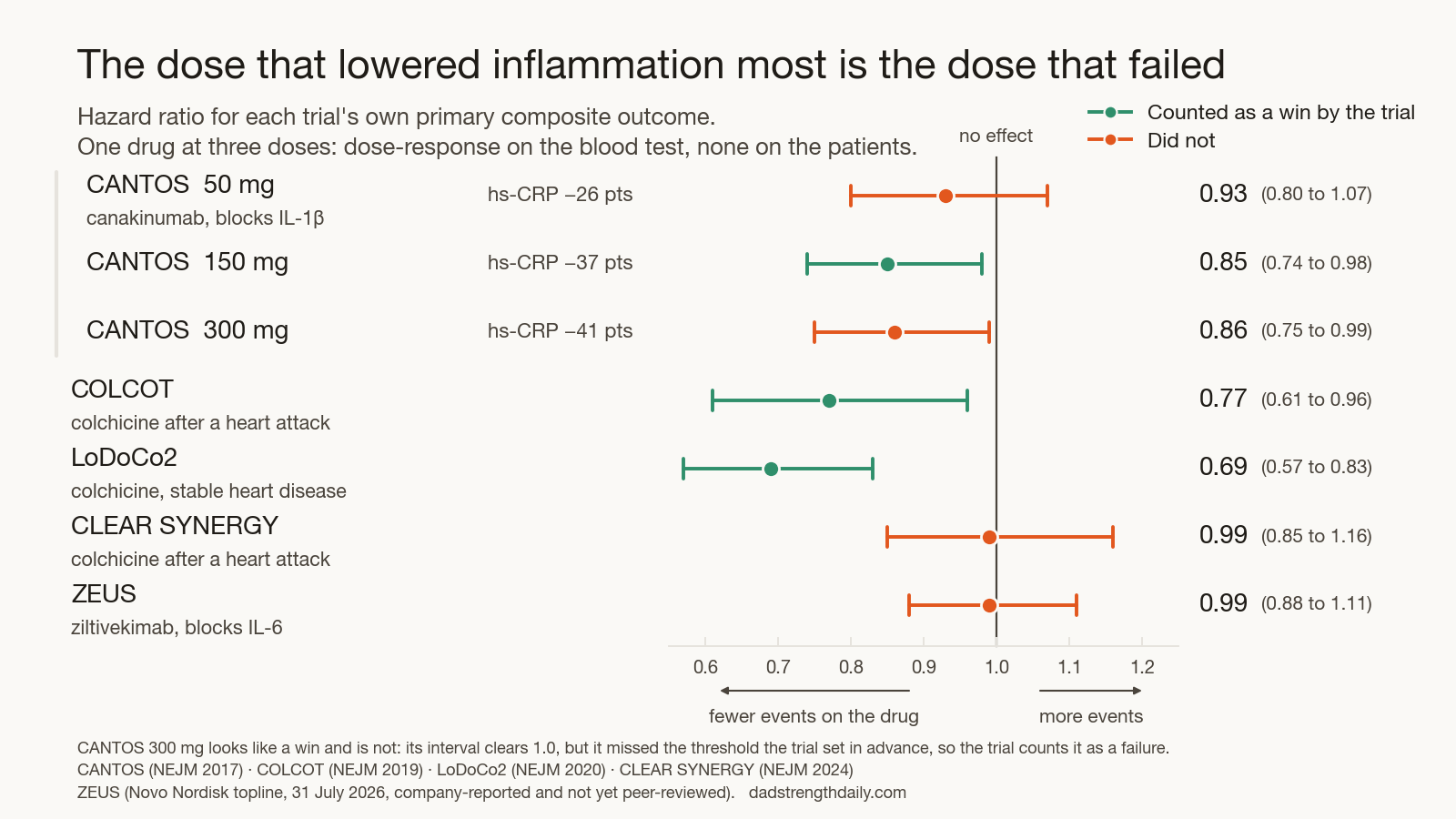
Every one of these drugs lowers inflammation. That is what they are for. Only some of them changed what happened to the patients, so moving the marker is clearly not the thing that decides it.
CANTOS makes that point better than ZEUS does. It is the trial usually cited as proof the hypothesis works, and it is thinner than its reputation. It ran one drug, canakinumab, at three doses, and they lowered hs-CRP by 26, 37 and 41 percentage points more than placebo, neatly in order.
That last part is the thing scientists most want to see. It is called a dose-response: more of the drug, more of the effect. Randomizing patients is what carries the causal argument in a trial like this, but a clean gradient on top of it is the confirmation that you are pulling the right lever.
CANTOS got that gradient on the blood test but not on the patients. The 15 percent reduction everyone quotes belongs to the middle dose, which cleared the statistical bar the trial had set for it with almost nothing to spare, a p value of 0.021 against a limit of 0.02115. The top dose, the one that crushed hs-CRP hardest, did no better than the middle one and missed its own bar. It was the same drug in the same trial, and taking more inflammation out did not buy more protection. That does not erase what the middle dose did. It does undercut the idea that the hs-CRP number is the thing that matters. Deaths did not fall, fatal infections rose, and the FDA turned down Novartis’s cardiovascular application in October 2018. Its inflammation signal turned out to be a great deal more interesting for cancer.
Colchicine is genuinely unresolved. Last year the European Heart Journal ran two reviews of the colchicine trials in the same issue. One pooled six trials and found a 25 percent reduction in events. The other pooled nine and found 12 percent. Both found a real reduction, so the direction is not in doubt. But that is the same literature added up two ways, in one journal, to answers that differ by half. How big the effect is, and who it is worth giving to, is not settled.
What hs-CRP is good for
Nine days before ZEUS reported, three preventive cardiologists published a short review of this drug class for the American College of Cardiology, among them Roger Blumenthal, lead author of the current cholesterol guideline. They wrote, before anyone knew the answer: “A biomarker effect does not guarantee event reduction.”
The cleanest illustration of that is a trial from 2008. JUPITER enrolled 17,802 people whose LDL was already decent, under 130, but whose hs-CRP was 2.0 or higher. It selected them on inflammation, cut their cardiovascular events roughly in half, hazard ratio 0.56, and was stopped early because the benefit was so clear.
The drug was rosuvastatin, a cholesterol drug.
I have to be fair about what that does and does not prove. Rosuvastatin cut their LDL by 50 percent and their hs-CRP by 37 percent at once, so JUPITER cannot tell you which change did the work. Ridker has argued for years that some of it really is the inflammation, and on prediction he has the better evidence: in a 2023 analysis of three statin trials, among people already on a statin, hs-CRP predicted heart attacks and death better than LDL did.
Predicting events from the number has gone a lot better than doing anything about it. Canakinumab moved inflammation without touching cholesterol at all, and bought a modest reduction in events. Ziltivekimab blocked IL-6 directly, in a sicker group, and could not show a benefit at all. So the honest read is not that inflammation is inert. It is that we still cannot lower the number on purpose and count on the outcome following.
That is roughly what the current guideline tells doctors to do with the number. The 2026 ACC/AHA dyslipidemia guideline lists hs-CRP as one of ten “risk enhancers” that can tip a borderline case toward a statin, and it is precise about the entry: 2 mg/L or above, on more than one occasion. A single reading does not count, because hs-CRP climbs with any infection or injury.
The guideline is also blunter about JUPITER than I expected. It calls hs-CRP a marker of inflammation, then says the trial cut events “with an effect size compatible with the LDL-C-lowering effect of statins alone.” The people who write the cholesterol rules already think the statin did it by lowering cholesterol.
A high hs-CRP can argue for starting treatment. Its absence, in the guideline’s own words, “should not be taken to indicate lower ASCVD risk” and does not justify delaying it. A coronary calcium score of zero, by contrast, is a reason to hold off, because it measures the disease rather than a signal about it, though the guideline only offers that scan at 3 percent ten-year risk or higher.
Get the next one in your inbox
I write about longevity, training, and preventive health weekly — without the guru worship. Free, no spam, unsubscribe whenever.
So why did anyone think this would work?
Because the genetics said it would.
The story going around this week is that the genetic evidence always showed IL-6 was a weak target, and the field talked itself into a trial it should have known would fail. That is not what the record says.
There is a way to size up a drug target before anyone has built the drug. You find people who happen to carry a gene variant that nudges the thing down from birth, and compare them against people who don’t. Nobody assigned them anything, so it is the closest thing to a randomized trial that nature runs. A 2022 analysis did this for both in 408,225 people from the UK Biobank: genetically lower IL-6 signalling on one side, genetically lower LDL cholesterol on the other, one population, one method. It split people at the median of a genetic score on each side, so the comparison is rough, but it is rough in the same way for both. Lower LDL came out at an odds ratio of 0.96 for cardiovascular disease. Lower IL-6 came out at 0.96 as well.
So the genetics gave IL-6 a green light about as bright as the one cholesterol got, which is why a lot of money walked through it. I don’t think anyone was foolish here. I came away treating “the genetics support it” as a much weaker claim than I used to, and it is a phrase I hear constantly from people selling supplements.
What I do with my own number
I am not taking hs-CRP off my panel. It told me something true. There may be a steadier way to measure the same thing, though: GlycA, one of six analytes behind a mortality score called MVX, moves about twofold where hs-CRP moves a thousandfold. When mine was 2.83 I was a heavier, unfitter man with an ApoB of 95, and the test was reporting that accurately.
What I stopped doing is treating it as a scoreboard. Nobody is selling an IL-6 inhibitor to men like me, but plenty of people sell anti-inflammatory supplement protocols aimed at exactly this number. Those protocols are not what ZEUS tested. ZEUS tested the idea underneath them, that pushing the number down is what helps you. It used one antibody against one pathway, in people far more inflamed than I am, and it could not show that. If your hs-CRP comes back at 2.5, the useful response is not to go shopping for something that lowers it. It is to take your ApoB and LDL, your blood pressure, and your weight more seriously than you were.
Mine went to under 0.2, and I now think it went there because I fixed the things underneath it. The reading was tracking those things. Which may be why pushing it down on its own, with a drug that does nothing else, has not yet been shown to help anyone.
I could be wrong, and there is a trial that will tell me something. HERMES is testing the same drug in nearly 4,900 people whose heart failure is the kind where the pumping strength still measures normal, picking them the way ZEUS did, on an hs-CRP of 2 or above, but without requiring kidney disease. Heart failure is a different disease, so a positive result there would not put IL-6 back in business for men like me. It would tell me the target is not dead, and I will have underrated inflammation in print. (ARTEMIS, the third trial, is being called the same test this week. It is not. It treats people within days of a heart attack and does not screen for inflammation at all.)
Novo expects the answer in the first half of 2027. I do not expect it to go Novo’s way, and if it does, I will say so here.
Update, August 22, 2026. The people who believe most in the inflammatory hypothesis have now answered ZEUS, and their answer is that the drug aimed at the wrong spot. In a Medscape piece from August 20, Jean-Claude Tardif, who ran COLCOT, and Mark Nidorf, who ran LoDoCo2, argue that IL-6 sits too far down a chain of signals with plenty of backup routes, and that the drugs which did cut events act higher up and hit several pathways at once. That fits the colchicine results above, so I take it seriously. I notice what they concede along the way, though. Nidorf, on the blood test I spent a year optimizing: “CRP doesn’t always equal inflammation. CRP equals risk.” A man who has spent his career betting on this pathway just made my whole argument in four words. And on the two ziltivekimab trials still running, Tardif says the odds of a win “have gone down tremendously,” while Nidorf doubts the heart failure one outright: “no anti-inflammatory has ever been shown to be useful in heart failure.” I wrote above that I do not expect HERMES to go Novo’s way. The hypothesis’s own champions are now betting the same direction.
The prediction side of this story got stronger the very same week, and that is not a contradiction. A new UK Biobank analysis (Cheon et al., Progress in Cardiovascular Diseases, 2026) is a different design from the genetic comparison above: it measured circulating IL-6 in 34,064 people without heart disease and followed them for almost 14 years. IL-6 and ApoB each predicted events on their own, having both high meant 55 percent more risk than having neither, and the two numbers predicted different things. ApoB was the stronger signal for heart attacks. IL-6 was the stronger signal for dying, from cardiovascular causes and from anything. One baseline blood draw, observational, so it proves prediction, not cause. Which is the point. The marker keeps telling you who is in trouble. ZEUS is what happened when a drug went after the pathway behind the marker and nothing else. I will keep measuring my hs-CRP once a year, and I will keep reading the result as information about me rather than a number to attack with a drug.
Update, September 7, 2026. Novo told investigators on September 4 that it is stopping HERMES early — the trial I said above I did not expect to go Novo’s way. A second trial, ATHENA, testing ziltivekimab in a similar heart-failure-with-inflammation population, is being stopped alongside it. A data monitoring committee reviewed both and concluded neither was likely to land anywhere different from ZEUS. These are almost certainly the two trials Tardif meant above when he said the odds had “gone down tremendously.” Novo has not published numbers — the trials are simply being wound down, with patients followed through their three-month visit as planned. The one ziltivekimab cardiovascular trial still running is ARTEMIS, which, as I noted above, is a different test: it treats people within days of a heart attack and does not select for inflammation at all. It reads out in the first half of 2027. Three trials into this drug’s cardiovascular program, lowering the marker as advertised still has not been shown to move an outcome that matters. (Source: Novo statement to Clinical Trials Arena, September 7, 2026.)
Working out which numbers are worth treating and which are only worth watching is most of what my heart and bloodwork guide is for.