
A trademark, a Netflix series, and about $100,000 a year for a city to keep the certification. The business kept growing while the science underneath it kept shrinking.
I wanted the Blue Zones to be true, and I think that is the whole reason they worked.
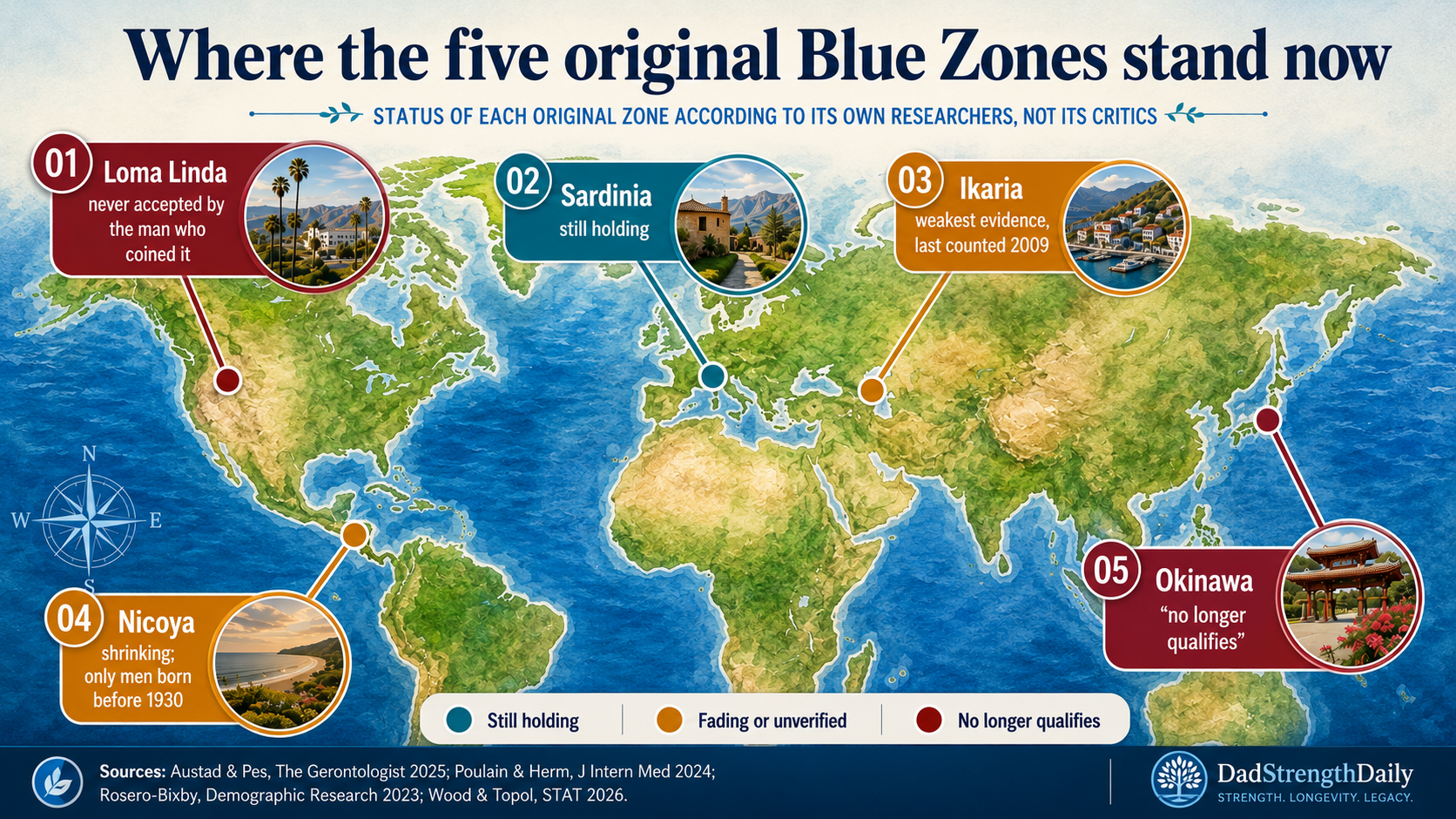
The story is close to perfect. There are five places on earth where people reach 100 at absurd rates, and nobody there is trying. No gym membership, no supplement stack, no tracking. They garden, they eat beans, they sit with their friends, they have a glass of red at five. Longevity turns out not to be a discipline but a way of living that people stumbled into, and it is available in beautiful places you can fly to.
Every part of that is built to be believed. It says the answer is simple, pleasant and ancient, and that the people who have it were not more disciplined than you, just luckier about where they were born. That is a far better story than eat less and lift things.
It is also coming apart, and not because a critic took it apart. Some of these places were real, several no longer are, and the men who built the concept cannot agree on whether the evidence was ever good enough. They have been arguing it out in their own journals for fifteen years, while the company built on the name has never been bigger.
The original signal was small
In the early 2000s a Belgian demographer, Michel Poulain, and an Italian physician, Giovanni Pes, went looking for places with unusual numbers of people reaching 100. They found a cluster in the mountains of Ogliastra in central-eastern Sardinia and marked it on a map with a blue pen. That is the entire origin of the name.
The core zone was six villages, about 12,000 people. Of everyone born there between 1880 and 1900, 0.51% reached 100. The concept’s defenders describe that as “approximately five times as high as the percentage of centenarians throughout Europe.”
Five times sounds enormous until you remember what it is five times of. Reaching 100 is rare everywhere, so several times a very small rate is still a very small number of people, spread here across six villages and two decades of births. A worldwide story about how to live now rests on birth records written by hand in rural Italy in the 1880s, and a rate that small can be moved a long way by a small number of wrong ones. Which is why it matters that Sardinia is the place where the checking was done properly. The investigators cross-referenced the civil registers against church and family archives, reconstructed genealogies to catch the trap where a dead child’s name is reused on a younger sibling, and used all of it to strike false claims out. The paperwork is not a pedantic objection. It is the whole question.
A year after that paper, a journalist named Dan Buettner joined the project, wrote a National Geographic cover story, added Okinawa and Loma Linda, and trademarked the term the scientists had coined.
Okinawa’s records burned in 1945
Okinawa is the pillar. The plant-based diet, hara hachi bun me, the purple sweet potatoes, all of it comes from there.
The strongest published challenge came from Poulain himself, and it is fifteen years old. His 2011 paper in Demographic Research is titled “Exceptional longevity in Okinawa: A plea for in-depth validation.” The Koseki is the Japanese family register, the document that says how old you are. Almost all of Okinawa’s were destroyed in the war; only five of the island’s 41 municipalities kept intact originals. The rest were rebuilt from memory under American occupation, and afterwards people went to court to correct them at thirty times the Japanese average.
So Poulain plotted register-change requests per 10,000 inhabitants in each municipality against how many centenarians that municipality produced. There is no obvious reason those should track each other. They tracked closely enough to account for about 62% of the variation between municipalities. The places that amended the most records produced the most hundred-year-olds. His conclusion: this “confirms the necessity of considering the bad data hypothesis.”
He asked again in 2024, noting that the life tables from before the war “did not show any significant longevity advantage” for Okinawa at all. The edge appears for the first time in 1975, after the records were rebuilt. And: “the longevity indicators may be affected even by relatively few errors in age. Such errors cause rather more over- than underestimation of longevity.” That paper ends with a section headed “A plea for further investigations.”
He does not call it fake, and it would be dishonest of me to imply he does. His 2011 abstract says plainly that “no concrete proof of invalid data has been found,” and that between the two explanations, bad records or a real effect, he “does not favor either.” Thirteen years later he added that even allowing for misreporting, “the situation in Okinawa remains exceptional.” He is not claiming the zone is fake. He is claiming the work done so far is not enough to know.
It is not that nobody tried, and the defenders’ case is more than one study. Willcox and colleagues checked 52 Okinawan centenarians against their documents and found 49 exact matches, with no sign of systematic exaggeration. The 2025 rebuttal adds home visits to 100 study participants, birth years cross-checked against the Chinese zodiac animal a person was born under, school records, military certificates and medical records, and family reconstructions that test whether a claimed age fits the ages of parents, siblings, children and grandchildren. That is real work, and it is why the defenders say the ages are settled. Poulain read the Willcox paper and answered it head-on: it “might be considered to be a direct response to the need for a complete validation,” he wrote, and then spent his own paper arguing it does not settle anything. Counting today’s centenarians against today’s population is the wrong instrument, he says, because a century of migration and shifting birth and death rates sits underneath the number and makes it “completely unusable for comparative purposes.” Two papers, thirteen years apart, from one of the two men who coined the name, and I could not find the fuller record-by-record validation he keeps asking for.
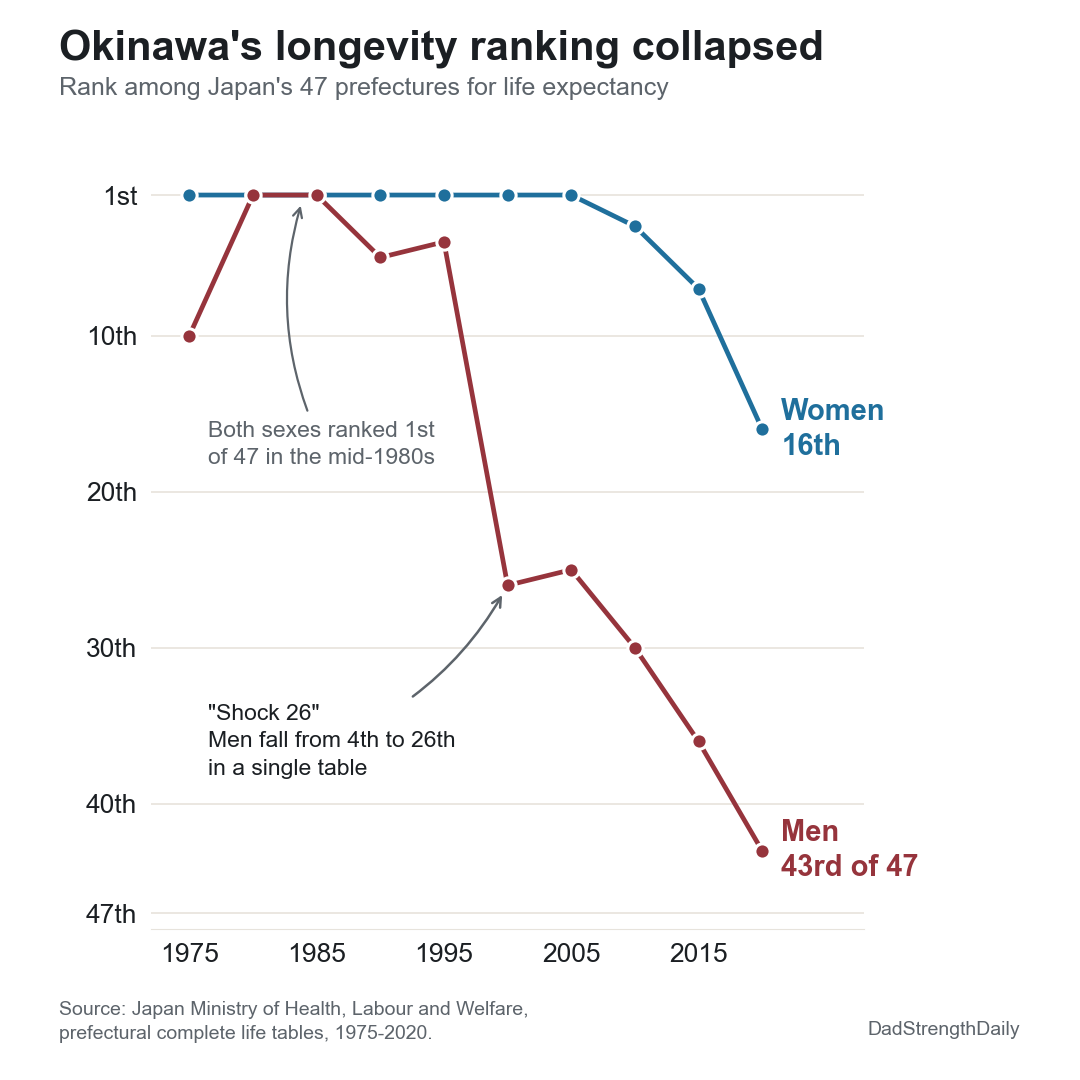
Meanwhile the island itself moved. Okinawan men ranked first among Japan’s 47 prefectures for life expectancy in 1980 and 1985. They were 26th by the 2000 table, the drop Okinawa calls “shock 26.” By 2020 they were 43rd of 47. Okinawan women held first place for six consecutive tables and are now 16th. That is a ranking, so it measures Okinawa against the rest of Japan rather than against its own past. What it says is that the island stopped being exceptional, which is the only thing the zone ever claimed.
Buettner knows. On Rich Roll’s podcast around 2020 he said Okinawa “is the least healthy prefecture in all of Japan. It’s got the highest rates of obesity, the highest rates of diabetes.” The Blue Zones website still tells visitors that “women there live longer than any women on the planet.”
The brand’s best card is that the collapse tracks the arrival of American food and cars. Doesn’t the decline prove the thesis? It fits it, except the generations who look extraordinary are the same ones whose records burned and were rewritten. Both stories predict the same graph. And even the record check Poulain keeps asking for would only tell us whether the original advantage was real. It would not tell us what caused it.
What the defenders now concede
In late 2025 The Gerontologist published the most substantial recent rebuttal to the critics, by Steven Austad and Giovanni Pes. It is the paper people point to when they say the Blue Zones survived, and on the central question it is emphatic. The ages in the four classic zones “have been extensively validated using the best techniques of modern demography,” it concludes, and those places “still have much to teach the world about how to live a long, healthy life.”
So one of the men who found the Blue Zones says the ages are settled. The other has spent fifteen years asking somebody to go and check them. Pes and Poulain were on the original Sardinian paper together, and they are no longer describing the same level of certainty about their own discovery. Neither the brand nor the loudest critics will tell you that.
The rebuttal defends four zones and never mentions Loma Linda, and on the part everyone actually cares about it says: “We have not discussed what factors make for a Blue Zone.” There is no evidence in it about diet, wine, beans or movement. It is an argument about paperwork, cited as though it were an argument about beans.
The most useful verdict belongs to neither side. A 2025 scoping review in Aging and Disease worked through 65 records covering ten claimed zones and graded them. Ogliastra, Okinawa and Nicoya came out “well-characterized.” Ikaria and four others were still “under investigation.” Loma Linda and Menorca were excluded outright, and on Loma Linda it is blunt: there are “no epidemiological studies to confirm its status,” and the only source is Buettner’s own review, which “lacks demographic studies and only includes personal narratives.”
So the honest reading is narrower than either side’s. Some of these clusters were real, the evidence varies enormously from one to the next, and several of the advantages have since gone. None of that tells you what caused the longevity, or validates nine lifestyle rules, or shows that a branded city programme makes anybody live longer.
Where the five stand, according to the people defending them:
| Zone | Status, per its own defenders |
|---|---|
| Sardinia | Still holding. The strongest documentary validation |
| Okinawa | “No longer qualifies as a Blue Zone” (Austad & Pes, 2025) |
| Nicoya | “Shrinking” (Austad & Pes, 2025). Only men born before 1930 |
| Ikaria | Poulain calls it “the weakest one.” Last counted 2009 |
| Loma Linda | Never accepted by Poulain, who co-coined the term |
Ikaria is the one that surprised me. The island-level case is not nothing: it rests on the Greek statistical authority, census records and the municipal dimotologion, the registry of every citizen in a Greek municipality. But the oldest islanders “largely lacked birth records,” and where an individual birth record was missing, interviews and family-event reconstruction were used instead: a battery of questions about the timing of demographic events and the ages of close relatives. And the step that pins down how old any particular Ikarian was is cited in that paper as an “Unpublished Internal Report. National Geographic,” produced for the magazine that was commercializing the story.
Pes is also defending a finding he helped establish; the paper identifies him as “a Blue Zone discoverer,” and the acknowledgements thank Dan Buettner, who founded the brand and sat on its board, for comments on earlier drafts. Neither of those is a financial conflict, and neither was hidden. Both are worth knowing when you weigh how certain the paper sounds.
Buettner’s own summary, to STAT: “all blue zones are waning right now.” He is a co-author on a forthcoming paper tracking their demise. And in April 2026, two decades and nine books later, researchers in the field announced they had finally agreed on a formal definition of what a Blue Zone is.
Get the next one in your inbox
I write about longevity, training, and preventive health weekly — without the guru worship. Free, no spam, unsubscribe whenever.
Loma Linda was added because a magazine asked
The American zone is the clearest look at how the thing was assembled. Buettner told the New York Times it was “kind of an outlier,” included because his editor at National Geographic told him “you need to find America’s blue zone.” He told Science he added it because his editor wanted a US site, and “I never bothered to delist it.”
It also fails the company’s own published criteria, which require a candidate country’s longevity to be “among the highest ranked at world level.” American life expectancy trails every comparable wealthy nation by about three and a half years.
And the town is ordinary. Taking the CDC’s census-tract life expectancy estimates for 2010 to 2015, the only years that dataset covers, and weighting Loma Linda’s tracts by population myself, the town comes out at 79.1 years, and roughly 44% of US tracts do better. The real finding was always about Seventh-day Adventists, whose men had about 7.3 more years of life expectancy at age 30 than other white Californians. That is a statewide religious cohort, followed from 1976, and Adventists are a minority of Loma Linda’s residents. A denomination became a destination.
What a city actually pays
Almost everything I know about the money side comes from one place: STAT’s investigation in May 2026.
Buettner sold Blue Zones LLC to Adventist Health in 2020; neither party has confirmed a price, and STAT reports $78 million without a source. Poulain told STAT that keeping an official designation runs a city about $100,000 a year. Miami Beach voted $220,000 for a six-month assessment alone. Buettner’s own analogy for the certification business is “sort of like LEED certification for health,” which is a revealing thing to reach for, since LEED is a paid accreditation scheme.
When the money stops, so does the zone. Fifteen Iowa communities signed up between 2012 and 2014, ten of them under a $25 million Wellmark Blue Cross Blue Shield sponsorship. When it ended and cities had to pay themselves, Cedar Rapids, Iowa City and Marion left. Iowa City’s manager was blunt: “Cost was a factor as we would have to pay to continue to use the brand.” When Cedar Rapids asked what renewal cost, it was told the fee was “considered proprietary information.”
I found no peer-reviewed evidence that a project has added a year to anyone’s measured lifespan. The famous number, 2.9 years added in Albert Lea, Minnesota, is the output of a 33-question online questionnaire filled in by volunteers, and Blue Zones’ own results page cannot keep its story straight: the headline stat card says “2.9 years added” while the body text restores the word “projected.” The one peer-reviewed evaluation I did find, Riley and colleagues in BMJ Open, is observational, and what it measured was a well-being score, not how long anybody lived. The programme as a whole did come out ahead on that score (+1.12, p=0.012). But when I went through the pieces, the policy work, which is the visible half a city pays for, was scored by staff rather than measured, and higher scores went with worse well-being in both models. High weekly exercise fell against the comparison towns too. The design cannot tell you the policies caused any of that, only that the association ran the wrong way. Five of the nine authors work for the health district running the programme or for the company that sells it.
Then there are the frozen meals, in 4,000 grocery stores, sold as “real whole food ingredients, crafted for longevity.” Buettner told STAT: “We’ve sold 2 million meals and figured we’ve saved about 50 life years… And I’m very proud of that.” Fifty years across two million meals is about thirteen minutes each.

What is actually left
Sardinia is the clearest surviving case, and it has the strongest documentary validation behind it. Okinawa and Nicoya have serious historical evidence too, even though both advantages have since faded. It is entirely possible a few genuinely long-lived clusters existed. Buettner’s municipal work, the sidewalks and bike lanes and smoking cessation, is more defensible than most of the longevity industry, which is currently selling stem cell infusions and other people’s blood.
The loudest critic does not come out well either. Saul Newman is the reason any of this got attention and his structural argument is sound, but I checked his headline numbers against the papers he cites and several fall over: a Japanese review that supposedly found 82% of centenarians dead, which I could not source anywhere; 72% of Greek centenarians dead, which turns out to be his own estimate; a wartime-bombing statistic he reports as 79% when the underlying figure is 62%. His central papers are still preprints. You do not need him anyway. Every concession that matters is in the defenders’ own published work.
What survives of the nine rules is fine and free. Move. Eat mostly real food. Keep your friends. Have a reason to get up. None of it was discovered in Sardinia. Attia went through the same material and landed harder than I would, concluding the work “has added nothing to our collective body of knowledge about how to live longer and healthier lives” and is “just fancy branding on generic advice that most of us have heard (for free) since childhood.”
Two of the nine need caveats. “Wine at 5” rests on the claim that moderate drinkers outlive non-drinkers. That claim comes from watching who drinks and who dies, which cannot separate the wine from everything else about the people drinking it. When Biddinger and colleagues used gene variants that predict how much a person drinks as a stand-in for drinking itself, the apparent benefit at low intake flattened out and risk climbed steeply as intake rose. The old association is still in the literature, including a National Academies review in December 2024, which is why you still hear it repeated. It is not a reason to start, and nobody should start on the say-so of a lifestyle brand.
The movement rule is the one that bothers me most, because it aims straight at men my age. “Move naturally” is easily heard as permission to skip deliberate training, and Buettner’s site runs a page titled “Why Diet and Exercise Don’t Work.” As population policy that is not a stupid argument; telling a whole country to diet and exercise has a lousy record. But what reaches a fifty-year-old is “don’t bother training,” and gardening does not deliver progressive overload. Strength and VO2max are among the strongest predictors we have for how the back half of life goes, and for most men my age improving either one takes the deliberate, scheduled work the Power 9 does not address.
I have followed the money through the supplement aisle before, and the shape here is the same. A real finding at the bottom, and on top of it a story that grew too big to test and a product to sell. The difference is that this one started with two researchers drawing a circle on a map, and that circle is still the most honest thing about it.