
Equinox sells a $40,000 longevity membership with a thousand people waiting. The strange part is not the price. It is how little of it is the longevity, and how much is service, status, and testing that can backfire.
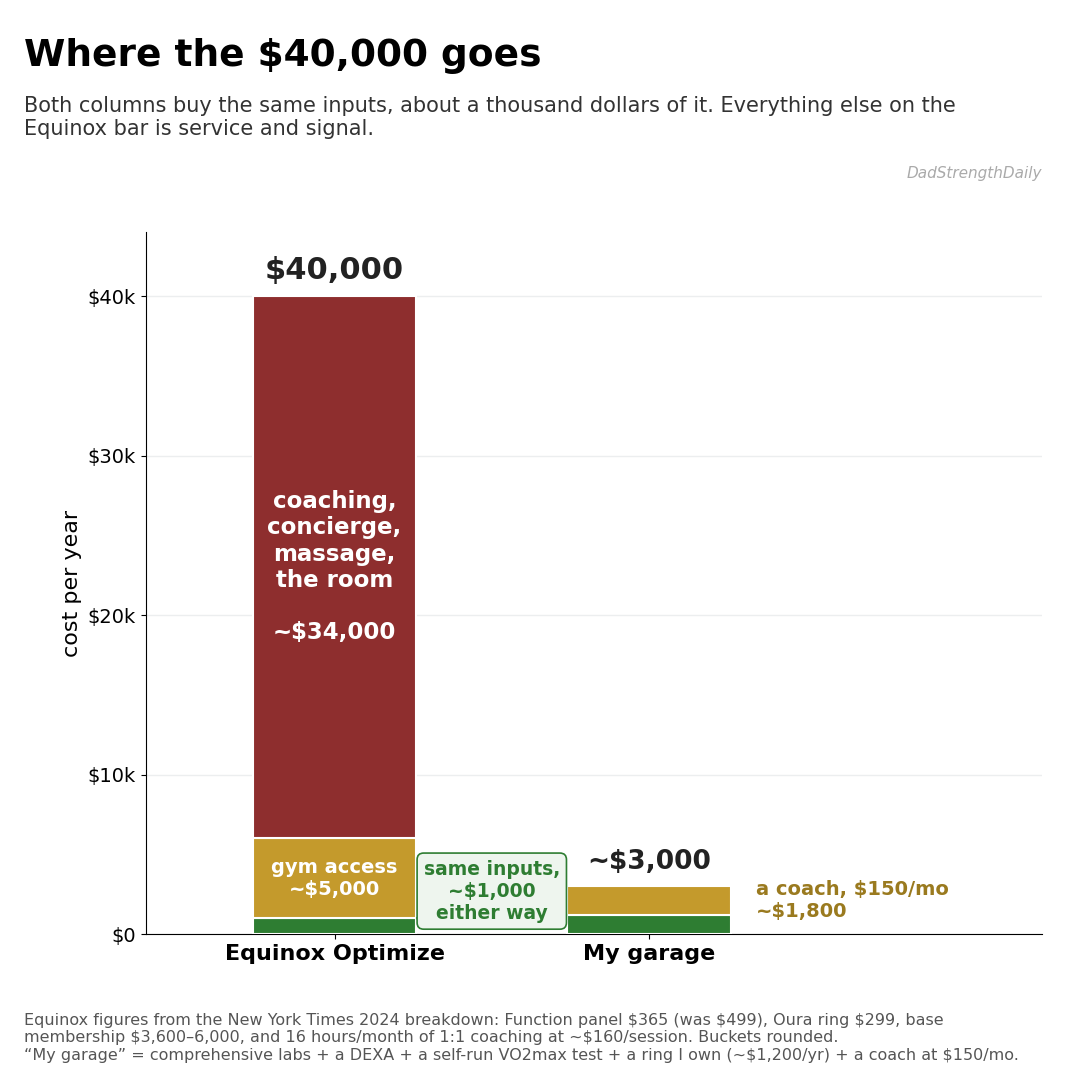
I do the $40,000 longevity protocol. It runs me a few thousand dollars a year, and most of it happens in my garage.
Equinox launched Optimize, its longevity membership, at forty thousand dollars a year, and the waitlist passed a thousand people. For that you get blood work covering more than a hundred markers twice a year, a personal trainer, a nutrition coach, a sleep coach, a monthly massage, an Oura ring, and a “health concierge” to run it all. The executive chairman put the pitch in four words. Health is the new luxury.
I read the list and realized I already do the core of it. My version is simpler: comprehensive blood work a couple of times a year, a body-composition scan, a VO2max estimate I run myself, a sleep-tracking ring I already own, a coach who programs my training for $150 a month, and a barbell and a rower in the garage. Call it a few thousand dollars a year. The same biological inputs, for something close to a tenth of the price, with far less service layered on top. What the cheap version skips is exactly that service around the numbers, the trainer’s hours and the concierge and the nice room, which is the part I think you are overpaying for. So I added up where the other thirty-some thousand actually goes, because the answer maps where health culture is heading right now, whether you are tempted by any of this or just wondering why your feed is suddenly full of it.
The expensive version is not selling secret biology. It is selling accountability, interpretation, convenience, and a room that signals you can afford to be there. Those things are worth something. But the work with the evidence behind it, the lifting and the conditioning and the sleep and the body composition and the few labs that actually change a decision, does not get more powerful because it happens in a nicer building.
What $40,000 actually buys at Equinox
When Optimize launched, the New York Times priced it out, and the line items are not mysterious. The blood panel comes from a company called Function Health, which sells the identical panel to anyone who wants it for $365 a year. It was $499 when the Times wrote it up. A base Equinox membership is $3,600 to $6,000. The Oura ring starts at $299. The rest, the large majority, is sixteen hours a month of one-on-one time: three training sessions a week, two half-hour sessions each with a sleep coach and a nutritionist, a monthly massage. Equinox private coaching runs about $160 a session.
So sort the forty thousand into honest piles. The tests and the gear, the part that actually touches your biology, come to maybe a thousand dollars. Base gym access is a few thousand more. Everything above that, better than thirty grand, is coaching time and the building it happens in.
The scientists the Times called were polite and unmistakable. Daniel Belsky, the Columbia epidemiologist who helped build one of the aging clocks this field runs on (lab-based estimates of how fast you are aging, not proven life-expectancy meters), looked at Function’s hundred-plus markers and called them largely “garden-variety medical tests” you could get through your own doctor’s office. On the program as a whole, he said nobody knows whether forty thousand dollars a year moves you any further toward healthy aging “than the cost of a pair of running shoes would.” Nir Barzilai, who runs the aging-research institute at Einstein, gave the same answer from the other side. Exercise, a decent diet, enough sleep, and strong relationships are the best things a person has for a long life, and he could not say Optimize was worth its price. Michael Snyder, a Stanford geneticist who has co-founded companies that sell panels like Function’s, said it most plainly. “The tests themselves, I mean, they do cost some money, but you’re really paying for the management system, if you will, the concierge service.”
What I actually do in the garage
So what does the version without the concierge look like? This is mine, in full. I get comprehensive blood work a couple of times a year through Marek Health. Disclosure: I pay them, they don’t pay me, and I post my own results, so I am not neutral here. I test that often because I am actively tracking a few interventions and risk markers, not because every healthy man needs two panels a year. The panel is a few hundred dollars, and the point of it is the handful of numbers that change what you do. An elevated ApoB, the particle count behind your cholesterol, starts a real conversation about diet and a statin. A creeping A1c or fasting insulin changes how I eat and how hard I push to stay lean. If a number would not change a decision, I do not need to chase it. The point is never to self-prescribe off a dashboard, it is to take the few numbers that matter to a doctor who can actually act on them.
The rest is unglamorous. A body-composition scan, a DEXA, once or twice a year, which runs sixty to a hundred and fifty dollars at a walk-in place. A VO2max estimate off the bike trainer, a ramp test that costs nothing because I own the bike. It is a field number, not a lab measurement with a mask, but it tracks the trend. The Concept2 rower in the corner. A ring I bought once. And a coach who writes my program and keeps me honest, for $150 a month. Add it up and it is a few thousand dollars a year, most of it the coach. That is the cleanest comparison in the piece: Equinox’s sixteen hours of monthly coaching is most of its forty grand, and my coach costs less per month than one Equinox session and programs for me all year. Same core job, the programming and someone expecting me to do it. (I am also on tirzepatide, a GLP-1, which I come back to later. It is a drug, not what Equinox is selling, so I leave it out of the math, but it does mean some of what my numbers show is drug-assisted.)
Under all of it is the part that does not photograph and costs nothing. I lift. I walk as much as a bad knee will allow. I sleep. I eat like an adult most of the time. I have written before that at some point the gadgets just become shopping, and I still think the rower and the barbell and the sleep matter more than anything you can scan. The tests tell me whether the basics are working. They do not replace them.
What the money at the top actually buys is two real things, and I will not pretend otherwise. One is accountability. A forty-thousand-dollar membership and a trainer expecting you at six in the morning will get some people to show up who would otherwise quit, and showing up is most of the game. The other is integration, a trainer and a nutritionist and a doctor all reading the same numbers instead of you stitching it together at the kitchen table. If you know you will not do it yourself, paying someone may be the right call. Just be clear what you are buying. It is adherence and convenience and a nice place to sweat. It is not better biology than a disciplined person gets at home, and at the upper tiers it can be tests that work against you.
The ladder from $365 to a million dollars
Equinox is not even the top of this market. It is the middle. Start at the bottom: Function’s panel is $365 a year, and a competitor called Superpower will read a hundred markers for $199. Climb a little and you are into the scan clinics, a $2,499 whole-body MRI at Prenuvo, an $8,000 “executive” workup at Human Longevity, a $21,500 membership at Fountain Life. Then Equinox at forty thousand. Keep going and it gets strange fast. Continuum Club in the West Village runs $25,000 to $100,000 a year and caps itself at 250 members. A concierge outfit called Extension Health sells a tier named, with a straight face, “The Superhuman,” for a quarter of a million. And Bryan Johnson, the tech founder who turned not dying into a personal brand, launched a million-dollar-a-year program in early 2026.
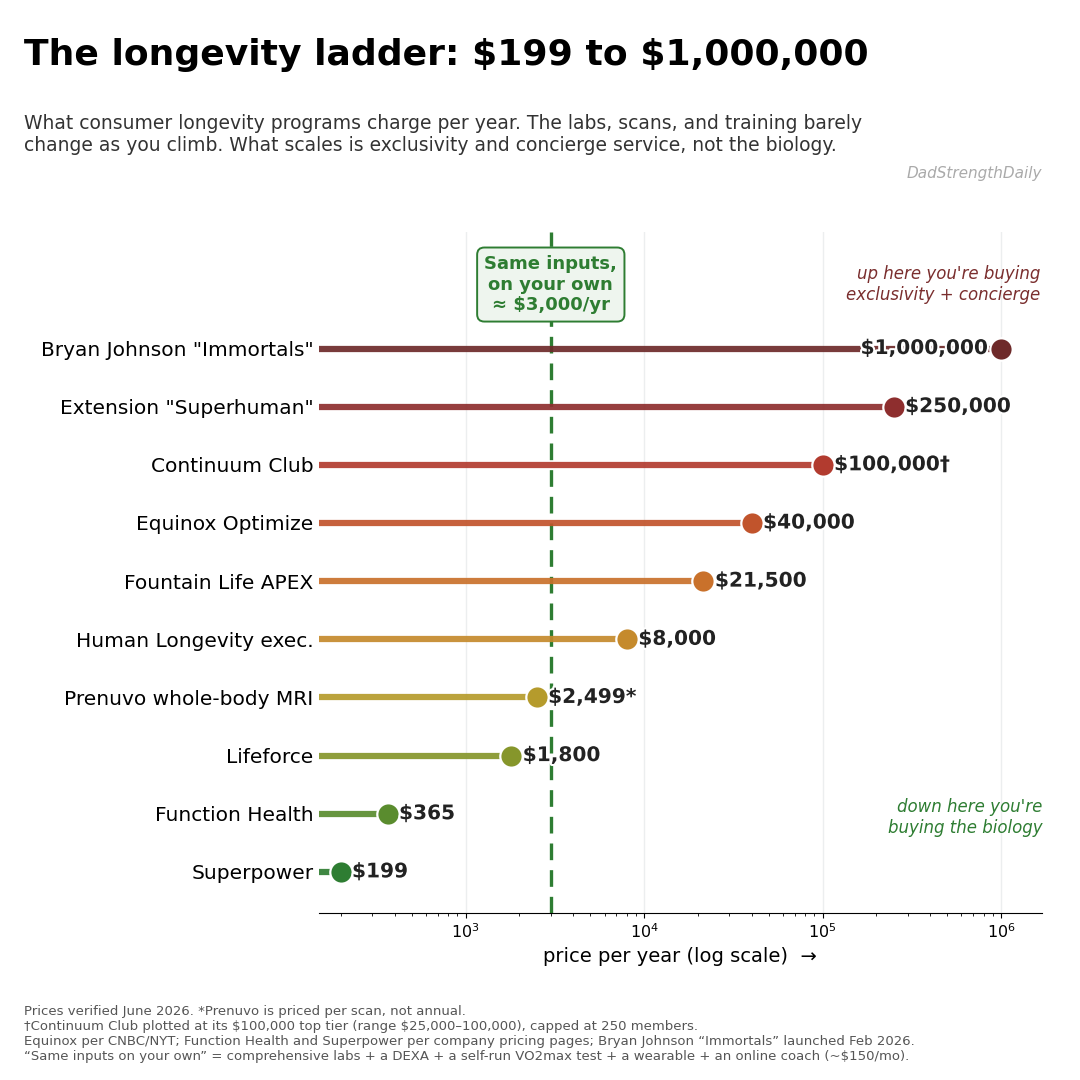
What barely changes as you climb is the biology. The $365 panel and the program that costs a thousand times more are reading mostly the same blood. A barbell is a barbell at every price, even if no one at the cheap end is there to spot you. What climbs with the number is exclusivity, and that is the product.
None of this is new, only more expensive. The gym business has always sold the idea of fitness more than the use of it. Planet Fitness keeps about seven thousand members per club in a room that holds three hundred, and the model only works if most of them stay home. Twenty years ago two economists put a number on the self-deception: people who signed up for monthly gym contracts predicted 9.5 visits a month and made 4.2, paying more than $17 a visit when a ten-pass would have cost them $10, and they renewed anyway. People buy the membership for the person they mean to become, then mostly stay home. Optimize is the luxury apex of that same bet, placed with two more zeros.
The new Rolex is a VO2max
Here is the one thing money has never been able to buy: a body. You can buy a watch this afternoon. You cannot buy a high VO2max, a low body-fat percentage, or a resting heart rate in the forties. Those take years and a kind of discipline that does not arrive with the wire transfer. That is why, somewhere in the last decade, fitness became the status symbol the wealthy care about most. A Rolex says you have money. A sub-five-minute mile at fifty says you have money and the self-command to spend it on yourself. It is the harder flex, and the more impressive one.
So the metrics became the jewelry. People quote their Oura score and their ApoB the way they used to mention where they ski. It is the body-conscious version of quiet luxury: a number no one can see unless you tell them is a more refined signal than any logo.
So a price like Equinox’s forty thousand dollars is not a problem to be optimized away. It is the point. This is a Veblen good, more desirable because it costs more, because the cost is what keeps the room small. The thousand-person waitlist is not a supply failure. It is the advertising. When the chairman of Equinox says health is the new luxury, he is reading out his business model.
Follow the instinct to its richest extreme and it stops being about looking good and turns into not dying at all. Bryan Johnson sells a million-dollar-a-year longevity program and has tried transfusing plasma from his teenage son; Bezos and Altman have poured fortunes into cellular-rejuvenation startups. None of it has worked yet, and the catch is the one nobody escapes. They will die too. That is the part the money cannot buy its way out of.
The newest version of that hope is already in my medicine cabinet, and unlike a scan or a plasma transfusion it might actually move the biology. The week I drafted this, the Times asked whether the weight-loss drugs are also longevity drugs; the only trial to measure it found semaglutide slowed the lab clocks of aging in a small, conflicted, after-the-fact look at eighty people with HIV. Maybe it holds up in healthy people, but the drug I take has a known cost in muscle and bone, the two tissues a fifty-year-old defends with a barbell and protein, not a prescription.
And that cuts the other way, which is the good news. The thing this market is straining to signal, a strong and durable body, is the one thing on the menu money cannot shortcut. Pay forty thousand dollars or pay a million, you still have to do the reps, get the sleep, and put in the years. The part that actually earns the signal, the barbell and the walk and the early night, sits there nearly free for anyone willing to do the work.
The tests that can hurt you
And the problem is not only that the top tiers are overpriced. Some of what they add is not neutral. Past a certain rung you stop buying health and start buying findings, and findings on a healthy person are mostly a liability.
In June 2026 two radiologists published an editorial in JAMA titled “Elective MRI Screening of the General Public, Buyer Beware.” Their verdict on the whole-body scans the upper tiers are built on was blunt. No major medical society recommends them for people without symptoms, they are unproven, and the harms likely outweigh the benefits. The reason is the incidentaloma, an accidental finding that turns up only because you went looking everywhere. Scan a healthy body in enough detail and, depending on the scan and the study, you turn up something in a fifth to two-fifths of people, a thyroid nodule, a small adrenal mass, a cyst on a kidney, the kind of harmless spot a healthy fifty-year-old carries around without knowing, and almost all of it turns out to be nothing. The hard part is telling which. But you cannot tell that from the picture. So the spot becomes a second scan, then a biopsy, then weeks of fear and sometimes a real complication, all chasing a problem that was never going to hurt you. This is about elective scanning in people with no symptoms, not the MRI your doctor orders because something is actually wrong. Those are different things.
The hundred-marker blood panels carry a gentler version of the same risk. A doctor who ran himself through Function’s testing told TIME that about half the markers were ordinary labs his doctor already ran, and he was not sure the rest were worth the cost in money and worry. Practicing doctors have said the same to STAT: they have become unpaid interpreters for tests their patients ordered alone, talking people down off numbers that mean little without context. The likeliest result of testing a well person for everything, as one researcher put it to NPR, is not a clean bill of health and not a life saved. It is something indeterminate that produces anxiety. I took the same question to the wider industry in what functional medicine actually sells, and where it breaks down.
So this is the genuinely odd corner of the market: the one place where paying more can buy a worse result.
The cheap part is the part that works
Two years ago I wrote a piece I called Peter Attia on a Budget, about building the concierge-clinic protocol yourself for a fraction. I still stand by the bones of it, but I would write it differently now. Back then the argument was that you could buy the protocol cheaper. What I would add today is that you should also want less of some of it than the top of the ladder is selling. Even the field’s biggest name has taken fire for downplaying the risks of overtesting and for advice that, once you cost it out, fits almost only the very wealthy.
Cut the luxury packaging and the working program is almost embarrassingly plain. A barbell. A rower or a bike. A few hundred dollars of blood work a couple of times a year. A scan now and then. Sleep. A coach who costs less per month than one session at the club. The handful of things with the strongest evidence behind a longer, healthier life have been cheap the whole time, and mostly within reach. It is also what is left of the Blue Zones once you take the branding off: move, eat real food, keep your friends. Real medical problems still need real care, and that is its own bill. But the base that does the heavy lifting was never the expensive part. What runs forty thousand dollars, or a quarter of a million, or a million, is the service around it and the company in the room. That is a real thing to want, and people will keep paying for it. Just know that you are paying for the luxury, not the years.
About Gunnar
Gunnar is 53. He lost about 170 pounds, trains in a garage gym, and writes DadStrengthDaily from personal experience, citing primary sources where he can. He also moderates r/ProactiveHealth. He is not a doctor, and nothing here is medical advice. Talk to your own doctor before acting on anything, especially GLP-1s, TRT, blood pressure, sleep apnea, and cancer screening.