
The “five times the risk” number is real. The useful lesson for a fifty-year-old is smaller, less sexy, and more actionable.
I have read the claim that VO2 max is the single best predictor of how long you will live so many times that I had stopped seeing it. It is everywhere in the longevity world, always bolted to the same striking number. Among the hundred-thousand-plus patients who came through the Cleveland Clinic for a treadmill test, the least fit had about five times the death rate of the fittest. Five times. That is a wider spread than smoking, than diabetes, than nearly anything your doctor measures.
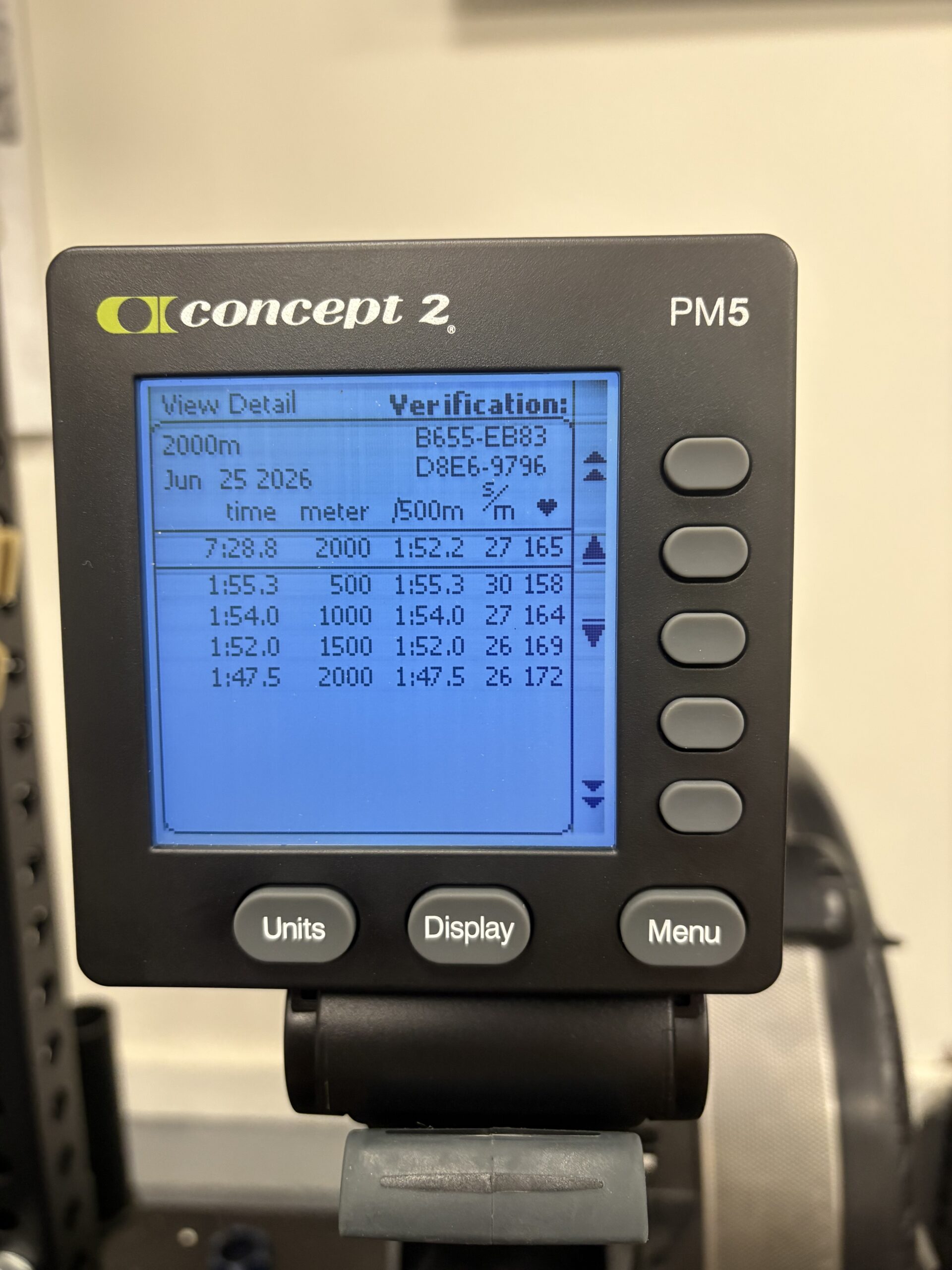
The number is real. I also have one of my own. I rowed a hard 2,000 meters in the garage this week and the result works out, by the rowing estimate, to a VO2 max around 42, decent for a man of 53 and a long way from impressive. Before I decided how to feel about that, I wanted to know what the number was actually worth. Is a high VO2 max doing something for me, or is it just a flattering readout of a body that was already built to last? Those are very different claims, and only one of them is a reason to train.
A high VO2 max is not grip strength, and it is not LDL either
Grip strength is the cautionary tale here. Squeeze a gauge in a doctor’s office and the result predicts your odds of dying over the next decade about as well as your blood pressure does. The squeezing itself is not what protects you. Strength itself does real good, and building it makes you less frail, but grip, as a number on a gauge, is mostly a readout. It reports something true about the whole body, muscle, nerves, how well you have aged, and you cannot add years to your life by training your hands for the test. More a marker than a lever.
LDL cholesterol sits at the opposite end. We have randomized trials that lower the number with a drug and watch heart attacks fall right alongside it, and genetic studies showing that people born with lifelong low LDL get a fraction of the heart disease. Move the number, move the outcome. That is cause, not correlation.
VO2 max lives between those two, and it leans closer to the LDL end than to the grip end, though not all the way. Nobody has run the trial that raises people’s fitness and then watches their death rate fall, the way the statin trials did for LDL, so the evidence here is still mostly observational. Two things push it toward the lever end anyway. The first is that the thing producing the number is a behavior with its own track record. Men whose measured fitness improved between two tests taken years apart went on to die less often than men whose fitness slipped over the same span, no matter where they started, and the ones who climbed from unfit to fit cut their age-adjusted death rate by about 44 percent (Blair’s Aerobics Center cohort). That is a sturdier kind of evidence than any single snapshot, because it follows one person as they change, which is the thing reverse causation has trouble faking.
The second fact pulls in the other direction. About half the variation in VO2 max across people tracks with genetics, and so does much of the variation in how people respond to training. A well-known family study ran volunteers through an identical twenty-week program and found the gains ranged from almost nothing to more than a liter a minute of extra capacity, clustering in families, with the response itself close to half heritable. Some people are simply low responders. This is about differences between people, not destiny for any one of them. It does not mean half of your own number is fixed at birth, only that the raw material and the trainability vary, and you find out where you land by doing the work.
To keep myself honest, I also put income on the same scale. Measured the raw way, worst fifth against best, the income gap is one of the widest of all, wider even than fitness. Most of it disappears the moment you adjust for the obvious differences, because richer people are, on average, fitter, leaner, and better doctored, so much of what looks like a fitness effect is really money and circumstance traveling through it. You cannot cleanly stack fitness on top of income. They overlap, with income sitting underneath.
The famous “five times” is mostly an artifact of where they drew the line
The five-times figure has a catch that took me a while to notice. It compares the bottom group against a thin sliver at the very top. In the Cleveland Clinic study, “elite” did not mean the top fifth of people. It meant the top two and a third percent, the ninety-eighth percentile and above. Set the least fit fifth against the fittest two percent and you are bound to get a dramatic ratio, and it is not the comparison most of us should be planning around.
There is a second thing the headline glides past. What that study ranked was not a lab VO2 max from a mask and a gas analyzer, but cardiorespiratory fitness estimated from how long people lasted on a treadmill, scored in METs. The two track closely and the field often treats them as one, yet they are not the same measurement, and neither is the number my rowing machine hands me. Most of the famous longevity figures, this one included, ride on the estimate rather than the lab test. That does not sink the finding. It just means the thing being measured is general fitness, not a precise reading off a tube.
Put every predictor on equal footing instead, the worst fifth of the population against the best fifth, and the number gets smaller but a lot more useful. I built the chart below that way, taking each line from the study that measured it best and putting them on one scale: how much more likely the worst fifth is to die than the best, after the usual adjustments for age and the obvious confounders. It is a rough comparison, not a definitive leaderboard, since the lines come from different studies and groups of people. It is just honest about size in a way the headline is not.
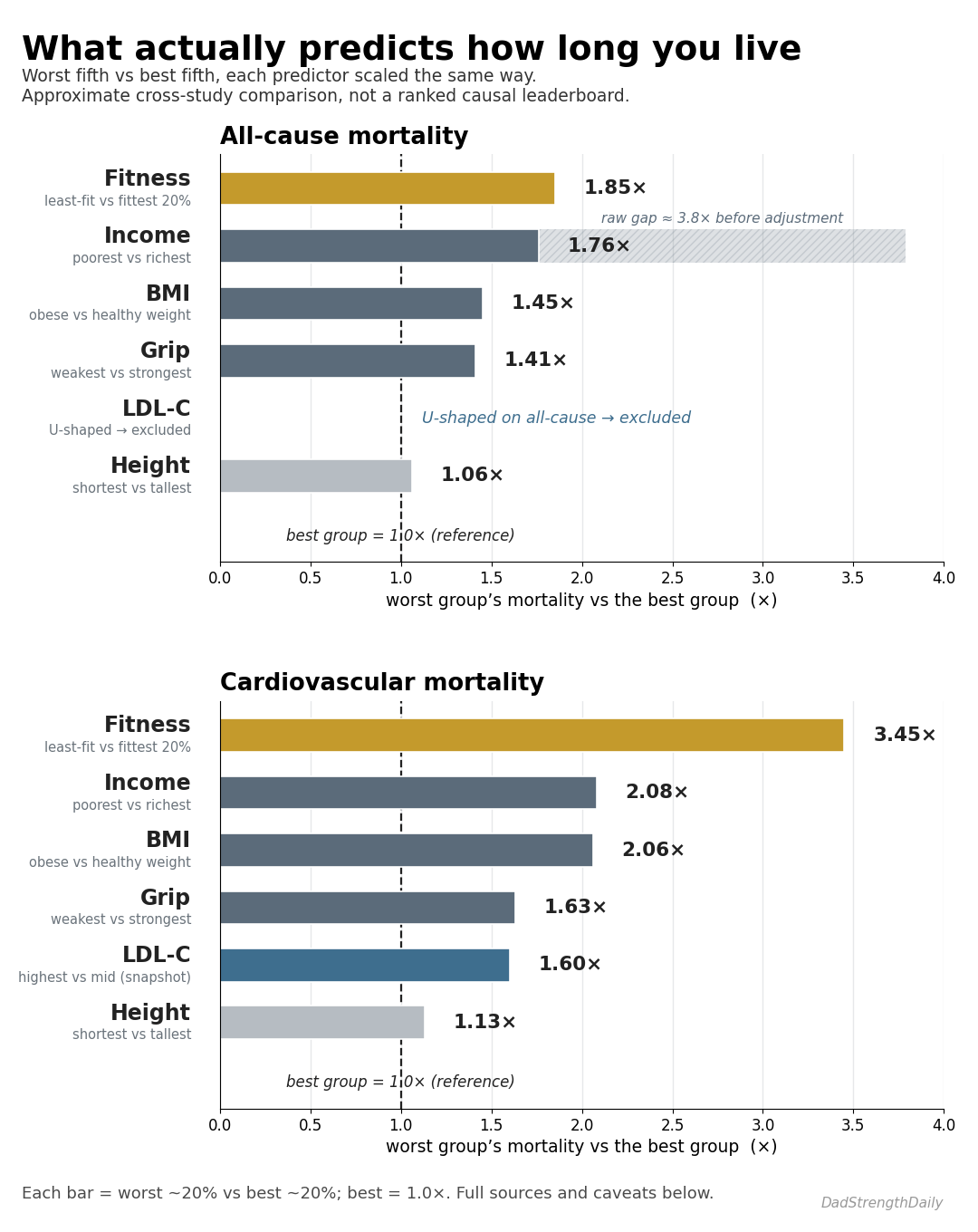
Each line on the chart comes from one primary source: fitness from Barlow (JAHA 2012, Cooper Center); income from the Southern Community Cohort (AJPH 2014, fully adjusted, raw gap about 3.8×); BMI from the Global BMI Collaboration (Lancet 2016); grip from Wu (JAMDA 2017); LDL-C from Rong (JAHA 2022); height from the Emerging Risk Factors Collaboration (IJE 2012). The famous fitness 5.04× (Mandsager 2018) sets the bottom group against the top 2.3 percent, a tail rather than a fifth. Where a study did not report exact fifths, the nearest reported category is used. These are associations, not proof of cause, with the exception of LDL.
Compared that way, fitness still comes out unusually strong, just not five times strong. The worst fifth carries about 1.85 times the risk of dying from any cause as the best fifth, and closer to 3.4 times for cardiovascular death, where your lungs and circulation have the most say. Grip strength, the pure marker, lands lower. Income looks about level with fitness here, but that bar is the adjusted version, with the slice that travels through fitness and weight already stripped out. Before that adjustment its gap is the widest on the chart. Height, which I dropped in as a sanity check, barely moves. The flashy number was never the part that mattered to me. This fairer one was, because it is the part I can act on.
Getting off the floor matters more than reaching the top
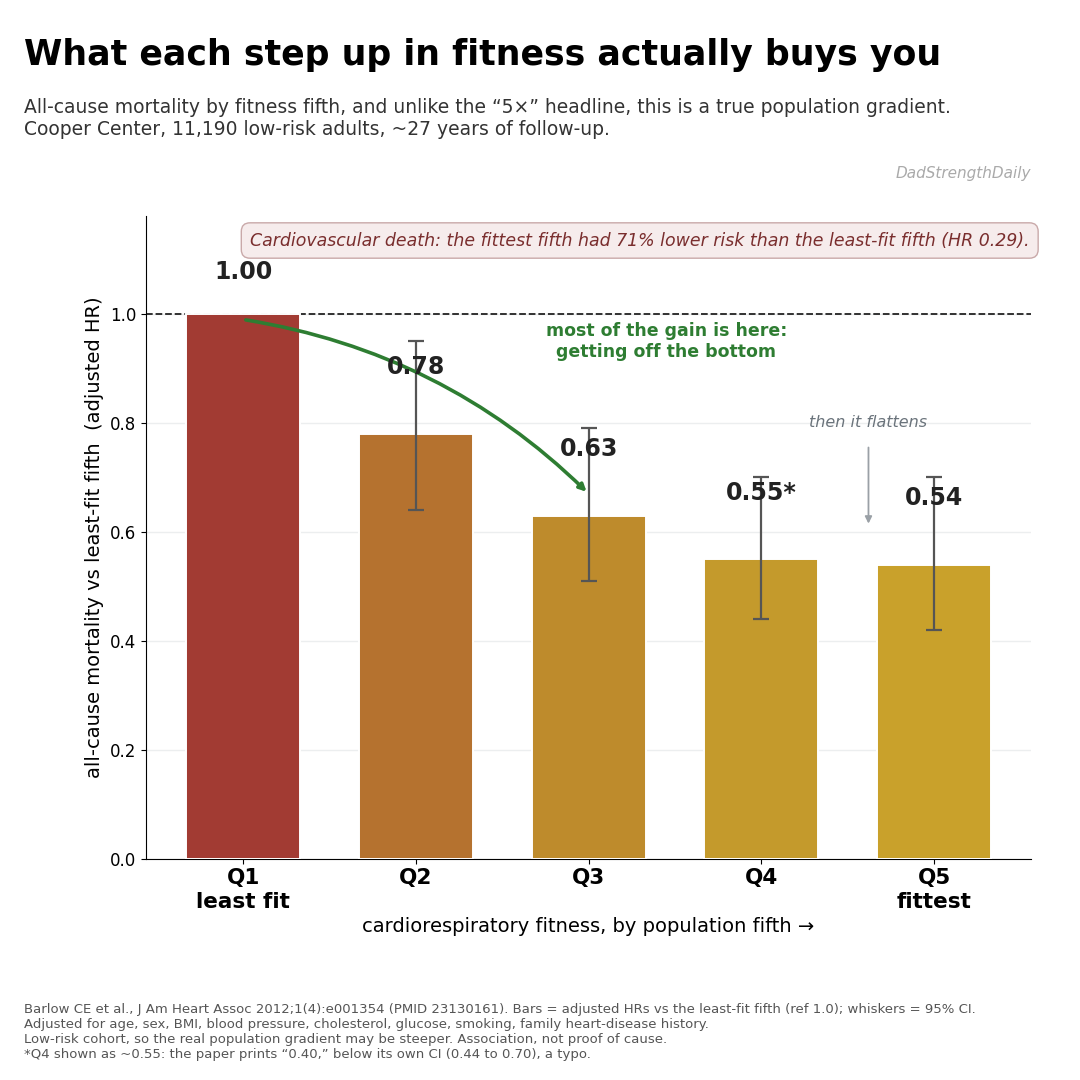
When you walk up the fitness ladder one rung at a time, the gift is front-loaded. Going from the least fit fifth to merely below average buys you more than going from good to great. The steepest drop in risk is right at the bottom, the move off the floor, and the curve flattens as you climb.
I find that freeing. It means the fifty-year-old who has done nothing does not need to chase an elite number to collect most of the reward. He needs to stop being sedentary. The man going from the couch toward a few hours of cardio a week, built gradually, is making one of the most valuable moves on the whole chart. The man going from very fit to slightly more fit is fine-tuning a thing that is already paid for.
It also takes the pressure off testing. You do not need a lab to know that a fifty-year-old should be doing some easy cardio and some hard intervals. The prescription is the same whether your number is thirty or forty-five. If you do test, the useful version is testing again a few months later to see which way the line is moving.
That is why I keep going back to the rowing machine. My 42 is comfortably above average for my age and a mile short of the top couple of percent the headline is built on, which is exactly the boring, good place to be. But it came off a single 2k, and a single 2k is a bragging right at best. What I actually watch is the same piece every few weeks, whether it is getting easier or a little faster, because the direction is the part I own and the absolute number is half inheritance.
Mostly easy, with a little very hard
The training that moves the number is not complicated, and I have written the full protocol elsewhere. Most of it should be easy, a pace where you can talk in short sentences but would rather not sing, the zone-two work that builds the base over months. A smaller slice should be genuinely hard. One caution belongs right here, before the hard part: if you have heart disease or chest pain, or you have been sedentary for years, do not open with four-by-fours. Build the easy volume first, and get cleared by a doctor if there is any doubt. With that base under you, the hard slice is the four-by-four intervals the Norwegians made famous, four minutes near your ceiling and four minutes easy, repeated four times. For me most weeks that is three or four easy sessions and one hard one.
The engine still answers at fifty and sixty and seventy. A large trial that put healthy seventy-somethings through interval training had them raising their VO2 max safely, though it did not show a clear drop in deaths, so I would not sell it as proof that intervals add years. Trainability fades with age, but it does not vanish, and most people have far more room than they assume.
I do mine indoors, easy aerobic work on a bike and the hard pieces on a rowing machine, because my knees quit on running a long time ago. That used to feel like a compromise, as though I were settling for less than the real thing. The data cured me of that. The engine does not know whether you built it running, rowing, or pedaling in a garage. It only knows whether you made it work hard enough, often enough. A number that a watch once called “poor” because I do not run turns out to be one of the few I can actually move in the right direction, as long as I keep showing up to build it.
So I have made my peace with the headline. VO2 max is not the five-times miracle the podcasts sell, and it is not a passive readout the way grip strength mostly is, either. Most of its payoff is still sitting unclaimed by whoever is least fit today. If that is you, skip the test and the target for now. Put twenty easy minutes on a bike or a rower a few times this week, and add one hard session when that stops feeling like much. I will be out in the garage chasing the same 2k.
Get the next one in your inbox
I write about longevity, training, and preventive health weekly — without the guru worship. Free, no spam, unsubscribe whenever.
The same study compared the two against one starting group and found cardio did more of the work than lifting did. That chart leads the guide.
About Gunnar
Gunnar is 53. He lost about 170 pounds, trains in a garage gym, and writes DadStrengthDaily from personal experience, citing primary sources where he can. He also moderates r/ProactiveHealth. He is not a doctor, and nothing here is medical advice. Talk to your own doctor before acting on anything, especially GLP-1s, TRT, blood pressure, sleep apnea, and cancer screening.