
Updated with a link to the retatrutide price estimate.
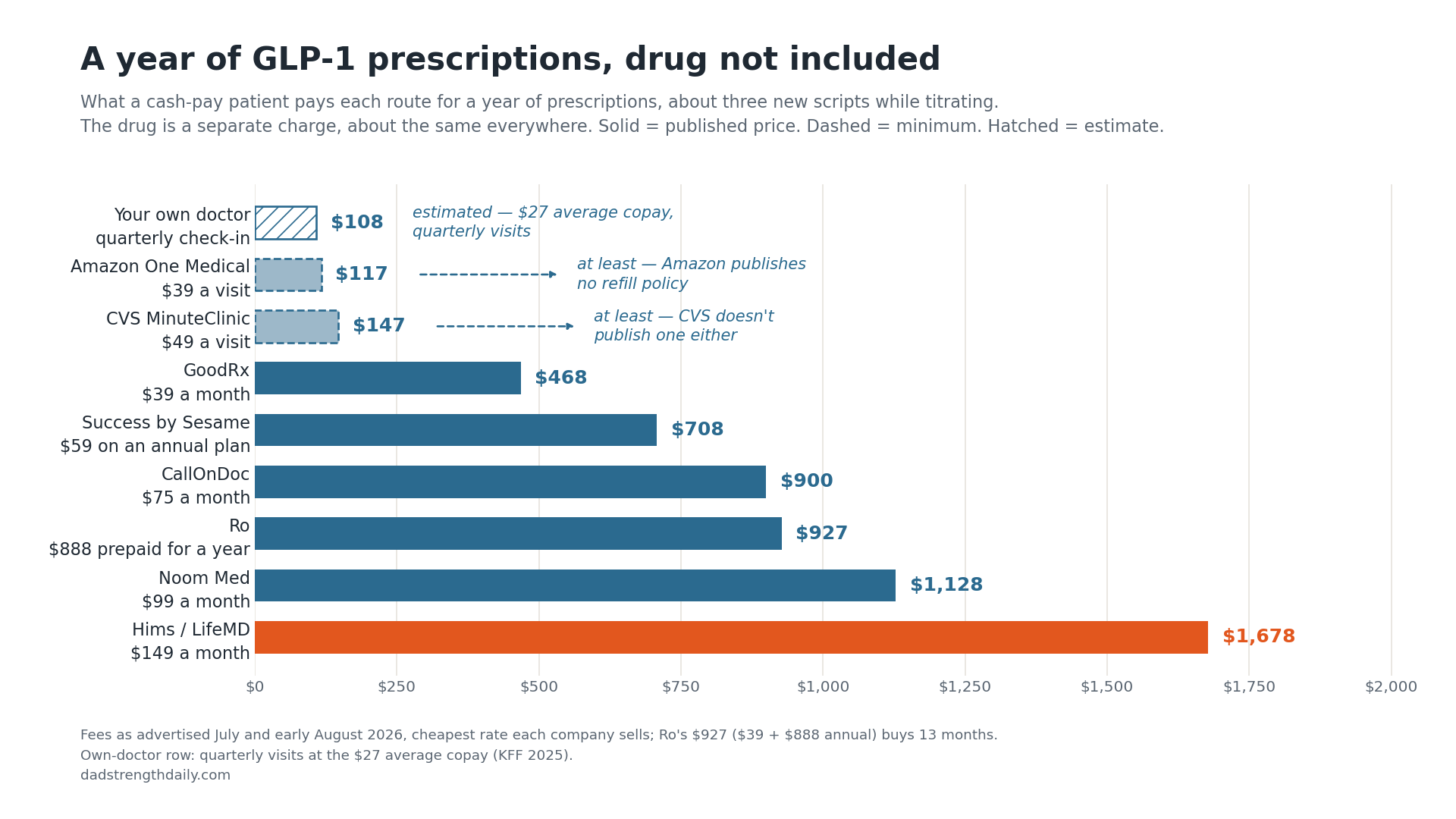
When insurance says no, the drug costs what LillyDirect and NovoCare charge, just about wherever you buy it. The prescribing service is the part you can shop, and it runs from about $100 to nearly $1,700 a year.
I got my Zepbound prescription at my annual physical. My doctor wrote it, sent it to my insurance, and the insurance said no, as many plans still do when the prescription is for weight loss. So I told her about LillyDirect, Eli Lilly’s own pharmacy that sells the drug for cash. It took a couple of tries, because LillyDirect was new enough that it was not in her electronic records system yet. Then it worked, and I bought it that way for months.
Total cost of the prescription itself, across all of those months: one office visit I was already having.
Every comparison of these services I could find on Google carried affiliate links, which makes the rankings hard to trust. So I spent an evening pricing the same prescription at nine different companies myself. There are no affiliate links in this post and nobody is paying me. I have written before about the five channels Americans actually use to get these drugs. This is narrower, and it is about the case where insurance will not cover the drug, so the medication is cash out of your own pocket: what it costs to get and keep the prescription on each one.
Nine companies, and the drug price barely moved. What it cost to get the prescription for a year ran from about a hundred dollars to almost seventeen hundred. If you are buying Zepbound or Wegovy without insurance coverage for the drug, the price of the medication is mostly settled for you at LillyDirect and NovoCare’s numbers. The prescribing service is the part you can shop.
The medication is not in any of the numbers below. What I am comparing is the care around the prescription: someone evaluates you, writes it, and keeps managing it for a year. Some services bundle coaching, messaging and insurance help into that; others charge by the visit. That makes it an imperfect comparison, but it is the one a cash payer actually faces. And it is the official branded product only: I expect the compounding pharmacy route to go away, and I am not discussing illegal imports from China. The post does not assume you have no insurance at all. The office visit that produces the prescription is usually still covered even when the drug is not, and that is what keeps the top row of the table cheap.
Disclosure: I take tirzepatide (Zepbound) and I own Eli Lilly stock, the only individual pharma stock I hold.
Here is what I found. If you just want the advice, there is a one page version of this whole post.
| Route | Month to month | If you pay up front | Minimum first-year cost |
|---|---|---|---|
| Your own doctor, then LillyDirect or NovoCare | $27 a visit | not a subscription | estimated $108 on a quarterly check-in (4 visits × $27) |
| Amazon One Medical, On-Demand | $39 a visit | not a subscription | at least $117 (3 × $39) |
| CVS MinuteClinic, virtual | $49 a visit | not a subscription | at least $147 (3 × $49) |
| GoodRx | $39 | none offered | $468 (12 × $39) |
| Success by Sesame | $99 | $59 on an annual plan | $708 (12 × $59) |
| CallOnDoc | $75 | a $24.99 plan exists, see below | $900 (12 × $75) |
| Ro | $149 | $74, billed $888 a year | $927 for 13 months ($39 + 12 × $74) |
| Noom Med | $99 | none offered | $1,128 ($39 + 11 × $99) |
| Hims, LifeMD | $149 | none offered | $1,678 ($39 + 11 × $149) |
The last column is the least you can pay each route in the first year, at the cheapest rate each company actually sells, assuming about three new prescriptions while you titrate. The own-doctor row is an estimate built on KFF’s $27 average copay and quarterly visits; your copay and your doctor’s schedule move it. Ro’s $927 is the $39 first month plus the $888 annual block, which buys you thirteen months, because there is no way to buy exactly twelve at that rate. CallOnDoc’s row uses the $75 its weight loss page publishes; the cheaper plan is a workaround, covered below.
What Zepbound and Wegovy cost without insurance
For most of the GLP-1 era, the way to save money was to find a cheaper version of the drug. That is what the compounding pharmacies were, and it is what built the telehealth weight loss business. Hims sold compounded semaglutide for around $200 a month all in, which was a fraction of what the branded drug cost, and the margins on it were enormous.
At the big telehealth brands, that business is over. Novo Nordisk sued Hims in February, the two settled on March 9, and Hims agreed to stop marketing compounded GLP-1s and sell the real thing instead. Meanwhile both manufacturers opened their own cash pharmacies. NovoCare sells Wegovy directly. LillyDirect sells Zepbound. Anyone with a valid prescription can buy from either.
Once the manufacturer sells the drug directly at a published price, the services downstream have little room to mark the branded medication up. When I checked in July 2026, essentially nobody was trying. Ro, LifeMD, Sesame, Amazon and Hims all advertise the same manufacturer prices or route you straight into the manufacturer’s program.
The numbers, as the manufacturers publish them in August 2026: Zepbound through LillyDirect is $299 a month at the 2.5 mg starting dose, $399 at 5 mg, and $449 at every dose above that — and the $449 is a purchase offer that requires refilling on schedule, not a sticker price. Miss the window and the list price on those doses is $499 to $699. Wegovy through NovoCare is $199 a month for your first two fills if you are new to the program, then $349, with the 7.2 mg high dose at $399; the once-daily Wegovy pill runs $149 to $299 depending on dose. Both savings programs currently run through December 31, 2026. So a month of Zepbound or Wegovy without insurance costs roughly $300 to $450 at the manufacturers’ own pharmacies, before anyone charges you for the prescription.
Update, September 2, 2026: Amazon Pharmacy is now listing the Zepbound single-dose pens at a flat $399 a month at every dose for Prime members paying without insurance. That makes it a worse deal than LillyDirect at the 2.5 mg starting dose, where Lilly charges $299, a tie at 5 mg, and $50 a month cheaper at 7.5 mg and above, where Lilly’s best self-pay price is $449. The $399 is Amazon’s own discount, not a Lilly coupon: the KwikPen on the same site is listed at Lilly’s $449. Lilly’s self-pay pricing does not cover the single-dose pen at all. Its $449 is for the KwikPen or the vials, and only if you refill within 45 days. Miss that window and the regular price is $499 to $699. Against that, a Prime membership costs $139 a year. I have not run a prescription through Amazon’s checkout, so I cannot say how long the price lasts or whether it outlives Lilly’s savings programs, which end in December. If you pay cash at a maintenance dose, check Amazon before your next LillyDirect refill.
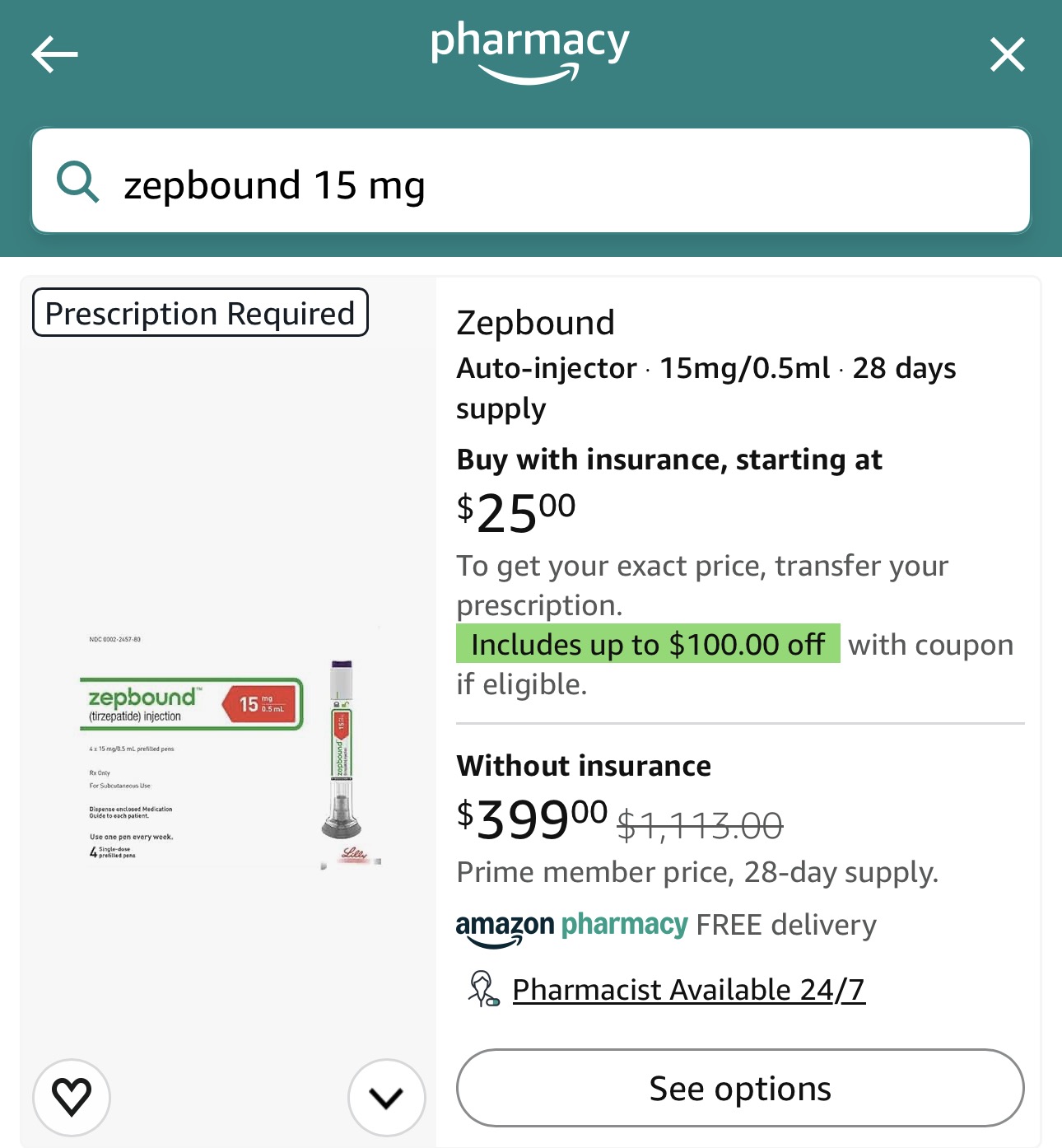
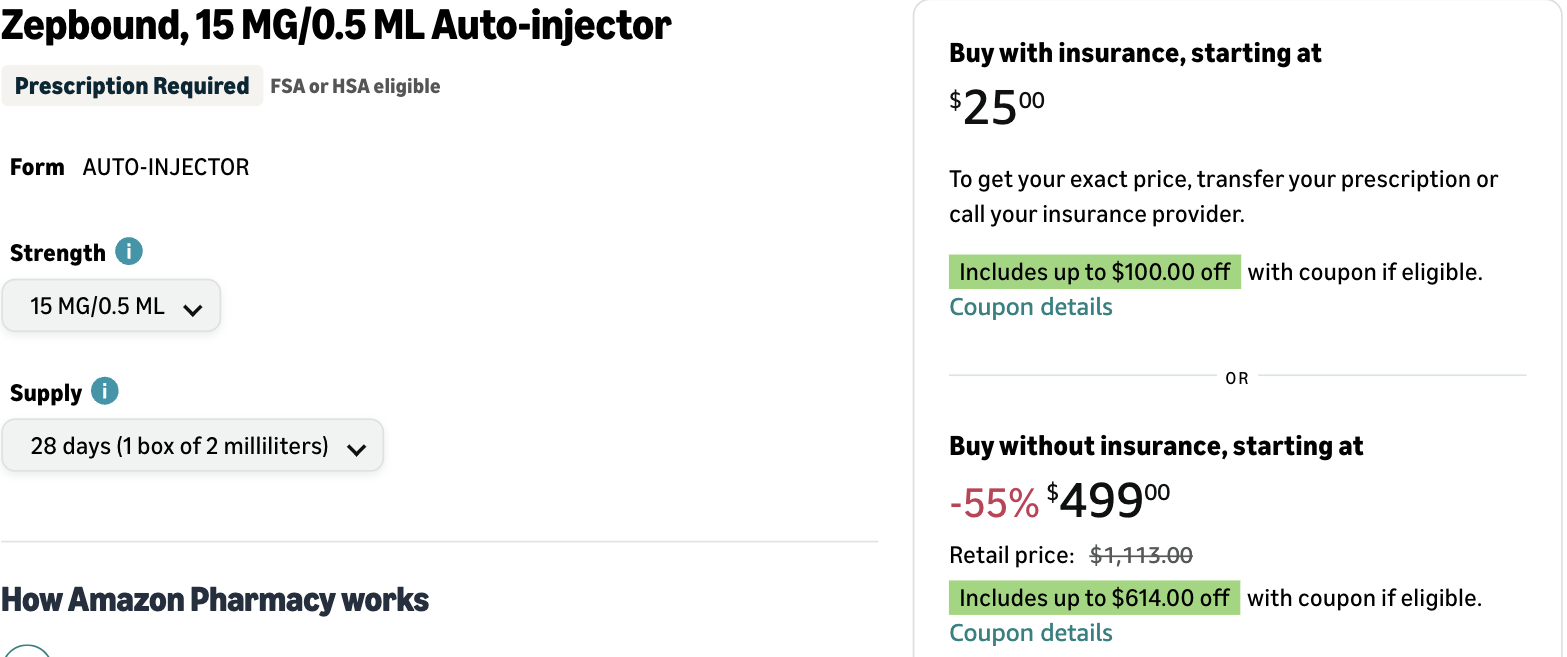
Update, September 4, 2026: The $399 price above is gone. Checking the same pens again two days later, both the 2.5 mg and 15 mg listings show $499 without insurance, with no Prime-member language on the page at all. That reverses the comparison: at $499, Amazon is now worse than LillyDirect’s self-pay price at every dose, not just 2.5 mg, by $200 at the low end, $100 at 5 mg, and $50 at 7.5 mg and up. I don’t know whether the $399 was a short-lived promotion or a pricing error; it held for at least the two days I could verify it. The lesson from both updates is the same one: compare Amazon and LillyDirect right before you buy, because the cheaper option can flip in either direction.
Nothing caps what they charge you to write the prescription.
Get the next one in your inbox
I cover the latest GLP-1 trials and access changes weekly. Free, no spam, unsubscribe whenever.
Three companies landed on exactly the same monthly number
Hims, Ro and LifeMD all charge $39 for your first month and then $149 a month, and all three explicitly exclude the medication from that fee. I checked them one after another expecting a spread and got the same number three times. Hims puts it in the fine print on its own page: an active membership is required, and “medication cost not included.” Ro’s FAQ says the same. LifeMD’s says the same.
That is $1,678 for your first year and $1,788 every year after, for the prescription and the app around it. The drug costs what it would cost anyway.
That heading is only true month to month. Ro will also sell you a year up front for $888, which is $74 a month, roughly half its own monthly rate. Hims and LifeMD had no equivalent I could find. So three companies that look identical on the page you land on are not remotely identical once you ask about paying up front, and the number they show you is the higher one.
The rest of the market has not landed there. Noom does the same thing at a lower number, $39 to get started and then $99 a month for its branded medication track, medication also excluded. Success by Sesame, which is also where Costco now sends its members, starts at $59 a month on an annual commitment. GoodRx runs a weight loss subscription at $39 a month. CallOnDoc sells a weight loss plan starting at $75 a month.
Ro, Sesame and CallOnDoc charge less if you pay up front, and none of them leads with it. The cheap rate always requires a commitment the landing page does not mention, and the people I found on Reddit reporting real bills were paying the higher monthly numbers.
CallOnDoc I could not pin down from published pages, so I asked, and what came back is reader reports, not a published price. Its weight loss page advertises $75 a month. Its subscribe and save page sells an Advantage plan at $24.99 a month, or $59.99 a quarter prepaid, that includes more visits than a refill needs. Two people told me they get Zepbound on the quarterly plan and have never paid the $75, and both described the same maneuver: subscribe first, then open the visit as a prescription refill instead of as a weight loss visit. A third asked CallOnDoc directly and was told the cheap plan had been phased out. One of the two had used it again days earlier, and the subscribe and save page was still selling the plan when I checked in early August.
So the $24.99 is real for some people and unreachable for others, and which one you are appears to come down to a menu choice at checkout. That is a workaround rather than a price, and the table uses the $75 the company publishes.
And then there is Amazon, which is the one that made me stop and reread the page. Amazon One Medical launched a national GLP-1 program in April, and its announcement says plainly that One Medical membership is not required to get started or to schedule a visit. Its weight loss page prices care “from $39,” you buy the medication at the same cash prices everyone else charges, and you can send the prescription to whatever pharmacy you want. Amazon also says in writing that it will not charge you if it turns you down: if a provider reviews your intake and decides they cannot treat you, “your treatment will be canceled and you won’t be charged.”
The $39 is not a monthly fee. Amazon calls it On-Demand Care, which used to be called pay-per-visit. Each treatment buys the visit plus fourteen days of follow-up messaging with the care team, and when you need a dose change later you pay again.
So I tried to work out what a year of Amazon would cost. Zepbound goes 2.5, 5, 7.5, 10, 12.5, 15, and the label allows a step every four weeks. In practice plenty of people sit at 5mg or 7.5mg for months because it is working fine and there is no reason to go up. Others are waiting out side effects, or cannot get hold of the next dose. Spread the six steps over two years, which is closer to how mine have actually gone, and you are asking for three new prescriptions a year.
I could not work it out.
What the $39 leaves out is refills. Whether the prescription you walk away with includes them is left to the individual clinician, and Amazon promises nothing either way. Its FAQ says only that if your provider did not include refills, “you’ll need to start a new treatment to request another prescription.” Once the fourteen days are up, anything further, a question or a dose change or a renewal, means you “request a new treatment.” A new treatment is a new charge.
So three prescriptions a year at $39 is the floor, not the bill. What you actually pay depends on how freely your clinician writes refills and how often you need to talk to someone, and Amazon publishes no visit schedule, no supply length and no refill policy for GLP-1s anywhere I could find.
CVS started doing the same thing in June. MinuteClinic charges $49 for a virtual weight loss visit and said when it announced the program on June 22 that there is no recurring membership or monthly fee. It is also the only company here that states plainly what it will not prescribe: compounded GLP-1s and controlled substances for weight loss are not prescribed at MinuteClinic.
The fine print takes some of that back. The $49 covers the consultation and not the labs. GLP-1 prescribing is not available in every state. CVS says the program covers 47 states and Washington, D.C., and does not name the three that are out. And its page never names Zepbound. It refers to GLP-1 agonists in general, and the one medication price it quotes, $149 a month, matches Novo’s price for oral Wegovy rather than anything Lilly charges, and CVS does not say which drugs qualify. I have used the $49 it publishes, and I would confirm they will write tirzepatide before paying it. CVS does not publish a refill policy either, so its number is a floor for the same reason Amazon’s is.
What the monthly fee actually buys
The monthly fee is not empty. The subscription companies all advertise ongoing provider messaging, dose titration, and help managing side effects, which matter more than they sound like they do if this is your first GLP-1 and the nausea arrives in week three. Noom adds a behavior change program, Ro and LifeMD will chase your insurer, and for someone without a doctor, or with one they would rather not discuss their weight with, the fee buys the conversation itself.
What the fee is mostly not buying is screening. A Yale team secret shopped 49 online GLP-1 sellers and 45 of them wrote a prescription. A high approval rate does not prove any single prescription was wrong, but it tells you the fee is not buying a hard look at whether you should be on the drug.
So check the refund policy before you pay anyone. Two of the nine, Amazon and Ro, promise in writing not to charge you if they decide they cannot treat you; Ro’s page says your $39 is refunded if you are not eligible. The rest say nothing, and people on the GLP-1 subs describe paying a full month’s fee to be told their BMI was too low. No fee guarantees supply either: a subscription keeps billing in a month when the drug is not available.
The prices you see are the starting prices
Every membership page leads with its cheapest possible number: the discounted first month, the plan that “starts at” a price, the rate that needs a year paid up front. The price you will live with is a click or two deeper, and sometimes it is not published at all. Hims advertises the Wegovy pen “starting at” $199 a month and publishes no price at all for the maintenance doses most people end up on. The FAQ says only that “pricing may vary by dosage.” You cannot find out what you will actually pay until you are inside the intake flow, which is a strange way to sell something to a person deciding whether they can afford it.
The companies charging a flat $149 a month turn out to be the easiest ones to budget for, because $149 times twelve is a sum anyone can do. Budget on the first-month price and you will badly underestimate what month eight costs.
The cheapest way to get Zepbound or Wegovy without insurance
Ask your own doctor first. Mine wrote the prescription during a physical I was already scheduled for, and sends the new one from the portal when I move up a dose, at no charge. The average primary care copay is $27, per KFF’s 2025 employer survey. A quarterly check-in schedule is the $108 in the table, monthly visits while you settle in push the year toward $162, and a visit for every dose increase lands you at nine visits and near $250. That is still cheaper than any subscription row by a wide margin. The mechanics favor this route: GLP-1s are not controlled substances, a prescription can carry refills for a year in most states, and only dose changes need a new script, which portals handle. I asked both of the big GLP-1 subreddits what people actually pay their own doctor. It is a handful of anecdotes, not a survey, but the pattern was uniform: a $20 or $25 copay, months of refills written at once, dose changes by message, and not one person charged per prescription.
If you do not have a prescribing doctor, I would start with Amazon, because thirty nine dollars is a cheap way to find out. Ask the clinician one question before anything else: does the prescription come with refills. With Amazon, that single answer is the difference between roughly a hundred dollars a year and several times that, and nobody can answer it for you in advance. I asked two subreddits and got nothing back, and Amazon did not reply when I emailed for comment.
Pay a monthly fee only if you know which problem it solves. Noom may be worth it for someone who will genuinely use the coaching, Ro and LifeMD if you want your insurer chased. What I would not do is pay $1,788 a year for the care around a prescription without knowing that is what I was paying. The membership fee is not hidden, exactly. It is just quoted next to a drug price in a way that makes the two feel like one purchase. None of that changes when the next drug arrives, only the drug price does, and I estimated what retatrutide will cost separately.
I take tirzepatide and own Eli Lilly stock. There are no affiliate links in this post, and no company paid to be included or excluded. Prices are what the companies advertised on their own pages when I checked in July and early August 2026, and this market reprices constantly. Nothing here is medical advice.