
Updated with a link to the retatrutide price estimate.
The fight that decides what you will pay for the strongest obesity drug yet seen in large trials comes down to a single amino acid, and nobody has won it yet.
I give myself a Zepbound shot every Friday, and sometime in the 2030s the patents on it start falling apart and a generic version should turn up at my pharmacy. That is the bargain: a company invents something, gets a stretch of protected years to earn its money back, and then everyone else may copy it and the price collapses. I have been on the paying end long enough to look forward to my half.
Retatrutide is being built to push that day out as far as the law allows.
Where retatrutide stands
| FDA approved | No |
| Development stage | Phase 3. Lilly said in July 2026 the data package for registration is complete; other Phase 3 trials are still running |
| FDA application | Planned Q1 2027, as a biologic (a fight of its own), for obesity, sleep apnea and knee osteoarthritis pain |
| Brand name | Not announced |
| Last checked | September 1, 2026 |
How it compares with the drug you can actually get: retatrutide vs Zepbound.
Eli Lilly announced this morning that retatrutide succeeded in two more Phase 3 trials. In people with type 2 diabetes, the highest dose took off 20.8 percent of body weight over 80 weeks. In people with severe obesity and established cardiovascular disease, 22.6 percent. That makes five positive Phase 3 studies, and the company says it will file for approval in the first quarter of 2027. I keep the running numbers for every one of these drugs in my GLP-1 pipeline tracker.
The third bullet at the top of that release is the part I think actually matters, and almost nobody asked what it would take for Lilly to be able to say it: “Lilly plans to submit a Biologics License Application (BLA) for retatrutide to FDA in Q1 2027.”
A Biologics License Application is not the paperwork that produced Zepbound, Mounjaro, Ozempic or Wegovy. Those are New Drug Applications. Retatrutide would be going in under a different statute entirely, and as of today the FDA does not agree that it qualifies.
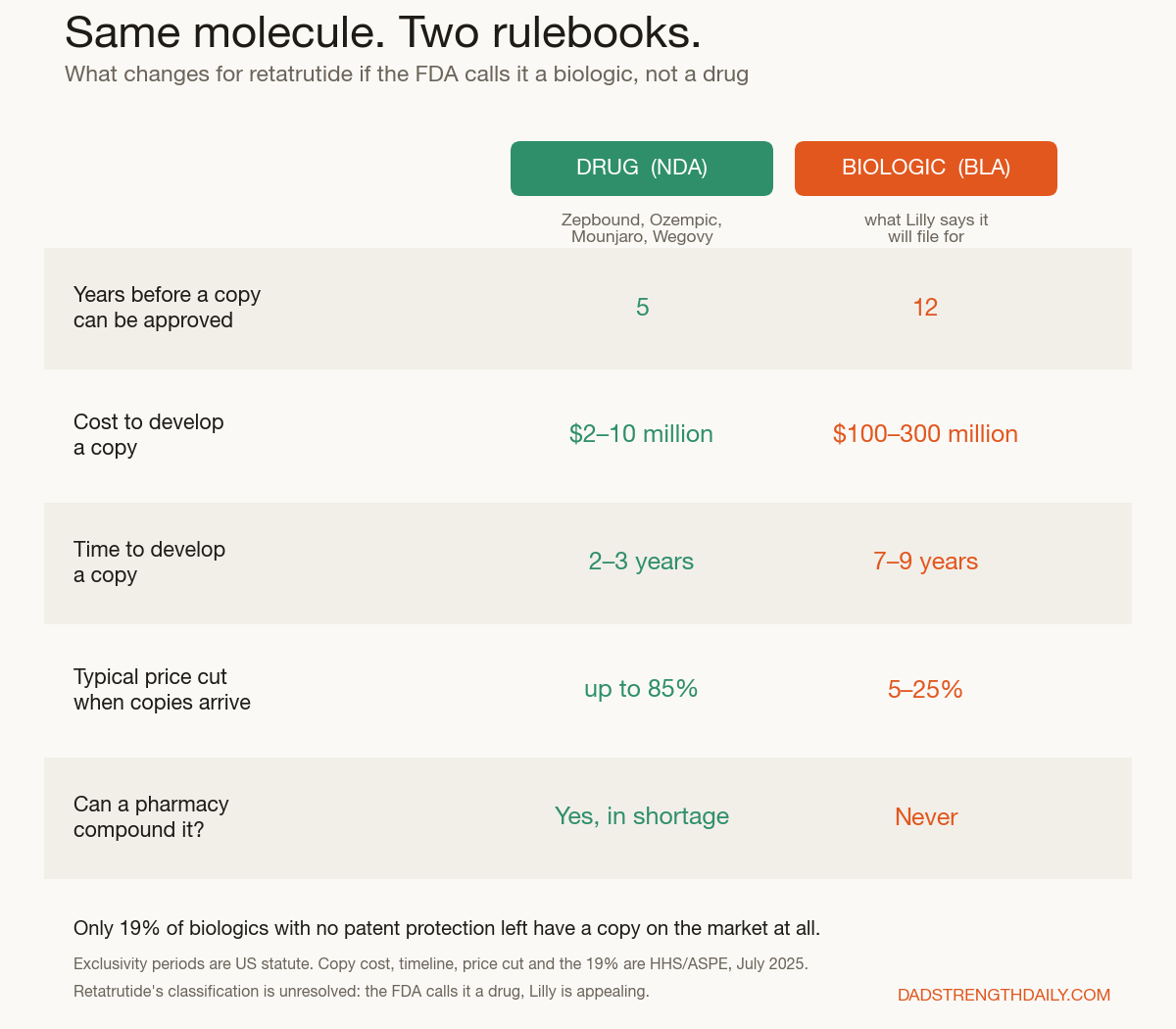
Why that matters, before any of the legal detail: a biologic gets twelve years of protection instead of five, can only be copied through a process that costs ten to a hundred times what a generic costs, and cannot be legally compounded at all, not even during a shortage. The molecule is the same either way. What changes is who else is ever allowed to make it.
My disclosure, because it colors everything below: I take Lilly’s tirzepatide, and I own Lilly stock, which is up considerably since I bought it. The outcome I am about to describe as bad for patients would be good for my brokerage account.
The whole fight is one amino acid
In 2020 the FDA drew a line to sort medicines into two bins. The rule is in the Code of Federal Regulations at 21 CFR 600.3, and it reads: “A protein is any alpha amino acid polymer with a specific, defined sequence that is greater than 40 amino acids in size.” Land above that line and you are a biologic, licensed under the Public Health Service Act. Land on or below it and you are an ordinary drug under the Food, Drug, and Cosmetic Act. And the statute does not only cover proteins. It covers a protein “or analogous product,” a second phrase nobody has ever written a rule to define.
The line is real, and it already cuts straight through this class of drug. Lixisenatide, a GLP-1 most people have never heard of, is 44 amino acids long, and in March 2020 it stopped being a drug and became a biologic. The molecule did not change. The paperwork did. You can still get lixisenatide in the US inside Soliqua, an insulin combination, and that product is licensed as a biologic right now. Semaglutide is 31 amino acids and tirzepatide is 39, so both landed on the drug side. The Zepbound in my fridge was approved as an ordinary drug, and its FDA paperwork says so in plain sight.
Retatrutide has a backbone of 39 amino acids, the same length as tirzepatide. Hanging off one of its lysines is a short side chain carrying two more pieces: a gamma-glutamate, and something called 8-amino-3,6-dioxaoctanoic acid. Both are amino acids. Only the gamma-glutamate is an alpha amino acid, the ordinary kind that makes up proteins in nature; the second one carries its amino group further down the chain and does not qualify. So Lilly counts every piece and gets 41, which clears the line. The FDA counts only the alpha kind, gets 40 at most, and 40 is not more than 40.
So the strongest obesity drug anyone has run through a large trial misses the biologic threshold by exactly one residue, and whether it misses turns on whether a non-alpha amino acid counts toward a limit written about alpha ones. Martha Rumore, a pharmacy law expert quoted in Pharmacy Practice News last year, put it better than I can: “This is a billion-dollar question that is hinging on the word ‘alpha.'”
Get the next one in your inbox
I cover the latest GLP-1 trials and access changes weekly. Free, no spam, unsubscribe whenever.
Lilly asked, the FDA said no, and Lilly sued
In November 2023 Lilly formally asked the FDA to designate retatrutide a biological product. On March 18, 2024 the agency issued its answer: retatrutide is a drug. At most 40 alpha amino acids and one non-alpha, and the rule says you need more than 40 of the alpha kind.
Lilly sued in September 2024. The case is Eli Lilly and Company v. Kennedy, in the Southern District of Indiana, in front of Judge Tanya Walton Pratt, and on September 30, 2025 she split it down the middle.
Lilly lost the main argument, and that part of the ruling still stands. The judge agreed with the FDA that the regulation is unambiguous, that “alpha amino acid polymer” means a polymer made of alpha amino acids, and that retatrutide therefore does not qualify as a protein.
Then came the second phrase. The FDA had taken the position that nothing excluded by its protein rule could ever be “analogous” to a protein either. Judge Pratt found that unlawful, in language sharper than judges usually use about an agency: the bright-line approach “flouts the statutory text and sidesteps congressional intent,” and “by requiring ‘analogous’ products to meet each and every requirement for a ‘protein,’ FDA effectively reads ‘analogous product’ out of the statute.” She threw out that half of the FDA’s reasoning and told the agency to do it again, while noting it could still land on the same answer if it explained itself properly.
Then nothing happened. The final judgment sending the question back to the agency was entered that December, which is when the clock everyone is counting actually started. Lilly appealed anyway in February, and by its reply brief in June it was complaining that nearly six months had passed since the remand without the FDA issuing any decision at all. That appeal is fully briefed at the Seventh Circuit, with oral argument set for September 24, 2026. I could find no public record of the agency re-deciding anything since.
Which is what makes this morning’s announcement worth slowing down for. A company does not get to pick which statute regulates it. That is the entire reason this fight exists. And yet Lilly put “plans to submit a Biologics License Application” at the top of a press release, as settled fact, for a product the government currently classifies as something else, with the appeal undecided.
That is a strange thing to put in a press release.
Lower down, the body is more careful. There the manufacturing package is the one “required for a BLA,” and what Lilly plans to submit becomes just “retatrutide, for U.S. approval.” I read that as the lawyerly fallback, room to file an ordinary New Drug Application using the same science if the courts do not cooperate. But the headline claim is not hedged, and Reuters reported it straight: Lilly “plans to submit a biologics license application.”
What nobody reported is the fight behind it. I went through the day’s coverage, and the closest anyone came was the Wall Street Journal, which told readers Lilly plans to submit the drug “as a biologic for U.S. approval in the first quarter of 2027, hoping to curb counterfeit versions.” That is a fair statement of the motive, and a generous one. Counterfeits are a real problem, and I have written about what turns up in those vials. But the wall that stops a counterfeiter is the same wall that stops a licensed compounding pharmacy, and which of those you notice depends on where you stand. So a company announced a regulatory pathway it is currently suing to obtain, and the suing part did not make the news.
So watch which application Lilly actually files. If it files a Biologics License Application, it won the argument or decided to force the issue. If it files a New Drug Application, it gave up the classification to get the drug reviewed. Having spent real money on a BLA-grade manufacturing package and said so out loud, Lilly has made that second option embarrassing.
What the word buys
The prize is exclusivity. A new drug gets five years of it, and a competitor can start the paperwork to challenge it after four. A biologic gets twelve years before any copy can be approved, and for the first four nobody can even file. Unlike patents, those years cannot be litigated away, so a competitor that wins every patent fight against a biologic still sits out the twelve.
The part I did not appreciate until I went digging in the government’s own numbers is what copying actually costs. A generic under the ordinary drug pathway runs two to ten million dollars and takes two to three years, and by the time five of them are competing the price is down about 85 percent. A biosimilar, which is what you have to build to copy a biologic, runs one hundred to three hundred million and takes seven to nine years, and tends to launch at a discount of only 5 to 25 percent. The Department of Health and Human Services published all of that last July, including the figure that stopped me: of biologics that have no patent protection left at all, only 19 percent have a biosimilar on the market. Twelve out of sixty-two. What changes is whether copying it is a few-million-dollar project or a few-hundred-million-dollar one, and at the higher number a lot of companies never bother.
Compounding is the one that bites hardest for anyone who lived through the last three years. Compounding pharmacies made the cheap tirzepatide and semaglutide that a lot of Americans used while those drugs were in shortage. That was legal because sections 503A and 503B of the Food, Drug, and Cosmetic Act carve out an exemption from the approval requirement, and the carve-out gets wider when a drug is officially in shortage. Biologics are not in it at all. The FDA’s guidance says so in as many words: biological products licensed under the Public Health Service Act “are not eligible for the exemptions for compounded drugs under sections 503A and 503B.”
The shortage exception lives inside the very sections that would not apply. If retatrutide is licensed as a biologic, there is no shortage bad enough to make a compounded copy legal under any law now on the books. We have seen this run before: on March 23, 2020, about ninety protein products including every insulin flipped from drugs to biologics overnight, and the FDA sent compounders a notice that they were no longer eligible, effective that day.
Lilly is arguing both sides in two different courts
In the Fifth Circuit, Lilly is the FDA’s ally. When the agency declared the tirzepatide shortage over in 2024 and compounders sued to reverse it, Lilly intervened on the government’s side and won in the district court. The compounders appealed; that appeal was argued last spring and is still out.
In the Seventh Circuit, Lilly is the FDA’s adversary, arguing the agency got retatrutide’s classification wrong.
I do not think that is legally inconsistent. They are different statutes asking different questions, and a company is entitled to be right about one and wrong about the other. But from where a patient sits, both roads end up somewhere very similar, which is that the cheap version loses. And the compounders have noticed. The Outsourcing Facilities Association, the trade group that lost the first round of the tirzepatide fight, filed a brief against Lilly in the retatrutide appeal this May arguing that “a victory for Lilly in this case will come at the expense of patient needs and patient access,” and naming limits on compounding as one of the stakes. I do not think the compounders are the good guys here. They are a trade group defending a business, and the copies they sold were never held to the standard a licensed product is. I also do not think they are wrong about this.
Dave Knapp, who covers this beat at On The Pen, describes where it lands as a two-lane market: tirzepatide becomes the volume drug as its protection erodes, and retatrutide sits in the premium lane behind a wall the volume drug never had. Sandoz has already filed to make generic tirzepatide, four years after Mounjaro was approved. On the biologic track the equivalent filing could not even be submitted until year four, and could not be approved until year twelve.
What I think happens
The honest answer on the law is that I do not know, and neither does anyone quoting a confident number. The FDA still has to make a decision it has been sitting on since December, appellate judges have to read a regulation about amino acids, and Lilly has a fallback argument that the agency blew a statutory deadline, which on its reading means retatrutide becomes a biologic by default. Any of those could go either way.
My guess is that this matters less in 2028 than people think and a great deal more in the late 2030s. Retatrutide will be expensive at launch whichever box it lands in, because a brand-new patented drug is expensive. Biologic status is the insurance policy behind the patents: a competitor that knocked out every one of them early would still be barred from approval until year twelve, with no compounded version legal in the meantime. This is a fight about the back half of the drug’s life, not the price of the first pen.
And none of it has anything to do with whether the drug works. Nearly 23 percent of body weight in people who already have cardiovascular disease is a real number, and it is going to help people. What bothers me is that what those people pay, and whether anyone is ever allowed to sell them a cheaper version, is being decided by an argument about how to count to forty-one. Nobody puts that in the press release. I think it ends up mattering more to what you pay than any of the trial numbers that led this morning’s coverage.
I will keep taking the Zepbound my doctor prescribes, and rooting for the copies to arrive on time. In the meantime I put a number on what retatrutide itself will cost.