
Updated with a link to the TRIUMPH-1 dose-cut analysis.
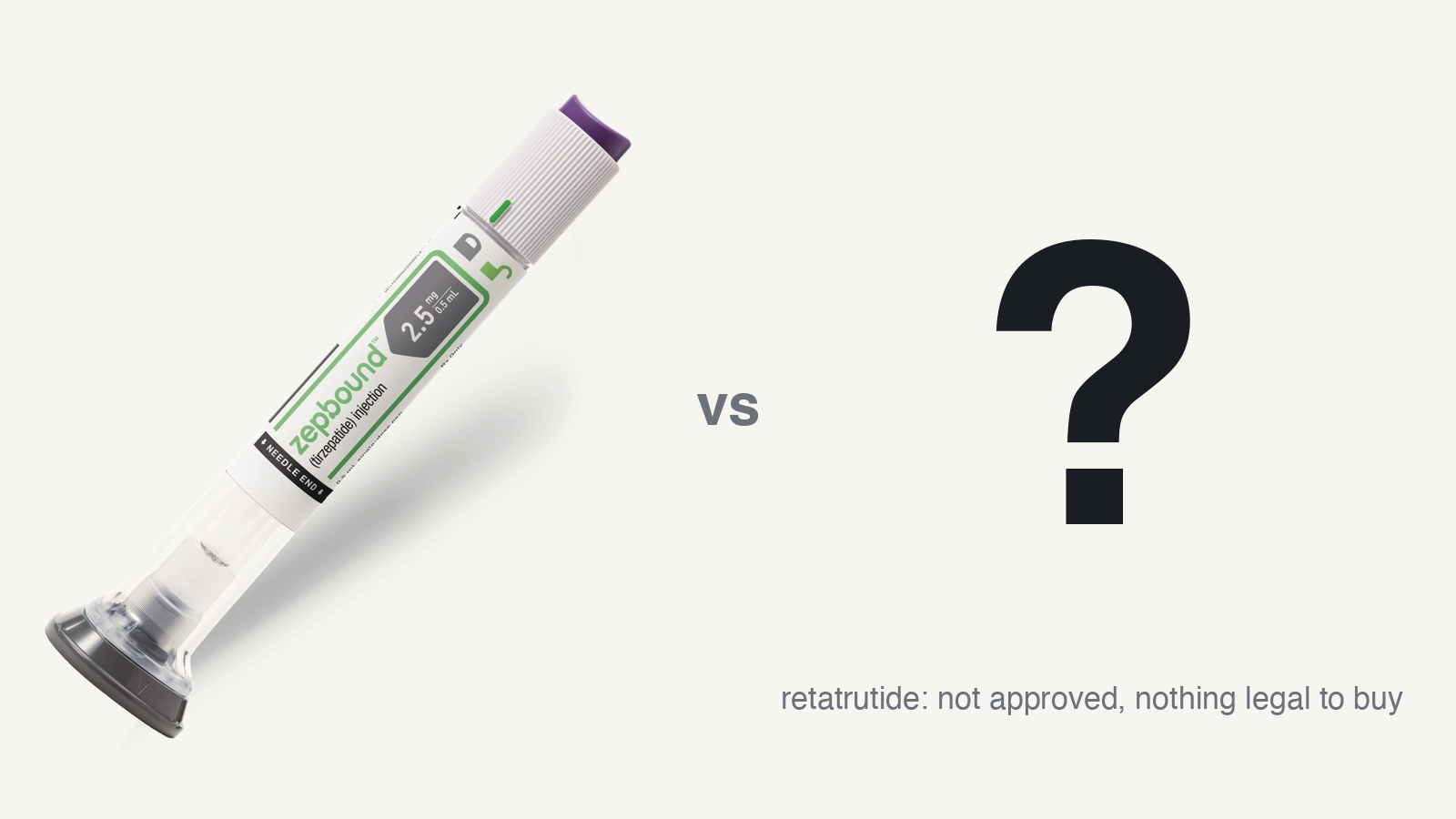
Retatrutide vs Zepbound is a comparison I have a stake in: I take Zepbound, I have lost about 170 pounds on it, and the drug everyone now wants to measure it against comes from the same company that makes mine. My answer up front: retatrutide will probably be the more effective drug, and I would still not wait for it, or buy it from a stranger, while Zepbound works.
Disclosure, since it colors all of this: I inject tirzepatide and I own Eli Lilly stock.
A drug this good that you cannot legally buy has people injecting something they ordered off a website; a records search I get to below found hundreds of them.
| FDA approved | No |
| Development stage | Phase 3. Lilly said in July 2026 the clinical data package for registration is complete and the manufacturing package is still being finished; other Phase 3 trials are still running |
| FDA application | Planned Q1 2027, as a biologic rather than a conventional drug (Lilly is in court over that classification), for obesity, sleep apnea and knee osteoarthritis pain |
| Brand name | Not announced |
| Last checked | September 4, 2026 |
Is retatrutide better than Zepbound for weight loss?
Yes, on the trial numbers, and it gets there without needing its top dose.
In TRIUMPH-1, 2,339 adults were assigned 4, 9 or 12 mg of retatrutide or placebo for 80 weeks; the full readout is in what TRIUMPH-1 just showed. The 12 mg dose came in at 28.3 percent, an average of 70 pounds. SURMOUNT-1 reported 20.9 percent on 15 mg of tirzepatide. You cannot just subtract one from the other; the two trials report weight loss under different statistical rules, and lined up the same way the gap is four to six points.
What impressed me is further down the dose ladder. Retatrutide’s middle dose, 9 mg, lost 25.9 percent, beating tirzepatide’s maximum dose under either rule. The lowest dose, 4 mg, lost 19.0 percent, with a slightly lower observed dropout rate for side effects than placebo.
Update, October 3, 2026: The full TRIUMPH-1 paper is now out in the New England Journal of Medicine. Its primary analysis counts everyone, including people who stopped the drug, and on that count the 4, 9 and 12 mg doses lost 17.6, 23.7 and 25.0 percent at 80 weeks, against 3.9 percent on placebo. The 19.0, 25.9 and 28.3 percent figures above are the same trial counted as if everyone had stayed on the drug, and the paper reports those too. Against SURMOUNT-1’s 20.9 percent, which is counted the first way, the top dose is 4.1 points ahead and the middle dose 2.8 points ahead, so the comparison above holds.
Update, October 4, 2026: The paper’s appendix also shows that 22.5 percent of the 12 mg group had their dose permanently cut, most often for perceived excessive weight loss. Details here.
A review in Annals of Internal Medicine covered 38 trials and found them too different to pool; within it, retatrutide’s best placebo-adjusted result was 22.1 percent and tirzepatide’s 19.0.
TRIUMPH-5 put about 800 adults on retatrutide or tirzepatide, double-blind, and finishes collecting data in November 2026.
Get the next one in your inbox
I cover the latest GLP-1 trials and access changes weekly. Free, no spam, unsubscribe whenever.
Does retatrutide cause less muscle loss than Zepbound?
No study has shown that, and TRIUMPH-5, the head-to-head trial that could have settled it, registers no body-composition endpoint.
The relevant retatrutide paper is Coskun et al., Lancet Diabetes & Endocrinology (2025), a DXA body-composition scan substudy of retatrutide’s Phase 2 diabetes trial. It found real fat loss, but its interpretation says “the proportion of lean mass loss to weight loss was similar to other obesity treatments.” That is reassurance retatrutide does not cost you more muscle, not a claim it costs you less. Tirzepatide’s own substudy (Look et al., 2025) reported roughly 75 percent fat and 25 percent lean “for both tirzepatide and placebo.”
The advice for holding onto muscle has not changed: enough protein and enough resistance training, whichever molecule you take.
What are retatrutide’s side effects compared to Zepbound?
Both are gut drugs first: nausea, diarrhea, constipation, vomiting, worst while you climb the dose. Where they differ is dysesthesia, an odd skin sensation usually described as tingling or burning. In TRIUMPH-1 it hit 12.5 percent at 12 mg against 0.9 percent on placebo; TRIUMPH-2 and TRIUMPH-3 came in lower. Not retatrutide’s private problem, though. Semaglutide at 7.2 mg produced it in 22.9 percent in Novo’s STEP UP trial.
Heart rate is the one I have a personal stake in, because I have an ascending aortic aneurysm. Zhang et al. (2026), pooling 12 trials, put retatrutide at 3.46 beats over placebo against 2.05 for tirzepatide. About a beat and a half above the drug I inject.
On heart outcomes the gap is in the evidence rather than in any result, and what exists favors tirzepatide, though it sits on Mounjaro’s label, not Zepbound’s. SURPASS-CVOT returned a hazard ratio of 0.92 for tirzepatide against dulaglutide, an 8 percent lower rate of major cardiovascular events, enough to show it was no worse but not that it was better, and the FDA approved a cardiovascular indication for Mounjaro on that basis in August. Retatrutide has nothing like it. TRIUMPH-3 counted 44 events on drug against 52 on placebo on a five-part composite, and 27 against 23 on the three-part composite that matches SURPASS-CVOT, too few either way to rule out benefit or harm, and TRIUMPH-Outcomes does not finish until February 2029.
Will retatrutide cost more than Zepbound?
My estimate is $450 to $650 a month at launch if you pay cash, most likely near $550; the working is in what retatrutide will cost. Zepbound, Lilly’s tirzepatide, is the model: on LillyDirect the KwikPen runs $299 a month at 2.5 mg, $399 at 5 mg and $449 from 7.5 mg up for people paying cash, the $449 tier only if you refill within 45 days, and retatrutide should cost more than any of those.
Where retatrutide lands also depends on a court fight over whether it is a biologic, with twelve years of exclusivity, or a drug, with five; the details are in my post on the retatrutide biologic lawsuit. I track every drug in this class on the GLP-1 pipeline tracker.
Who can get retatrutide before it is approved?
Not legally, unless you are in one of Lilly’s trials or clear its expanded access program, and almost nobody reading this will. That program is NCT07629401, and STAT reported its gate, attributed to a source familiar rather than to Lilly on the record: obesity that has not responded to other treatment plus at least two serious obesity-related complications. Lilly called what it was offering authentic retatrutide, which says something about everything else sold under the name.
That has not slowed anyone down. A preprint searching the records of twenty-nine million Americans found 652 people with documented retatrutide exposure, and of those whose source was documented, 71 percent got it outside any trial or ordinary prescription, mostly from an online vendor, a compounding pharmacy or a wellness clinic. Lilly has sued six sellers and flagged over 14,000 websites and social posts, which I covered in there’s no legal retatrutide to buy.
I understand the appeal and it is still a bad trade. The trial averages for retatrutide and the drug you can get with a prescription differ by a few percentage points, measured in people who got the real molecule.
What I am doing about it: staying on Zepbound. With the aneurysm I am the wrong guy to volunteer for the higher heart-rate number on a hunch, and two of retatrutide’s three planned indications are already on the label of the drug in my refrigerator.
Retatrutide is going to be a very good drug. It is not going to be so much better than Zepbound that it is worth buying from a stranger to get it a year early.