
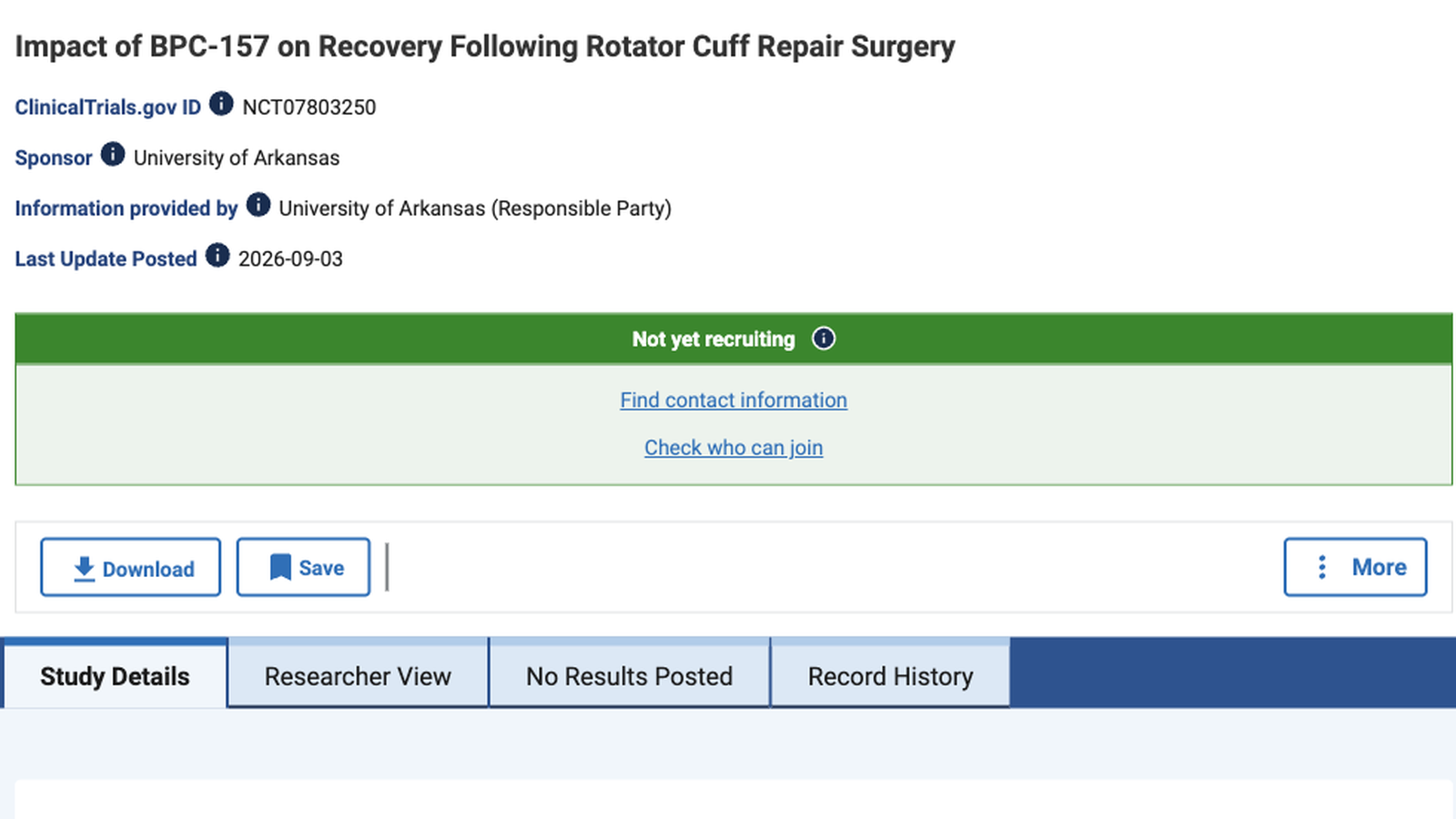
The University of Arkansas has registered a trial of BPC-157 in people recovering from rotator cuff surgery, described as randomized, double-blind and placebo-controlled. It’s small, it hasn’t started, and its main data collection isn’t scheduled to finish until August 2027. I’m excited anyway, because this is the kind of test the tendon-healing claim has always needed.
Of all the peptides people ask me about, BPC-157 draws the most enthusiasm and the most personal stories. Men my age with a shoulder that hasn’t felt right in a year swear by it. When I went looking for the human evidence, I came up nearly empty. It’s also the peptide where you can’t tell on your own whether it worked. Only a controlled trial can settle that, and none of the five human studies in FDA’s July 2026 review tested a tendon, ligament or muscle injury.
What the BPC-157 rotator cuff trial will test
The trial enrolls adults with a full-thickness rotator cuff tear, confirmed on MRI, who are having it repaired arthroscopically at the University of Arkansas for Medical Sciences in Little Rock. After surgery, one group injects BPC-157 under the skin once a day for 90 days. The other group, per most of the record, injects saline. Everyone follows the standard rehab. Per the registry, the patients, the care providers, the investigators and the people measuring outcomes are all blinded.
The main result is shoulder strength, measured with a handheld dynamometer (a force gauge) by a blinded tester at 12 weeks and 5 months after surgery. The team also plans to look at tendon healing on MRI, range of motion, patients’ own ratings, and blood markers of collagen turnover and inflammation.
The registry record was first posted on September 3, 2026. Its status is “not yet recruiting,” with a planned start of January 1, 2027. The start date and the August 2027 completion date are both estimates. If you’re hoping to sign up: it isn’t enrolling yet, it runs at that one hospital in Little Rock with three named surgeons, and the registry page lists a study contact.
Why you can’t judge BPC-157 on yourself
On Zepbound, I at least get a hard number from the scale. If my shoulder felt better after a month of BPC-157, I still wouldn’t know whether the peptide did it. Peter Attia laid out why in his August episode on peptides.
Musculoskeletal injuries tend to improve on their own and fluctuate a lot. People start a peptide when they feel worst, which is when you’d expect improvement anyway, drug or no drug. They’re probably also resting, changing their training, doing physical therapy and perhaps taking anti-inflammatories. The placebo effect is strong for pain and for how recovered you feel. And the people who got better post about it, while the ones who didn’t quietly move on. His line: “BPC-157, CJC-1295, or some other peptide stack, is just one part of a sea of variables, and yet it always seems to be the thing that gets the credit.”
In the same episode he described the test that would answer the question: BPC-157 injected into one shoulder and saline into the other, blinded. He said that doesn’t seem to happen. He made the same point in an April AMA: a friend’s recovery story never comes from that kind of comparison. The Arkansas trial runs that test across two groups of patients instead of two shoulders.
What 20 to 30 people can and can’t tell us
This is a pilot. Per the record, its job is to check safety, see whether the study can actually be run, look for early signs of benefit, and set up a larger trial. Enrollment is listed as 30, an estimate, although the summary says 20. With 20 or 30 people, a difference would have to be large to show up clearly. If they find none, I wouldn’t take that as proof BPC-157 does nothing.
One detail in the record doesn’t line up. The entry for the control treatment calls it a “no-treatment control” with no placebo injections, while the summary and the arm description say daily saline injections. If the control group got no injections, the trial couldn’t be double-blind. Most of the record describes saline. I’d want the investigators to clear that up before the first patient enrolls.
The trial also excludes anyone who has had testosterone replacement or other hormone replacement therapy in the past 12 months, anyone with diabetes, and anyone who has had a rotator cuff repair before. I’m on testosterone, so I couldn’t sign up.
What I want to see is whether the BPC-157 group gets its shoulder strength back faster than the saline group, and whether the MRIs agree. Twenty or thirty people may not settle it, but it’s a comparison no forum post can give me.
Get the next one in your inbox
I write about GLP-1s, training, and preventive health once a week — what the evidence actually says, from someone using it. Free, no spam, unsubscribe whenever.
If this was useful, read next
- BPC-157 Human Trials: 5 Studies, ~80 People, One Failed RCT — every human study in FDA’s review, and why none of them tested an injury
- I Wanted to Know If BPC-157 Could Help My Aorta. No One Could Tell Me. — where BPC-157 came from and why the certainty got ahead of the data
- Peptides Promise Everything. An FDA Panel Just Said Yes to Six of Seven. — what the July advisory panel actually decided about BPC-157