
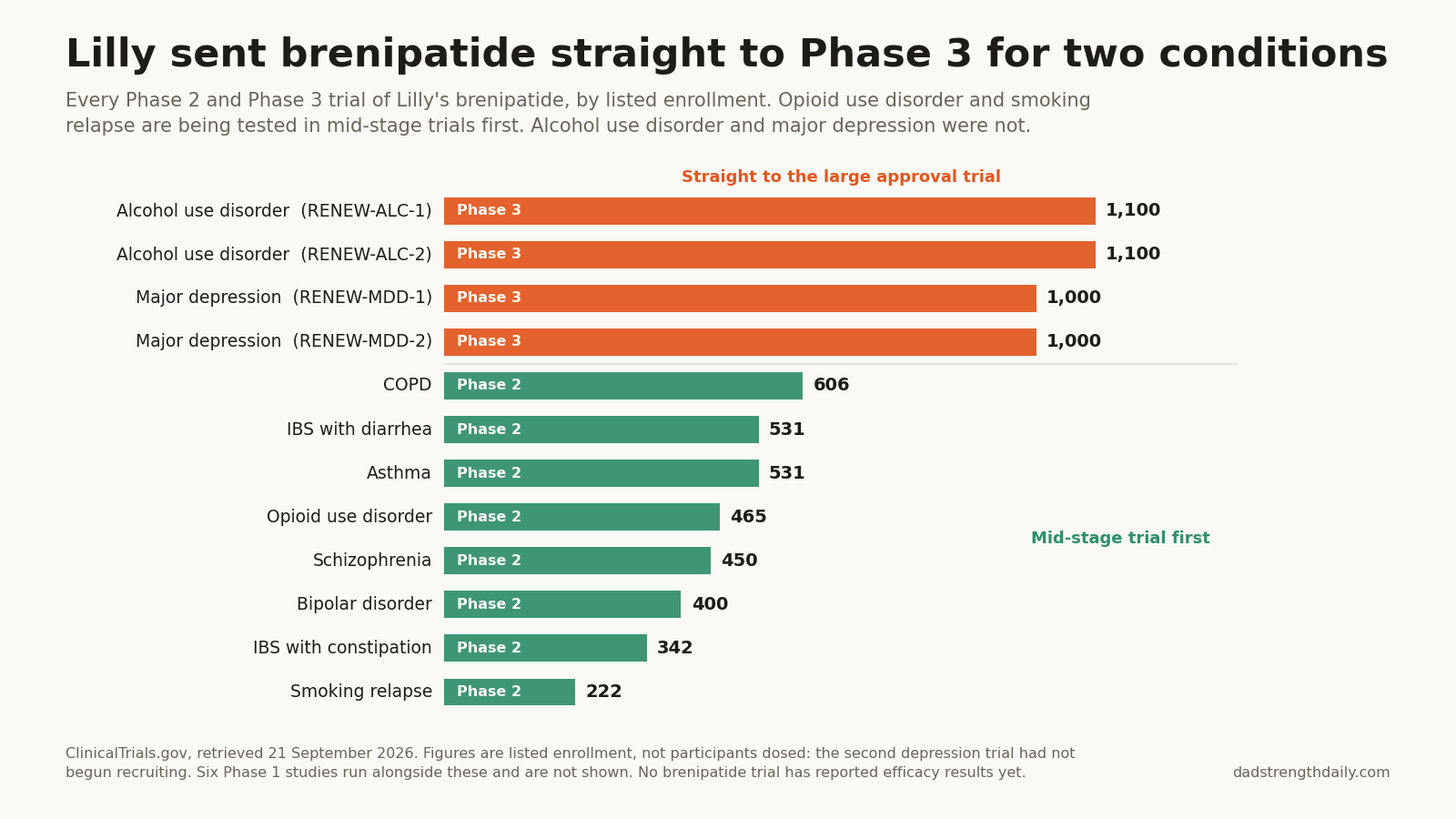
The brenipatide Phase 3 program is Lilly’s bet that it can reach an alcohol and depression label before anyone else, and it pulls a possible approval years closer.
Key Points
- Lilly sent brenipatide, an experimental GIP/GLP-1 drug, straight from Phase 1 into Phase 3 for alcohol use disorder and major depression, skipping the mid-stage trial that usually comes first.
- There are four registered Phase 3 trials, with a combined target enrollment of about 4,200 people.
- Only 2.5 percent of Americans aged 12 and over with alcohol use disorder received medication for it in 2024. An approval would establish a studied treatment and could make coverage easier to get.
- Skipping a separate Phase 2 could shorten development by years if the trials succeed, and leaves Lilly the only company running a Phase 3 of a GLP-1 for drinking. A rival drug has positive mid-stage results but no Phase 3 yet.
- The alcohol trials are scheduled to finish collecting their main results in April 2028.
Disclosure: I own Eli Lilly stock and I take tirzepatide, which is a Lilly drug. Read what follows with that in mind.
Lilly wants to be first to market with a GLP-1 approved for drinking and for depression. Brenipatide, its experimental GIP/GLP-1 drug, is in four registered Phase 3 trials across those two conditions, about 4,200 people between them, and Lilly opened them without the mid-stage study that normally comes first.
A friend of mine has been sober for years and still gets the cravings; he started a GLP-1 hoping the thing that quiets food noise might quiet the other kind, and for him it mostly has. He is not the only one doing that with a drug approved for something else. Last week Lilly showed the first human data it has made public on a drug built for the job.
What Lilly showed
The findings came out at Psych Congress 2026, a psychiatry conference held in New Orleans, as a research poster: a summary pinned up for other researchers, often years before anything reaches a journal. None of it has been peer reviewed.
The early tolerability findings were encouraging. The study was unusually large for a Phase 1, running 212 people through multiple cohorts and dose levels. There were no deaths and no serious adverse events. Four of the 184 people who got the drug, or 2.2 percent, stopped because of a side effect. Stomach trouble was no more common than on placebo. Burning or tingling skin was reported by 15.2 percent on brenipatide and nobody on placebo. The drug stays in the body long enough that Lilly says weekly dosing works.
That is all the study was built to measure: its registered main outcome is how many participants had adverse events. It reports nothing on drinking, cravings or mood, and neither does any other brenipatide trial so far.
The brenipatide Phase 3 program, and the stage it skipped
Drug development usually runs in three stages, and safety is measured at all three. Phase 1 gives the drug to a small group, often 20 to 80 people, to work out the dose and catch the side effects that come with raising it. Phase 2 is the first real test of whether it does anything for the condition, in no more than a few hundred patients, and picks up the common short-term risks. Phase 3 is the large trial regulators want before an approval, several hundred to several thousand people, and it is where a side effect rare enough to miss in a small study finally has the numbers to show up.
For alcohol use disorder and major depression, Lilly skipped the middle one.
Went straight to Phase 3: alcohol and depression
| Trial | Enrollment |
|---|---|
| RENEW-ALC-1 | 1,100 |
| RENEW-ALC-2 | 1,100 |
| RENEW-MDD-1 | 1,000 |
| RENEW-MDD-2 | 1,000 |
Testing in Phase 2 first
| Trial | Enrollment |
|---|---|
| COPD | 606 |
| IBS, diarrhea | 531 |
| Asthma | 531 |
| Opioid use disorder | 465 |
| Schizophrenia | 450 |
| Bipolar disorder | 400 |
| IBS, constipation | 342 |
| Smoking relapse | 222 |
Opioid use disorder and smoking relapse are addiction programs at the same company, and both are in Phase 2. Alcohol and depression are not. Lilly started the two alcohol trials in October 2025 and the first depression trial in February 2026, and told Genetic Engineering & Biotechnology News why. “When we look at AUD and MDD,” said Robert Nicholson, who runs Lilly’s neuroscience medical affairs group for psychiatry and substance use, “both of those have existing needs … those are the needs where we think about the opportunity and why we thought it was worth going straight to Phase III in those conditions.”
The prize is time. The brenipatide Phase 3 trials started years sooner than they otherwise would have. Brenipatide’s own eight Phase 2 trials are scheduled to take between 14 and 29 months to collect their main results, a median of 21. Add the months it takes to read a Phase 2, pick a dose and open a Phase 3, and by my count skipping that step could shorten development by a couple of years, assuming the trials succeed.
Lilly did not give up the dose question everywhere, though. Both depression trials randomize patients to three different brenipatide doses against placebo, which is the dose-ranging a Phase 2 normally does, moved inside the registration trial. Those trials also ask a narrower question: participants are already on standard antidepressant treatment, and the endpoint is whether adding brenipatide delays a relapse rather than lifts anyone out of an episode. The alcohol trials do neither. They test a single escalating regimen, and nowhere in the program are doses compared in people who drink. In depression Lilly is still asking which dose works. In alcohol it has already decided.
That is the part of the bet with a bill attached. If the alcohol trials come back negative, nobody will be able to say whether the drug does not work or the one dose Lilly chose was wrong, and 2,200 people will have spent 56 weeks finding that out. A Phase 2 is the cheap way to be wrong. Lilly decided it did not need one.
Why an approval would matter
There are three approved medicines for alcohol use disorder, and only 2.5 percent of Americans aged 12 and over with past-year alcohol use disorder received medication for it in 2024. It is a drug nobody thinks to ask for, a doctor who does not routinely offer it, and a prescription written for a diagnosis people still hide.
An approval would not fix all of that, but it would establish a studied treatment for drinking rather than a weight drug borrowed for the purpose. A doctor could prescribe it for the condition. Coverage would get easier to argue for. The dose would be the one tested for the job. That is the difference between the people already trying this quietly and the people who could get it properly.
What Lilly is betting on, and when we find out
Lilly has not publicly reported any brenipatide efficacy results. What it has is the class. When the alcohol trials opened, the published evidence was one randomized trial of 48 people in JAMA Psychiatry, where low-dose semaglutide cut lab drinking and craving, against an earlier exenatide trial that missed its main drinking endpoint. Two larger results have landed since, both after Lilly committed: a Danish trial of 108 people that cut heavy drinking days by 13.7 percentage points more than placebo, and an American trial of 50 that missed its primary craving endpoint but showed fewer heavy drinking days.
Lilly also began Phase 3 before publishing the Phase 1 findings it showed last week. That study ran from September 2024 to July 2026; the first alcohol patient was randomized in October 2025, roughly thirteen months in, with the rest still to come. FDA’s rule anticipates this. The phases “are conducted sequentially” in general, it says, and then adds that “they may overlap.”
Lilly is not the only one chasing this. Altimmune’s pemvidutide, a glucagon and GLP-1 drug, reported positive Phase 2 results in alcohol use disorder in July, cutting heavy drinking days more than placebo in 100 people. That is efficacy evidence Lilly does not have for brenipatide. What Lilly has instead is a Phase 3 already running, and nobody else does.
Both alcohol trials run 56 weeks and are scheduled to finish collecting results in April 2028. They measure change in drinking patterns rather than abstinence, and I wrote about why that choice matters separately. If Lilly is right, the first GLP-1 approved for drinking arrives years earlier than it would have. For a condition where almost nobody gets a medicine at all, that is the part worth paying attention to.
Get the free Bloodwork Decoder
I made the one-page cheat sheet I wish I’d had at my first physical: what every number on your labs actually means, what’s worth aiming for at 50, and what to ask your doctor. Subscribe free and I’ll send it straight to your inbox. No spam, nothing to sell.
If this was useful, read next
- My Friend Got Sober and Stayed That Way. The Cravings Didn’t Leave. — Why an approved drug for craving would matter
- Three Trials Are Testing GLP-1s on Drinking. None of Them Is Explicitly Aiming at Sobriety. — What these trials actually measure
- Brenipatide: Eli Lilly’s GLP-1 for Alcohol Use Disorder — What the drug is and why Lilly aimed it at drinking