
Updated with a note that Lilly is testing brenipatide as a weekly shot, not a monthly one.
Updated September 9, 2026: added a section below on the smoking-relapse-prevention trial and a newly registered COPD trial.
I quit drinking after getting headaches, looking at the evidence and deciding it wasn’t worth it. Most people with alcohol use disorder can’t just decide. Fewer than 2% of them ever get medication for it, and the drugs we do have (naltrexone, acamprosate, disulfiram) produce small effects and get almost no uptake.
This drug could be different and have big impact.
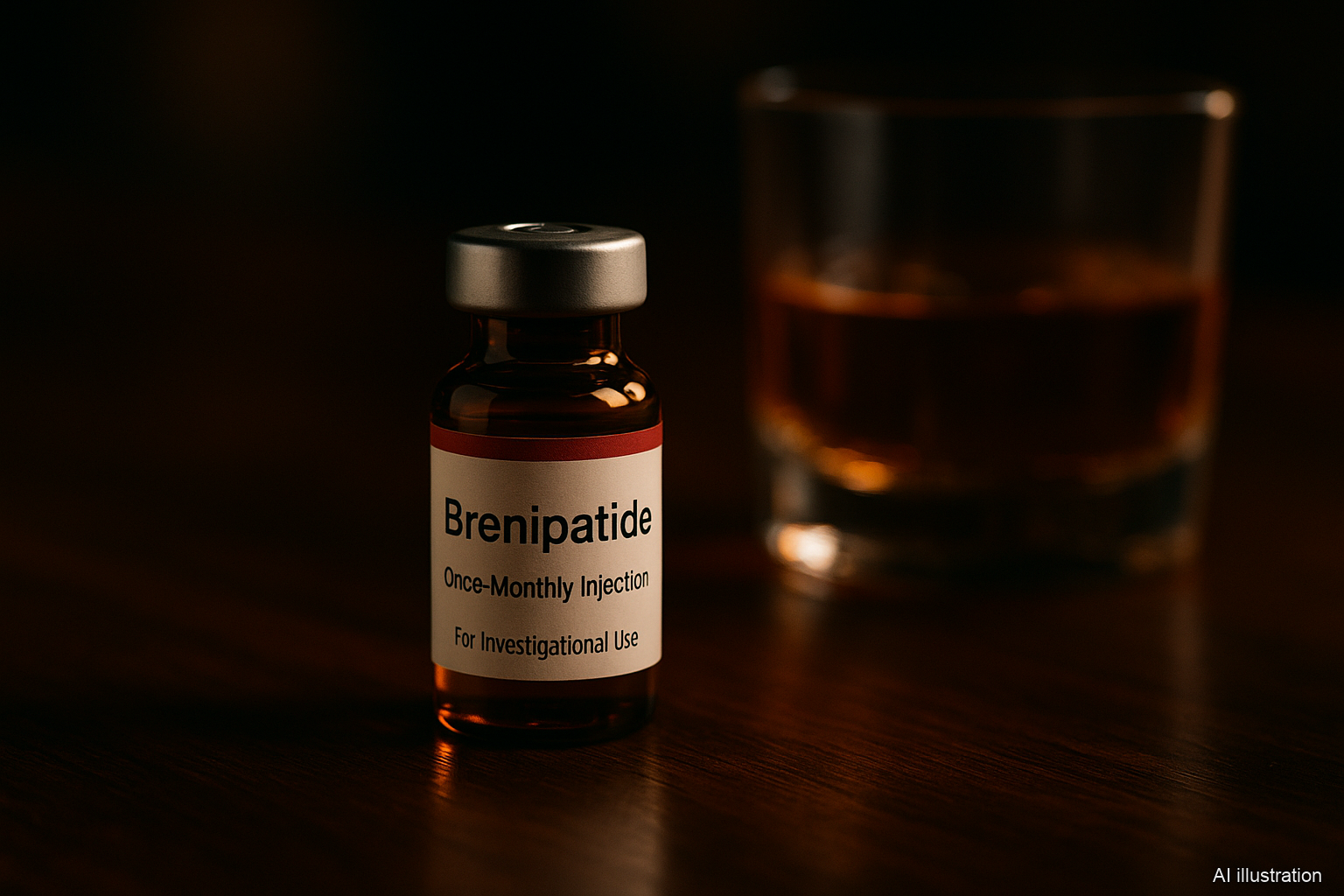
Lilly has a drug Brenipatide in late-stage trials called brenipatide. Same class as tirzepatide (Mounjaro/Zepbound), but engineered with a much longer half-life. I broke down how brenipatide and tirzepatide actually compare in a separate piece. Dosed once a month, subcutaneous. That schedule alone is a big deal for addiction medicine, where adherence is half the battle. Vivitrol, the monthly depot of naltrexone, outperforms the daily pill for exactly that reason.
Update, September 26, 2026: brenipatide is a weekly shot, not a monthly one. When I wrote this post, published descriptions of the drug called it monthly. The first human data, in Lilly’s poster at Psych Congress in September 2026, came from once-weekly dosing, and Lilly concluded the results “support the selection of weekly maintenance doses.” Its half-life, 9 to 12.5 days, is still longer than tirzepatide’s. I have left the argument below for why a monthly shot would matter in addiction, because that case still stands. It is no longer a description of brenipatide.
Two Phase 3 AUD trials are actively enrolling (RENEW-ALC-1 and RENEW-ALC-2), 1,100 patients each. Separate trials are running for smoking relapse, opioid use disorder, bipolar disorder, schizophrenia, IBS, asthma, and — as of August 2026 — COPD. Readouts start landing in 2027.
Brenipatide for Alcohol Use Disorder: The Existing Data Is Striking
Get the next one in your inbox
I cover the latest GLP-1 trials and access changes weekly. Free, no spam, unsubscribe whenever.
Here’s why Lilly is going hard at this. The signal in the existing data is almost hard to believe.
A BMJ study published last month followed 606,000 veterans on GLP-1s vs. SGLT2 inhibitors. In people with no prior substance use disorder, GLP-1 users had 18% less alcohol use disorder, 20% less nicotine, and 25% less opioid use disorder. In people with an existing SUD, GLP-1 use was associated with 39% fewer overdoses and 50% fewer substance-related deaths over three years.
A JAMA Psychiatry Phase 2 trial of semaglutide in AUD (48 people, 9 weeks) showed medium-to-large effect sizes on drinking outcomes and reduced cravings. That matters because approved AUD meds like naltrexone typically show only small effect sizes. And the semaglutide group hit those numbers at the two lowest clinical doses.
So here’s the case. A drug class that wasn’t designed for addiction is already outperforming drugs that were. Lilly is now testing a molecule engineered for it, with a dosing schedule that solves the adherence problem, in the largest randomized AUD trials ever run.
What makes this interesting despite all that is Lilly isn’t the only shot on goal. Baseline Therapeutics launched in January specifically to run Phase 3 trials of their own GLP-1 candidate (BT-001) in AUD. The VA has since opened a 622-person Phase 3 of semaglutide, and Altimmune’s pemvidutide has reported its Phase 2. Thirty-three GLP-1 trials for substance use disorders are currently registered on ClinicalTrials.gov. Even if half of them fail, the other half would hand us more pharmacotherapy than AUD has gotten in a lifetime.
If these trials turn out positive, it’s the biggest thing to happen to addiction medicine in a generation.
Brenipatide vs Tirzepatide: Longer Half-Life, Fewer Shots, Bigger Potential?
Update, September 26, 2026: the next two sections argue for once-monthly dosing. Lilly is testing brenipatide as a weekly shot, the same schedule as tirzepatide (see the note at the top).
If tirzepatide is the GLP-1/GIP drug that broke into the mainstream, brenipatide might be one of the more interesting “next wave” peptides to watch.
Tirzepatide is already the proven heavyweight. It is the active ingredient in Mounjaro and Zepbound, and it has moved from diabetes drug to weight-loss blockbuster to sleep-apnea treatment. For most people, tirzepatide is still the practical benchmark: strong appetite control, major weight-loss data, once-weekly dosing, and real-world use in people dealing with obesity, type 2 diabetes, and related metabolic problems.
Brenipatide is earlier in the story. It is not FDA-approved, and it should not be treated like something to casually buy, dose, or experiment with. Nobody can tell you its side effects yet either, because not one of its thirteen registered trials has reported. But the reason it is starting to get attention is that brenipatide appears to sit in the same broad GLP-1/GIP universe while being studied for something that could be even more disruptive: alcohol use disorder, craving, and reward-driven behavior.
For weight loss, weekly injections are already tolerable for a lot of motivated people. But for alcohol use disorder, smoking relapse, opioid use disorder, or other craving-driven problems, monthly dosing could be a much bigger deal. People dealing with compulsive behavior do not need more friction. They need fewer chances to miss, delay, rationalize, or fall off the plan. A once-monthly GLP-1/GIP-style drug aimed at cravings would be a very different animal from a weekly obesity shot.
That is where brenipatide gets exciting. Tirzepatide is mostly thought of as a metabolic drug. It helps people eat less, lose weight, improve blood sugar, and potentially reduce the downstream damage of obesity. Brenipatide may be pointing at a slightly different frontier: what happens when incretin-style drugs are aimed not just at hunger, but at reward, compulsion, alcohol intake, nicotine relapse, and addictive behavior?
For men over 50, that matters. Weight gain, alcohol intake, poor sleep, blood pressure, low energy, and lousy recovery are rarely separate problems. A drug class that started with blood sugar and appetite is now being studied in places that look a lot more like real middle-aged life: drinking too much, eating too much, sleeping badly, carrying too much belly fat, and trying to claw back health before the wheels come off.
The simple version: tirzepatide is the established weapon. Brenipatide is the speculative one. Tirzepatide already has FDA-approved uses and massive clinical momentum. Brenipatide is still investigational, but it might be aimed at a deeper and potentially more explosive target: cravings and compulsive behavior, with a dosing schedule that could be far easier to stick with.
Brenipatide Half-Life: Why Once-Monthly Dosing Matters
The reason brenipatide can dose once a month and tirzepatide can’t comes down to a single swap in the peptide backbone. Lilly replaced a tryptophan with α-methyl-tyrosine, which makes the molecule far more resistant to the enzymes that normally chew up GLP-1 analogs in the bloodstream. Net effect: it hangs around longer and blood levels stay steadier between shots.
For weight loss, that’s a nice-to-have. For addiction, it might be the whole game. You go to the clinic, get the shot, and the drug is doing its job whether you remember it or not. No daily decision, no weekly self-injection ritual to skip during a relapse window. Monthly naltrexone (Vivitrol) already beats the daily pill for the same reason: people actually stick with it. Brenipatide is borrowing that idea and pairing it with a drug class that seems to have a bigger biological grip on craving.
Brenipatide and Weight Loss: Why It’s Not the Primary Goal
A lot of you might be interested in brenipatide and weight loss. Quick answer: yes, brenipatide will probably cause weight loss, but that’s not what it’s being developed for.
It’s a dual GLP-1/GIP agonist, same class as tirzepatide (aka. Zepbound) . Activating those receptors at therapeutic doses almost always produces meaningful weight loss as a side effect, so trial participants will likely drop weight. Lilly does have a Phase 1 obesity program for brenipatide, but it’s running well behind the alcohol program. If it is the weight-loss side of this class you came for, start with the drugs you can actually get today.
If brenipatide makes it to market, the first FDA label will be for alcohol use disorder, not obesity. Whether off-label use for weight loss follows depends on insurance, on whether Lilly bothers to chase an obesity label as a second indication, and on whether monthly dosing makes sense for a problem most people manage with weekly shots already. Don’t think of this as the next Zepbound.
When Will Brenipatide Be Available?
The two big trials (RENEW-ALC-1 and RENEW-ALC-2) wrap in 2027. If the data is good, I’d expect Lilly to file with the FDA in 2028. Best case you’d see it in clinics 2029 or 2030. That’s my read.
If you’re looking into this for personal use right now, brenipatide is not legally available. It also has not shown up in any real way on the grey-market peptide circuit that already moves retatrutide, semaglutide, and tirzepatide knockoffs at scale. The engineered once-monthly backbone is harder to copy than weekly peptides, so the gray market is unlikely to deliver legitimate brenipatide for years. If someone is selling you “brenipatide” today, they’re almost certainly not selling you brenipatide.
Beyond Alcohol: Smoking Relapse and a Widening Pipeline
The alcohol trials get most of the attention, but they’re not the whole story. Lilly registered a Phase 2 trial in November 2025 testing brenipatide in adults who have already quit smoking cigarettes and want to avoid relapse — NCT07223840, recruiting now. That’s a narrower claim than “smoking cessation”: the trial isn’t testing whether brenipatide helps someone quit, it’s testing whether it helps a quit stick. Relapse is the harder problem in smoking cessation — most people who quit start again within a year, and the drugs approved for it (varenicline, bupropion, nicotine replacement) do little to prevent that.
Since I first covered this drug, Lilly has kept adding studies. A Phase 2 trial in moderate-to-severe COPD (NCT07759245) was registered in August 2026 and hasn’t started recruiting yet. The logic tracks: GIP and GLP-1 receptors are expressed in lung tissue, obesity independently worsens COPD, and there’s an anti-inflammatory angle nobody’s tested at this scale before. There’s also a second Phase 3 depression trial (NCT07775300), plus ongoing Phase 2s in bipolar disorder, schizophrenia, and both IBS subtypes. None of these have reported data.
Brenipatide is now one of the most heavily multi-indication drugs in Lilly’s pipeline — which either means the biology is genuinely that broad, or Lilly is running a lot of long-shot bets on one molecule while the real value is still the AUD program above. Time, not speculation, will settle that.
What Comes Next
That does not mean brenipatide is “better” than tirzepatide. It means it may be playing a different game. If the alcohol-use-disorder trials are positive, and if the longer-acting/monthly-dosing angle proves out, this could move from obscure pipeline peptide to one of the most talked-about drugs in the GLP-1 world very quickly. Until then, it belongs in the “watch closely, don’t self-experiment” category.
Further Information
If you want to go deeper on this, the JAMA Psychiatry author interview with Hendershot and Klein on the semaglutide AUD trial is solid and short. The Might Ramble Podcast #17 with Lorenzo Leggio is the single best conversation I’ve found on the mechanism and the state of the field. NPR’s Jon Hamilton had a tight story on the veterans data that’s worth the ten minutes.
I keep a running tracker of every GLP-1 and incretin drug, approved and still in the pipeline, with what each one targets, how far along it is, and what's coming next.
See the full GLP-1 Pipeline Tracker →About Gunnar
Gunnar is 53. He lost about 170 pounds, trains in a garage gym, and writes DadStrengthDaily from personal experience, citing primary sources where he can. He also moderates r/ProactiveHealth. He is not a doctor, and nothing here is medical advice. Talk to your own doctor before acting on anything, especially GLP-1s, TRT, blood pressure, sleep apnea, and cancer screening.