
Updated with Lilly’s first Phase 1 safety data and a note that the drug is dosed weekly, not monthly.
Brenipatide side effects: thirteen registered trials, ten conditions, and not one has reported. Here is what is actually known.
I take tirzepatide every Friday, so I know exactly what a GLP-1 does to a digestive system. Brenipatide works on the same two receptors — GLP-1 and GIP, same as tirzepatide — but Lilly isn’t chasing weight loss with it. The company calls it optimized for neuroscience, not metabolism, and the trial list backs that up: brenipatide is dosed once a month instead of once a week, and it’s currently in thirteen registered trials chasing ten different conditions — alcohol and opioid use disorder, smoking relapse, major depression, bipolar disorder, schizophrenia, both types of irritable bowel syndrome, asthma, and, as of this year, COPD. That’s an unusually wide net for one molecule. When I started reading about it, the first thing I went looking for was the side-effect list.
There isn’t one. I went through every registered brenipatide trial on ClinicalTrials.gov, and not one of them has reported results.
Update, September 26, 2026: Lilly has now shown the first brenipatide safety data, in Lilly’s poster at Psych Congress in September 2026. It is a conference poster, not a paper. In the Phase 1 study, 184 people got the drug. There were no deaths and no serious adverse events, and 4 of the 184 (2.2 percent) stopped because of a side effect. Stomach side effects were no more common than on placebo, 25 percent in both groups. The one that stood out was burning or tingling skin, reported by 15.2 percent on brenipatide and nobody on placebo. The study dosed once a week. The registered trials below have still posted no results on ClinicalTrials.gov, and there are no efficacy numbers for any condition. I covered the poster and Lilly’s trial plans in a separate post.
For context on where brenipatide sits in the class: semaglutide (Ozempic/Wegovy) hits one receptor, GLP-1, weekly. Tirzepatide (Mounjaro/Zepbound) added GIP and beat it on weight loss. Retatrutide goes a receptor further, adding glucagon, and is the strongest weight-loss drug of the three — Lilly has it through five positive Phase 3 obesity trials. Brenipatide shares tirzepatide’s two receptors but skips the weight-loss program almost entirely; I broke down the full mechanism-and-dosing comparison with tirzepatide separately. The difference that matters here is that brenipatide’s trials are aimed at addiction and the brain, not the scale.
That matters because of how much is riding on this drug. Fewer than one in fifty people with alcohol use disorder ever gets medication for it, so a drug that worked here would matter more than anything this class has done for weight.
And GLP-1 side effects have always tracked the dose. In Lilly’s own retatrutide trial, nausea ran 42 percent at the top dose against 15 percent on placebo. Push the dose for effect and more people feel sick, and the people who feel sick stop showing up. For a drug meant to treat addiction, where staying on it is most of the battle, how far Lilly can dial it down decides whether any of the ten indications land.
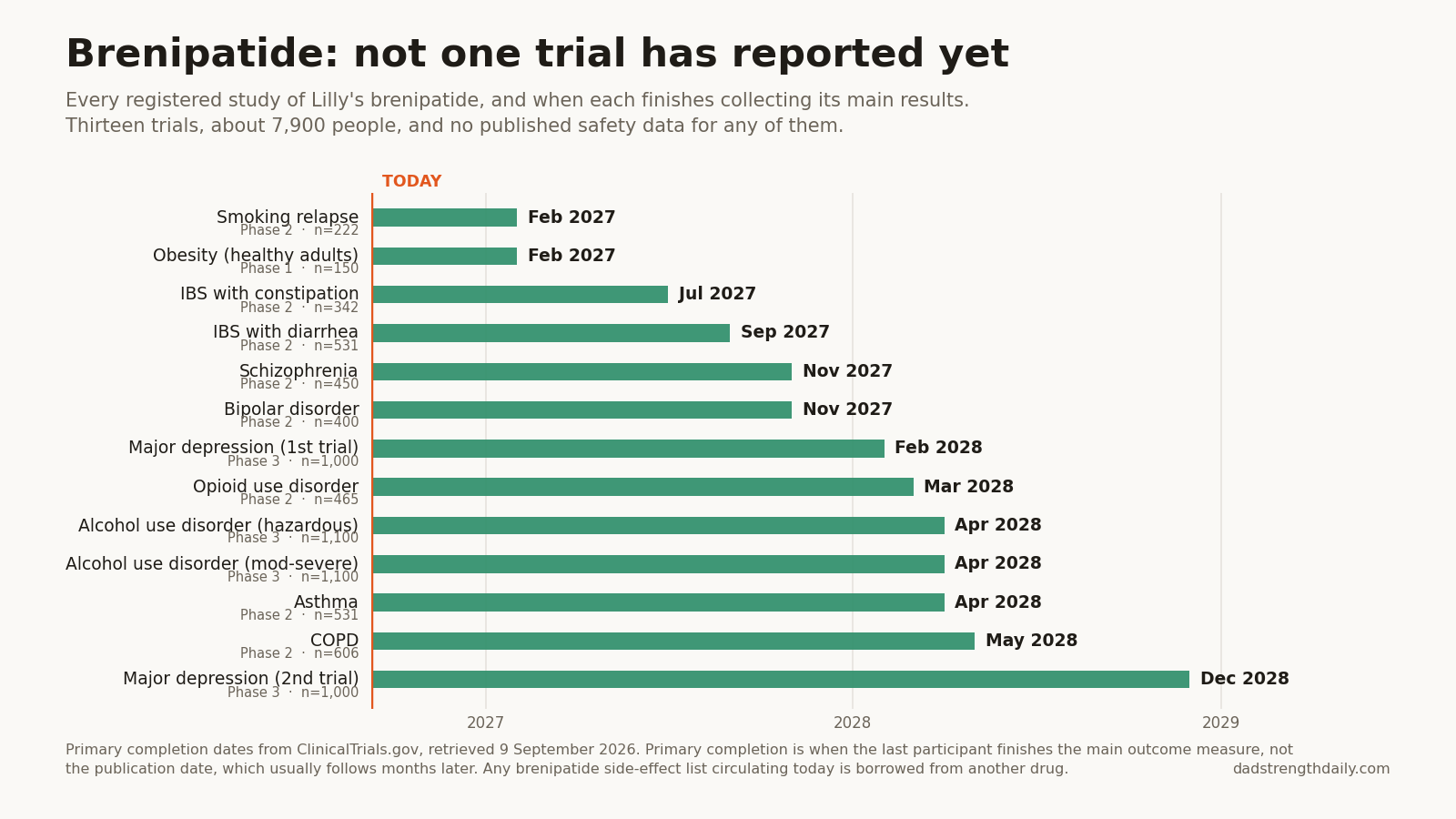
What do we know about brenipatide side effects?
Phase 3 — the biggest trials, and the last to report
| Indication | N | Due |
|---|---|---|
| Major depressive disorder | 1,000 | Feb 2028 |
| Alcohol use disorder (incl. hazardous drinking) | 1,100 | Apr 2028 |
| Alcohol use disorder (moderate to severe) | 1,100 | Apr 2028 |
| Major depressive disorder (2nd trial) | 1,000 | Dec 2028 |
Phase 2
| Indication | N | Due |
|---|---|---|
| Smoking relapse prevention | 222 | Feb 2027 |
| IBS with constipation | 342 | Jul 2027 |
| IBS with diarrhea | 531 | Sep 2027 |
| Schizophrenia | 450 | Nov 2027 |
| Bipolar disorder | 400 | Nov 2027 |
| Opioid use disorder | 465 | Mar 2028 |
| Asthma | 531 | Apr 2028 |
| COPD | 606 | May 2028 |
Phase 1
| Indication | N | Due |
|---|---|---|
| Healthy adults, overweight/obesity | 150 | Feb 2027 |
There is a small Phase 1 in overweight adults and nothing else aimed at weight, which is a surprise for a drug still filed under obesity in most of the coverage I read.
Any specific side-effect list circulating today was carried across from semaglutide or tirzepatide, which are different molecules, or it was invented. It is worth knowing who publishes these. A good number are companies recruiting patients into the trials, and an outfit whose business is signing you up for a study is not a neutral source on whether the drug is easy to take.
Get the next one in your inbox
I cover the latest GLP-1 trials and access changes weekly. Free, no spam, unsubscribe whenever.
Lilly is testing it for constipation and for diarrhea
Two rows in that table are doing something I have not seen before. Lilly is running brenipatide in IBS with constipation and in IBS with diarrhea, at the same time, as two separate studies.
Nausea, slow stomach emptying, diarrhea, constipation. That cluster is the standard complaint on every GLP-1 there is, and it is why people give up on Zepbound. Here it is the product.
I would not read that as one dial Lilly can turn either way. Constipation and diarrhea on a GLP-1 do not have to share a mechanism, and Lilly has not said they do. What two funded Phase 2 trials do tell you is that the company thinks the gut effect is strong enough to be worth aiming at, in both directions. Both registry entries state that the studies are evaluating “how well brenipatide is tolerated, what side effects may occur.”
Once-Monthly Dosing Cuts Both Ways
Update, September 26, 2026: Lilly is testing brenipatide as a weekly shot. Its Phase 1 dosed once a week, and its poster concluded the data support weekly maintenance doses. This section was written when published descriptions called it monthly. On a weekly schedule, skipping a dose to restart lower costs a week, the same as on tirzepatide.
Brenipatide is designed to be given once a month. Almost everything else in the class is weekly, or daily.
The upside is not in doubt. Vivitrol, the monthly naltrexone depot, beats the daily pill largely because people keep taking it. The catch is titration. GLP-1s start you low and step you up, precisely because that is how you get people through the first few weeks without quitting. I have had a tirzepatide dose land badly, and what I did about it was skip the next shot and restart lower. On a monthly drug that correction costs a month.
Whether that makes brenipatide harder to sit through than a weekly shot, or whether the slow fade between injections turns out steadier, is exactly what none of these trials has answered yet.
When you will actually know
February 2027 brings the first real numbers, from the smoking trial and the Phase 1. The two IBS trials report through the second half of 2027 and should say the most about the gut, since measuring gut effects is their whole purpose. The alcohol results wait until April 2028, which is later than most coverage suggests — and the newest addition, a COPD trial registered this August, pushes a month past that to May 2028. The furthest out of all thirteen is a second depression trial that doesn’t finish until December 2028.
Until then nobody has the answer, and anyone offering you one is guessing.