
Key Points
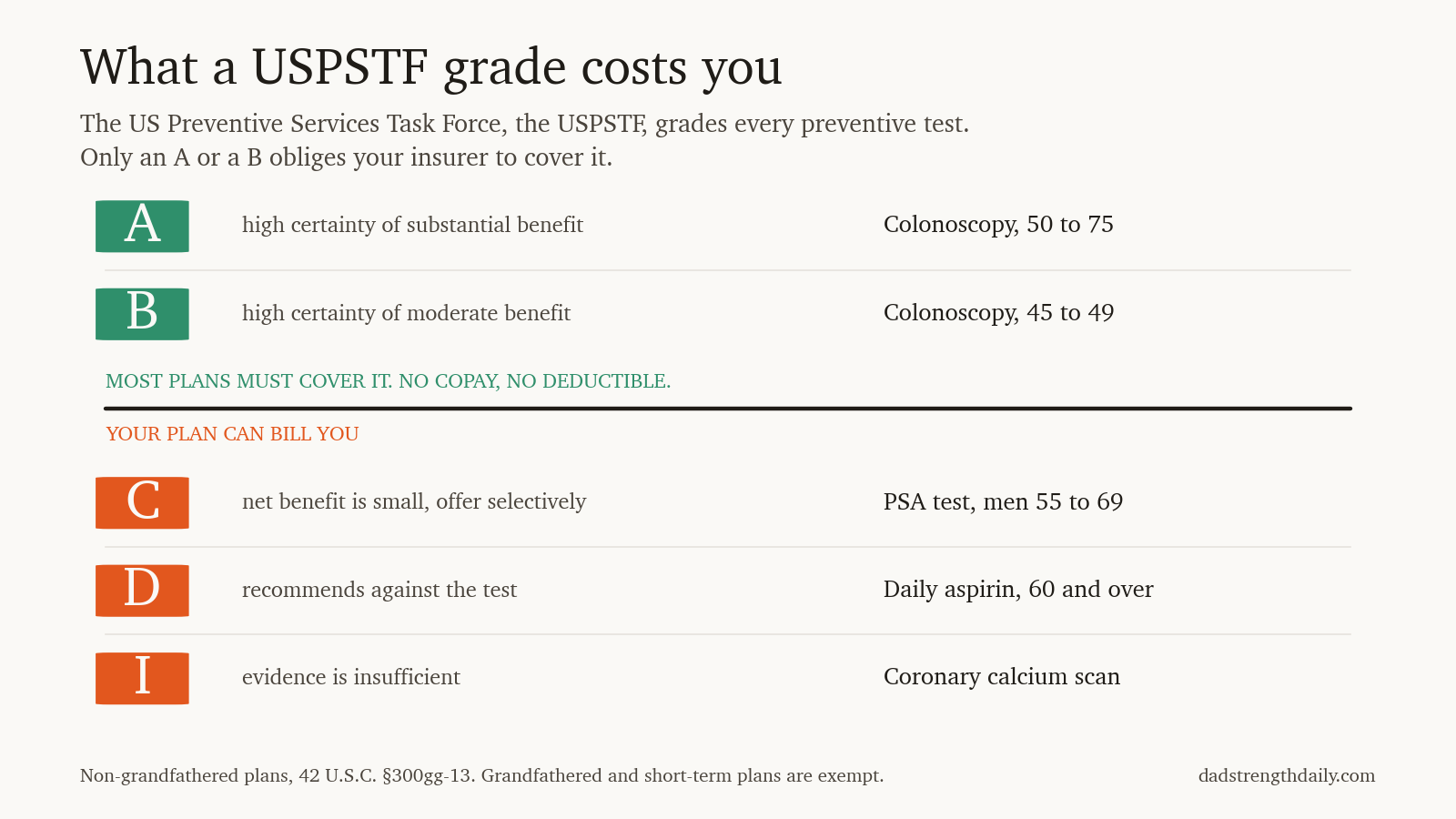
- A federal panel, the USPSTF, grades preventive services A, B, C, D or I. Only an A or a B has to be covered with no cost sharing. That’s why your colonoscopy is free and your PSA test may not be.
- The hiatus hasn’t erased any existing A or B recommendation.
- Two decisions that could change what men my age pay have been sitting unfinished: prostate screening for nearly three years, calcium scans for two. The panel hasn’t met since March 2025.
What USPSTF grades mean for what you pay
I used to get every screening I could. The backlash against whole-body MRI scans made me more selective, and now I start by looking up the test’s grade from the US Preventive Services Task Force. USPSTF grades are a decent evidence filter. They’re also why some tests cost me nothing and others come out of my pocket.
The Task Force is a 16-seat panel appointed by the HHS Secretary, who can also remove members and block what they recommend. A 2025 Supreme Court ruling upheld the arrangement on exactly those grounds. Half those seats were empty until September 17, when HHS named eight new members. Under the Affordable Care Act, non-grandfathered plans “shall not impose any cost sharing requirements for” anything the panel grades A or B. C, D and I carry no such obligation.
| Grade | What it means |
|---|---|
| A | High certainty the net benefit is substantial |
| B | High certainty the net benefit is moderate, or moderate certainty it is moderate to substantial |
| C | The net benefit is small. Offer it selectively |
| D | Recommends against it |
| I | The evidence is insufficient to judge |
C is where the federal $0 guarantee ends. It doesn’t mean “don’t do it,” and a plan can still choose to cover a C or an I.
Existing A and B grades don’t expire, and none has lapsed during the hiatus. Vaccines are covered under a separate rule: flu, COVID, RSV and shingles go through the CDC’s immunization committee, which sits in its own paragraph of the same law with the same no-cost obligation.
There are exceptions. Grandfathered and short-term plans sit outside the rule, and Medicare runs on its own statute. Go out of network and you can lose the protection. So can asking for a test because you already have symptoms, which can turn it into diagnostic care. A new grade is also slow to arrive, since plans have until the first plan year starting a full year after it issues.
Get the next one in your inbox
I write about longevity, training, and preventive health weekly — without the guru worship. Free, no spam, unsubscribe whenever.
What’s already free
Fifty-four services carry an A or a B. These are the ones men are most likely to run into after 50.
| Service | Who it covers, and what it is | Grade |
|---|---|---|
| Colorectal cancer screening | Adults 50–75. Colonoscopy every 10 years, or an annual stool test (FIT) | A |
| Colorectal cancer screening | Adults 45–49. Same choices, starting five years earlier | B |
| Blood pressure screening | Adults 18+. A cuff reading, confirmed outside the office before treatment | A |
| Tobacco cessation | Adults who smoke. Ask, advise, then counseling plus FDA-approved medication | A |
| Statin, primary prevention | 40–75 with at least one CVD risk factor and 10-year risk of 10% or higher. A daily pill | B |
| Lung cancer screening | 50–80, 20 pack-years, current smoker or quit within 15 years. An annual low-dose CT | B |
| Prediabetes and type 2 diabetes | 35–70 with overweight or obesity. Fasting glucose or HbA1c, roughly every 3 years | B |
| Abdominal aortic aneurysm | Men 65–75 who have ever smoked. One ultrasound, once in your life | B |
| Hepatitis C screening | Adults 18–79. A one-off blood test | B |
| Unhealthy alcohol use | Adults 18+. A 1–2 minute questionnaire (AUDIT-C), then brief counseling | B |
| Depression screening | Adults 18+. A short questionnaire (PHQ-2, then PHQ-9 if positive) | B |
| Behavioral weight-loss program | Adults with BMI 30 or higher. Referral to an intensive multi-session program | B |
PSA screening is a C for men 55 to 69 and a D at 70 and older, so it isn’t on the list. Daily aspirin was, until 2022.
Aspirin got demoted. In 2016 daily aspirin was a B for 50–59 with elevated heart risk. Newer trials shifted the evidence, ASPREE among them: in 2018 it reported higher all-cause and cancer mortality in adults 70 and older. Weighing those trials against bleeding risk, the 2022 update made it a C for 40–59 and a D at 60 and over. I’m not telling you to stop taking it. I’m telling you the grade moved.
It moves the other way too. PSA was a blanket D for all men in 2012, then moved to a C for 55 to 69 in 2018. Longer follow-up showed a small potential mortality benefit, though one large trial found it and another didn’t, and active surveillance cut some of the harm of finding low-risk cancer.
Two USPSTF decisions that are stuck
Prostate screening
The Task Force finished its research plan in December 2023 and has produced no draft in the 33 months since. The 2018 C still governs, which is why you can be billed for a PSA test. A move to B would put it on most plans at no cost. I screen harder than a C implies. I’ve had a baseline PSA drawn, I’ll get another, and I care about the slope more than any one result. That’s my call, not the consensus.
Coronary calcium scoring
Research plan finished September 2024, no draft since. A 2018 statement still governs it, and that statement said the evidence was insufficient. An I can last a decade: one analysis found that an I statement that eventually gets a definitive grade takes an average of 8.4 years to get there. One thing has improved. The pending review now covers calcium scoring by itself, instead of lumping it in with the ankle-brachial index and hs-CRP.
An I means the ACA doesn’t require no-cost coverage, and my plan treated the scan as cash-pay. It cost me about $150, my doctor ordered it without any argument, and the score came back zero. It also found something I wasn’t looking for, an ascending aortic aneurysm, which is now the thing on my chart I watch most closely.
Sixteen more topics are stalled alongside these two, including cognitive impairment in older adults and chronic kidney disease. None of them move until the panel does.
Why nothing is moving
The Task Force normally meets three times a year. It has now gone eighteen months without one. July 2025 was cancelled with no reason given, November 2025 was blamed on the shutdown, and March 2026 never happened. A summer meeting was pushed to late August, and by the time the new members were named in September the panel still had not met. A recommendation needs a vote, and a panel that doesn’t meet can’t vote.
Staffing is the other constraint. AHRQ funds and supports the evidence-review machinery the panel depends on. It had nearly 300 employees in 2024 and 84 in 2026, STAT reports.
Filling the eight seats was necessary. It finishes nothing. The reviews still have to be written, sent out for comment, and voted on at a meeting nobody has scheduled, and even then only an A or a B obliges your plan to cover it. If you’re waiting for a PSA test or a calcium scan to become free, check what your own plan covers. I wouldn’t count on the federal requirement arriving soon.