
The deadliest cancers for men over 50, by age band; what half a century of progress actually bought; and the one screening decision where three expert bodies still disagree.
By Gunnar · Not medical advice · Every number links to its source · September 15, 2026 · Editorial standards
- Among cancers, lung cancer is the leading cause of death in men from 50 onward, and about 87% of lung cancers in men are attributable to smoking.
- Prostate cancer is the most diagnosed cancer in men, but it ranks sixth as a cause of death at 50 to 64 and second only after 65.
- Tobacco accounts for 32.2% of cancer deaths in US men, more than excess weight, alcohol, diet, inactivity, infections and sun combined.
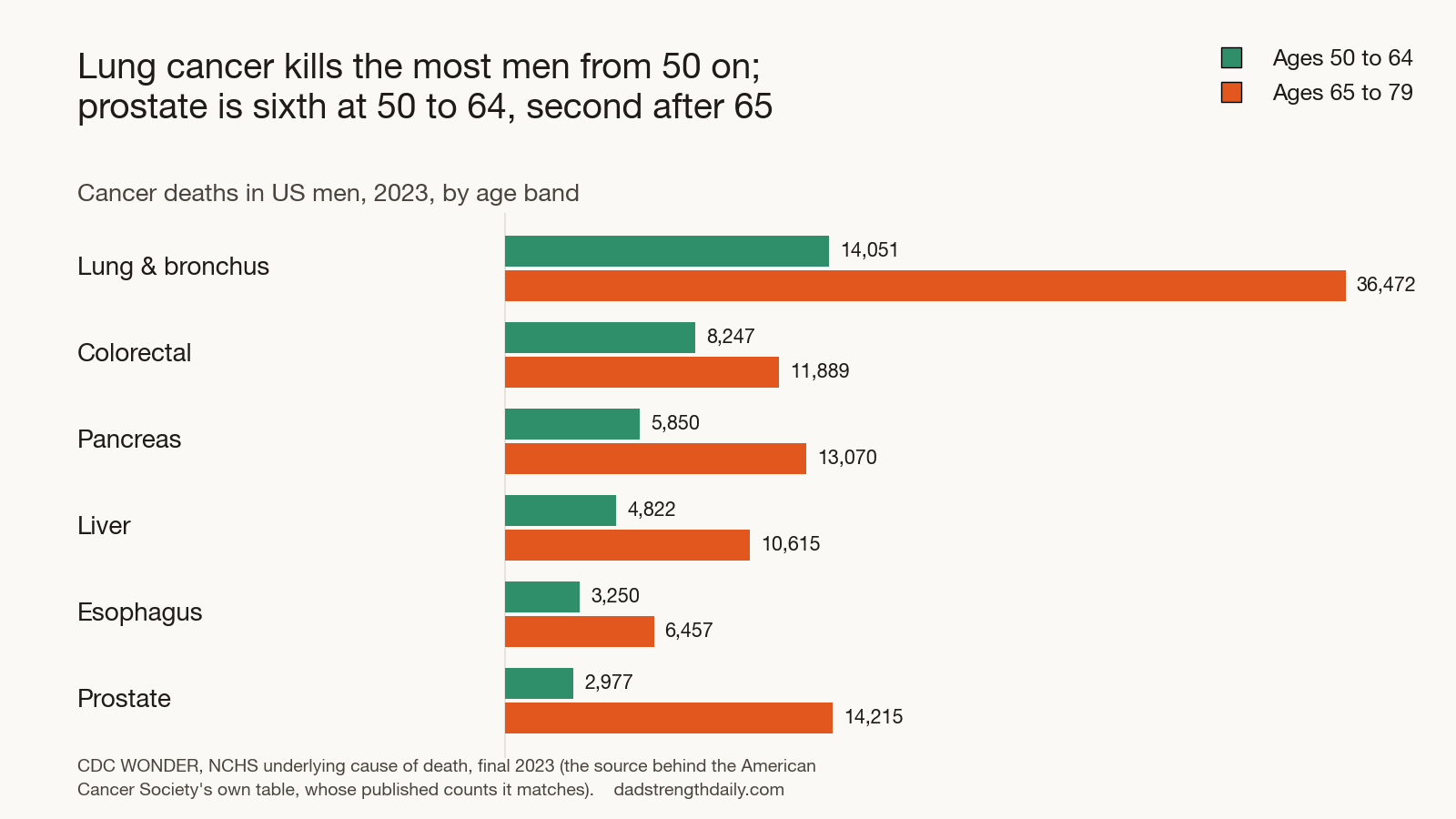
Among cancers, lung cancer is what kills the most American men in their fifties and sixties. Prostate cancer, the one men my age actually worry about, ranks sixth at 50 to 64: 2,977 deaths in 2023, against 14,051 from lung cancer.
That is not the order I had in my head. Prostate is the cancer men hear about, and it is the most commonly diagnosed cancer in men. Diagnosis and death are two different lists.
The deadliest cancers for men over 50
A US man’s lifetime chance of an invasive cancer diagnosis is 39.2%, about two in five; of dying of cancer, 17.2%, about one in six. In 2023, cancer killed 64,426 US men aged 50 to 64 and 151,101 aged 65 to 79. These are the deadliest cancers for men over 50, by age band.
| 50–64 | 65–79 | 80+ | |
|---|---|---|---|
| Lung | 14,100 | 36,500 | 17,100 |
| Colorectal | 8,200 | 11,900 | 7,200 |
| Pancreas | 5,800 | 13,100 | 5,900 |
| Liver | 4,800 | 10,600 | 3,400 |
| Esophagus | 3,200 | 6,500 | 2,500 |
| Prostate | 3,000 | 14,200 | 16,600 |
| Bladder | 1,300 | 5,000 | 6,000 |
SEER data for 2022 to 2024 put a 50-year-old man’s chance of dying of cancer within ten years at 1.4%. At 60 it is 3.9%, at 70 it is 7.4%. Cancer also overtakes heart disease as the leading cause of death in men aged 60 to 79.
Prostate cancer tops the diagnosis counts and sits well behind lung in the death counts. ACS expects about 334,000 new prostate cancers in men this year against 111,000 lung cancers, and about 36,000 prostate deaths against 63,000 lung deaths. One man in eight is diagnosed with prostate cancer at some point; one in 49 dies of it. Five-year relative survival is 98.2%, and only 9% of cases are caught after the cancer has spread. Lung is the mirror image, 29.5% survival with half caught late, and pancreatic cancer is worse still at 13.7%.
What 50 years of cancer progress actually bought
Most of the progress came from men smoking less, not from anything that happens in a clinic. The overall US cancer death rate fell 34% from 1991 through 2023, which ACS translates into about 4.8 million averted deaths, about 3.3 million of them in men. Islami and colleagues (CA Cancer J Clin, 2025) put one number on the reason: lung cancer deaths averted by falling smoking rates equal 60.1% of the entire decline in men’s cancer mortality from 1970 to 2022. US smoking prevalence went from 42% in 1964 to 11% in 2023.
Treatment is not nothing, and the best attempt to divide the credit shows where it lands. Goddard and colleagues (JAMA Oncology, 2024) modelled the five cancers with the best data and found eight in ten averted deaths came from prevention and screening rather than treatment, with 98% of the lung gain from tobacco control. Take lung out of their model and treatment’s share rises to 46%, 1.14 million of 2.49 million averted deaths. Their model leaves out liver, pancreas, ovary and the rarer cancers, about a quarter of all cancer deaths.
The cancer men fear most moved the most: the prostate cancer death rate in men is down 53% from its 1993 peak. The survival numbers look better still, and they carry the most caveats. Five-year survival across all cancers rose from 49% in the mid-1970s to 70% for 2015 to 2021, and ACS prints its own warning beside that: earlier detection inflates survival through lead time and overdiagnosis, and the pancreatic gain is “partly an artifact” of slow-growing neuroendocrine tumours turning up incidentally.
The pessimists of that era were right about the data in front of them. Bailar and Smith wrote in the New England Journal of Medicine in 1986 that “we are losing the war against cancer”, and Bailar and Gornik wrote in the same journal in 1997 that “The effect of new treatments for cancer on mortality has been largely disappointing.” Both came before imatinib in 2001, pembrolizumab in 2014, the first CAR-T approval in 2017 and the first KRAS drug in 2021. That is also why treatment looks small in a fifty-year accounting: the drugs that work best are younger than the trend they are being measured against.
Get the next one in your inbox
I write about longevity, training, and preventive health weekly — without the guru worship. Free, no spam, unsubscribe whenever.
Where men can actually move the odds
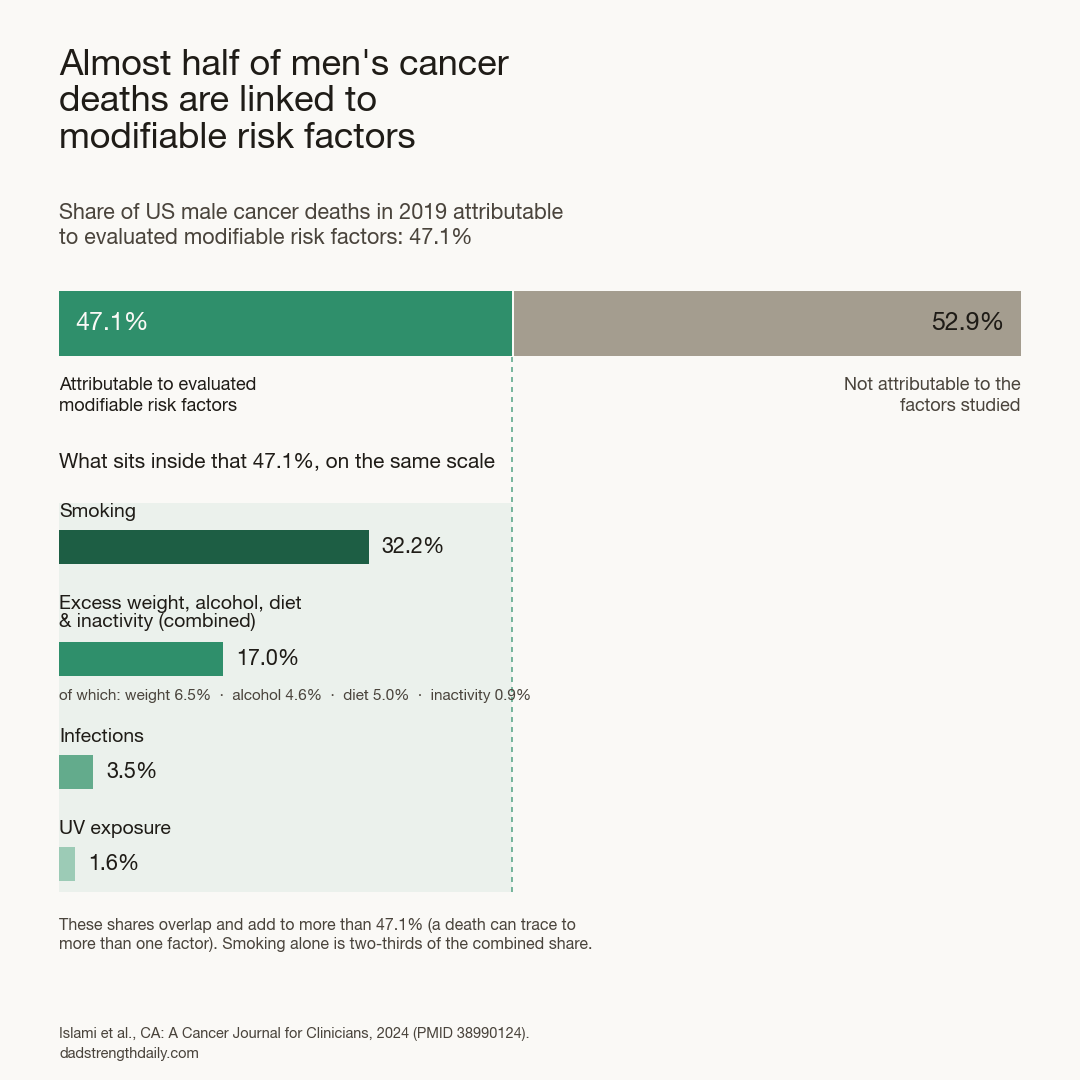
Almost half of cancer deaths in American men are attributable to risk factors that can change, and tobacco is two thirds of that. Not smoking is the biggest single thing on the list and nothing else is close. Excess weight, alcohol, diet and inactivity come next as a group, at 17.0% of male cancer deaths, then infections at 3.5% and sun exposure at 1.6% (Islami and colleagues, CA Cancer J Clin, 2024; the shares overlap, so they do not sum to 47%). Attributable is not the same as controllable, though. Second-hand smoke, infections and things that happened to you decades ago are all inside that 47%.
I have never smoked. One cigar in the 1990s, and nobody in my family smoked either, so the largest line item was gone before I did anything, which is luck as much as virtue. I quit drinking in my forties and lost about 170 pounds with the help of Zepbound. UV should be larger for me than for the average man, because I am very fair, my family is from northern Germany, and I burn on overcast days, which is why I now have a sunscreen rule I actually follow. US alcohol-related cancer deaths have doubled since 1990, with the largest rate increase in men 55 and older.
Exercise belongs on the list, and the prize is real but modest. Hitting the standard 150 to 300 minutes of moderate activity a week goes with 8 to 14% lower colon cancer risk in men, and the federal advisory review grades the evidence “strong” for cancers of the bladder, colon, esophagus, stomach and kidney (a pooled analysis of 755,459 people; associations, not proof that the exercise did it).
What cancer screening should a man over 50 get?
| Cancer | What to do |
|---|---|
| Colorectal Screen | Start at 45. Colonoscopy every 10 years, or a stool test every 1 to 3 years if that is the one you will actually do. USPSTF and ACS both start at 45 now. |
| Lung If you smoked | Annual low-dose CT from 50 if you have 20 pack-years. ACS sets no limit on how long ago you quit, which is the more inclusive rule and the one I would use. |
| Prostate Screen the trend | Get a PSA, then keep getting it and watch the slope rather than the single number. My position is below. |
| Skin, bladder No screening | Nothing to book at average risk; the evidence is not there either way. |
| Pancreas, liver, esophagus No screening | No test worth booking at average risk. For the liver the lever is the hepatitis B vaccine, part of the adult vaccine list, plus a one-time hepatitis C test. |
| Aspirin Not for cancer | Do not start it for cancer prevention. USPSTF dropped colorectal cancer from its aspirin recommendation and advises against starting after 60. |
My position on prostate screening: get a PSA, keep getting it, and pay attention to the slope. One value against a population cutoff is the weakest way to use the test. Three values over a few years tell you whether anything is moving, and a rising trend is what should trigger the next step, which today is an MRI rather than a straight line to biopsy. Peter Attia makes this case at length: PSA velocity from serial tests, PSA density from the MRI, transperineal biopsy if tissue is needed, and active surveillance for low-grade disease add up to a different screening system than the one the USPSTF judged, with “dramatically better” discriminating power. I find that persuasive, and it is what I do. I am on testosterone replacement, so I am having blood drawn regularly anyway.
The guideline bodies have not caught up, and their caution is not stupid. More testing means more false positives, more biopsies, and treatment of cancers that would never have harmed the man who had them. USPSTF still calls PSA an individual decision from 55 to 69 and recommends against it at 70 and older; the American Urological Association goes furthest, PSA every two to four years from 50 to 69. Start earlier, at 45, if you are Black or if your father or brother was diagnosed before 65 (ACS). I land with the AUA, and with Attia on how to read the results. That is my conclusion, not a consensus.
The deadly cancers routine screening still misses
Nothing on that list looks for pancreatic, liver or esophageal cancer in a man at average risk, and those three killed 13,922 US men aged 50 to 64 in 2023. I paid for a Galleri test myself and the result was “No Cancer Signal Detected.” I was glad to read it, and that is close to all I can say about it.
NHS-Galleri put about 142,000 people through that test, and at ASCO in June 2026 the trial missed its main goal, which was catching fewer cancers at stage III and IV. The company describes the same results more warmly, the full paper still is not published, and an FDA panel meets on September 23, 2026. So here is what a clean result on one of these tests is worth: nothing you can act on. It is not a reason to skip anything. If you are due for a colonoscopy or a lung CT, go and get it. Same for the newer single-cancer blood tests for lung and colon cancer: worth watching, not worth substituting.