
Updated with the medical societies’ fall 2026 flu, COVID and RSV guidance.
I am 53. I read health news every day and write a health blog, and still, until recently, I could not have told you what I was due for. The flu shot, sure. I get one every autumn the way I get a haircut. Shingles I had written a whole post about. Past those two I would have been guessing, and I do not think I am unusual. The schedule of vaccines after 50 is real, it applies to every one of us, and I have never met anyone outside a clinic who could recite it.
Nobody hands you the list. The recommendations live on agency pages you have no reason to visit, and the record of what you have already had is scattered across every clinic, pharmacy and employer you have passed through in four decades. So: the list, in plain words, and then the more useful half, which is how to find out where you stand.
Which vaccines after 50 do you actually need?
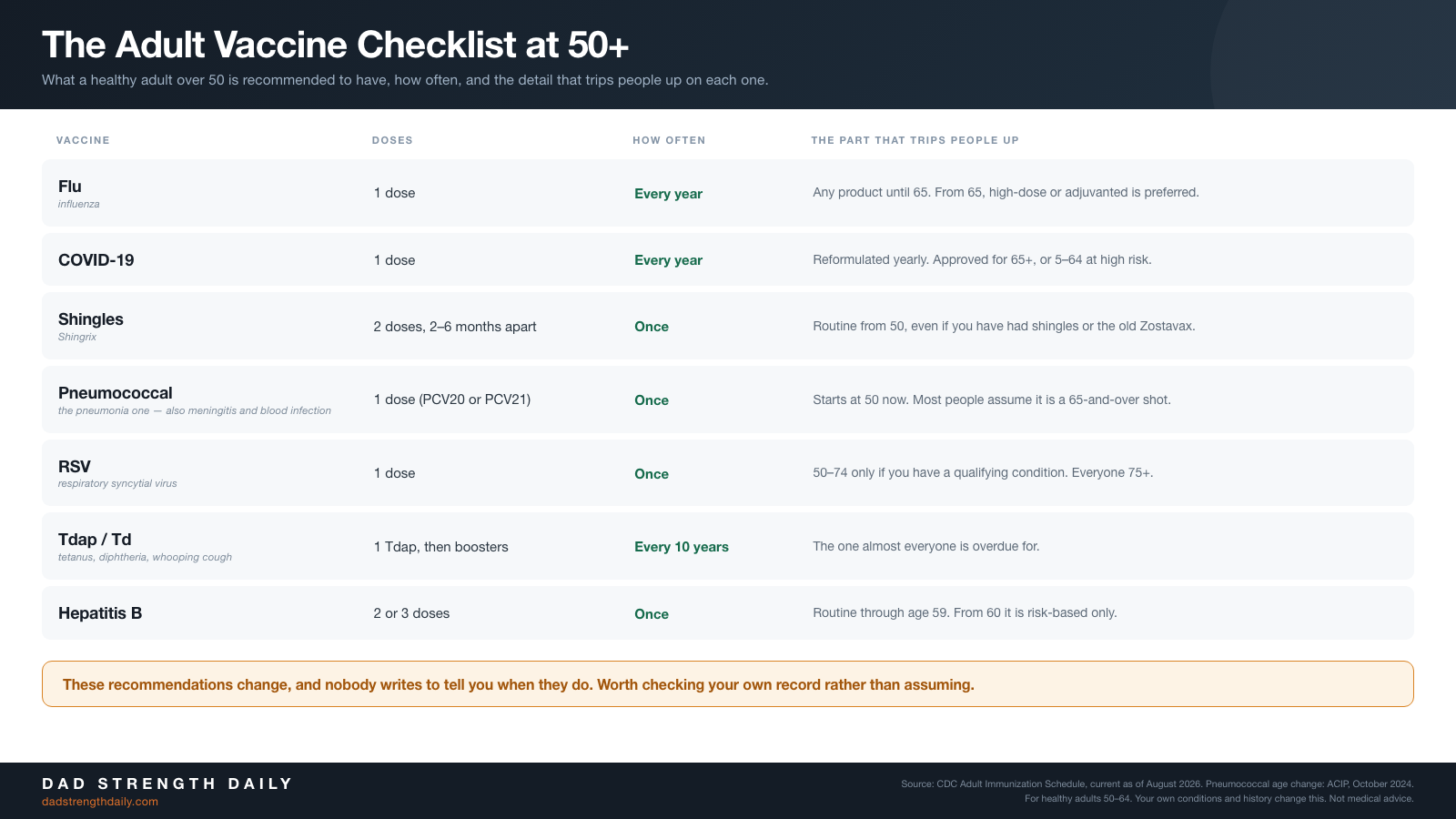
Seven items, and I doubt most of us could name more than three.
The flu shot is yearly. I get one every autumn and treat it as maintenance, not a decision. There is now an mRNA version as well, which is a separate decision from whether to get a flu shot at all. The COVID shot is on the same yearly clock; the last time around I had both done in a single pharmacy visit.
Shingles is a two-dose series, the second dose two to six months after the first. It is the one item here I have already argued at length, in the post I wrote about getting Shingrix at 51, so I will spare you the rerun.
Pneumococcal is a one-time shot for most people, and it deserves its plain name, the pneumonia one. It protects against Streptococcus pneumoniae, the bacterium behind most bacterial pneumonia, which can also cause meningitis and bloodstream infections. One dose, and for most of us the errand is done.
RSV is a single dose too, not an annual shot, and at our age it is recommended only if you have a qualifying health condition, which makes it a conversation with your doctor rather than a default. Working out whether I have a qualifying condition turned out to be harder than the patient-facing page makes it look.
Tdap is the tetanus booster, renewed every ten years, a schedule almost nobody tracks because tetanus feels like a childhood subject. And hepatitis B vaccination is now routine through age 59, which is why it applies to a man in his fifties today when it did not apply to his father at the same age.
Get the next one in your inbox
I write about longevity, training, and preventive health weekly — without the guru worship. Free, no spam, unsubscribe whenever.
Who tells you when this list changes?
Nobody. These recommendations move: an advisory committee votes, a government web page gets a new date stamp, and nothing notifies the people affected. Pneumococcal is my own proof. Its starting age dropped from 65 to 50 in October 2024, and I got the shot at 51 without being able to tell you, honestly, whether I knew the age had changed or simply said yes to what was offered. Which is the argument for pulling your own record rather than waiting to be prompted.
Update, September 3, 2026: This autumn the answer is the medical societies, because the federal process stalled. The CDC advisory committee whose votes I just described is tied up in a court fight, and by September 2 no federal fall schedule had been published. So on that day the pediatricians, family doctors, obstetricians and infectious-disease specialists published their own, and the American Medical Association put them on a single page. For people our age it is the same list with the ages filled in. A flu shot every year, and the high-dose version once you are 65 if the pharmacy has it. An updated COVID shot every year, plus a second dose six months later once you are 65. A one-time RSV shot from 50 to 74 if you have a qualifying condition, and for everyone at 75. The flu figure they lean on comes from the Vaccine Integrity Project’s analysis in JAMA: vaccination cuts hospitalizations in older adults by 31 percent. What a society list means for insurance coverage, which has keyed off that committee’s votes, is still open.
How do I look up my vaccination record?
Start with your state, and lower your expectations before you log in. There is no national vaccination registry in the United States. Every state runs its own immunization information system, the systems do not talk to each other, and your record does not follow you when you move. Your old state keeps its copy; your new one never hears about it. CDC keeps a state-by-state directory of where to ask, and that is the starting link wherever you live. If you have lived in three states, plan on doing this three times.
Whether you can simply log in and look is a coin flip. Massachusetts, where I live, has a self-service portal called My Vax Records. California, Colorado, Arizona, Washington, Illinois, Louisiana and Pennsylvania all run something similar, several of them fronted by the same white-label product, MyIR Mobile, so readers in different states may find themselves on an identical screen. New York City runs its own registry, separate from the state. Elsewhere you have to ask a human. New York State outside the city routes you through a provider, Texas takes requests by form, and Florida’s system is built for providers and schools, not patients.
Two states carry a consent trap to know about before you search. New York State and Texas are opt-in, which means that if nobody ever collected your agreement you are not in the system at all, and an empty result tells you nothing about your actual history. Texas adds a second twist: if you never file an adult consent form, the childhood record the state does hold is deleted when you turn 26. Massachusetts sits at the other extreme and includes adults by law, with no opt-out.
What will your state record be missing?
Whatever nobody reported to it. A registry holds only what a provider or pharmacy sent in, and that limit bites harder for us than for our kids. National registry participation for children under six was 99.2% in 2024. For adults it is far lower, and I am deliberately not printing a figure, because the most recent one I could source is years stale.
The predictable holes: anything given in another state, anything from a workplace or occupational health clinic, anything from a travel clinic, anything from a VA or military facility (those records are kept separately, and you request them from the VA or your service branch), anything that predates the registry, and anything a provider simply never sent.
And the errors run in both directions, not only toward silence. My own page flags me overdue for DTP while listing, an inch further down, a Tdap I was given in November 2024, which on a ten-year clock should hold me until 2034. I cannot reconcile those two entries, and neither can the page.
A gap can be fixed, though no state lets you edit your own record directly. The pattern everywhere is that you bring documentation, a paper CDC card for instance, and the health department makes the entry. Massachusetts takes amendment requests online.
If the registry comes up short, this is the order worth working through:
- Your state registry. Still the first stop, for anything a reporting provider gave you in-state.
- Your pharmacy account. CVS and Walgreens are reliably strong for exactly what pharmacies give: flu, COVID, shingles. CVS keeps a health dashboard.
- Patient portals. MyChart and its cousins are as complete as one health system’s own records, and no more.
- Apple Health Records. It pulls immunizations from participating hospitals. It does not query state registries, so it is a second window onto the same institutional data rather than a wider net.
- The paper CDC card. Only what somebody wrote on it, and one house fire from gone.
No single source on that list is complete for most adults. Two or three of them assembled is the honest version of the advice.
What is the record good for?
Reconstructing your doses. That is the whole job, and it matters, because every one of the vaccines after 50 starts with the question of what you have already had, and across a lifetime of clinics memory is a bad witness.
What the record cannot do is clear a clinical decision. Some state portals will forecast what you are due for, and the forecast reasons from the only things a registry holds, your age and your dose dates. There is no field for your health conditions, and eligibility for part of this list turns exactly on those. “The portal didn’t flag it” is not “you don’t need it.”
So pull the record, and treat what comes back as raw material rather than a verdict. Mine handed me a contradiction I cannot resolve, a history I had half forgotten, and a better set of questions for my next appointment than I walked in with. The reading of it still belongs to a person.
About Gunnar
Gunnar is 53. He lost about 170 pounds, trains in a garage gym, and writes DadStrengthDaily from personal experience, citing primary sources where he can. He also moderates r/ProactiveHealth. He is not a doctor, and nothing here is medical advice. Talk to your own doctor before acting on anything, especially GLP-1s, TRT, blood pressure, sleep apnea, and cancer screening.