
I have been interested in the mRNA mechanism since I first understood what it actually was, long before it had anything to do with me. Later I read the book: The Vaccine: Inside the Race to Conquer the COVID-19 Pandemic, Joe Miller writing with Uğur Şahin and Özlem Türeci, the two scientists who built BioNTech. Around the time the first shots arrived, a friend of my wife’s called the technology zombie juice.
I want to be fair about that, because she was not being unreasonable. Stripped to its plain description the idea is genuinely strange. You inject a set of instructions, and your own cells read them and manufacture a piece of a virus so your immune system can practise on it. Nobody’s intuition comes pre-loaded with that. Zombie juice is a decent first reaction from someone hearing it cold.
Six years on, the platform has its first influenza approval. The trial says the new shot beat a conventional flu vaccine by 26.6%, which sounded persuasive until I worked out exactly which conventional vaccine they had tested it against.
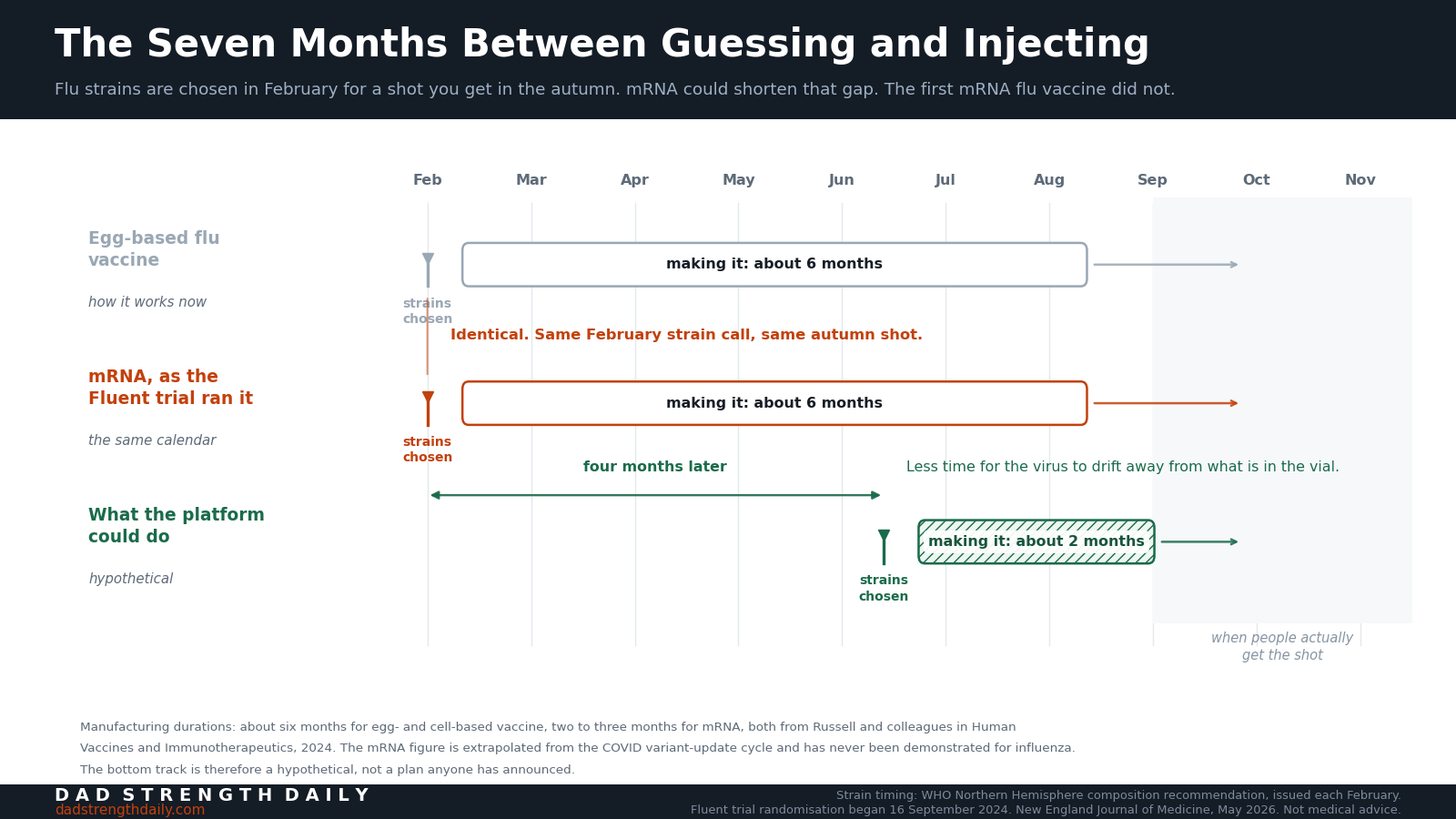
Why is a flu shot designed seven months before anyone needs it?
Every February the World Health Organization recommends the Northern Hemisphere flu vaccine composition, and the FDA’s advisory committee finalises the American version in February or March. Flu season runs roughly October through March. So the strains in the shot you get in the autumn were picked seven or eight months before you roll your sleeve up, and ten or more before the season peaks. The virus does not stop evolving while it waits. The call cannot be made later because of manufacturing: growing influenza virus in eggs or in cell culture takes about six months after the strain is chosen, according to Russell and colleagues in Human Vaccines and Immunotherapeutics in 2024.
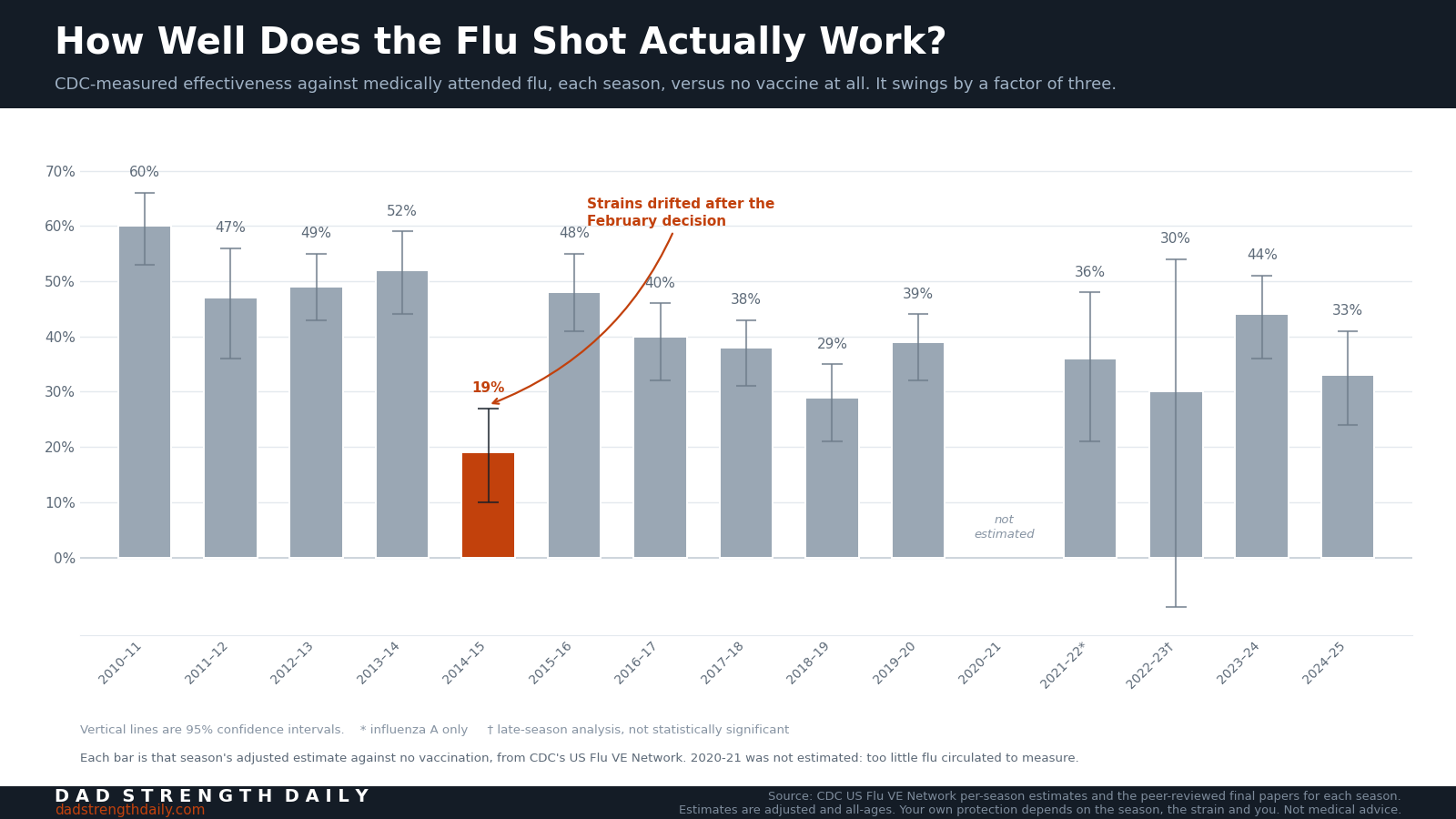
That guess can miss badly. In the 2014-15 season H3N2 drifted after the February decision, and 68% of circulating H3N2 viruses ended up different from the vaccine strain. CDC’s final adjusted estimate of effectiveness against H3N2 that season was 6%, with a confidence interval running from minus 5 to 17. That interval contains zero, which means the analysis did not establish that the shot protected against the strain making people sick that year.
There is a second problem, separate from the first. Growing influenza virus in hens’ eggs selects for mutations in the virus itself, because the versions that grow best in eggs are not the versions circulating in people. That is the manufacturing changing the virus, a different failure from the virus changing in the wild. Ortiz de Lejarazu-Leonardo and colleagues, in Vaccines in 2021, put the cost at a 4% to 16% loss of effectiveness, around 9% on average.
mRNA sidesteps that, because the vaccine is synthesised from a sequence and the virus is never grown in anything. That is mechanistic reasoning rather than an outcomes trial, and no head-to-head has isolated the effect for mRNA-1010. The same 2024 paper estimates mRNA could compress the six-month production window to two or three months, though that figure is extrapolated from the COVID variant-update cycle, where an FDA recommendation in June 2022 produced updated shots that September. It has not been shown for flu.
Get the next one in your inbox
I write about longevity, training, and preventive health weekly — without the guru worship. Free, no spam, unsubscribe whenever.
Have I already been buying half of the mRNA pitch?
As it turns out, yes, and I did not know it.
The shot I get is Flucelvax, which is cell-based. It is grown in mammalian cell culture instead of in eggs, so it contains no egg protein and, more to the point here, no egg-adapted virus. I did not pick it for that reason. Until this week I could not have told you why it mattered. Stein and colleagues, in Influenza and Other Respiratory Viruses in 2025, found cell-based vaccines beat egg-based ones by a relative effectiveness of 7.7% in the 2022-23 season.
So of the two advantages the mRNA platform is sold on, one is already in my arm. What is left, for me specifically, is speed. The general case for mRNA flu vaccines is wider than the case being made to me. The platform’s bigger swing is not flu at all. Moderna and Merck have an individualised mRNA cancer vaccine in melanoma, and how that Phase 3 result got announced is its own story.
Is the mRNA flu shot better than the one I already get?
On August 5, 2026, the FDA approved mFLUSIVA, Moderna’s mRNA-1010, for adults 50 and older. It is the first mRNA flu shot ever licensed anywhere, and it is expected for the 2026-27 season.
The approval is split. Ages 50 to 64 got standard approval on efficacy data, meaning counted flu cases. Ages 65 and up got accelerated approval on immune response, with clinical benefit still to be verified in a confirmatory trial. So for the group at highest risk from influenza, approval rests for now on immune-response data rather than demonstrated clinical efficacy.
That is odd on its face, because nearly half the people in the trial were 65 or over and their flu cases were counted like everyone else’s. The reason is the shot they were compared against, and it is the same reason the FDA balked at the application in the first place. I will come back to it.
The pivotal trial, called Fluent and published in the New England Journal of Medicine in May 2026, randomised 40,805 adults aged 50 and up at 301 sites across 11 countries, of whom 40,303 ended up in the analysis that counted cases, against a licensed standard-dose flu vaccine, across the 2024-25 northern hemisphere season. Relative efficacy was 26.6%, interval 16.7 to 35.4. In absolute terms, 411 of 20,179 people in the mRNA arm got PCR-confirmed influenza-like illness, or 2.0%, against 557 of 20,124, or 2.8%. Mean age was 64, and just under half the participants were 65 or older.
Do the subtraction in the open, because the percentage flatters it. Work from the actual counts rather than the rounded ones and the gap is 0.73 of a percentage point. Vaccinate about 137 people with the new shot instead of the old one and you prevent one confirmed case at that season’s attack rate. Everyone in that trial was vaccinated, the comparison group included, so 137 is the number needed to change which product you get, not the number needed to protect somebody who would otherwise have had nothing.
For scale on the other comparison, the 2018 Cochrane review of flu vaccines in healthy adults put it at 71 people vaccinated rather than unvaccinated to prevent one case. I am not going to line 71 up against 137 and declare a winner, because they measure different things in different populations, one against nothing and one against another shot. Anyone quoting you a single flu-vaccine number without saying which comparison it came from is not telling you enough.
One arithmetic exercise is worth doing, because the seasons line up. The trial ran in 2024-25, and CDC put ordinary flu vaccine effectiveness that same season at 33%. If, and this is a substantial if, the vaccine in the trial performed like the average vaccine in that CDC figure, the two effects together imply something around 51% against no vaccination at all.
That is worth having in your head, because 26.6% sounds feeble next to a chart of flu seasons and 51% does not. But it is not an observed number for mFLUSIVA. No trial has measured this vaccine against an unvaccinated group, and CDC’s 33% describes a whole season’s mix of products rather than the specific shot this trial beat. Hold on to that last point, because it turns out to matter more than the arithmetic.
You pay for the upgrade in how you feel the next day. Injection-site pain 65.8% against 29.8%. Fatigue 45.1% against 20.3%. Headache 37.8% against 18.0%. Muscle pain 35.4% against 11.6%. Roughly two to three times the rate on every common complaint, and most of it mild to moderate and gone in a day or two.
The line I would want spelled out, though, is the severe end. Grade 3 reactions, meaning bad enough to interfere with daily activity, ran at 6.4% with the mRNA shot against 1.0% with the comparator. Serious adverse events were 2.2% against 1.9%, and deaths were 0.2% in both arms with none judged vaccine-related. So the safety picture is reassuring and the discomfort picture is not nothing. One in fifteen people had a reaction that got in the way of their day.
One more honest note from the tables. The 26.6% is driven by influenza A. Against influenza B the confidence interval runs from minus 18.5 to 57.5, which crosses zero, on 25 cases against 35. The trial did not show the shot works better against B. It showed it works better against the strains that happened to circulate.
So where did all that speed go?
This is the part I did not expect.
mFLUSIVA was formulated against the same WHO strains, chosen on the same February schedule, as every egg-based and cell-based competitor on the shelf. No later cutoff. No compressed timeline. The advantage that makes the platform interesting was never exercised.
The pivotal trial ran across a normal-length single flu season, exactly as a conventional flu vaccine trial would.
And the regulatory path was not quick either. In February 2026 the FDA issued a refusal-to-file on the application. The stated objection was about trial design, specifically the choice of comparator, and had nothing to do with manufacturing or timing. That was followed by a Type A meeting, and then a decision date of August 5, 2026.
So the first mRNA flu vaccine reached the market on the same February strain calendar as everything else, after a conventional trial and a review that took half a year and a reversal to get through.
I want to be careful about what that proves. A first licensure needs a full efficacy trial, and that needs a whole flu season, so no version of this approval could have run at the platform’s theoretical speed. The shorter pipeline is real and has not gone anywhere. What has not happened is the actual test: an annual strain update, decided later than everyone else’s, reaching arms in time for the same season. That is the year to watch, and it is not this one.
So what am I doing in October?
Getting a flu shot, the way I do every autumn. That part was never in question, and it is one of a short list of shots that actually matter after 50.
Whether it will be the mRNA flu shot is a separate matter, and I am not in a hurry about it.
The strongest criticism of that trial is that it beat a standard-dose vaccine rather than one of the stronger formulations. That criticism is about people my father’s age, not mine. High-dose and adjuvanted shots are licensed for 65 and older only, and for adults 50 to 64 there is no preferential recommendation for any particular flu vaccine. So the comparison the trial actually ran is the comparison that describes my options, and it describes his badly.
Then I read the actual paper instead of the summary, and found the thing that settles it for me.
The control arm was not some generic standard-dose shot. It was Fluarix, or one of its siblings, Fluarix Tetra and Influsplit Tetra and Alpharix Tetra. Those are GSK vaccines and they are grown in eggs. Right down to the residual ovalbumin in the vial.
So the trial measured an mRNA vaccine against egg-based vaccines. Not against the cell-based one in my arm.
Worth saying plainly before the reasoning: the trial was funded by Moderna and Blackstone Life Sciences, and Moderna designed it, ran the analysis and prepared the manuscript. That is important context for reading any industry-sponsored comparison. The 26.6% is also the pooled result across everyone 50 and older, not a figure calculated for my decade.
Now the part that matters more than it sounds. Some unknown share of that 26.6% relative advantage may reflect the egg problem from earlier in this piece, the one Flucelvax already sidesteps. I cannot tell you how much, because nobody has run mRNA head to head against a cell-based shot. What I can tell you is that the headline number was earned against a vaccine I do not get, and that I would want the other trial before I switched.
Against that: about 137 people switching to prevent one case, two to three times the rate of sore arms and tired days, a price I have not seen published, and a vaccine I already take that has been quietly avoiding the egg problem for years.
I will ask my doctor about it in September, along with a separate question about RSV that I have not been able to settle by reading. Until then, a flu shot in October, probably the cell-based one again, and a real interest in what this platform does the first time it gets to run at its own speed.
About Gunnar
Gunnar is 53. He lost about 170 pounds, trains in a garage gym, and writes DadStrengthDaily from personal experience, citing primary sources where he can. He also moderates r/ProactiveHealth. He is not a doctor, and nothing here is medical advice. Talk to your own doctor before acting on anything, especially GLP-1s, TRT, blood pressure, sleep apnea, and cancer screening.