
I am 53, I read health news the way other men read box scores, and until last week I did not know that the RSV vaccine now starts at 50.
Not 60. Fifty. CDC lowered the floor in 2025 for adults aged 50 to 74 who are at increased risk of severe RSV illness. RSV is respiratory syncytial virus, a common respiratory infection that is a bad cold for most people and a serious lower-respiratory illness for some older adults. The only adult vaccine I have ever properly researched is Shingrix, and I did that because of what shingles did to my wife. RSV I had never looked at once.
Then I went to check whether “at increased risk” describes me. That turns out to be the whole of RSV vaccine eligibility, and the useful answer lives on a CDC page written for clinicians.
Who does CDC say should get an RSV vaccine now?
Two sentences, verbatim, from a page dated February 20, 2026. “CDC recommends everyone ages 75 and older get an RSV vaccine.” And: “CDC recommends adults ages 50–74 who are at increased risk of severe RSV illness get an RSV vaccine.”
Several things on that page surprised me. It is not an annual shot. One dose is the whole course, the page says it protects adults 50 and older for at least two years, and if you have already had one you are not supposed to get another right now. That two-year figure has a problem, and so does every other number in this post. I will come back to it. The window is late summer and early fall, August through October for most of the continental United States. So if this applies to you, it applies to you this month.
Three products are licensed for adults, GSK’s Arexvy, Moderna’s mResvia and Pfizer’s Abrysvo, and CDC says there is no preference among them.
Hold onto the no-preference part.
Get the next one in your inbox
I write about longevity, training, and preventive health weekly — without the guru worship. Free, no spam, unsubscribe whenever.
What are the RSV vaccine eligibility rules at 50 to 74?
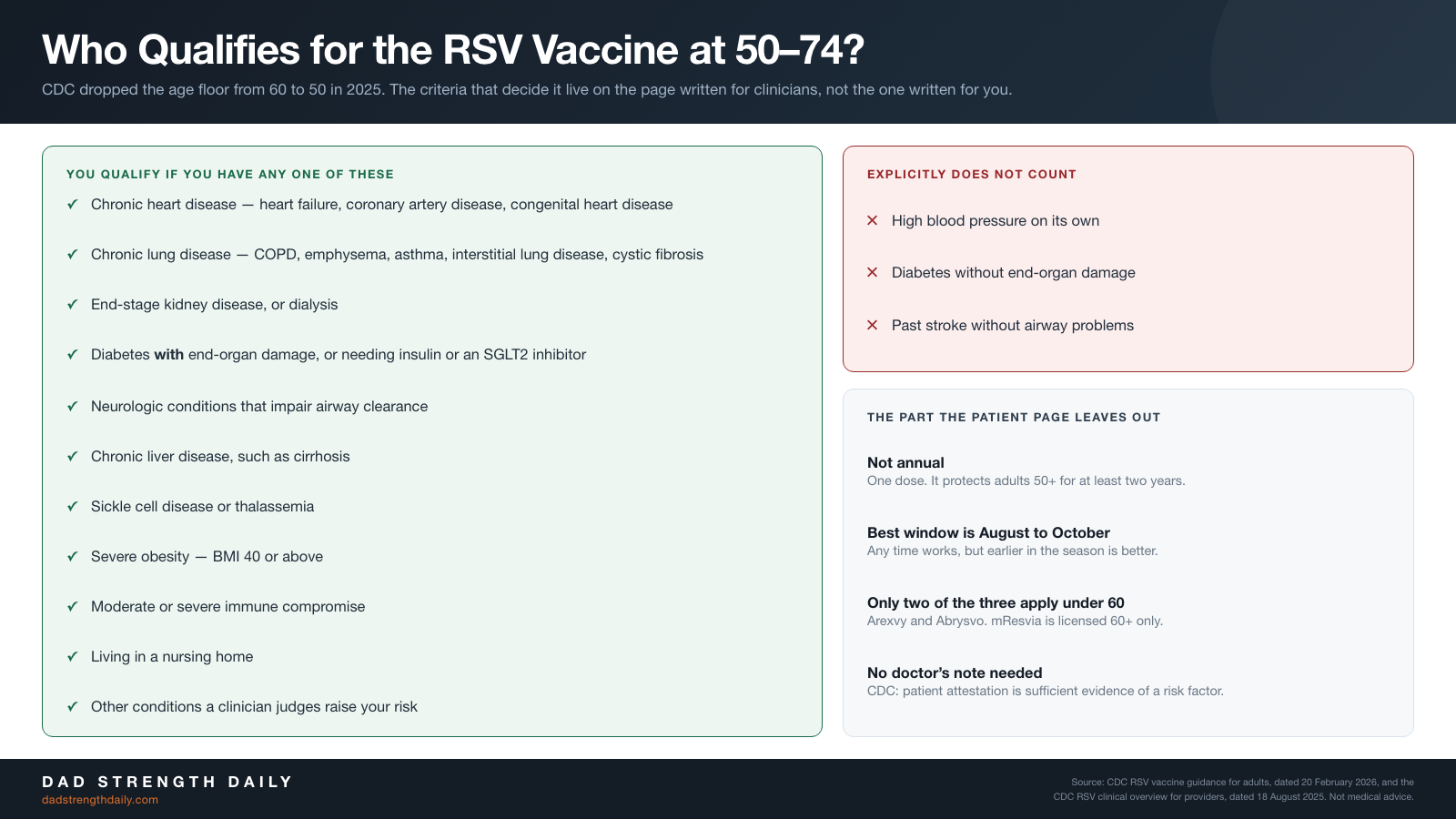
The patient-facing page gives four categories: chronic heart or lung disease, weakened immune system, certain other underlying medical conditions, and living in a nursing home. “Certain other underlying medical conditions” is where the answer actually lives, and as written it tells you nothing. The page links out to a clinical overview written for providers, and that is where the actual criteria live.
That list is specific in a way the patient page is not:
- Chronic cardiovascular disease, given as heart failure, coronary artery disease or congenital heart disease, and then in brackets, “excluding isolated hypertension”
- Chronic lung disease
- End-stage renal disease
- Diabetes, but only when complicated by kidney disease, neuropathy, retinopathy or other end-organ damage, or requiring insulin or an SGLT2 inhibitor
- Neurologic conditions that impair airway clearance, with stroke excluded unless airway clearance is affected
- Chronic liver disease
- Sickle cell disease or thalassemia
- Severe obesity, defined as a BMI of 40 or above
- Moderate or severe immune compromise
- Nursing home residence
So, me. I take telmisartan for blood pressure, and isolated hypertension is the one thing that list goes out of its way to exclude in writing. I have never had diabetes. My kidney markers have always been normal.
I also have an ascending aortic aneurysm, found by accident on a coronary calcium scan I paid for myself. That is a real, structural, chronic problem with my cardiovascular system, and it is not named anywhere on that list. Whether “chronic cardiovascular disease” is meant to take it in is exactly what I cannot tell.
The list has one more line, and it is the honest answer: other chronic conditions or risk factors that a health care provider determines would raise the risk from a viral respiratory infection. A health care provider determines. Not me, and not a blog post.
The window that was never actually open
Severe obesity, a BMI of 40 or above, is on that qualifying list. In October 2024 I weighed 373 pounds. At six foot three that is a BMI around 47. I was 51 years old, I was standing at a Walgreens counter that November getting a Tdap and my first Shingrix dose, and by the letter of the list I had a qualifying condition.
I was also not eligible, because in November 2024 the recommendation still started at 60.
It came down to 50 when the Health and Human Services Secretary adopted it on June 25, 2025. By then I was down to 275 and still falling, a BMI of 34, well clear of the 40 the criterion turns on. Today I am about 205 pounds and a BMI of 26.
So the two things never overlapped. When I had the condition I was too young for the rule. When the rule reached my age I no longer had the condition. Nothing went wrong in that: the age floor moved for good reasons, and losing the weight genuinely removed the risk factor, which is the entire point of losing it.
Do you need proof of a condition to get the vaccine?
Attached to that clinical list is a sentence I have seen quoted nowhere. Verbatim: “Patient attestation is sufficient evidence of the presence of a risk factor. Vaccinators should not deny RSV vaccination to a person because of lack of medical documentation.”
You do not need a note from your doctor. You say you have a qualifying condition, and the person giving the shot is instructed not to turn you away over missing paperwork.
Read that straight rather than as a hack. CDC plainly did not want documentation to be the thing that stopped qualifying people from getting vaccinated, and anyone who has tried to move records between two health systems knows why that rule exists. If you want to know what your own record actually says, that is its own exercise, and a more interesting one than I expected.
But notice exactly what it does and does not do. It removes the paperwork requirement for a condition that is already on the list. If you have COPD, you do not need to prove it at the counter. It does not hand you the power to decide that something not on the list counts, which is my situation exactly. My aneurysm is not a documentation problem. It is a classification problem, and no amount of attestation settles it. That is still the job of the clinician the list itself points to.
Which is also why “do I have a qualifying condition” should not quietly become “do I want the shot.”
Money makes that concrete. Under the ACA, non-grandfathered private plans must cover vaccines recommended by ACIP, the federal advisory committee that writes these recommendations, for the population the recommendation covers, with no cost sharing. Medicare Part D has been $0 since the Inflation Reduction Act. Cash prices run somewhere around $300 to $650 a dose depending on product and pharmacy by one retail-price survey, a spread wide enough that I will not print a single figure. Which number you see turns on the same RSV vaccine eligibility question the patient page cannot settle.
Which RSV vaccine can a 53-year-old actually get?
“No preference” is true as far as it goes, and it answers a different question than the one I had. Arexvy is licensed for 60 and up, plus 50 to 59 at increased risk. Abrysvo covers 60 and up plus 18 to 59 at increased risk. mResvia is licensed for 60 and older only.
So at 53, if I qualify at all, the real choice is between two products, not three. CDC is not saying anything false; “no preference” only helps once you know which ones you can actually have, and the patient page lists all three without the age ranges beside them.
The efficacy numbers are good, and every one of them comes from a trial in adults 60 and older. In AReSVi-006, published in the New England Journal of Medicine in 2023, Arexvy showed 82.6% efficacy against RSV lower respiratory tract disease across 24,966 participants, which in absolute terms was 7 cases against 40. Abrysvo’s RENOIR trial gave 66.7% against illness with at least two symptoms, 11 cases against 33.
Look at the counts before the percentages. Seven against forty. That is why the interval around 82.6% runs from 57.9% to 94.1%.
And the extension down to my age band was not based on a trial in my age band. It rested on immunobridging, meaning comparable neutralizing antibody levels in at-risk younger adults, rather than a randomized trial counting cases in 50-somethings. Every number above belongs to people at least seven years older than me. So does the two-year protection figure I quoted at the top. That durability comes out of the older-adult trial program, not from a randomized trial counting RSV cases in people my age.
On the risk side, in January 2025 the FDA required Pfizer and GSK to add language to the Warnings and Precautions section of both labels, not a boxed warning, reading that “the results of a postmarketing observational study suggest an increased risk of Guillain-Barré syndrome (GBS) during the 42 days following vaccination.” That came from Medicare claims in beneficiaries 65 and older, and worked out to roughly 9 excess cases per million doses of Abrysvo and 7 per million for Arexvy, or about one in 110,000 to one in 140,000. I would not call that proof the vaccines caused those cases, and FDA does not either. It saw a signal in the Medicare data, required the warning, and still concluded the shots do more good than harm. There is no equivalent estimate for people in their fifties.
For scale on the other side, CDC’s advisers were working from an estimate of 15,000 to 20,000 RSV-associated hospitalizations a year among American adults aged 50 to 59, and that figure comes from a work group slide deck rather than a peer-reviewed paper.
So what am I doing about it?
I do not know whether I qualify. Anyone who tells you the answer off a web page is guessing about a stranger.
I have an echocardiogram on the calendar for September and a doctor who knows exactly what my aorta is doing. She is getting a second vaccine question in the same appointment, because the first mRNA flu shot landed this year and I have not settled that one either. The recommended window runs through October, so the question and the season land within a few weeks of each other.
What I came away with instead of an answer was something more irritating. The page my own health agency wrote for patients cannot tell a patient whether the recommendation is about him. The answer is one click away, on a page written for somebody else.
About Gunnar
Gunnar is 53. He lost about 170 pounds, trains in a garage gym, and writes DadStrengthDaily from personal experience, citing primary sources where he can. He also moderates r/ProactiveHealth. He is not a doctor, and nothing here is medical advice. Talk to your own doctor before acting on anything, especially GLP-1s, TRT, blood pressure, sleep apnea, and cancer screening.