
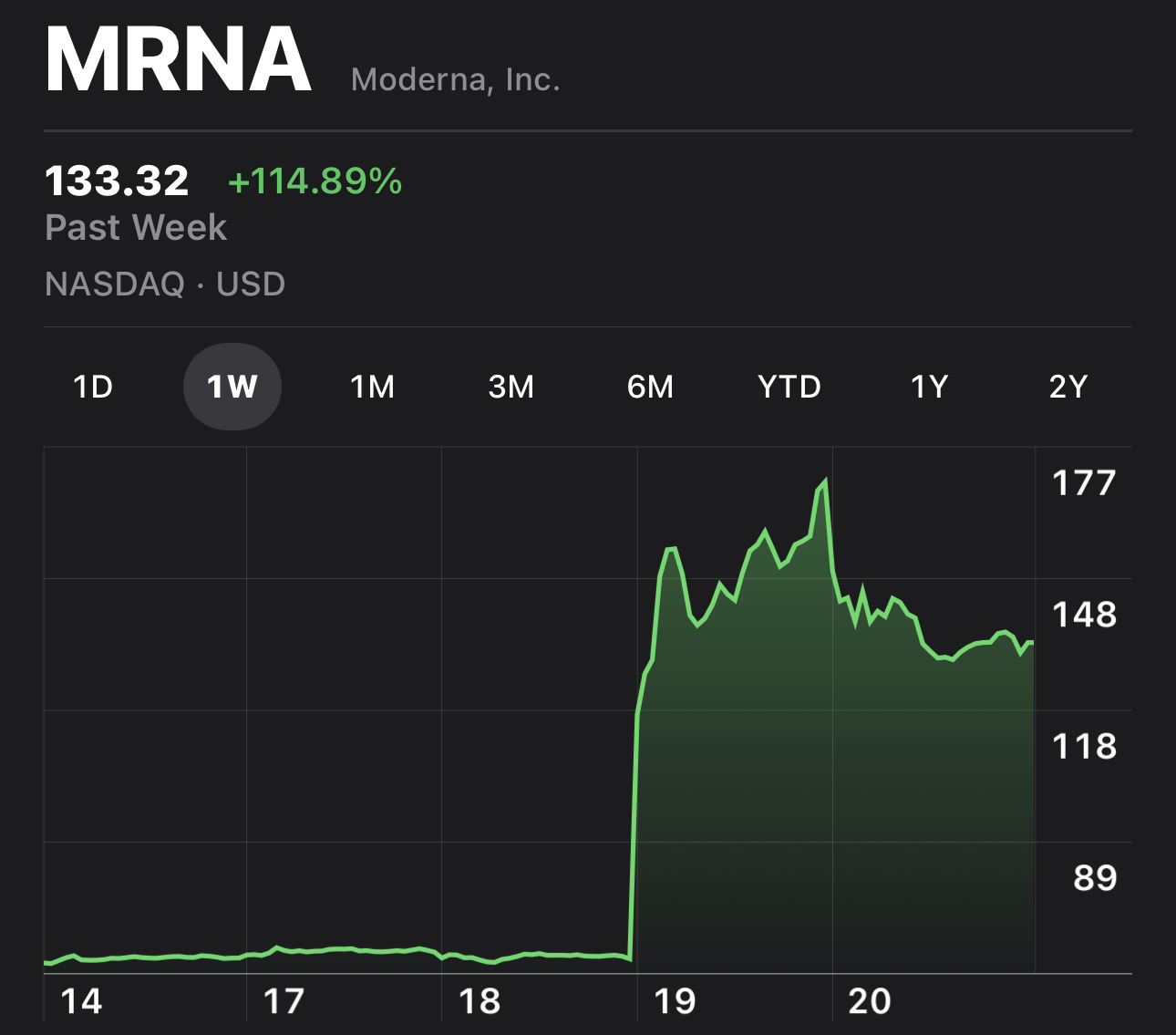
On August 19, Moderna’s stock closed up almost 177 percent, nearly tripling in a single day, and gave back nearly a quarter of its value the next day. Merck, its partner on the drug, rose about 11 percent. BioNTech, which had nothing to do with the announcement, gained roughly a fifth of its value on read-across alone. The trigger was a joint press release saying that a Phase 3 trial of intismeran, given alongside Keytruda, had worked.
Intismeran, until recently called mRNA-4157 or V940, is an individualised mRNA cancer vaccine. It is not a shot to prevent melanoma; it is built for one person out of their own tumour, after the cancer is cut out, to lower the odds it returns.
Most of the outlets got the details right. ABC News was the one I saw overreach, telling readers the treatment “shows promise in extending lifespan”, which goes beyond what the announced result establishes.
I want to slow this down, and I am close to the last person you would expect to.
Where I stand
I am an mRNA enthusiast. I read The Vaccine, Joe Miller’s book written with Uğur Şahin and Özlem Türeci, the scientists who built BioNTech, and have found the mechanism elegant since I understood what it does. When the first COVID shots arrived, a friend of my wife’s called it “zombie juice.” Hearing it cold, that was fair. I thought it one of the better ideas medicine had produced in years.
I have also been called a shill for big pharma. A commenter on r/Biohackers read an investigation I had done of a gray-market retatrutide seller and replied, “You sound like you work for Lily”. So, for the record: I inject an Eli Lilly drug every week and own Lilly stock, which means I profit from a company I think prices its products indefensibly. Whatever is wrong with my judgement here, it is not that I am rooting against these companies. I would genuinely like to be right about mRNA.
What the release actually says
Read the Merck and Moderna release closely and this is the sum total of what it says about whether the drug worked. The trial met its primary endpoint of recurrence-free survival and a key secondary endpoint of distant metastasis-free survival. That is the entire efficacy disclosure. No hazard ratio, no percentage, no confidence interval, no count of how many people in either arm had their cancer come back. Outside the boilerplate there are exactly six numbers in the whole document, and every one belongs to a different, older, much smaller study. No journal has published this. No conference has it on the schedule. Even the most enthusiastic take concedes as much: Bloomberg’s Lisa Jarvis, calling this “the advance we’ve been waiting for,” notes the companies “didn’t include numbers to show the magnitude” of the benefit.
Those six numbers come from KEYNOTE-942, the Phase 2b trial, 157 patients, updated at five years this spring. That is the source of the “49 percent reduction” and the hazard ratio of 0.51 now circulating. They are real, they are encouraging, and they are not the Phase 3 result. I have already watched people staple that 49 percent onto the new trial. One confident commenter went further and announced the trial had been ended early at an interim analysis because the effect was so strong. More than forty people upvoted him. The trial was not ended; the release says plainly that it continues, to measure whether people actually live longer. He guessed confidently into an empty space, and got upvoted for it.
It is a vaccine, but not in the sense most people hear the word. About 1,100 patients with resected stage IIB to IV melanoma were randomised to intismeran plus Keytruda, or Keytruda alone. The companies sequence the removed tumour, pick up to 34 protein fragments unique to its mutations, and encode them on one custom mRNA, one batch for one person. Your own cells display those fragments, a most wanted poster for the immune system, while Keytruda keeps the tumour from switching off the cells that respond. It cannot exist before the cancer does, because it is built from the cancer.
The stock did not move on melanoma, which is a much smaller market than the lung, colon and pancreatic cancers investors are extrapolating toward. It moved on the hope that a vaccine working here will work in those too. The caveat specialists kept raising is that melanoma is unusually favourable terrain: high mutational load, and a better response to immune therapy than almost any solid tumour. A win here says less about the rest of cancer than the market reaction might suggest.
Why I am going to wait
So I am going to wait for the numbers. I would have felt slightly alone holding that on the 19th, except I was not. The Science Media Centre in London published reactions from three practising oncologists the same morning. Marco Gerlinger at the Barts Cancer Institute said the release announced only that the study was positive, with long-term survival almost certainly not known yet. Lennard Lee at Oxford listed what is missing, and it is basically everything: how big the benefit is, who it worked best in, what it did to quality of life, whether anyone lived longer. Yin Wu at King’s College London asked the question a patient would actually ask: if this buys a couple of percentage points and costs a fortune and makes you feel worse, what have you got.
Almost none of the coverage mentioned the next part. The adjuvant drugs used for melanoma today were cleared on delaying the cancer’s return, not on a proven survival benefit: the two big trials that could have shown one, CheckMate 238 for nivolumab and COMBI-AD for the targeted combination, did not reach statistical significance on overall survival. Delaying recurrence is not the same claim as living longer, and everyone in the field knows it. Survival numbers for this trial will not exist until 2029 or 2030. So waiting for the figures is not me being sour.
Why this one is personal
Which is where my interest stops being about a stock. I am fair skinned, pale and quick to burn, with family from Hamburg on the north German coast. In dermatology terms that is Fitzpatrick type I to II. Among readers of a melanoma story, I sit near the middle of the target, not its edge. I am 53, which puts me in the group where this disease is still becoming more common.
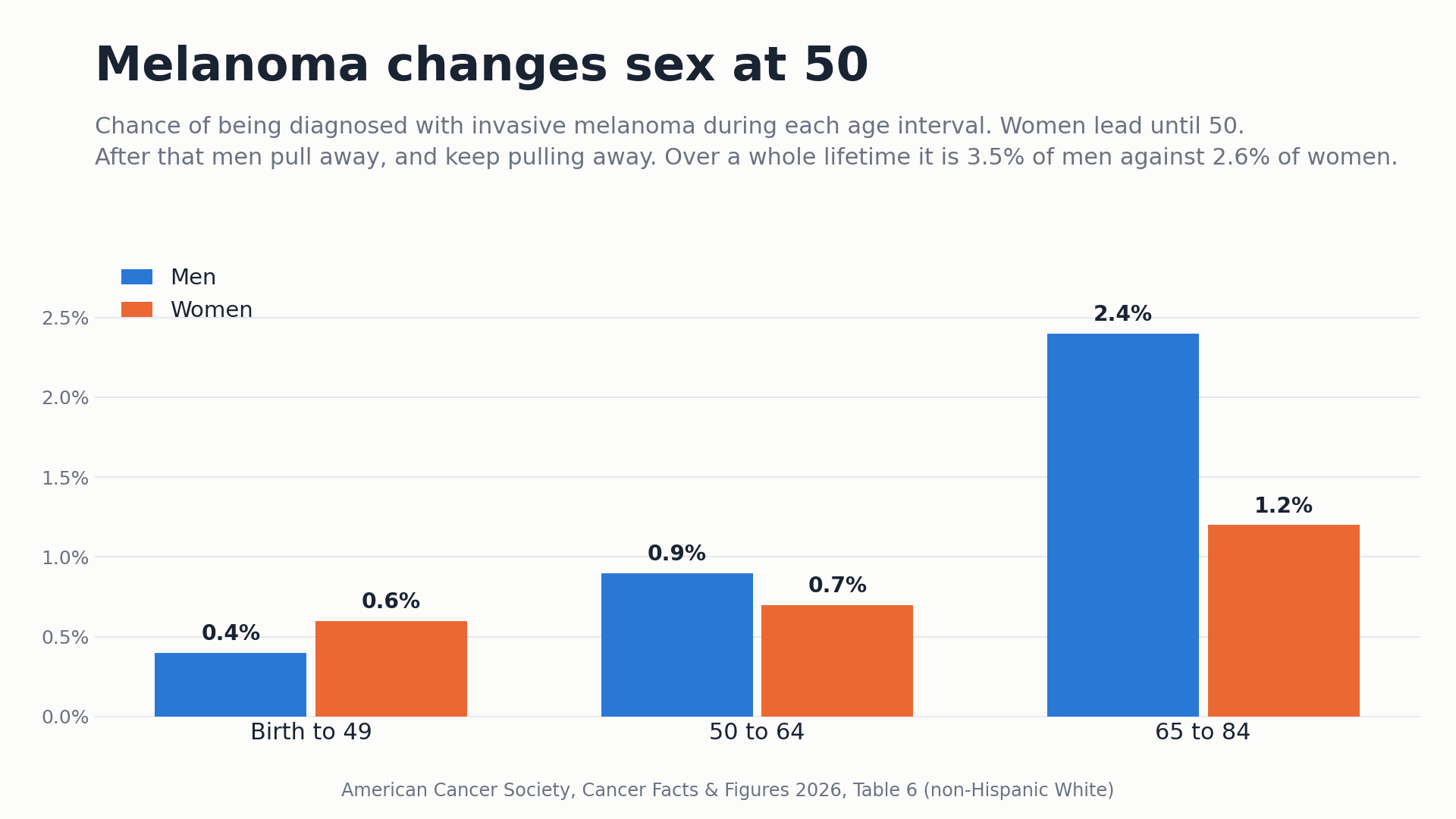
Most men my age do not know that melanoma changes sex around 50. Before 50 it is more common in women; after 50, in men, and the gap widens every decade. The American Cancer Society projects about 65,400 new invasive cases in men this year against 46,600 in women, and roughly 5,500 melanoma deaths against 3,010. About one in 28 white men will be told he has invasive melanoma in his life. Incidence in men over 50 is still climbing even as it falls in younger men.
Men also do worse once they have it, and a large part of the reason is brutally ordinary: we get to a doctor later, with thicker tumours. Afshar and colleagues, in the International Journal of Cancer in 2024, measured how much of the male death gap that accounts for. Thickness at diagnosis explained about 44 percent, and where the tumour sat another 20. That still leaves roughly a third nobody can pin on stage or site or age, so there is probably something biological in there too.
Site is a big part of it. Of the melanomas men get, 41.8 percent are on the trunk, against 14.9 percent of women’s, while women get more of theirs on the legs, where they can see them. Geller and colleagues, in the Archives of Dermatology in 2009, found that back lesions were 46 percent of the melanomas a physician caught but only 16 percent of the ones people caught on themselves. The back and scalp, where much male melanoma sits, are the parts you cannot check in a mirror, so get someone else to look. Balding adds a sunlit blind spot: men with significant crown baldness get scalp melanomas at a higher rate, caught thicker.
The checklist can miss the dangerous kind
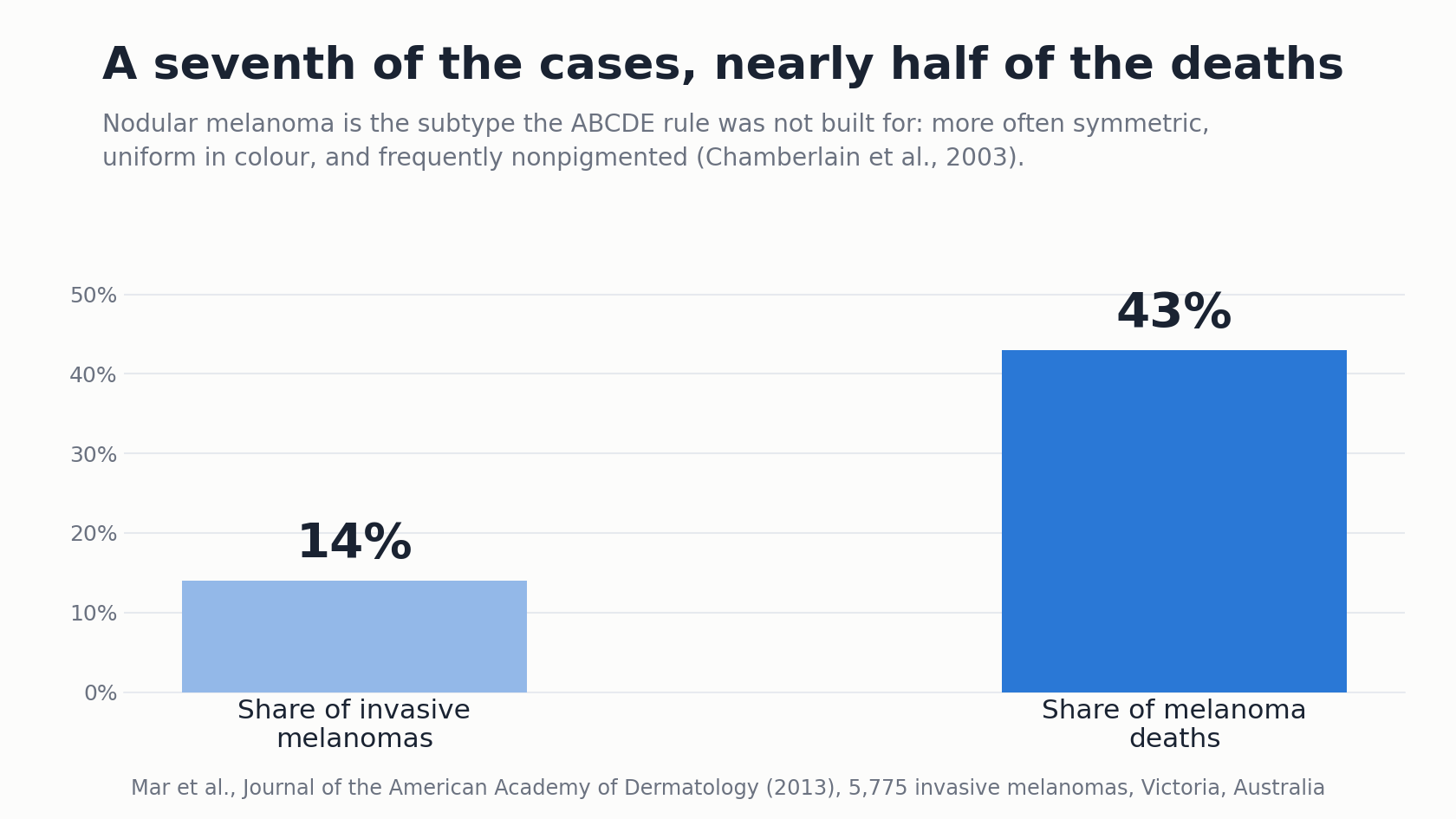
Most of us learned the ABCDE rule: asymmetry, border, colour, diameter, evolving. It was built around the common superficial spreading melanoma, the flat irregular blotch. Nodular melanoma does not follow those rules. Mar and colleagues, in the Journal of the American Academy of Dermatology in 2013, found it was 14 percent of invasive cases but 43 percent of the deaths, and already about 2.6 millimetres thick at diagnosis when the superficial kind averaged 0.6. Chamberlain’s group, in the same journal in 2003, described why: nodular melanomas tend to be symmetric, one even colour, often not pigmented at all. They fail A, B and C, and often the six-millimetre D too, all while being four times thicker than the kind the rule was built for. Some dermatologists teach EFG instead: elevated, firm, growing. A raised, firm bump changing over a few weeks is exactly what ABCDE can miss.
I cannot turn this into a clean instruction, because the screening evidence will not support one. The US Preventive Services Task Force still rates whole-body skin screening by a clinician “I,” for insufficient evidence, and has since 2016. Germany rolled out national screening and watched an early mortality drop drift back. There has never been a completed randomised trial of skin screening with death as the endpoint. I landed in the same place on a colon-cancer blood test and a lung-cancer one: catching something sooner and dying of it less often are two different claims, and the trials that would join them up have mostly not been run.
If you have already had a basal or squamous cell carcinoma, your melanoma risk is roughly double, and that is the most useful everyday flag most men in this bracket have. And the claim that 80 percent of your sun exposure happens before you turn 18 is false, and not by a little: the primary source puts it under 25 percent. What you get at 55 still counts.
When the numbers come
The data are headed to an upcoming international medical meeting, and analysts expect the big European cancer congress in Madrid at the end of October. Whatever number turns up, remember it was measured against Keytruda, not a placebo, which is much harder to beat than the older melanoma figures most of us half remember. Keeping the cancer away longer is worth something by itself, whether or not it ever buys an extra year.
I read the BioNTech founders’ book, I want this technology to win, and I will be reading whatever goes up on that screen with real interest and disclosed biases. My prediction is that the number will land softer than a stock that nearly tripled has priced it to be, and that the men who get the most out of this week will be the ones who never owned the shares.
Get the next one in your inbox
I write one of these a week for men around 50 who want the evidence without the grift.